Scaling
With evaporation, the salts remain in the circuit: their concentration increases and deposits form on the heat exchange surfaces, reducing cooling efficiency.
An evaporative cooling tower cools water by evaporating a small fraction of it. The remaining water becomes enriched with salts and, being warm and oxygenated, provides an environment favourable to corrosion, scaling and bacterial growth: efficient cooling requires continuous monitoring and careful treatment.
Evaporative cooling towers are used in civil buildings (hospitals, large residential buildings, shopping centres) and in industry: food, paper, pharmaceutical, chemical, sugar refineries, steelworks. Water treatment protects them from three main phenomena.
Insight: cooling tower water treatment →With evaporation, the salts remain in the circuit: their concentration increases and deposits form on the heat exchange surfaces, reducing cooling efficiency.
Salt-rich, warm and oxygenated water attacks pipes and heat exchangers: the antiscalant preserves the efficiency of the plant.
Heat and nutrients encourage the growth of algae, bacteria and biofilm; the tower releases aerosol droplets into the air, a vehicle for the spread of Legionella.
Legionella control →In both types, cooling takes place through the evaporation of part of the circulating cooling water. Water treatment systems condition this water chemically, so that the cooling tower operates at maximum efficiency.
The plant water is distributed over the fill, in direct contact with the air, and collected in the basin. The treatment concerns the entire circuit: bleed-off, make-up water, antiscalant and biocides.
The fluid to be cooled flows inside a heat exchange coil and does not come into contact with the air; separate cooling water, which evaporates, is sprayed onto the coil. The treatment concerns the spray water, which is subject to the same phenomena of scaling, corrosion and microbiological growth.
The illustration refers to an open-circuit tower, in which the plant water circulates between the heat exchanger and the tower; the process consists of six stages, from cooling to treatment.
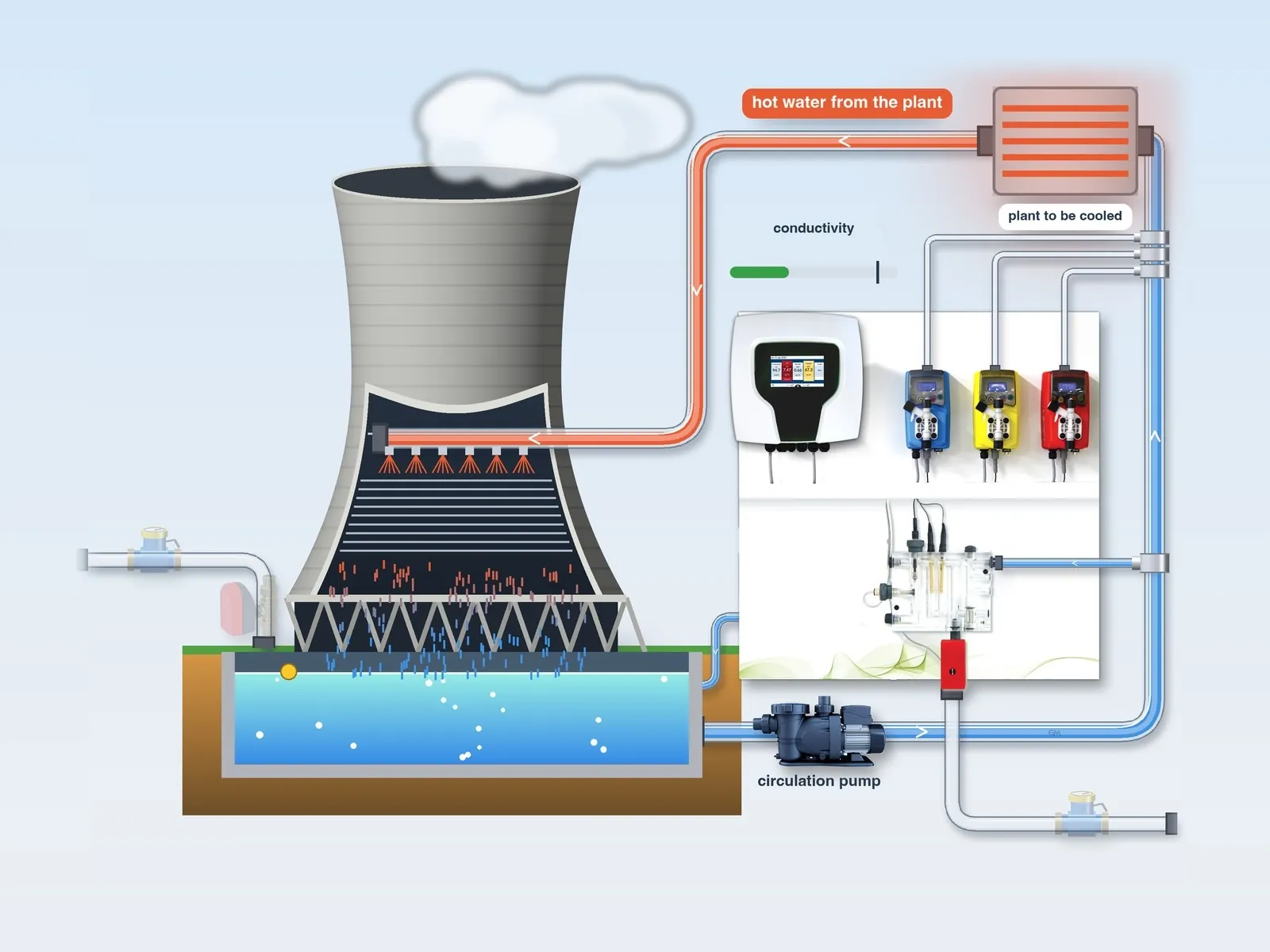
The circulation pump sends the hot water from the plant to the tower: the distributors spray it onto the fill, down which it flows as a thin film.
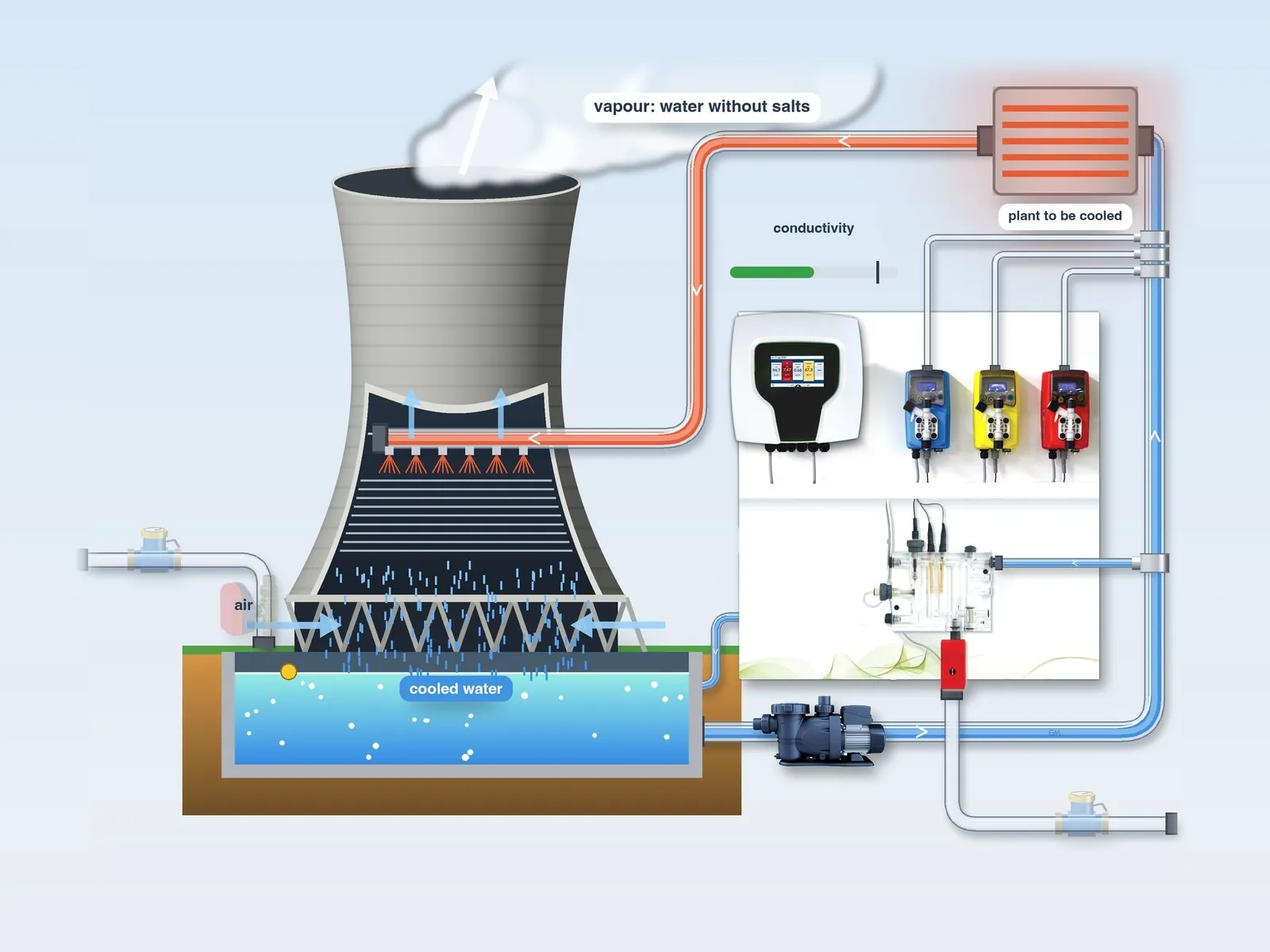
The air enters at the base and rises: the evaporation of a small fraction of the water removes heat from the entire mass, which falls back cooled into the basin and returns to the plant.
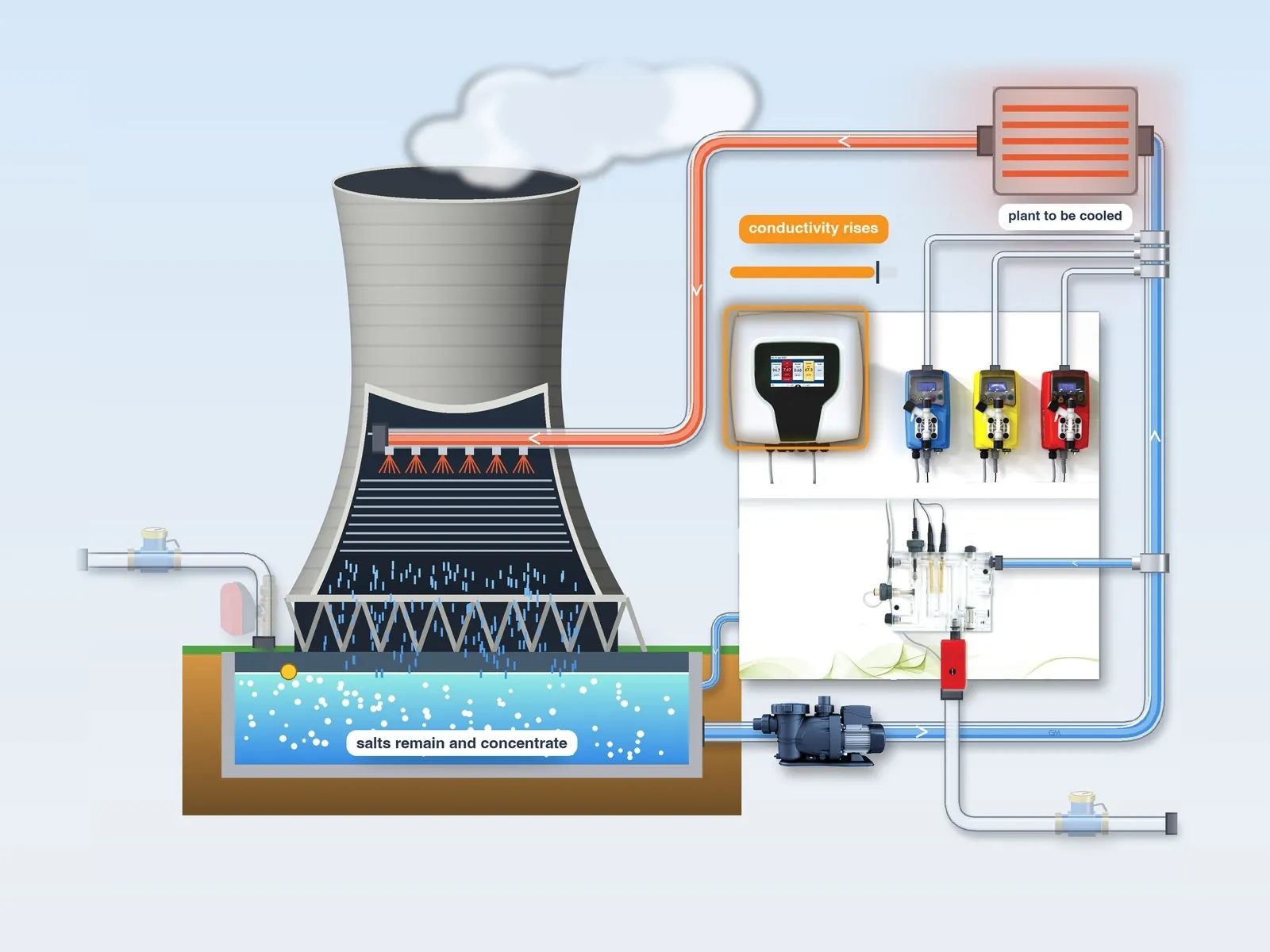
The vapour consists of pure water: the salts remain in the circuit and become concentrated. The ratio between the conductivity of the circuit and that of the make-up water indicates the cycles of concentration.
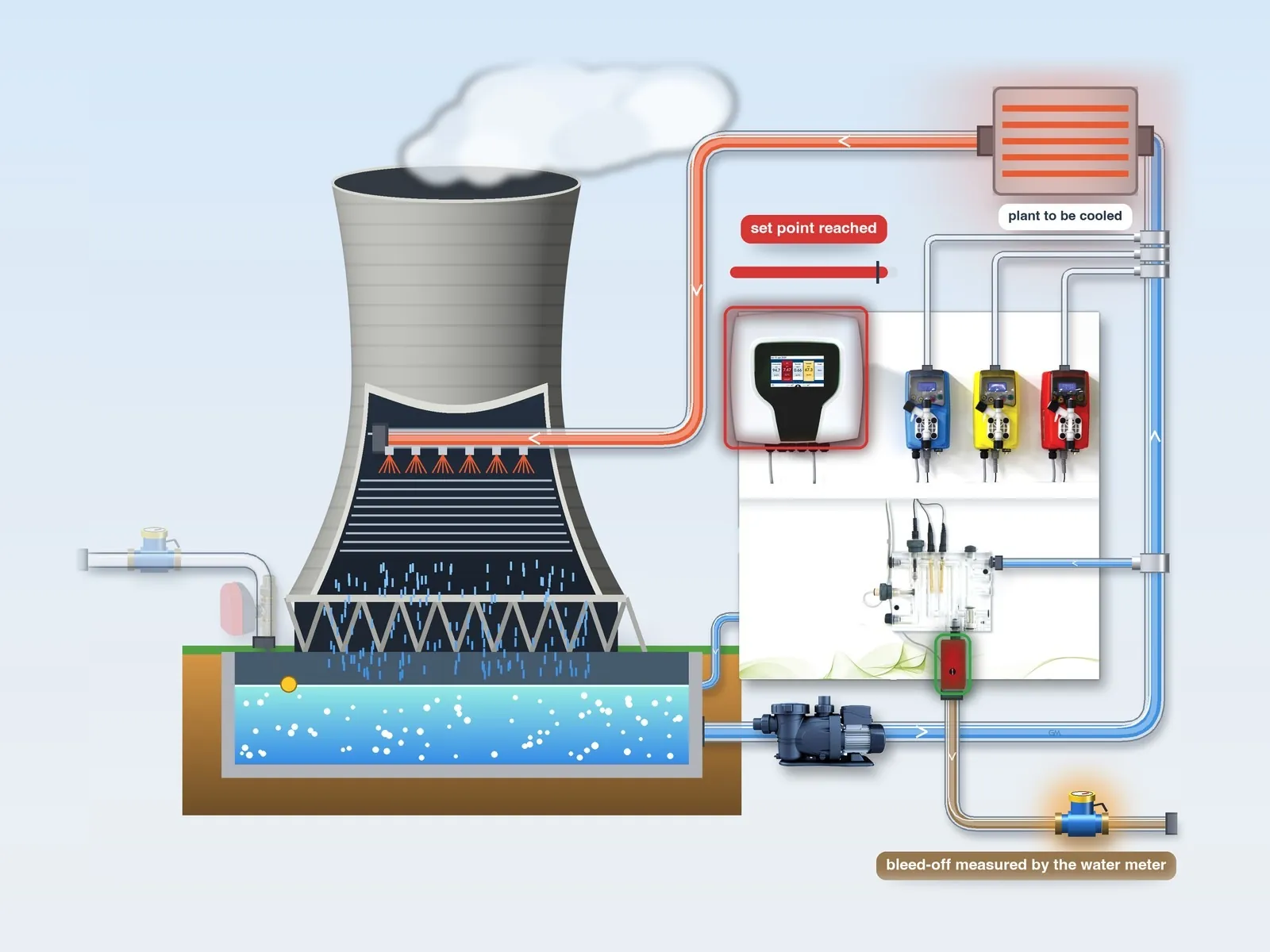
When the conductivity set point is reached, the controller opens the motorised valve and discharges part of the concentrated water (blowdown); the water meter measures the volume discharged.
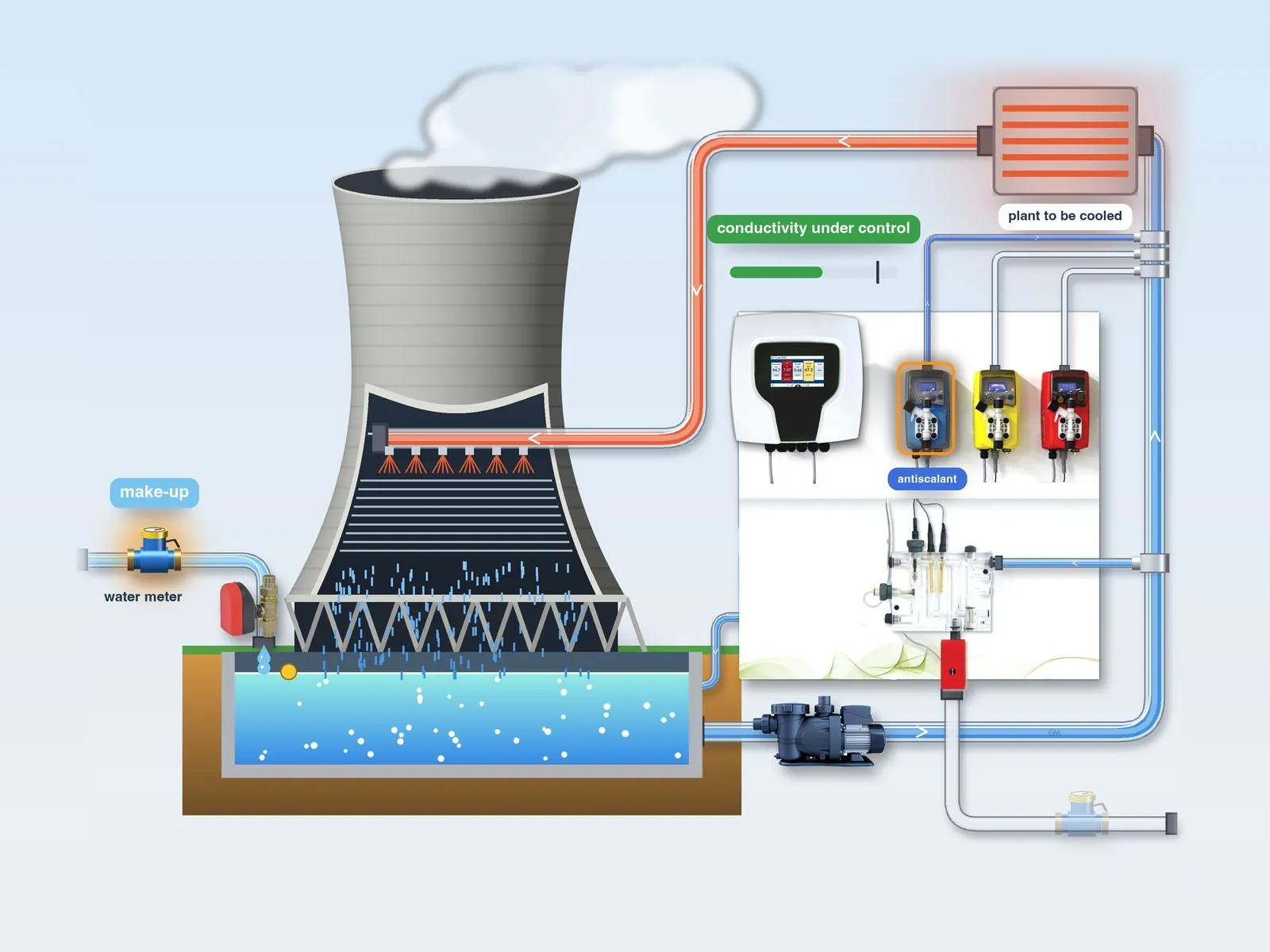
Make-up water replaces the water evaporated and discharged: the float controls the valve and the pulse-output water meter measures the make-up volume. At the same time, the pump doses the antiscalant in proportion to the water fed in.
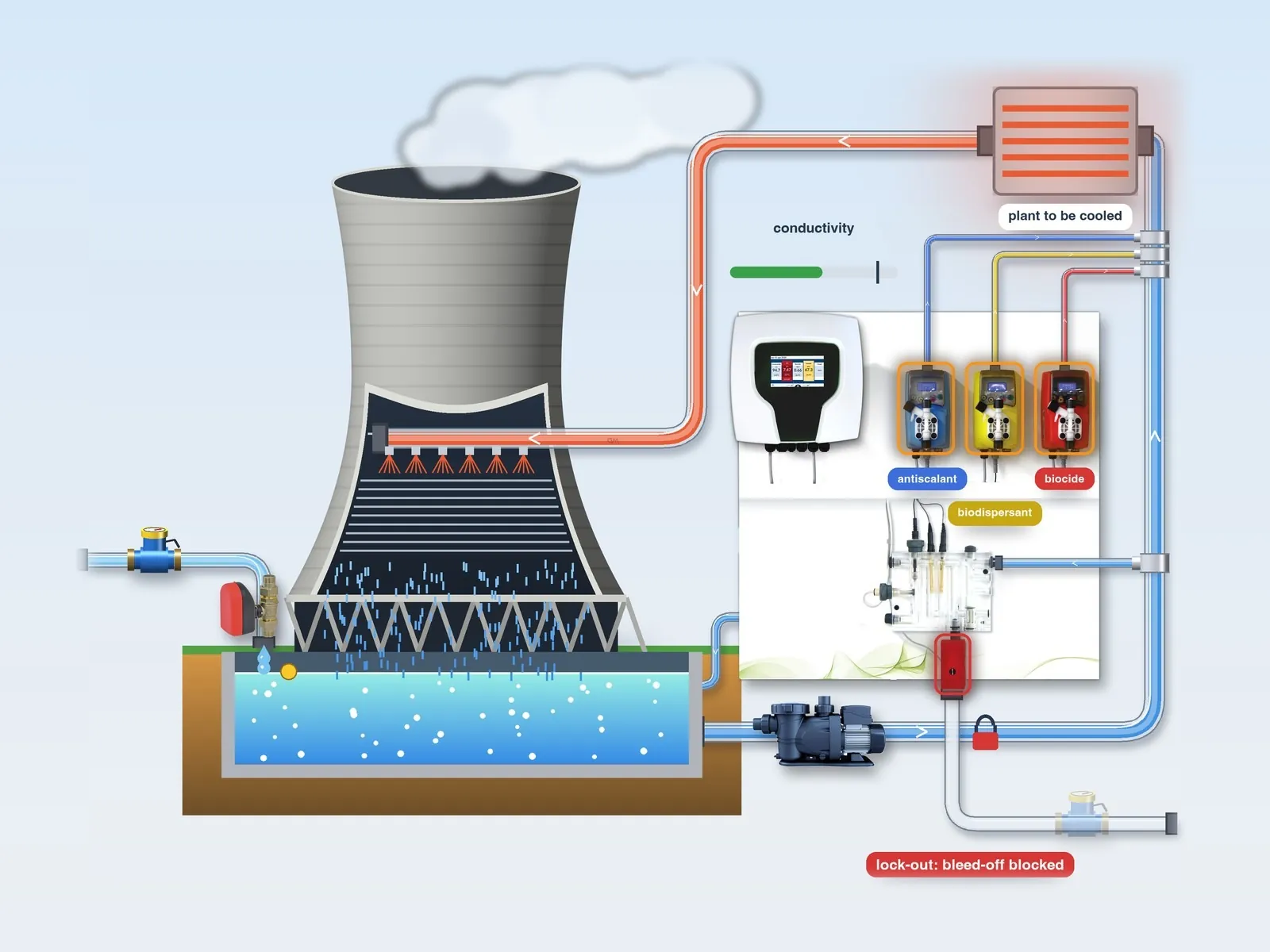
The pumps dose the antiscalant in proportion to the make-up water and, according to the schedule, biodispersant and biocides; after the biocide has been dosed, the discharge remains inhibited (lock-out).
In all systems, the conductivity probe and the injection points are installed on the recirculation circuit, the bleed-off is taken from the probe holder and the make-up water is fed into the basin; what changes is the controller and the number of products dosed.
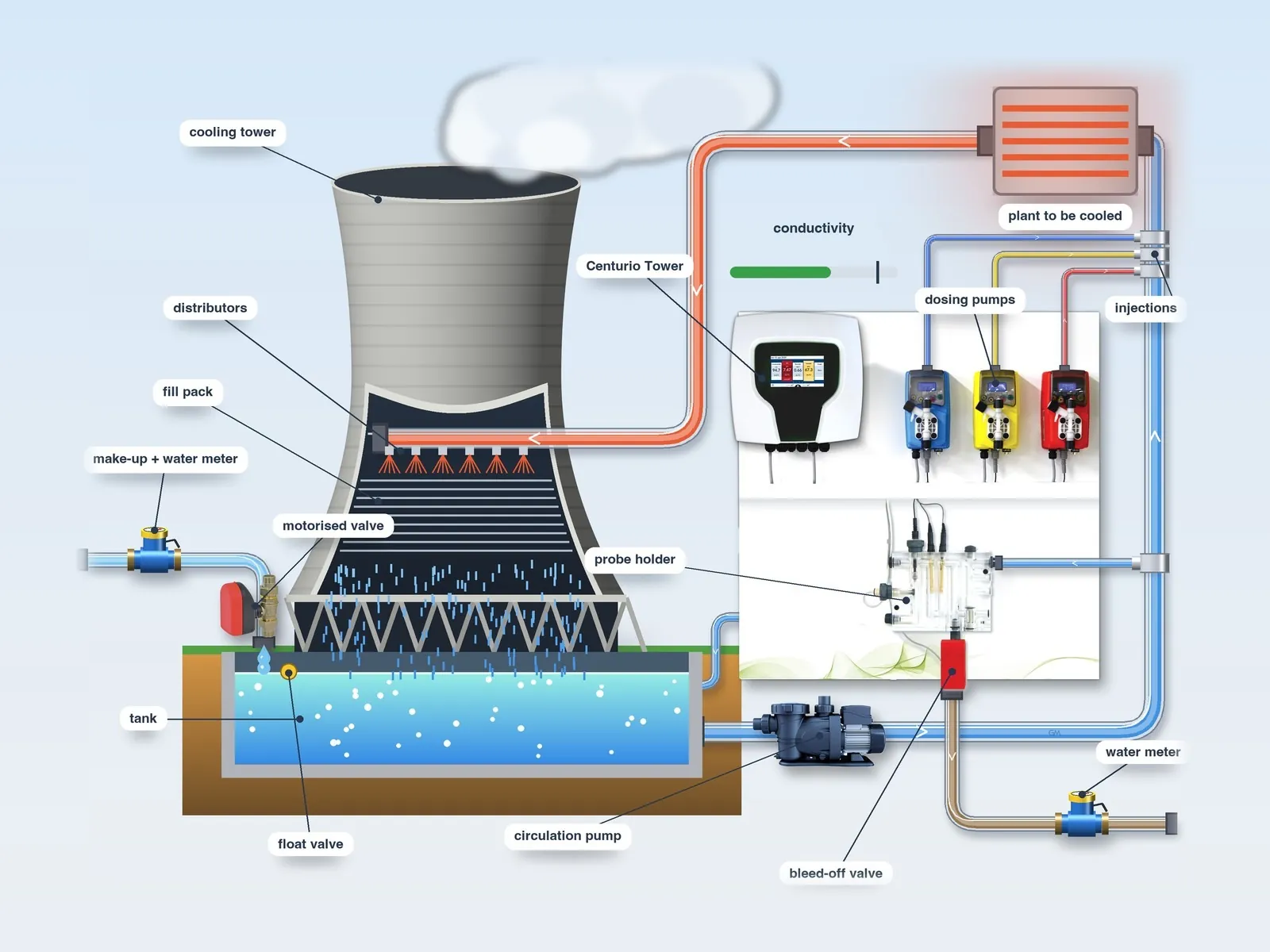
The Centurio Tower adds to the functions of the MTOWER the measurement of tracer, corrosion and turbidity, for the continuous verification of treatment effectiveness.
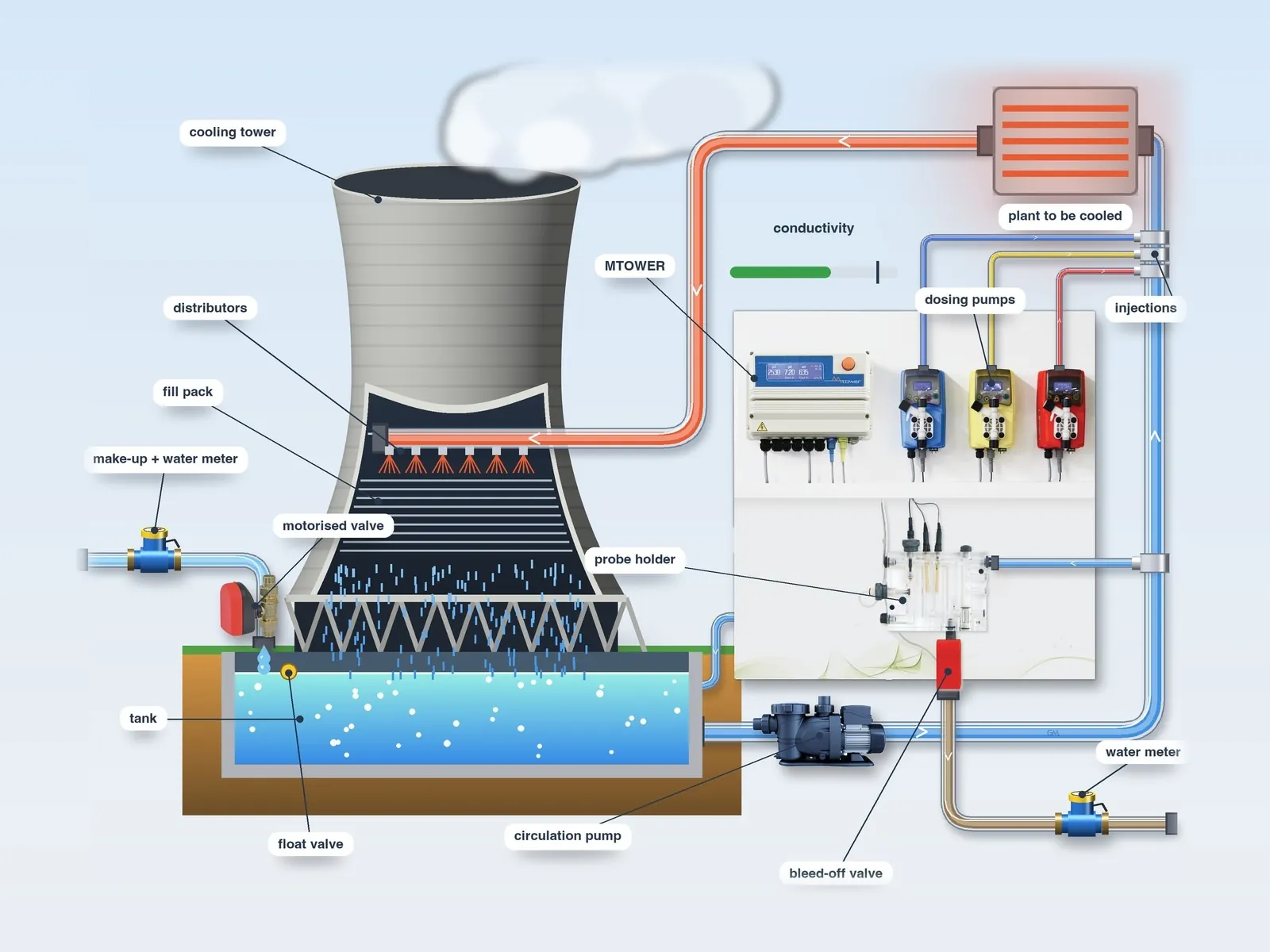
The controller manages bleed-off, antiscalant, two biocides and two activators with external pumps; two water meters measure make-up and discharge.
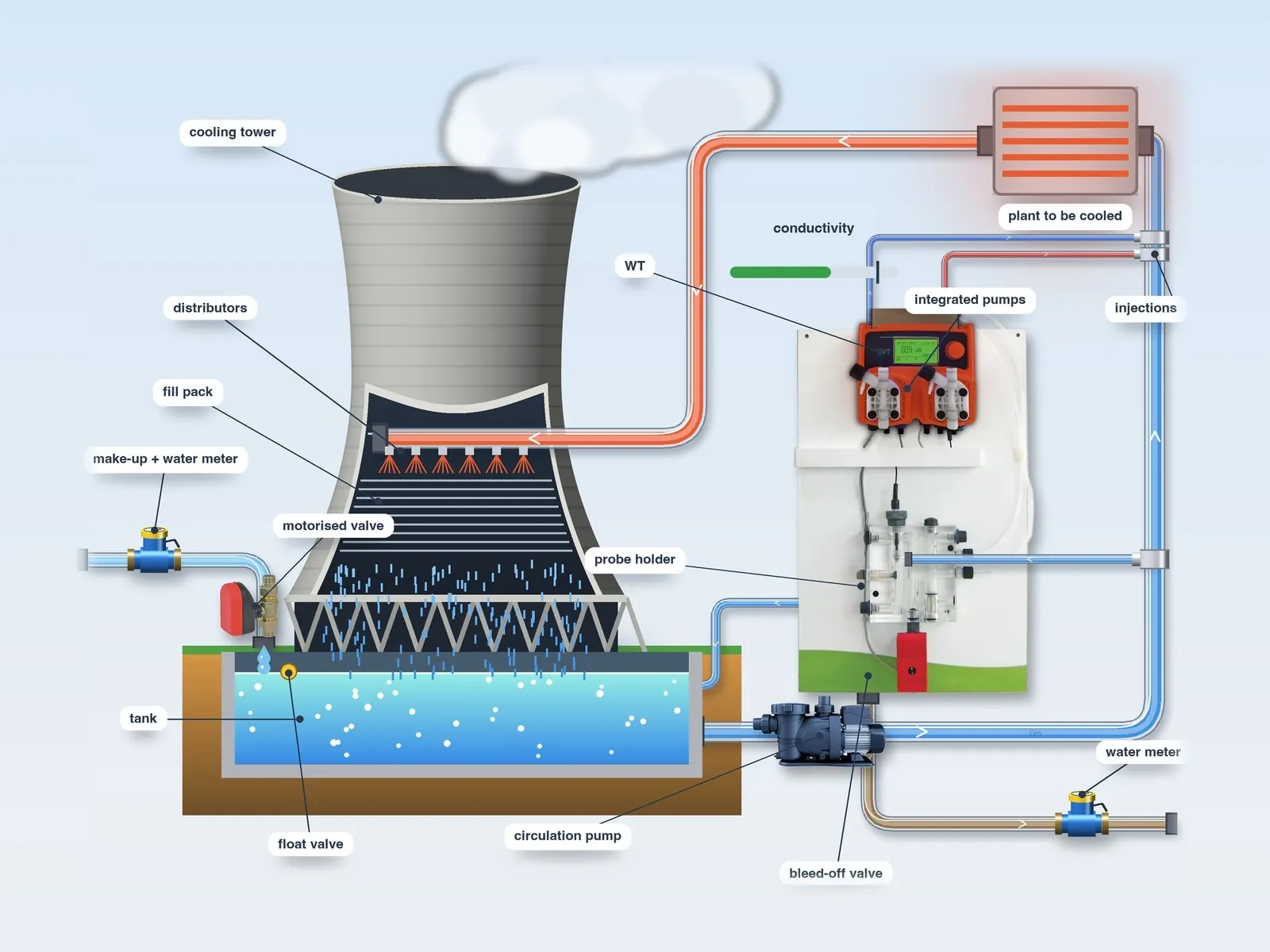
The WT controls the bleed-off and, with its two integrated pumps, doses the antiscalant in proportion to the make-up water and the biocide on a schedule.
The most complete solution: in addition to make-up water, bleed-off, antiscalant and biocides, the Centurio Tower measures tracer, corrosion and turbidity and continuously verifies the effectiveness of the treatment.
Multi-parameter controller with touch screen: channel 1 for conductivity, other channels for pH, Redox, chlorine and biocides, tracer, corrosion, turbidity and mA inputs.
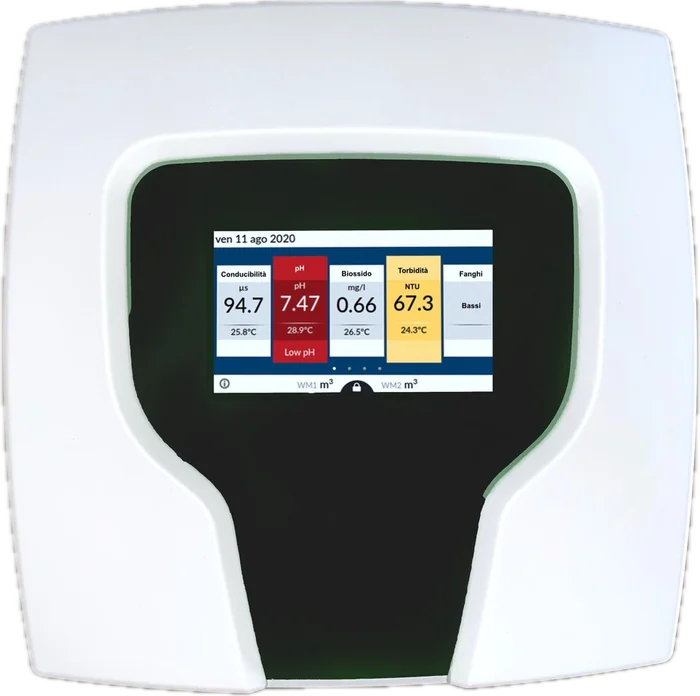
Multi-parameter controller with touch screen: up to 10 parameters, make-up and bleed-off water meters, scheduled or measurement-based biocides.
Centurio Tower →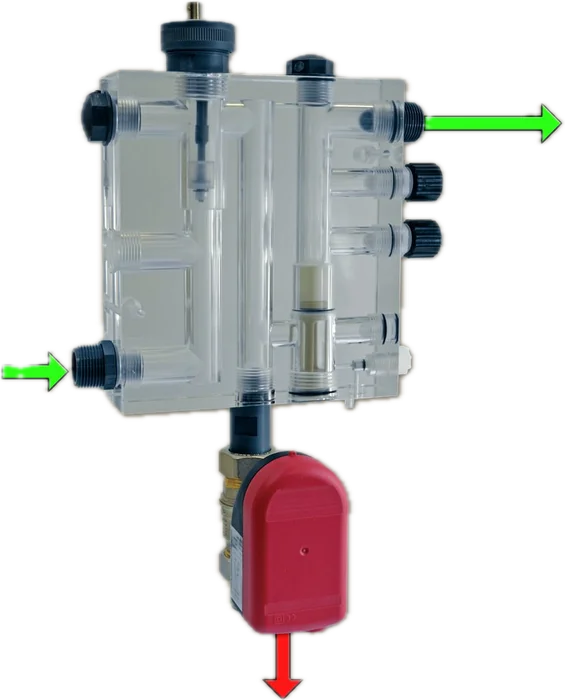
Probe holder for cooling towers: water sampling, chemical injection and bleed-off via a motorised valve.
Manifold →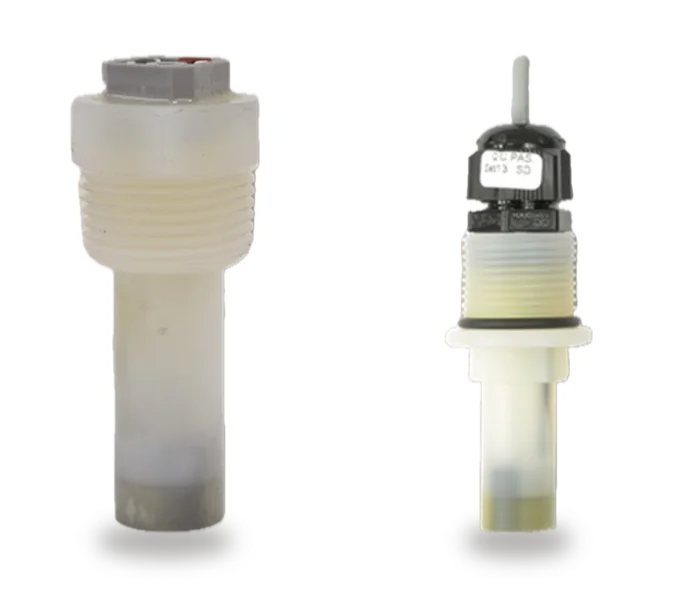
Electrode probes for the conductivity of the tower water, with temperature compensation.
Conductive probes →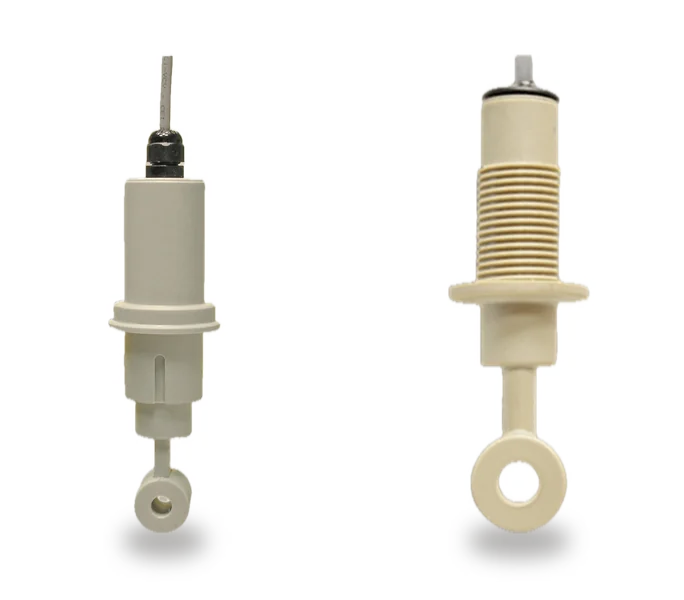
Free from polarisation and largely insensitive to fouling, they also measure in the absence of flow.
Inductive probes →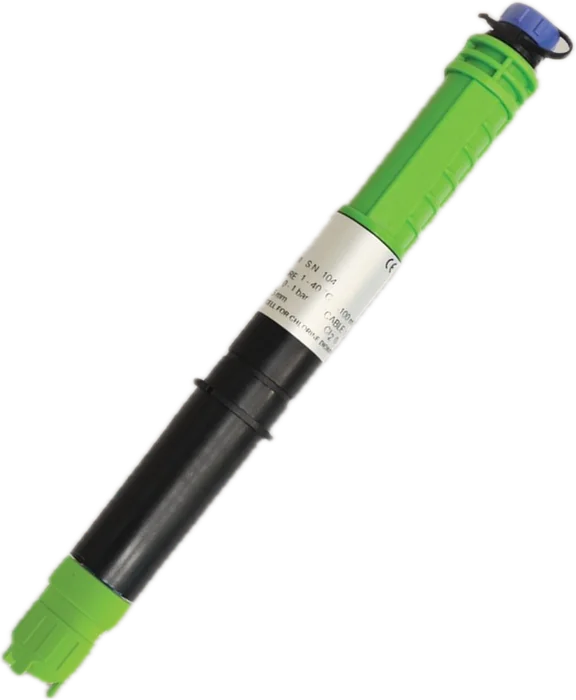
SCL cell with selective membrane: it measures free chlorine, compensating for pH and temperature.
SCL cells →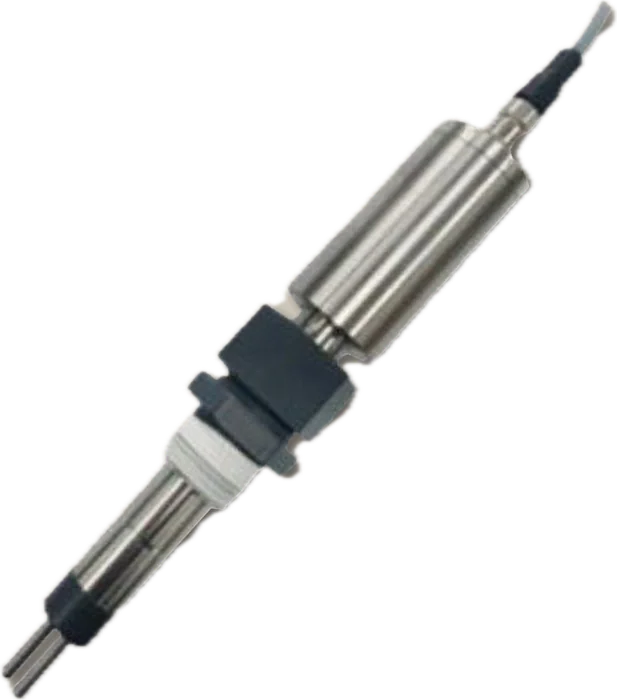
E-CORR: corrosion rate from 0.001 to 10 MPY, managed by the Centurio Tower.
Corrosion →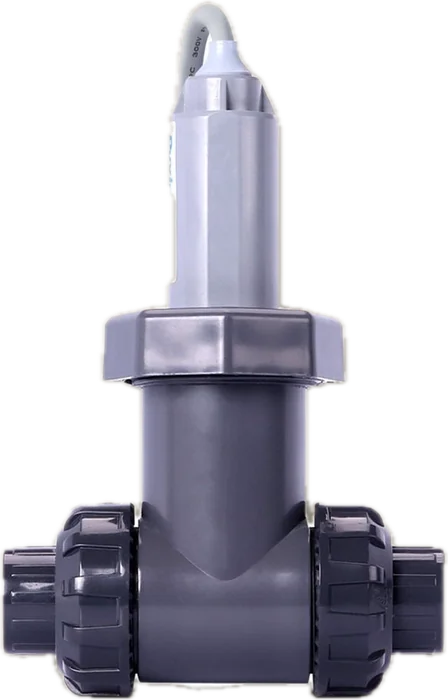
ETRC2 fluorimeter, 0 – 300 ppb: actual concentration of the antiscalant in the water.
Tracers →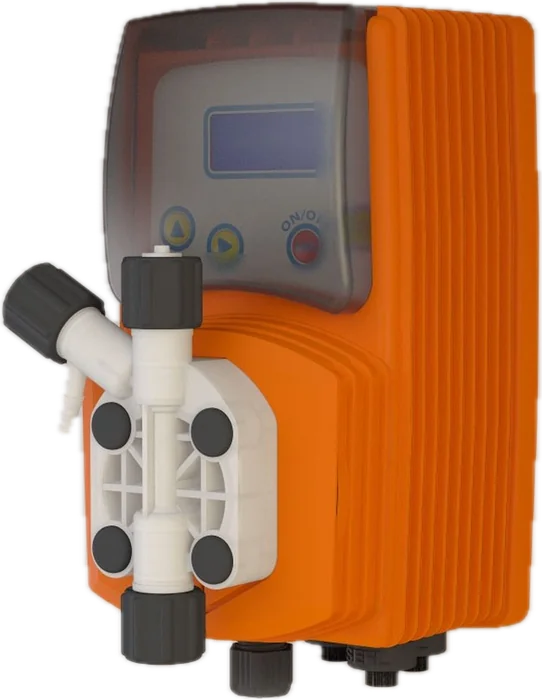
Antiscalant, biodispersant, biocides and activators, controlled by the controller.
Dosing pumps →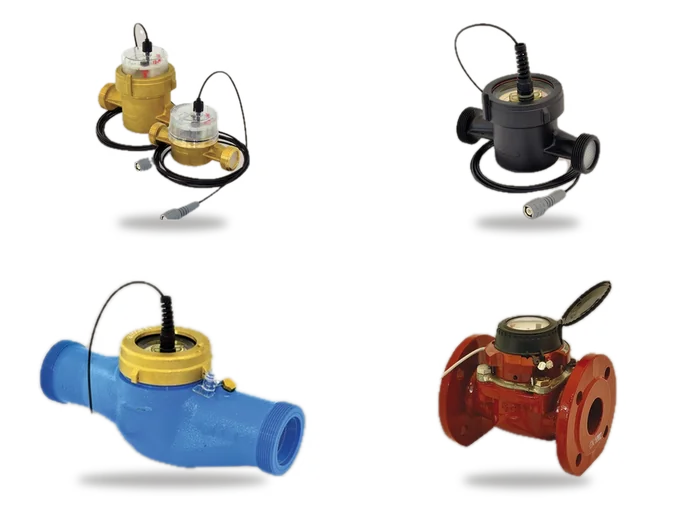
They measure the water fed in and discharged; the make-up water meter controls the antiscalant dosing.
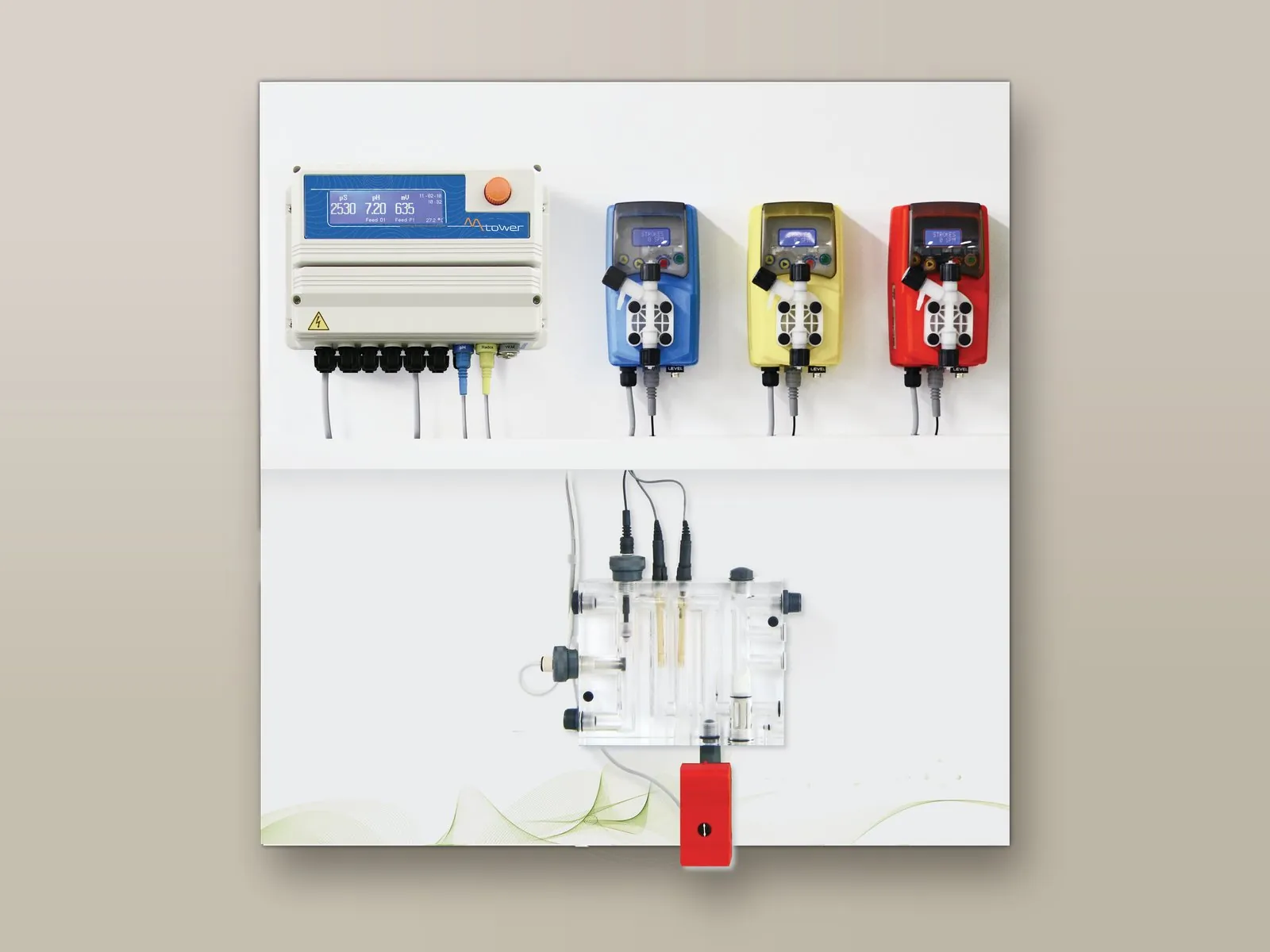
Water meters →The MTOWER controls external pumps and manages two alternating biocides. It is supplied on a panel with the probe holder and the motorised bleed-off valve.
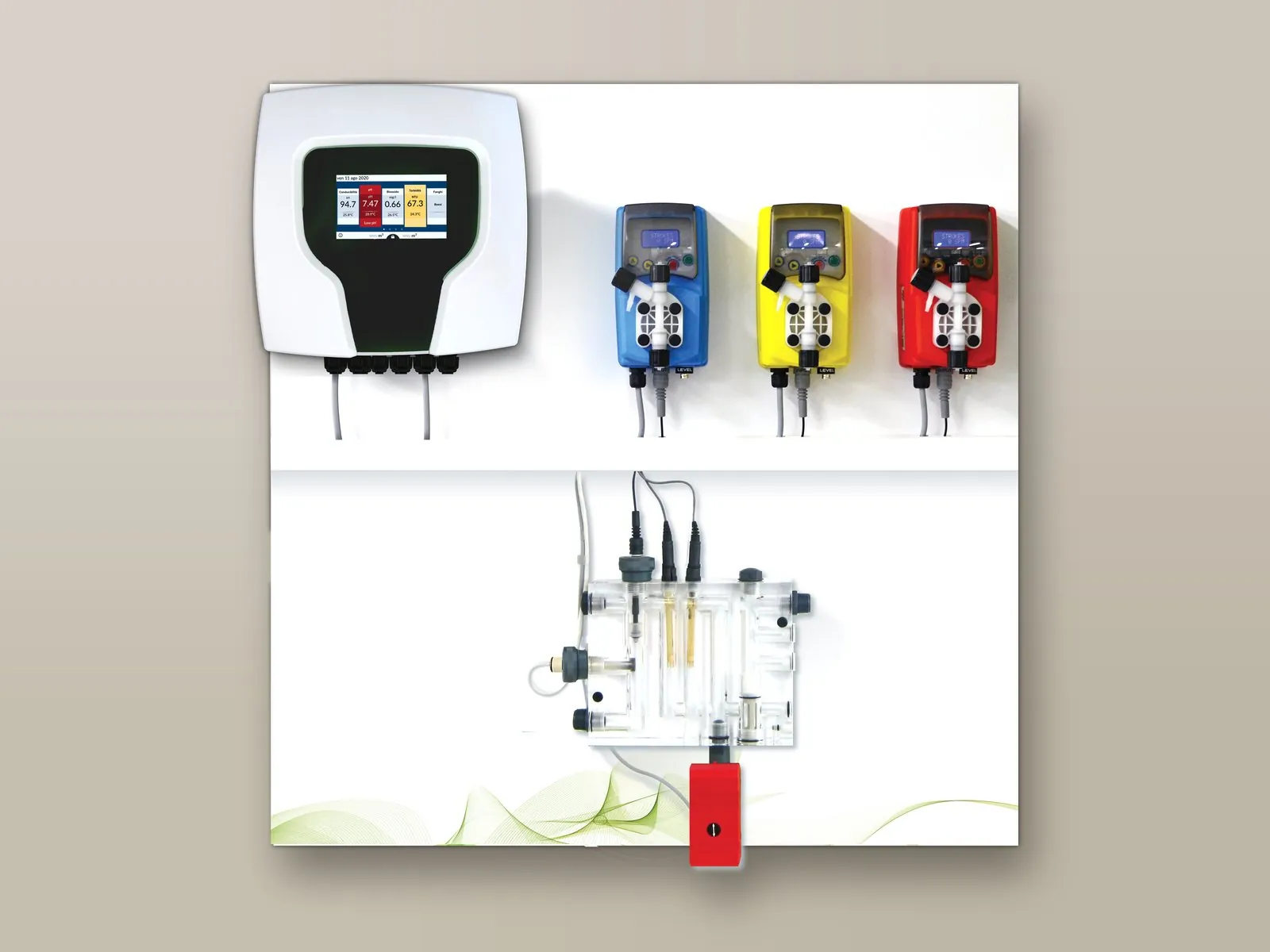
It manages bleed-off, antiscalant, two biocides and two activators. Three models: 1CH (conductivity), 2CH (with pH, Redox or chlorine), PLUS (with pH and chlorine or Redox). Also available on a frame in a cabinet.
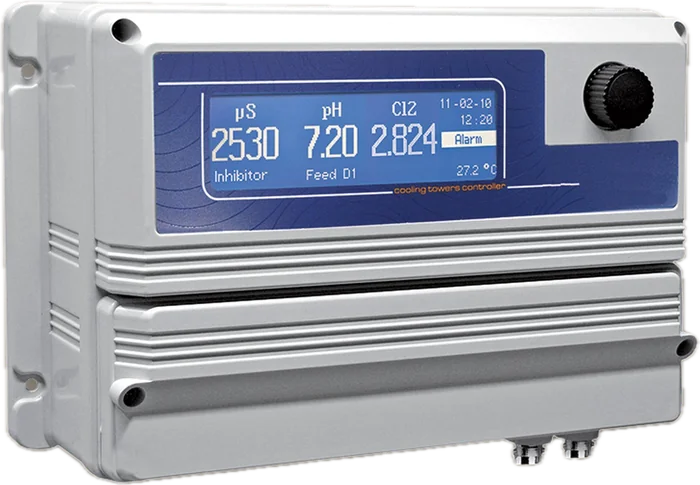
Conductivity (1CH), plus pH, Redox or chlorine (2CH), plus pH and chlorine or Redox (PLUS).
MTOWER controller →Probe holder for cooling towers: water sampling, chemical injection and bleed-off via a motorised valve.
Manifold →Electrode probes for the conductivity of the tower water, with temperature compensation.
Conductive probes →Free from polarisation and largely insensitive to fouling, they also measure in the absence of flow.
Inductive probes →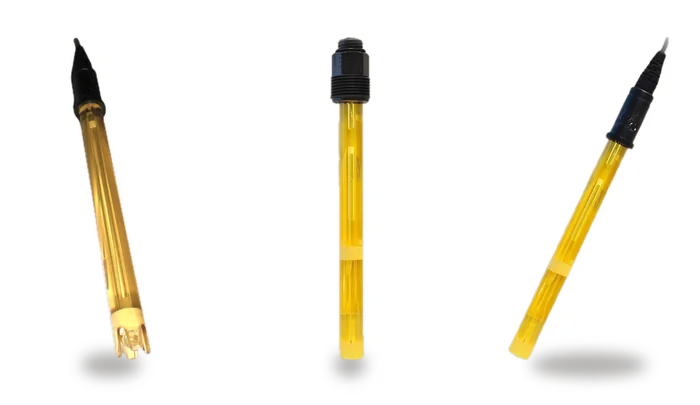
In the 2CH and PLUS models: pH electrode, amperometric cell for the biocide or Redox electrode.
pH electrodes →Antiscalant, biodispersant, biocides and activators, controlled by the controller.
Dosing pumps →They measure the water fed in and discharged; the make-up water meter controls the antiscalant dosing.
Water meters →The WT combines controller and two pumps in a single unit. It is supplied on a panel with the probe holder and the motorised bleed-off valve.
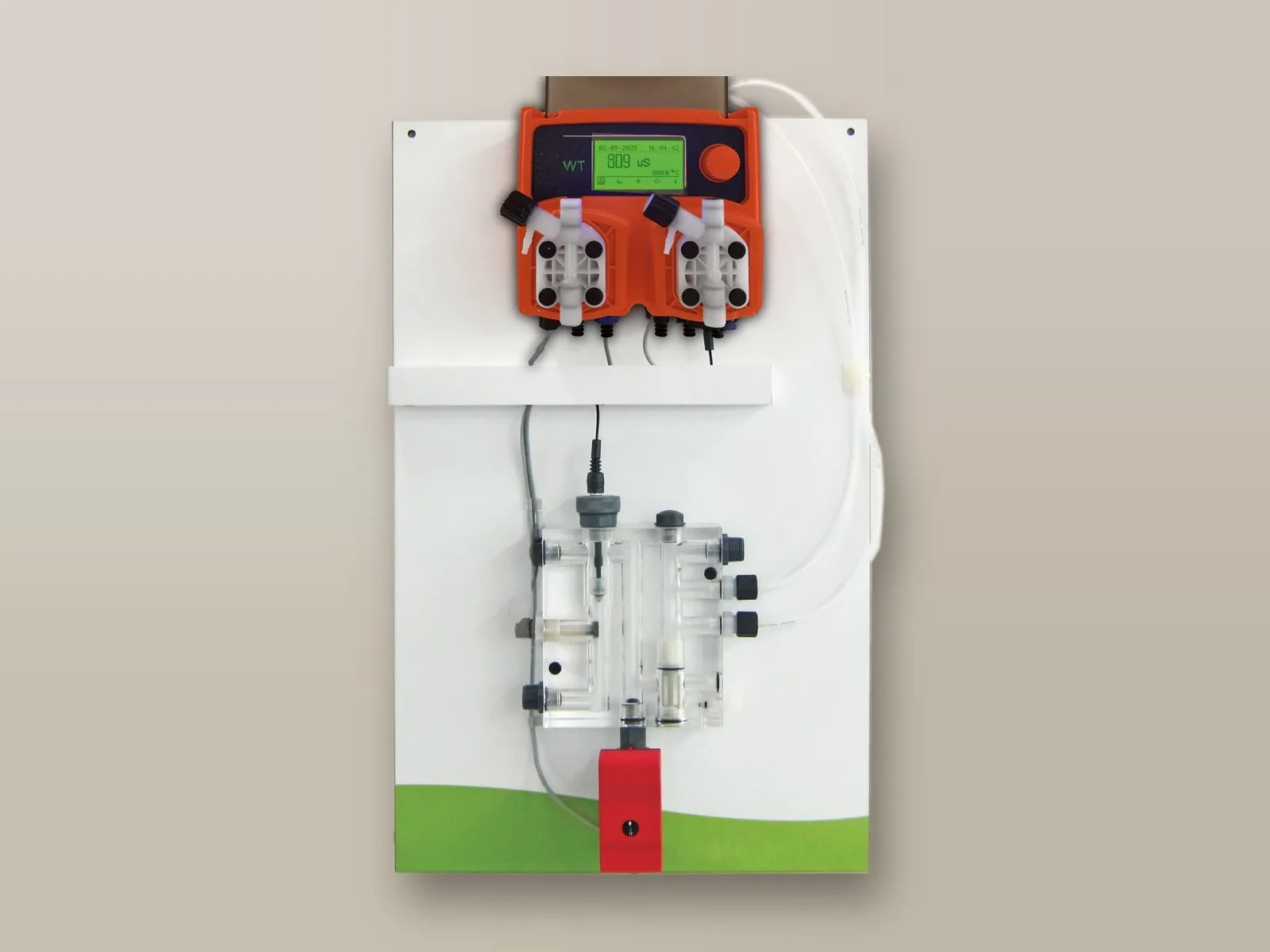
It measures conductivity, controls bleed-off and doses antiscalant and biocide with two integrated pumps, peristaltic or solenoid.
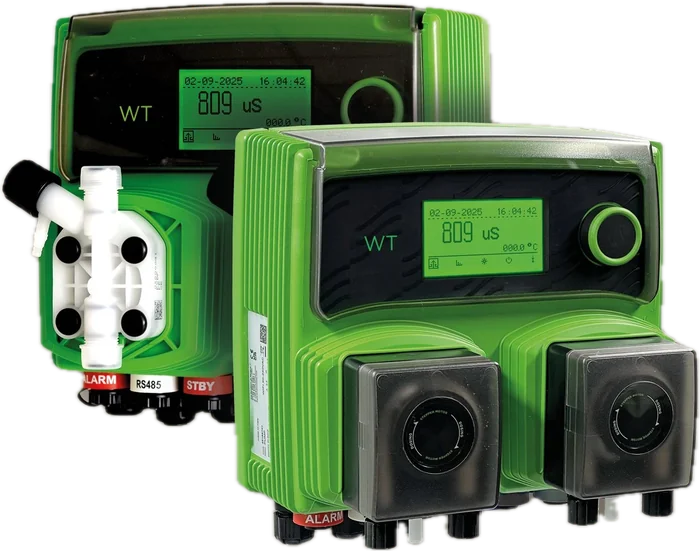
Controller with two integrated pumps, peristaltic or solenoid: it measures conductivity, controls bleed-off and doses antiscalant and biocide.
WT pump →Probe holder for cooling towers: water sampling, chemical injection and bleed-off via a motorised valve.
Manifold →Electrode probes for the conductivity of the tower water, with temperature compensation.
Conductive probes →Free from polarisation and largely insensitive to fouling, they also measure in the absence of flow.
Inductive probes →They measure the water fed in and discharged; the make-up water meter controls the antiscalant dosing.
Water meters →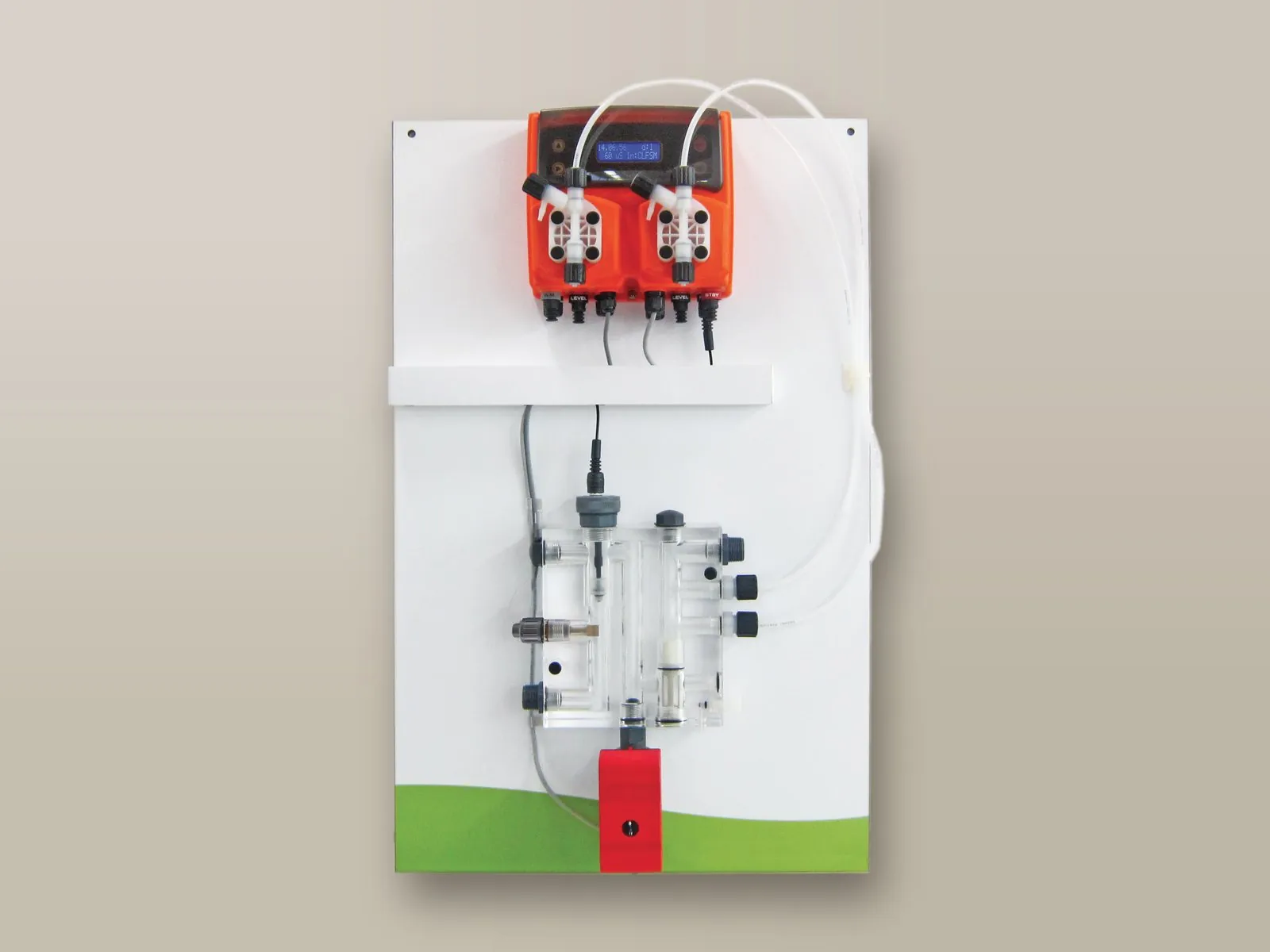
The WTC system has been replaced by the WT, which takes over its functions in a single unit. The WTC offered conductivity with temperature compensation (inductive probe 0.3 – 10 mS), automatic discharge from set point with safety timer, integrated pumps for antiscalant and biocide, antiscalant proportional to make-up water, remote control.
| Function | Centurio Tower | MTOWER PLUS | MTOWER 2CH | MTOWER 1CH | WT |
|---|---|---|---|---|---|
| Functions | |||||
| Conductivity-based bleed-off | ● | ● | ● | ● | ● |
| Metered make-up and bleed-off | ● | ● | ● | ● | – |
| Antiscalant proportional to make-up | ● | ● | ● | ● | ● |
| Two alternating biocides | ● | ● | ● | ● | – |
| Pre-biocides (activators) | ● | ● | ● | ● | – |
| Pre-bleed | ● | ● | ● | ● | ● |
| Drain lock-out | ● | ● | ● | ● | ● |
| pH control | ● | ● | ● | – | – |
| Measurement-based biocide (Redox or chlorine) | ● | ● | ● | – | – |
| Tracer | ● | – | – | – | – |
| Corrosion and turbidity | ● | – | – | – | – |
| Two integrated pumps | – | – | – | – | ● |
| Touch screen, up to 10 parameters | ● | – | – | – | – |
| Scheduled or proportional biocide | – | – | – | – | ● |
| Flow control | ● | ● | ● | ● | ● |
The products to be managed determine the system; for the MTOWER, the measurements in addition to conductivity determine the model.
Answer the questions: the recommended system appears below.
Bleed-off, antiscalant proportional to make-up water and scheduled biocide, with the integrated pumps.
Controller with two integrated pumps, peristaltic or solenoid: it measures conductivity, controls bleed-off and doses antiscalant and biocide.
WT pump →Probe holder for cooling towers: water sampling, chemical injection and bleed-off via a motorised valve.
Manifold →Electrode probes for the conductivity of the tower water, with temperature compensation.
Conductive probes →Free from polarisation and largely insensitive to fouling, they also measure in the absence of flow.
Inductive probes →They measure the water fed in and discharged; the make-up water meter controls the antiscalant dosing.
Water meters →Bleed-off, antiscalant, two alternating biocides and two activators, with measured make-up and discharge.
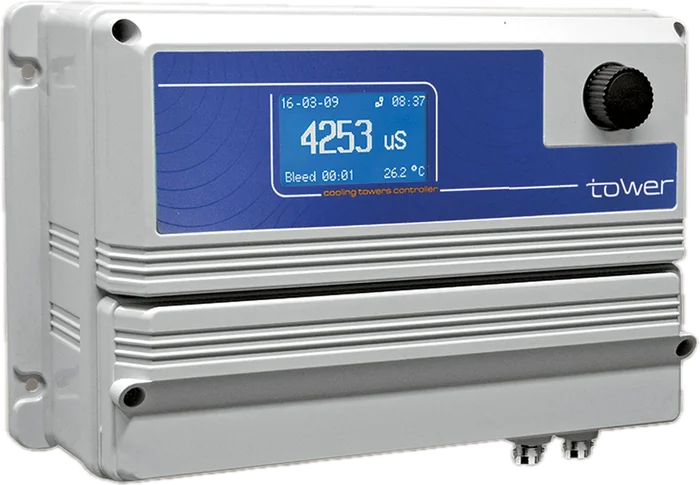
Conductivity and temperature: bleed-off, antiscalant, two biocides and two activators.
MTOWER 1CH →Probe holder for cooling towers: water sampling, chemical injection and bleed-off via a motorised valve.
Manifold →Electrode probes for the conductivity of the tower water, with temperature compensation.
Conductive probes →Free from polarisation and largely insensitive to fouling, they also measure in the absence of flow.
Inductive probes →Antiscalant, biodispersant, biocides and activators, controlled by the controller.
Dosing pumps →They measure the water fed in and discharged; the make-up water meter controls the antiscalant dosing.
Water meters →The functions of the MTOWER 1CH, plus pH control or biocide dosing based on the Redox or chlorine measurement.
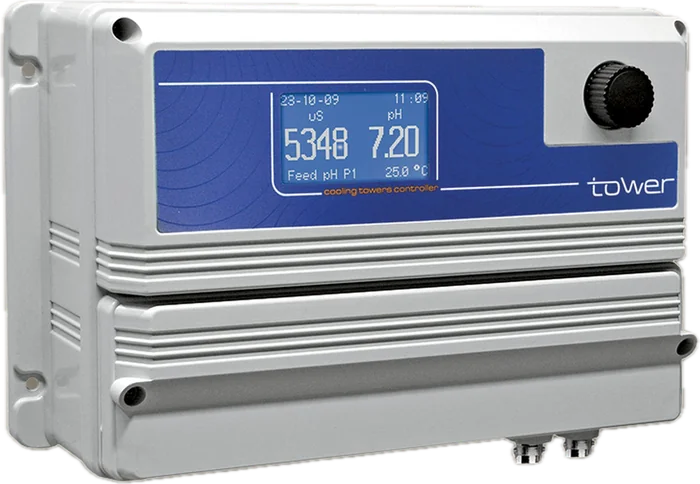
Conductivity plus pH (CD pH), Redox (CD Rh) or chlorine or another biocide (CD CL).
MTOWER 2CH →Probe holder for cooling towers: water sampling, chemical injection and bleed-off via a motorised valve.
Manifold →Electrode probes for the conductivity of the tower water, with temperature compensation.
Conductive probes →Free from polarisation and largely insensitive to fouling, they also measure in the absence of flow.
Inductive probes →Depending on the version: pH electrode, Redox electrode or amperometric cell for the biocide.
pH electrodes →Antiscalant, biodispersant, biocides and activators, controlled by the controller.
Dosing pumps →They measure the water fed in and discharged; the make-up water meter controls the antiscalant dosing.
Water meters →The functions of the MTOWER 1CH, plus pH control and biocide dosing based on the chlorine or Redox measurement.
Conductivity, pH and chlorine (CD pH CL) or conductivity, pH and Redox (CD pH Rh).
MTOWER PLUS →Probe holder for cooling towers: water sampling, chemical injection and bleed-off via a motorised valve.
Manifold →Electrode probes for the conductivity of the tower water, with temperature compensation.
Conductive probes →Free from polarisation and largely insensitive to fouling, they also measure in the absence of flow.
Inductive probes →0 – 14 pH, with temperature compensation.
pH electrodes →Amperometric cell for the oxidising biocide or Redox electrode ±999 mV.
SCL cells →Antiscalant, biodispersant, biocides and activators, controlled by the controller.
Dosing pumps →They measure the water fed in and discharged; the make-up water meter controls the antiscalant dosing.
Water meters →Up to 10 parameters: in addition to bleed-off, antiscalant and biocides, the measurement of tracer, corrosion and turbidity verifies the effectiveness of the treatment.
Multi-parameter controller with touch screen: up to 10 parameters, make-up and bleed-off water meters, scheduled or measurement-based biocides.
Centurio Tower →Probe holder for cooling towers: water sampling, chemical injection and bleed-off via a motorised valve.
Manifold →Electrode probes for the conductivity of the tower water, with temperature compensation.
Conductive probes →Free from polarisation and largely insensitive to fouling, they also measure in the absence of flow.
Inductive probes →SCL cell with selective membrane: it measures free chlorine, compensating for pH and temperature.
SCL cells →E-CORR: corrosion rate from 0.001 to 10 MPY, managed by the Centurio Tower.
Corrosion →ETRC2 fluorimeter, 0 – 300 ppb: actual concentration of the antiscalant in the water.
Tracers →Antiscalant, biodispersant, biocides and activators, controlled by the controller.
Dosing pumps →They measure the water fed in and discharged; the make-up water meter controls the antiscalant dosing.
Water meters →Functions common to cooling tower systems; the number of functions managed varies from model to model (see the comparison).
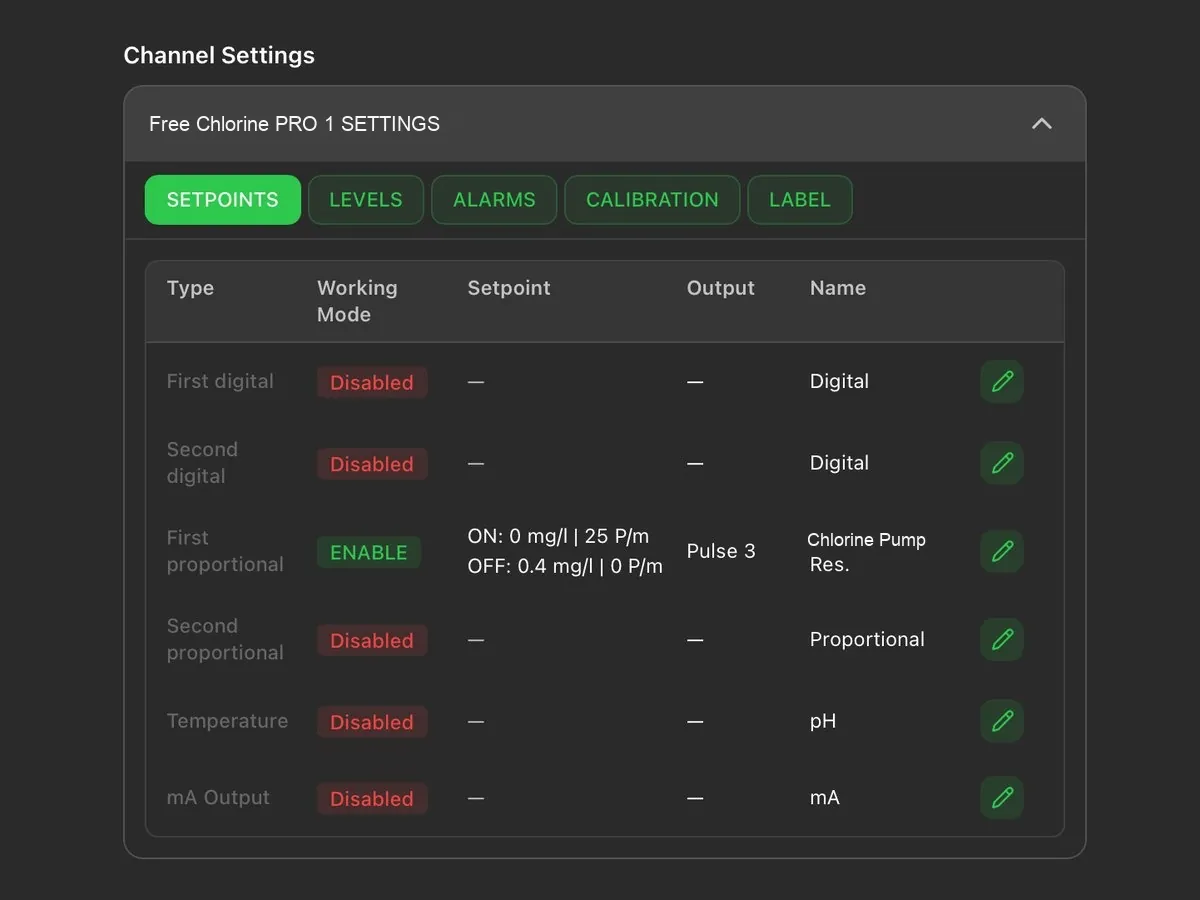
When the set conductivity is reached, the discharge valve opens and remains open for a preset time or until the conductivity returns to a lower value. The set point, the opening delay, the dead band and the timeout can be set, the timeout being the maximum opening time beyond which the discharge closes and the alarm is triggered; bleed-off can also be controlled manually.
A product with antiscalant and corrosion inhibitor action: formulations for cooling towers generally combine the two active ingredients, which counteract the formation of scale and protect the metals, preserving pipes and heat exchange surfaces. It is dosed in proportion to the make-up water, measured by the pulse-output water meter.
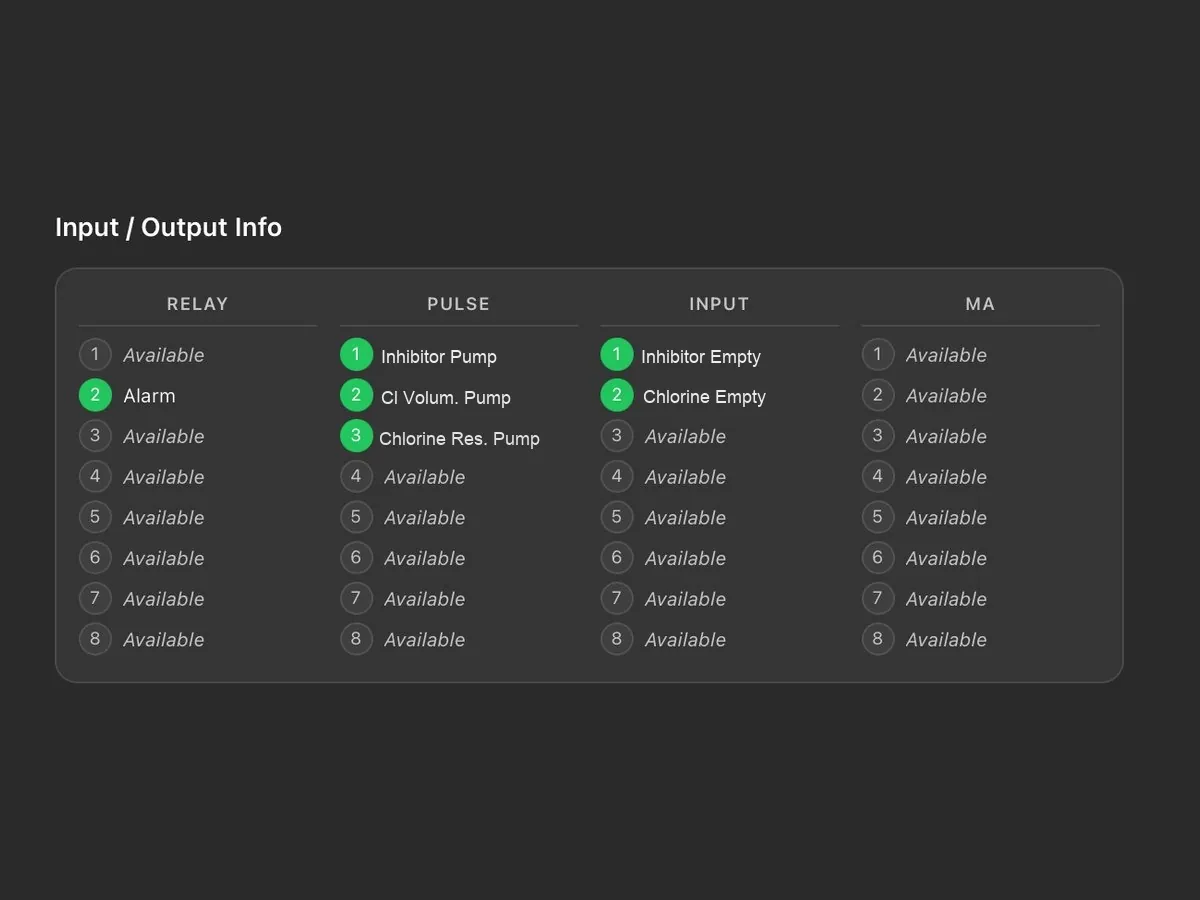
Two pumps dose two different biocides, for example an oxidising and a non-oxidising one, to prevent micro-organisms from adapting to a single product (the risk mainly concerns non-oxidising biocides); two further outputs dose the pre-biocides, generally activators of the subsequent biocide dosing.
With an amperometric cell for free chlorine or chlorine dioxide, or with a Redox probe, the biocide is dosed continuously according to the measurement: an advanced function of MTOWER 2CH, MTOWER PLUS and Centurio Tower.
The biocide cycle follows the sequence pre-bleed, pre-biocide, biocide, lock-out. The pre-bleed discharges water for a set time or down to a set conductivity, with the bleed-off timeout; at the end of the biocide dosing the discharge valve remains blocked for the set time (lock-out), so that the product is not discharged.
A mixture of surfactants that removes biofilm from the heat exchange surfaces, helps the biocides penetrate the deposited organic material and restores heat exchange efficiency.
In pH-controlled towers, pH is measured and acids are dosed; the measurement can be made redundant with a second verification probe.
A pulse-output water meter on the make-up pipe measures and records the volume of water fed into the circuit; a second water meter on the discharge measures the volume discharged.
Water meters →The flow sensor suspends dosing when the circulation pump is stopped, preventing product from accumulating in the probe holder.
No flow, product levels, maximum bleed-off time, faulty probes and out-of-range readings, with alarm output and remote notification.
Modes available on MTOWER and Centurio Tower; the WT doses the antiscalant by water meter, at constant ppm, as a percentage of time or as a percentage of the bleed-off, and the biocide on a weekly or daily programme.
The antiscalant pump runs for the entire time the discharge is open.
At the end of the discharge the pump doses for a percentage of its duration: with 10 minutes of discharge at 50%, 5 minutes of dosing.
The pump runs for a percentage of a cycle time: with a 1-hour cycle at 50% it doses for 30 minutes.
When a preset number of water meter pulses is reached, the pump doses for a set time, for example 30 minutes every 50 pulses.
The litres per pulse of the water meter, the ppm to be maintained, the product concentration and the volume of each injection are set; the controller calculates the dosing.
Each biocide has a dedicated programme, on a 4-week or daily cycle, with pre-bleed, activator, lock-out and optional start of the circulation pump; with a dedicated probe the biocide can also be dosed according to the measurement.
New water fed into the circuit to compensate for evaporation, bleed-off and drift.
Ratio between the conductivity of the circuit and that of the make-up water: it indicates how many times the salts are concentrated.
The discharge opens above the set point and closes only when the conductivity falls below the set point minus the dead band.
The delay prevents openings caused by momentary disturbances; the timeout closes the discharge and raises the alarm if it remains open for too long.
Discharge carried out before the biocide, for a set time or down to a lower conductivity, because the discharge remains blocked during dosing and lock-out.
Timed blocking of the discharge after the biocide has been dosed, so that it remains in the circuit for the necessary contact time.
The pre-biocide is dosed before the biocide and is generally an activator of its dosing; the biodispersant breaks up the biofilm and exposes it to the action of the biocides.
The tracer, measured in ppb, indicates the concentration of the antiscalant; MPY express the corrosion rate (1 MPY = 0.0254 mm/year).
| WT | MTOWER 1CH | MTOWER 2CH | MTOWER PLUS | Centurio Tower | |
|---|---|---|---|---|---|
| Parameters | Conductivity | Conductivity | Conductivity + pH, Redox or chlorine | Conductivity + pH + chlorine or Redox | Up to 10 |
| Conductive conductivity | 0 – 10 mS (ECDCCPT) | 0 – 300 µS … 0 – 300 mS | 0 – 300 µS … 0 – 300 mS | 0 – 300 µS … 0 – 300 mS | 0.1 µS … 1 S depending on the cell constant |
| Inductive conductivity | 0 – 3 or 0 – 30 mS (ECDINDPT), 0 – 10 mS (ECDSINDPT) | 0 – 3, 30 or 300 mS | 0 – 3, 30 or 300 mS | 0 – 3, 30 or 300 mS | 0.1 – 3 … 0.3 – 300 mS |
| pH | – | – | 0 – 14 | 0 – 14 | 0 – 14 |
| Redox | – | – | ±999 mV | ±999 mV | ±999 mV |
| Chlorine and other biocides | – | – | Depending on the cell | Depending on the cell | Depending on the cell |
| Tracer | – | – | – | – | 0 – 300 ppb |
| Corrosion and turbidity | – | – | – | – | 0.001 – 10 MPY; up to 4,000 NTU |
| Inputs | 2 levels, water meter, flow, stand-by | 5 levels, 2 water meters, flow, temperature, stand-by | 6 levels, 2 water meters, flow, temperature, stand-by | 6 levels, 2 water meters, flow, temperature, stand-by | 8 levels, 2 water meters, flow, RS485 probe, 6 channels |
| Outputs | 2 integrated pumps, bleed-off, alarm, Modbus RTU | 2 proportional (inhibitor and biodispersant); mA output on request | 2 proportional in the CD pH version (inhibitor and pH); mA output on request | 3 proportional (inhibitor, pH and chlorine or Redox); mA output on request | 8 proportional, 6 ON/OFF, 2 volt-free contact, 6 current, alarm |
| Alarms | Flow, levels, bleed-off safety timer | Flow, 2 levels, bleed-off timeout | Flow, 2 levels, bleed-off timeout | Flow, 3 levels, bleed-off timeout | Probes, levels, dosing, bleed-off, flow, out of range |
All controllers compensate measurements for temperature. MTOWER: optional communication, one chosen from USB, Ethernet, 4G, Wi-Fi and Modbus, and optional 4/20 mA output; Centurio Tower: Ethernet, Wi-Fi, Modbus RTU, Modbus TCP/IP and current outputs as standard, 4G on request, data on USB. WT: Bluetooth, Wi-Fi and Modbus; pump flow rates on the pump page. Probes are ordered separately.
Controller, probes, pumps, bleed-off valve and water meters are supplied mounted and wired, ready for connection: management is centralised in a single point and operators do not come into contact with the chemicals.
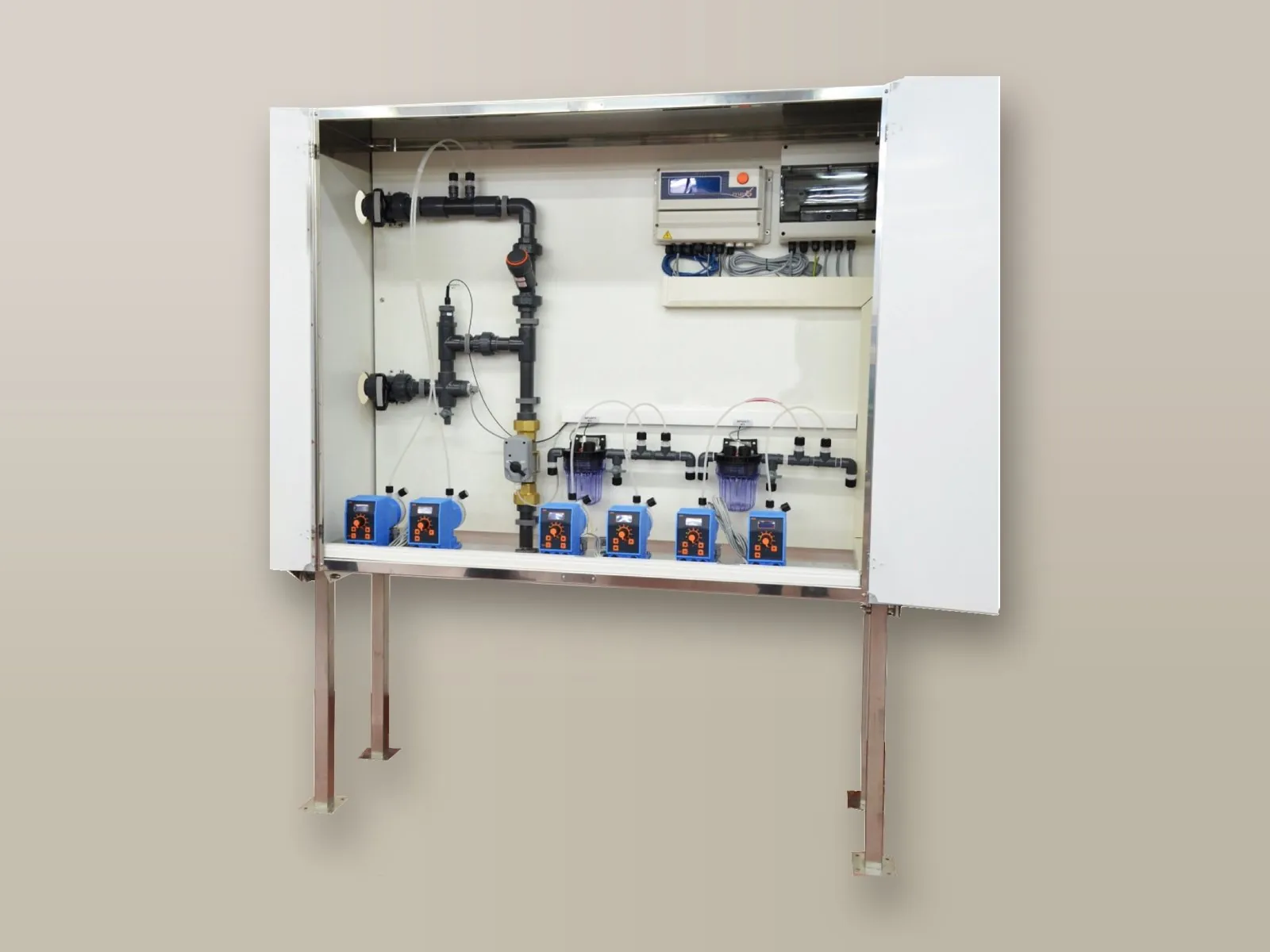
Panel-mounted MTOWER (or Centurio Tower) for bleed-off valve management, measurement and dosing, with measurement of make-up water and bleed-off; also with 2 dosing pumps, manifold and 1" bleed-off valve. Conductivity, pH, Redox or pH and Redox versions, with conductive or inductive probe.
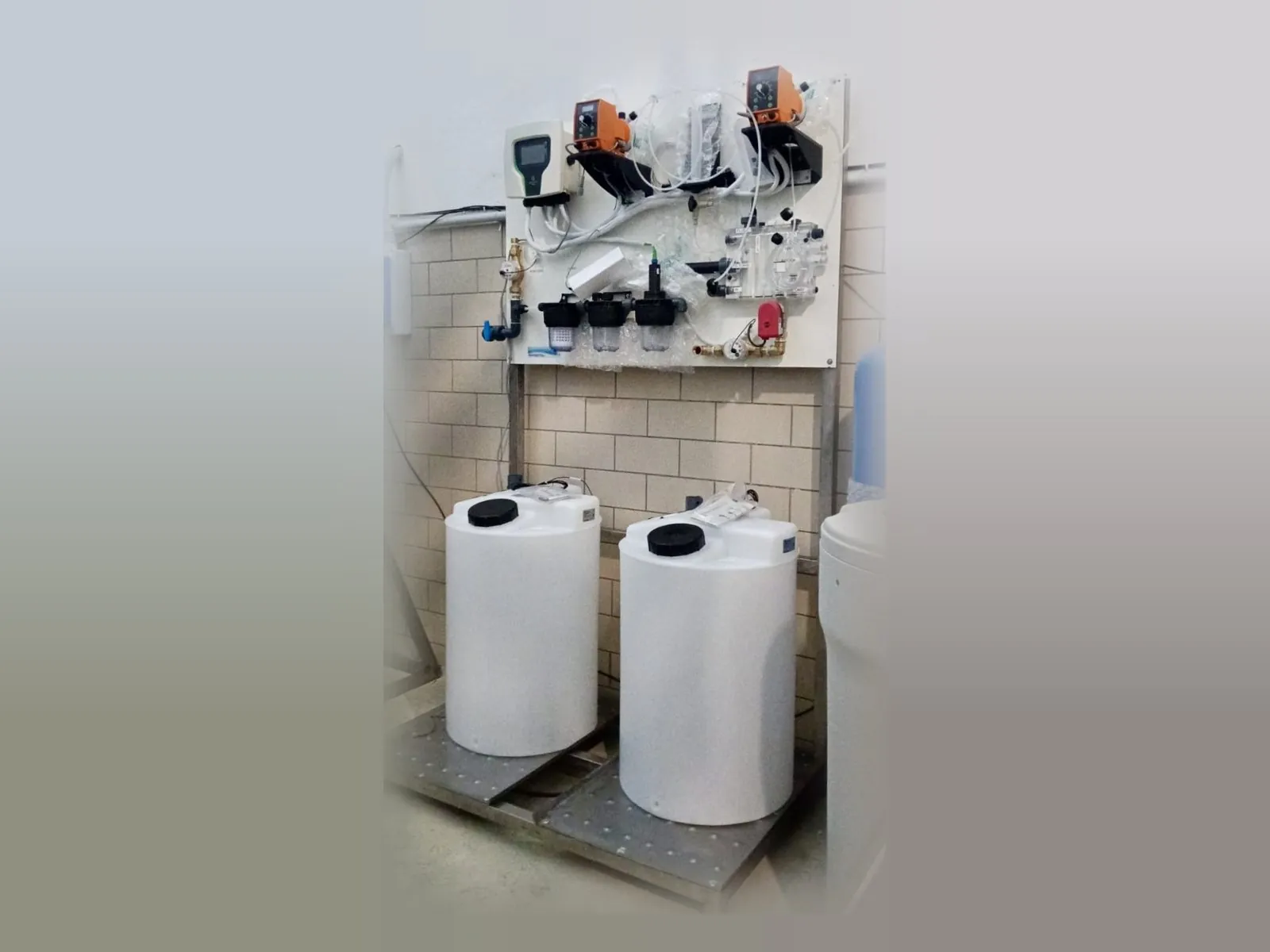
Up to 3 conductivity measurements and 3 bleed-off lines (expandable to 6) with 4 pumps: one for the antiscalant on the make-up water and three for the biocides. Or three measurements (conductivity, pH and Redox) with measuring pipework, 1 1/4" bleed-off and 4 injection points.
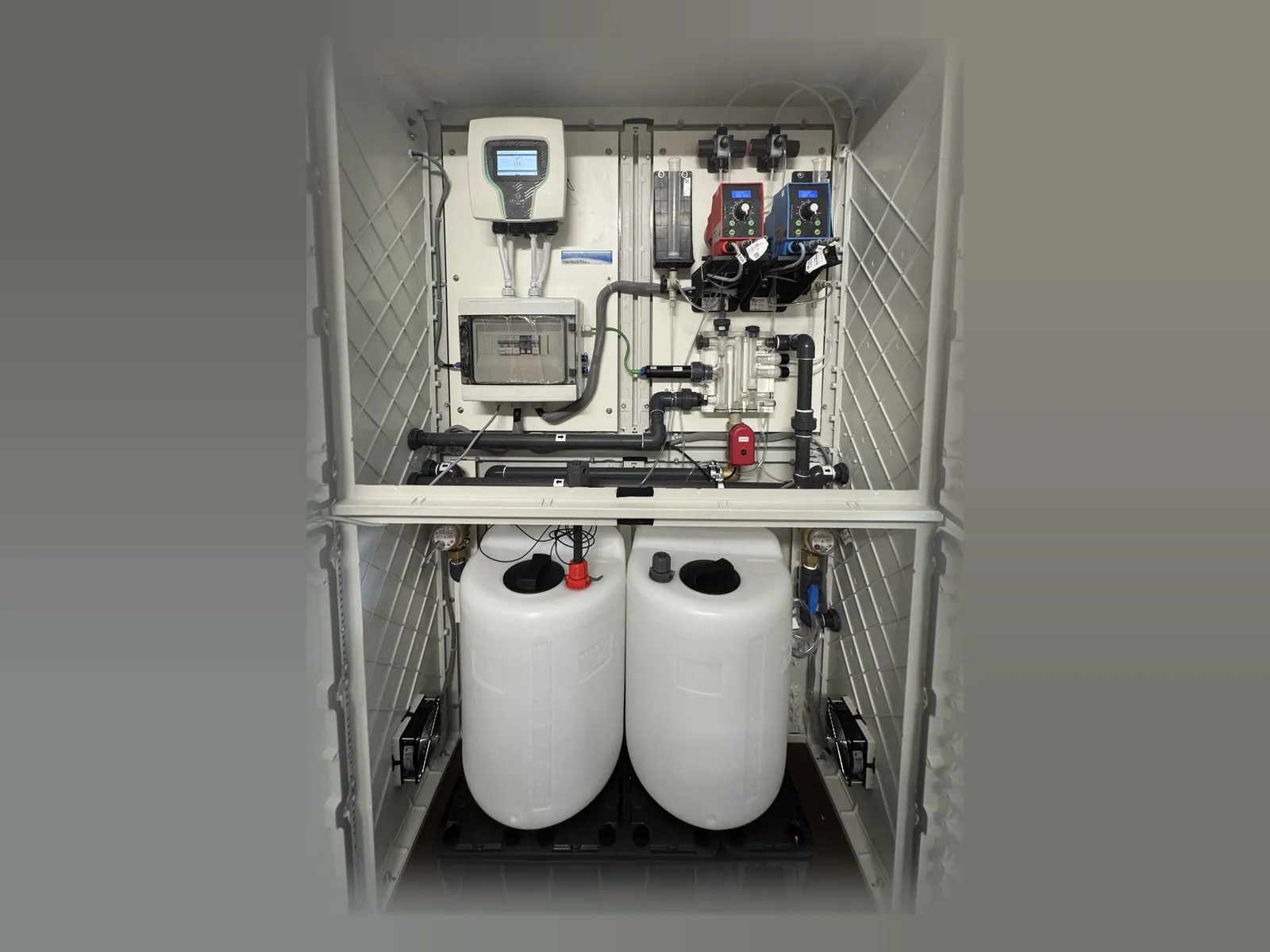
Centurio Tower with up to 6 measurements (conductivity, pH, Redox, tracer, corrosion and turbidity), water meter and valve on the panel, 1 1/4" bleed-off, 4 pumps; separate panels for turbidity and for double or triple corrosion. Modular configuration: probes, valves and pumps can be added or removed.
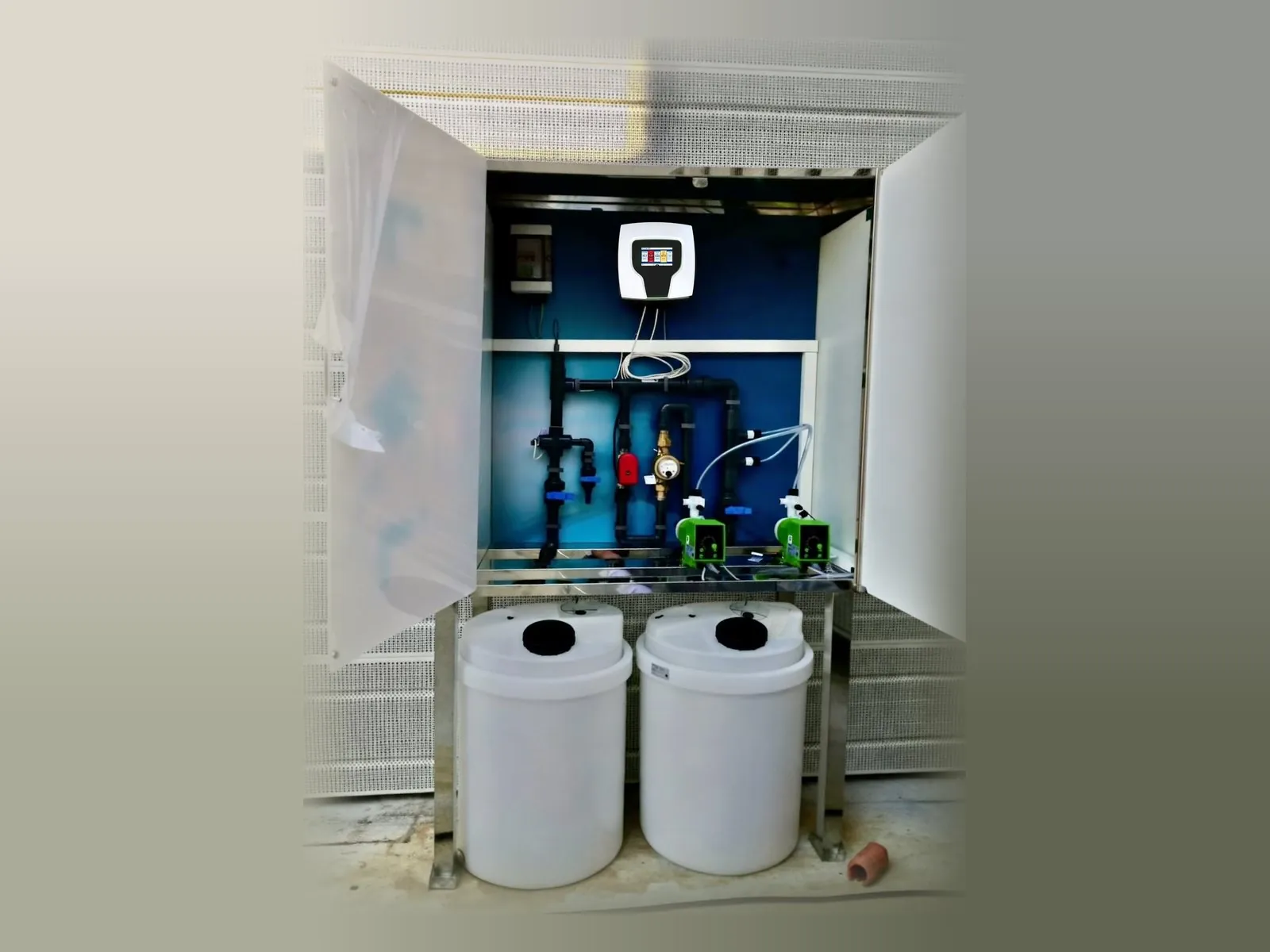
Stainless steel or plastic skids, boxes with protective screen or window, electrical panels for the entire system: electrical connections and pipework prepared for installation.
Skid →Pumps, controllers or components supplied by the customer can also be mounted, with customised dimensions, back panel, logo and electrical panel.
The probes are installed in the flow-through probe holder or in the panel manifold, on the recirculation water.
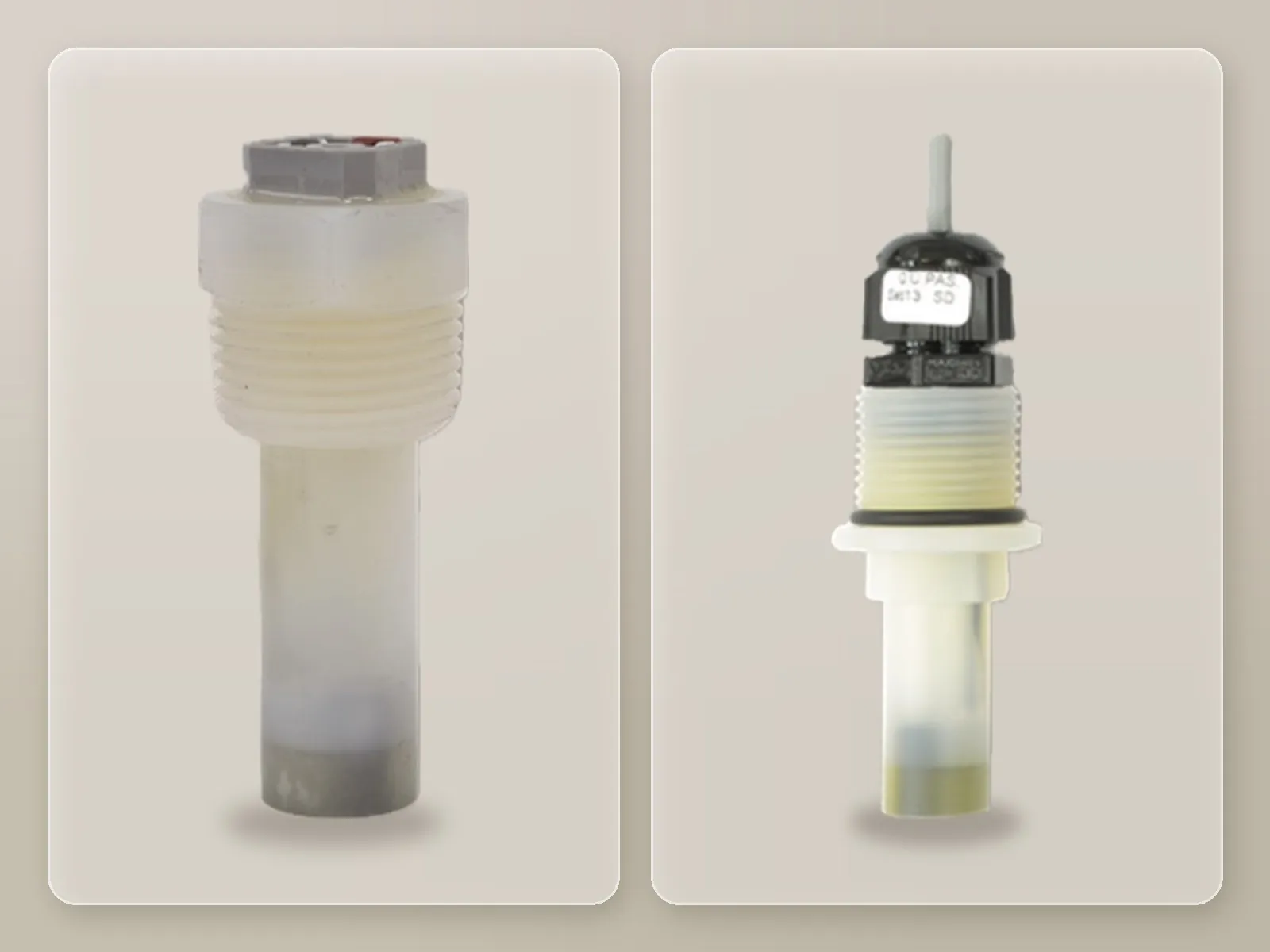
Various measuring ranges, from 0 – 300 µS to 0 – 300 mS, with temperature compensation.
ECD probes →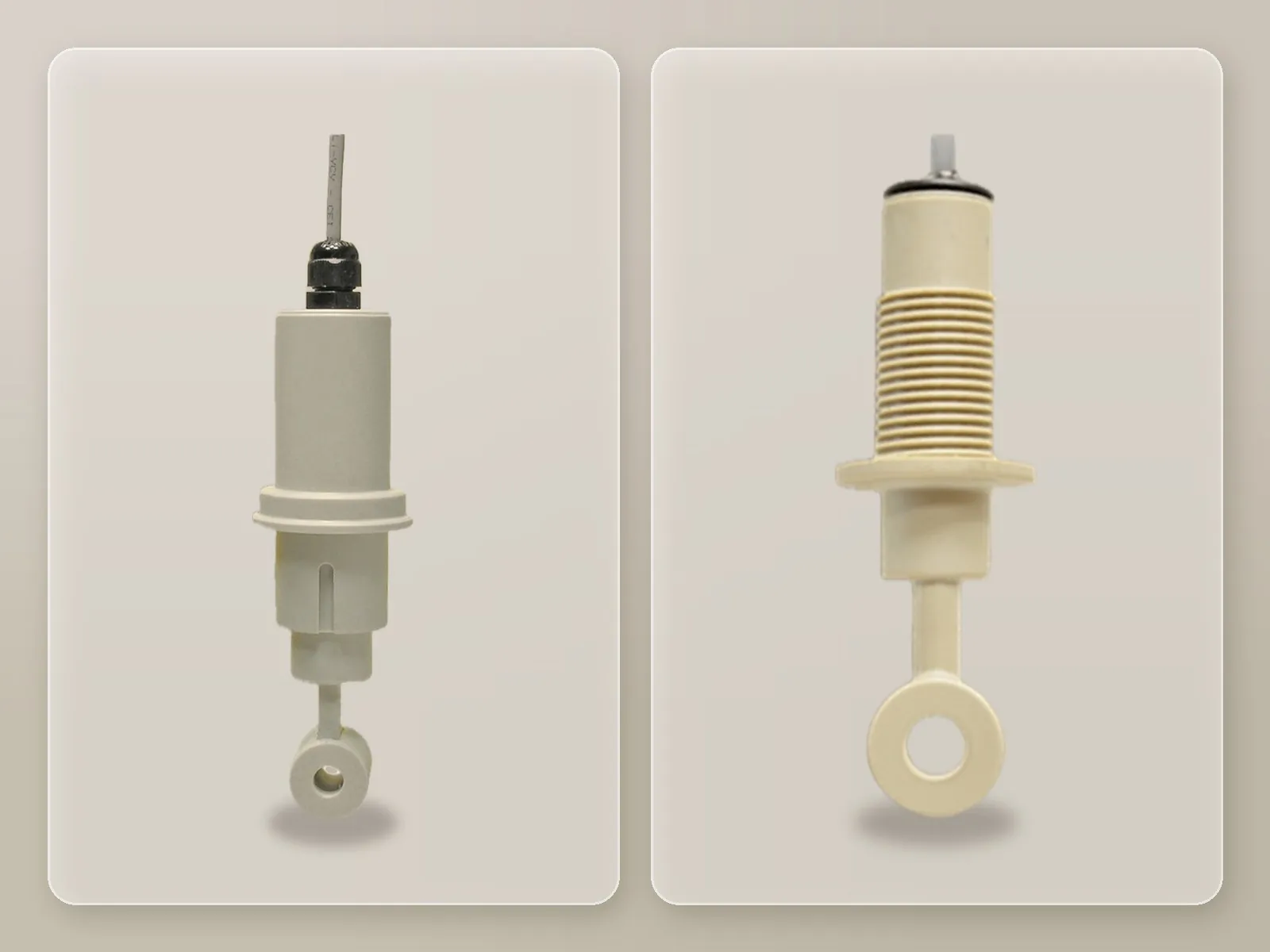
Free from polarisation and largely insensitive to fouling: 0 – 3, 0 – 30 or 0 – 300 mS, also in the absence of flow.
Inductive probes →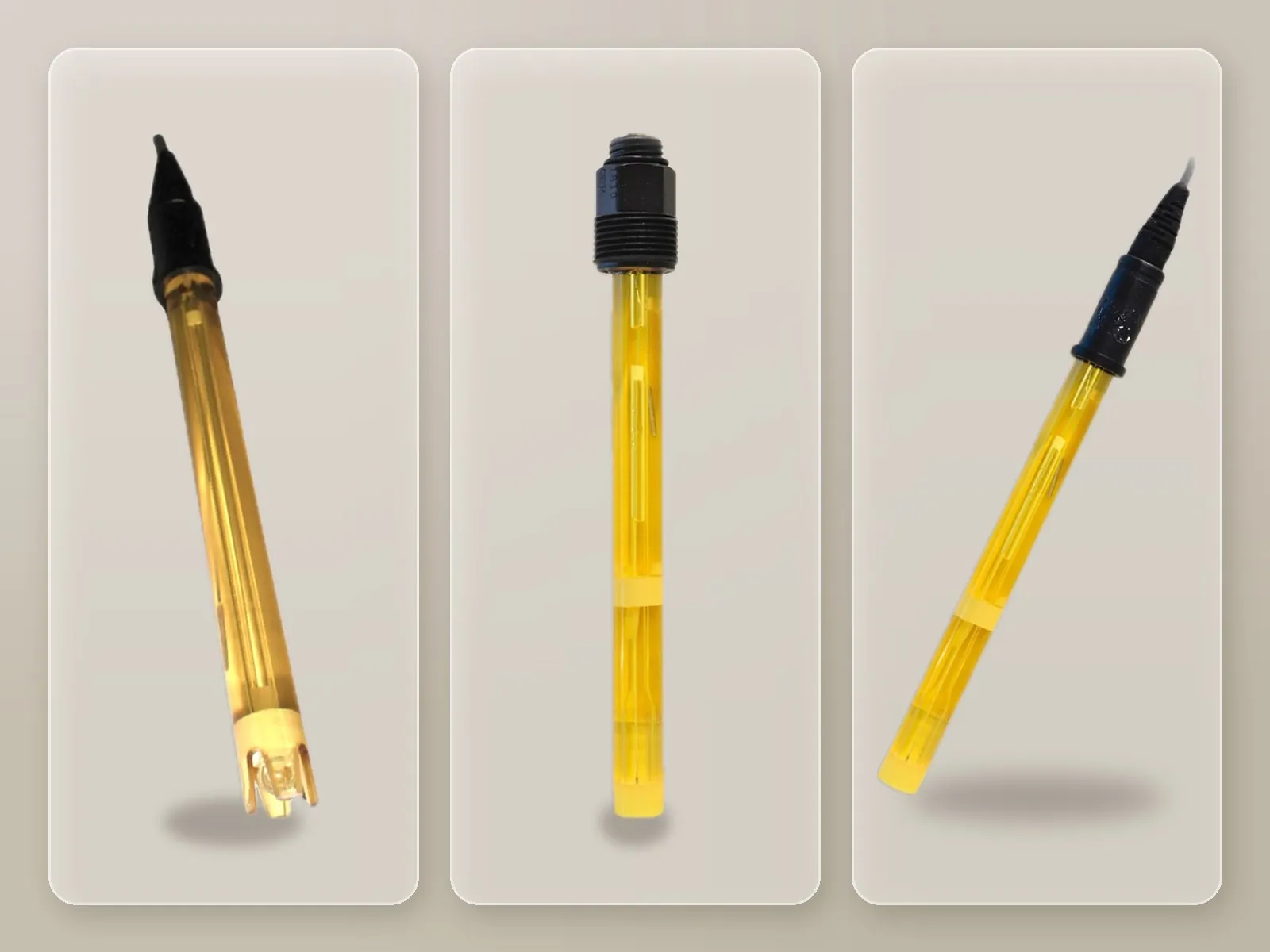
0 – 14 pH, with temperature compensation.
pH electrodes →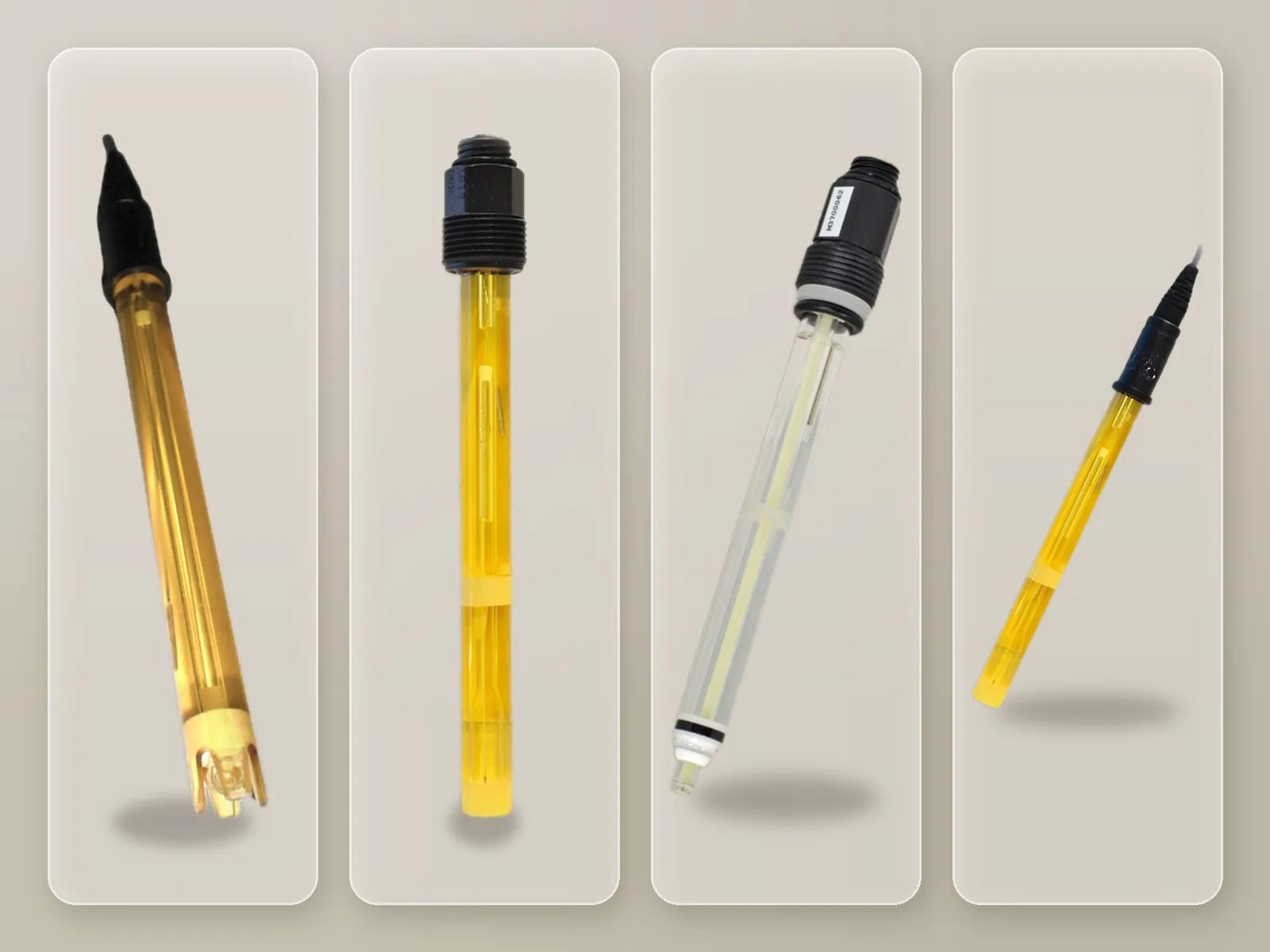
±999 mV: detects the action of oxidising biocides.
Redox electrodes →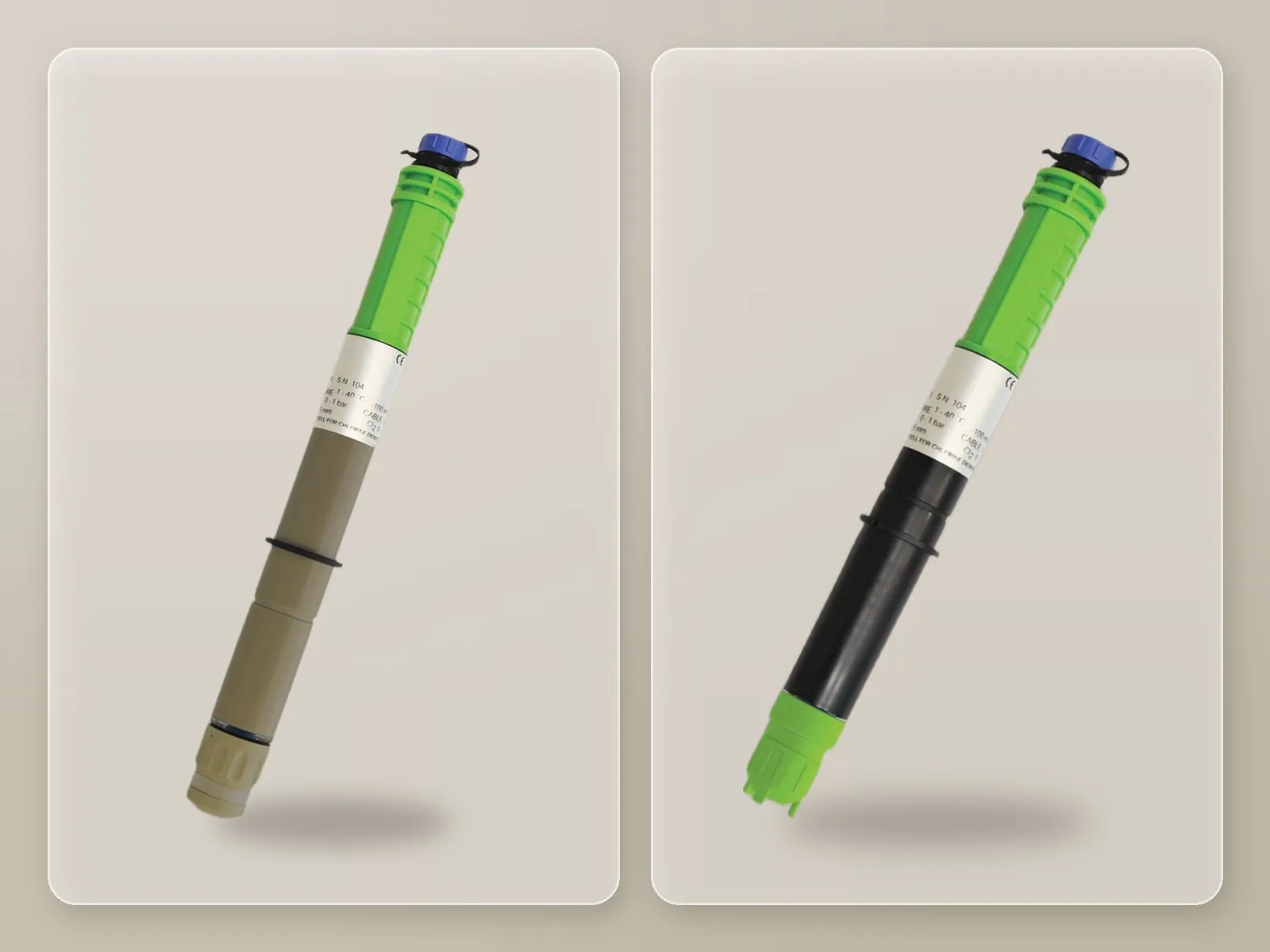
Amperometric cells for free, total and combined chlorine, bromine, chlorine dioxide, hydrogen peroxide, ozone and peracetic acid.
SCL cells →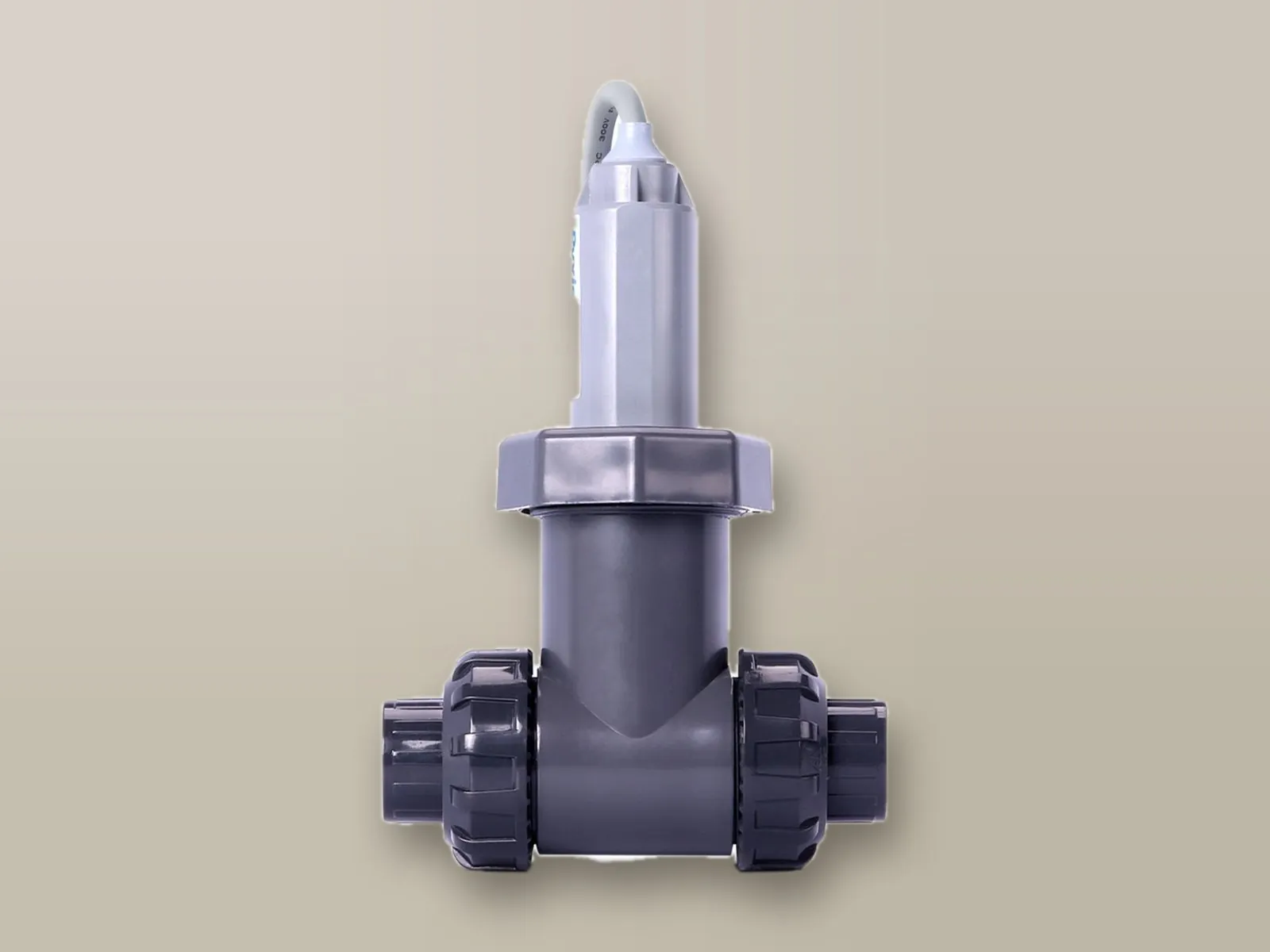
ETRC2 fluorimeter: 0 – 300 ppb, for determining the concentration of antiscalant in the water.
Tracers →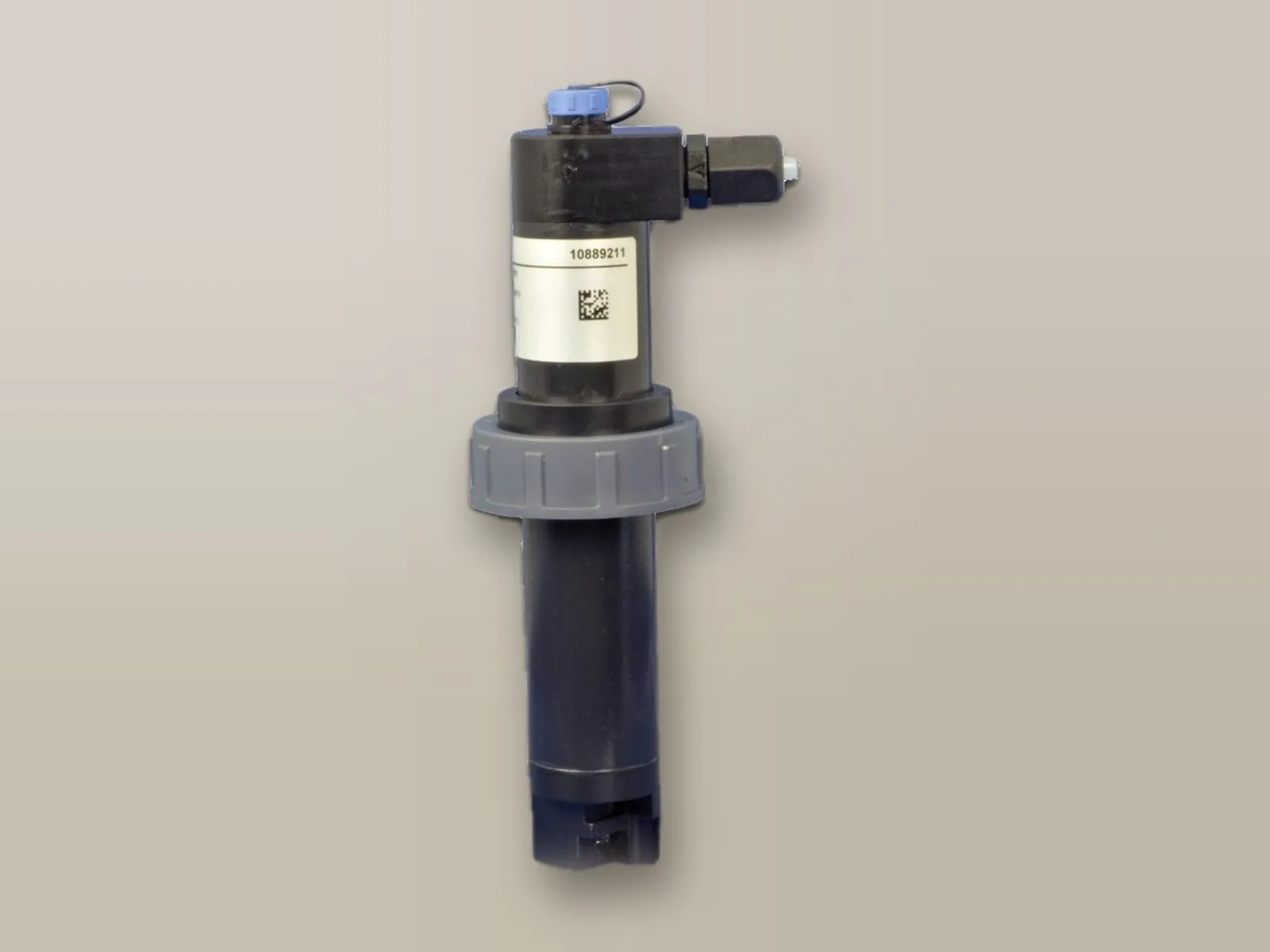
Self-cleaning ETORB2, up to 4,000 NTU.
Turbidity →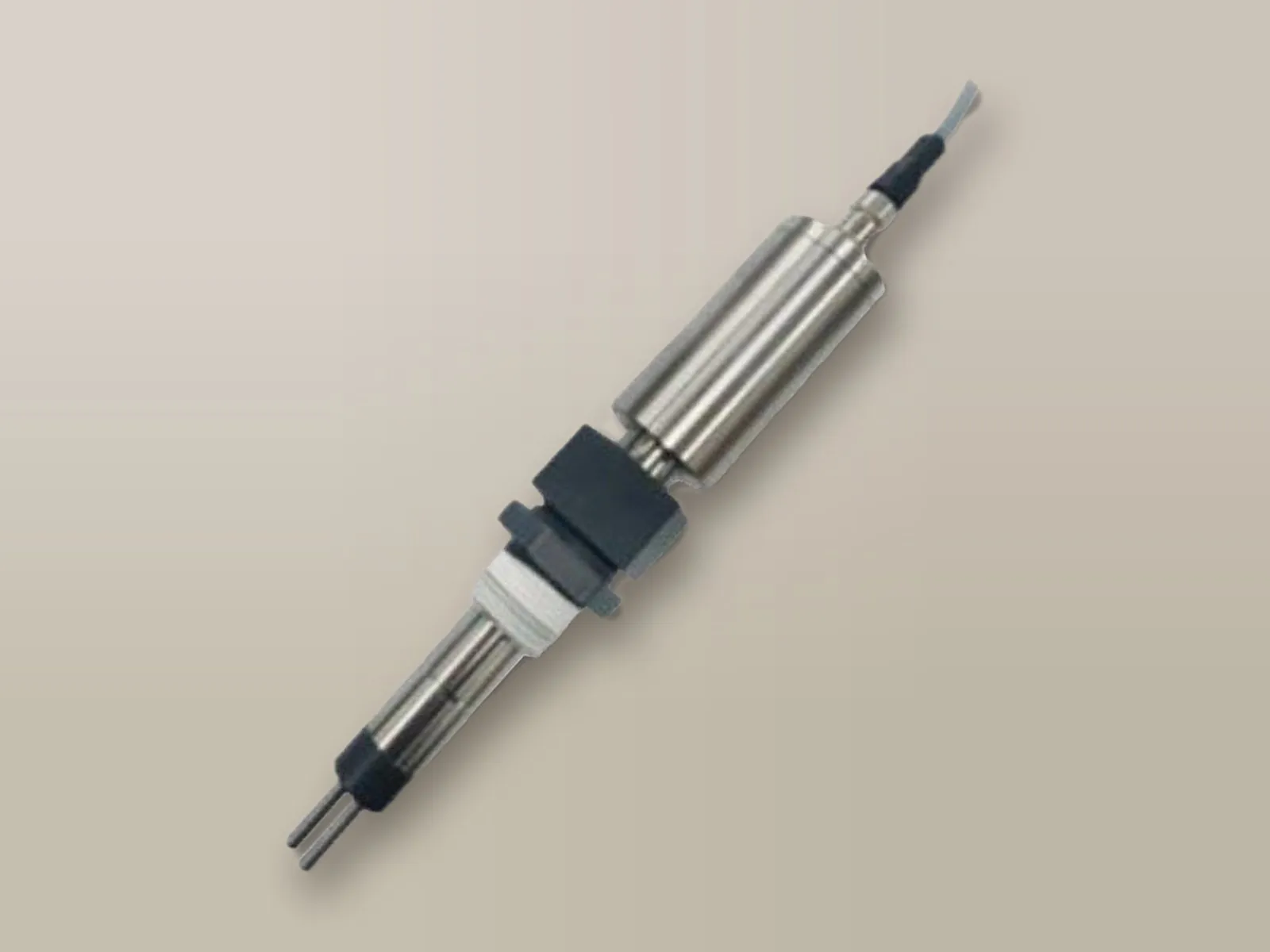
E-CORR: corrosion rate from 0.001 to 10 MPY.
Corrosion →PVDF body, graphite electrodes.
| Model | Mounting | Connection | Range | K factor | Temperature compensation |
|---|---|---|---|---|---|
| ECDC/1 | In-line / by-pass | R3/4" | 0 – 20 mS | 1 | – |
| ECDCC/1 | In-line / by-pass | R3/4" | 0 – 20 mS | 1 | NTC 10K |
| ECDCCPT/1 | In-line / by-pass | R3/4" | 0 – 20 mS | 1 | PT100 |
| ECDC/10 | In-line / by-pass | R3/4" | 0 – 200 mS | 10 | – |
| ECDCC/10 | In-line / by-pass | R3/4" | 0 – 200 mS | 10 | NTC 10K |
| ECDCCPT/10 | In-line / by-pass | R3/4" | 0 – 200 mS | 10 | PT100 |
| ECDCIM/1 | Immersion | G1/2" | 0 – 20 mS | 1 | – |
| ECDCCIM/1 | Immersion | G1/2" | 0 – 20 mS | 1 | NTC 10K |
| ECDCCIMPT/1 | Immersion | G1/2" | 0 – 20 mS | 1 | PT100 |
| ECDCIM/10 | Immersion | G1/2" | 0 – 200 mS | 10 | – |
| ECDCCIM/10 | Immersion | G1/2" | 0 – 200 mS | 10 | NTC 10K |
| ECDCCIMPT/10 | Immersion | G1/2" | 0 – 200 mS | 10 | PT100 |
Operating temperature 1 – 60 °C (100 °C at 2 bar), operating pressure 7 bar (2 bar at 100 °C).
PVDF body, stainless steel electrodes.
| Model | Mounting | Connection | Range | K factor | Temperature compensation |
|---|---|---|---|---|---|
| ECDI/1 | In-line / by-pass | R3/4" | 0 – 5 mS | 1 | – |
| ECDIC/1 | In-line / by-pass | R3/4" | 0 – 5 mS | 1 | NTC 10K |
| ECDICPT/1 | In-line / by-pass | R3/4" | 0 – 5 mS | 1 | PT100 |
| ECDI/01 | In-line / by-pass | R3/4" | 0 – 200 µS | 0.1 | – |
| ECDIC/01 | In-line / by-pass | R3/4" | 0 – 200 µS | 0.1 | NTC 10K |
| ECDICPT/01 | In-line / by-pass | R3/4" | 0 – 200 µS | 0.1 | PT100 |
| ECDIIM/1 | Immersion | G1/2" | 0 – 5 mS | 1 | – |
| ECDICIM/1 | Immersion | G1/2" | 0 – 5 mS | 1 | NTC 10K |
| ECDICPTIM/1 | Immersion | G1/2" | 0 – 5 mS | 1 | PT100 |
| ECDIIM/01 | Immersion | G1/2" | 0 – 200 µS | 0.1 | – |
| ECDIIM/02 | Immersion | G1/2" | 0 – 500 µS | 0.2 | – |
| ECDICIM/01 | Immersion | G1/2" | 0 – 200 µS | 0.1 | NTC 10K |
| ECDICPTIM/01 | Immersion | G1/2" | 0 – 200 µS | 0.1 | PT100 |
Operating temperature 1 – 60 °C (100 °C at 2 bar), operating pressure 7 bar (2 bar at 100 °C).
Epoxy body, platinum electrodes, diameter 12 mm.
| Model | Mounting | Range | K factor | Temperature compensation |
|---|---|---|---|---|
| ECDHL/1 | In-line / by-pass | 0.2 – 20 mS | 1 | – |
| ECDHLC/1 | In-line / by-pass | 0.2 – 20 mS | 1 | NTC 10K |
| ECDHLCPT/1 | In-line / by-pass | 0.2 – 20 mS | 1 | PT100 |
| ECDHL/01 | In-line / by-pass | 0 – 200 µS | 0.1 | – |
| ECDHLC/01 | In-line / by-pass | 0 – 200 µS | 0.1 | NTC 10K |
| ECDHLCPT/01 | In-line / by-pass | 0 – 200 µS | 0.1 | PT100 |
| ECDHL/10 | In-line / by-pass | 20 – 200 mS | 10 | – |
| ECDHLC/10 | In-line / by-pass | 20 – 200 mS | 10 | NTC 10K |
| ECDHLCPT/10 | In-line / by-pass | 20 – 200 mS | 10 | PT100 |
Operating temperature 1 – 70 °C, operating pressure 7 bar.
Stainless steel body and electrodes, R3/4" connection, in-line or by-pass mounting.
| Model | Range | K factor | Temperature compensation | Operating temperature |
|---|---|---|---|---|
| EICDC/1 | 0 – 20 mS | 1 | NTC 10K | 1 – 130 °C |
| EICDCPT/1 | 0 – 20 mS | 1 | PT100 | 1 – 130 °C |
| EICDC/01 | 0 – 200 µS | 0.1 | NTC 10K | 1 – 130 °C |
| EICDCPT/01 | 0 – 200 µS | 0.1 | PT100 | 1 – 130 °C |
| EICDC/001 | 0 – 20 µS | 0.01 | NTC 10K | 1 – 130 °C |
| EICDCPT/001 | 0 – 20 µS | 0.01 | PT100 | 1 – 130 °C |
| EICDCHPT/1 | 0 – 20 mS | 1 | PT100 | 1 – 200 °C |
| EICDCHPT/01 | 0 – 200 µS | 0.1 | PT100 | 1 – 200 °C |
| EICDCHPT/001 | 0 – 20 µS | 0.01 | PT100 | 1 – 200 °C |
Operating pressure 15 bar.
| ECDINDPT | ECDSINDPT | |
|---|---|---|
| Measuring range | 0.3 – 3 mS 0.3 – 30 mS 0.3 – 300 mS | 0.3 – 10 mS |
| Measuring system | Inductive | Inductive |
| Body | PEEK | PEEK |
| Mounting | In-line / by-pass / immersion | In-line / by-pass / immersion |
| Temperature compensation | PT100 | PT100 |
| Operating temperature | 1 – 85 °C (100 °C for temporary measurement) | 1 – 85 °C (100 °C for temporary measurement) |
| Operating pressure | 8 bar | 8 bar |
| Electrode | Pressure | Connection | Body | Minimum conductivity | Junction | Temperature | Cable | Diameter | Notes |
|---|---|---|---|---|---|---|---|---|---|
| EPHS | 7 bar (3.5 bar) | BNC | Epoxy | 100 µS | – | 70 °C (80 °C) | 0.8 m | 12 mm | – |
| EPHM | 7 bar (3.5 bar) | BNC | Epoxy | 100 µS | – | 70 °C (80 °C) | 4.5 m | 12 mm | – |
| EPHL | 7 bar (3.5 bar) | BNC | Epoxy | 100 µS | – | 70 °C (80 °C) | 15 m | 12 mm | – |
| EPHSN6 | 7 bar (3.5 bar) | SN6 with PG13.5 thread | Epoxy | 100 µS | – | 70 °C (80 °C) | 1 – 100 m | 12 mm | – |
| EPHMD/100 | 7 bar | BNC | Epoxy | 100 µS | Double | 100 °C | 4.5 m | 12 mm | – |
| EPHM/D | 7 bar (3.5 bar) | BNC | Epoxy | 100 µS | Double | 70 °C (80 °C) | 4.5 m | 12 mm | – |
| EPHM/D/SN6 | 7 bar (3.5 bar) | SN6 with PG13.5 thread | Epoxy | 100 µS | Double | 70 °C (80 °C) | 1 – 100 m | 12 mm | – |
| EPHMD/LI | 7 bar (3.5 bar) | SN6 with PG13.5 thread | Epoxy | 3 µS | Double | 70 °C (80 °C) | 1 – 100 m | 12 mm | For low-conductivity water |
| EPHSC | 7 bar (3.5 bar) | BNC | Epoxy | 100 µS | Double | 70 °C (80 °C) | 4.5 m | 12 mm | Self-cleaning |
| EPHSC/SN6 | 7 bar (3.5 bar) | SN6 with PG13.5 thread | Epoxy | 100 µS | Double | 70 °C (80 °C) | 1 – 100 m | 12 mm | Self-cleaning |
| EPHM/HF | 7 bar (3.5 bar) | BNC | Epoxy | 100 µS | Double | 70 °C (80 °C) | 4.5 m | 12 mm | Resistant to 1% hydrofluoric acid |
| EPHSN6 GK | 10 bar | SN6 | Glass | 150 µS | – | −5 / 135 °C | 1 – 100 m | 12 mm | High temperature |
All models: combination electrode, range 0 – 14 pH, resolution 0.01.
| Electrode | Range | Pressure | Connection | Body | Minimum conductivity | Junction | Temperature | Cable | Diameter | Notes |
|---|---|---|---|---|---|---|---|---|---|---|
| ERhS | ± 1,000 mV | 7 bar (3.5 bar) | BNC | Epoxy | 100 µS | – | 70 °C (80 °C) | 0.8 m | 12 mm | – |
| ERhM | ± 1,000 mV | 7 bar (3.5 bar) | BNC | Epoxy | 100 µS | – | 70 °C (80 °C) | 4.5 m | 12 mm | – |
| ERhL | ± 1,000 mV | 7 bar (3.5 bar) | BNC | Epoxy | 100 µS | – | 70 °C (80 °C) | 15 m | 12 mm | – |
| ERhHLB SN6 | ± 1,500 mV | 6 bar | SN6 with PG13.5 thread | Glass | 100 µS | – | 80 °C | 10 m | 12 mm | High linearity and sensitivity, for low chlorine concentrations |
| ERhSN6 | ± 1,000 mV | 7 bar | SN6 with PG13.5 thread | Epoxy | 100 µS | – | 100 °C | 1 – 100 m | 12 mm | – |
| ERhMD/100 | ± 1,000 mV | 7 bar | BNC | Epoxy | 100 µS | Double | 100 °C | 4.5 m | 12 mm | – |
| ERhM/D | ± 1,000 mV | 7 bar (3.5 bar) | BNC | Epoxy | 100 µS | Double | 70 °C (80 °C) | 4.5 m | 12 mm | – |
| ERhSC | ± 1,000 mV | 7 bar (3.5 bar) | BNC | Epoxy | 100 µS | Double | 70 °C (80 °C) | 4.5 m | 12 mm | Self-cleaning |
| ERhSC/SN6 | ± 1,000 mV | 7 bar (3.5 bar) | SN6 with PG13.5 thread | Epoxy | 100 µS | Double | 70 °C (80 °C) | 1 – 100 m | 12 mm | Self-cleaning |
All models: combination electrode, resolution 1 mV.
| SCL3N/0.5 | SCL3N/2 | SCL3N/20 | SCL18/0.5 | SCL18/2 | SCL18/20 | SCL3S/20 | |
|---|---|---|---|---|---|---|---|
| Measuring range | 0 – 0.5 mg/l | 0 – 2 mg/l | 0 – 20 mg/l | 0 – 0.5 mg/l | 0 – 2 mg/l | 0 – 20 mg/l | 0 – 20 mg/l |
| Resolution | 0.001 | 0.001 | 0.01 | 0.001 | 0.001 | 0.01 | 0.01 |
| Free chlorine | Inorganic | Inorganic | Inorganic | Inorganic | Inorganic | Inorganic | Organic and inorganic |
| Water | Fresh | Fresh | Fresh | Fresh | Fresh | Fresh | Fresh or salt |
| Electrodes | 2 | 2 | 2 | 3 | 3 | 3 | 2 |
| Selective membrane | Yes | Yes | Yes | No | No | No | Yes |
| Automatic compensation | pH and temperature | pH and temperature | pH and temperature | pH and temperature | pH and temperature | pH and temperature | Temperature |
| Self-cleaning | – | – | – | Yes | Yes | Yes | – |
| Operating pH | 5 – 9.5 | 5 – 9.5 | 5 – 9.5 | 5 – 9 | 5 – 9 | 5 – 9 | 5.5 – 9.5 |
| Operating temperature | 1 – 40 °C | 1 – 40 °C | 1 – 40 °C | 5 – 70 °C | 5 – 70 °C | 5 – 70 °C | 5 – 45 °C |
| Operating pressure | 1 bar | 1 bar | 1 bar | 8 bar | 8 bar | 8 bar | 1 bar |
| Water flow | 30 l/h | 30 l/h | 30 l/h | 40 l/h | 40 l/h | 40 l/h | 30 l/h |
| SCL2/0.5 | SCL2/2 | SCL2/20 | SCL17/0.5 | SCL17/2 | SCL17/20 | |
|---|---|---|---|---|---|---|
| Measuring range | 0 – 0.5 mg/l | 0 – 2 mg/l | 0 – 20 mg/l | 0 – 0.5 mg/l | 0 – 2 mg/l | 0 – 20 mg/l |
| Resolution | 0.001 | 0.001 | 0.01 | 0.001 | 0.001 | 0.01 |
| Electrodes | 2 | 2 | 2 | 3 | 3 | 3 |
| Selective membrane | Yes | Yes | Yes | No | No | No |
| Self-cleaning | – | – | – | Yes | Yes | Yes |
| Operating pH | 1 – 6 | 1 – 6 | 1 – 6 | 5 – 9 | 5 – 9 | 5 – 9 |
| Operating temperature | 1 – 40 °C | 1 – 40 °C | 1 – 40 °C | 5 – 70 °C | 5 – 70 °C | 5 – 70 °C |
| Operating pressure | 1 bar | 1 bar | 1 bar | 8 bar | 8 bar | 8 bar |
| Water flow | 30 l/h | 30 l/h | 30 l/h | 40 l/h | 40 l/h | 40 l/h |
Automatic temperature compensation on all models.
| SCL8/2 | SCL8/20 | SBR/20 | SCL9 | SCL11/200 | SCL11/2000 | SCL10 | SCT | |
|---|---|---|---|---|---|---|---|---|
| Measurement | Total chlorine | Total chlorine | Bromine | Hydrogen peroxide | Peracetic acid | Peracetic acid | Ozone | Chlorites |
| Measuring range | 0 – 2 mg/l | 0 – 20 mg/l | 0 – 20 mg/l | 0 – 200 mg/l | 0 – 200 mg/l | 0 – 2,000 mg/l | 0 – 20 mg/l | 0 – 2 mg/l |
| Resolution | 0.001 | 0.01 | 0.01 | 0.1 | 0.1 | 1 | 0.01 | 0.001 |
| Operating pH | 4 – 12 | 4 – 12 | 6.5 – 9.5 | 1 – 11 | 1 – 6 | 1 – 6 | 2 – 11 | 5.5 – 9.5 |
| Operating pressure | 1 bar | 1 bar | 0.5 bar | 1 bar | 1 bar | 1 bar | 1 bar | 1 bar |
All models: 2 electrodes, selective membrane, automatic temperature compensation, operating temperature 1 – 40 °C, water flow 30 l/h.
| ETRC2 | |
|---|---|
| Measuring range | 0 – 300 ppb of PTSA |
| Error | ± 1 ppb or 5% of reading |
| Sensitivity | 1 ppb |
| Linearity | 0.99 r² |
| Signal source | LED |
| Detection | Photodiode |
| Response time | 5 seconds |
| Sample pressure | 100 psi (approx. 7 bar) |
| Sample temperature | 4 – 40 °C |
| Ambient temperature | 4 – 49 °C |
| Output | 4-20 mA and RS-485 Modbus RTU |
| Power supply | 24 VDC (± 2 V), 65 mA |
| Body | PVC |
| E-CORR COLD | E-CORR HOT | |
|---|---|---|
| General corrosion | 0.001 – 10 MPY | 0.001 – 995 MPY |
| Localised corrosion | index 0 – 100 | index 0 – 100 |
| Resolution | 0.001 MPY | 0.001 MPY or 1% of reading |
| Conductivity compensation | 10 – 10,000 µS/cm | 10 – 50,000 µS/cm |
| Reading interval | 1, 2, 5 or 20 min | 3 – 1,440 min |
| Alloy factor | 0 – 3 | 0 – 3 |
| Operating temperature | −10 / +50 °C | −10 / +240 °C |
| Operating pressure | 7 bar | 34.5 bar |
| Power supply | 24 VDC, 2 W | 24 VDC, 2 W |
| Outputs | 2 × 4/20 mA (general and localised), RS485 | 2 × 4/20 mA (general and localised), RS485 Modbus |
| Installation | In-line, NPT threaded connection | In-line, 3/4" NPT or BSP connection |
| Body | AISI 304 | Titanium and PEEK |
| Dimensions | 281.5 mm, Ø 23 / 43 mm | 280 mm, Ø 52 mm |
| Weight | 687 g | 1,150 g |
| Cable | 1.5 m, extensions available | 1.5 m, extensions available |
| Protection | IP65 | IP68 |
Verification of the actual protection of the plant: continuously by means of a probe, or over the long term by means of coupons.
Linear polarisation resistance method, with automatic compensation for conductivity (10 – 10,000 µS/cm) and electrochemical noise: 0.001 – 10 MPY, general corrosion or specific to steel, copper, 304 stainless steel, brass and aluminium. AISI 304 body, IP65. Managed by the Centurio Tower.
Corrosion probe →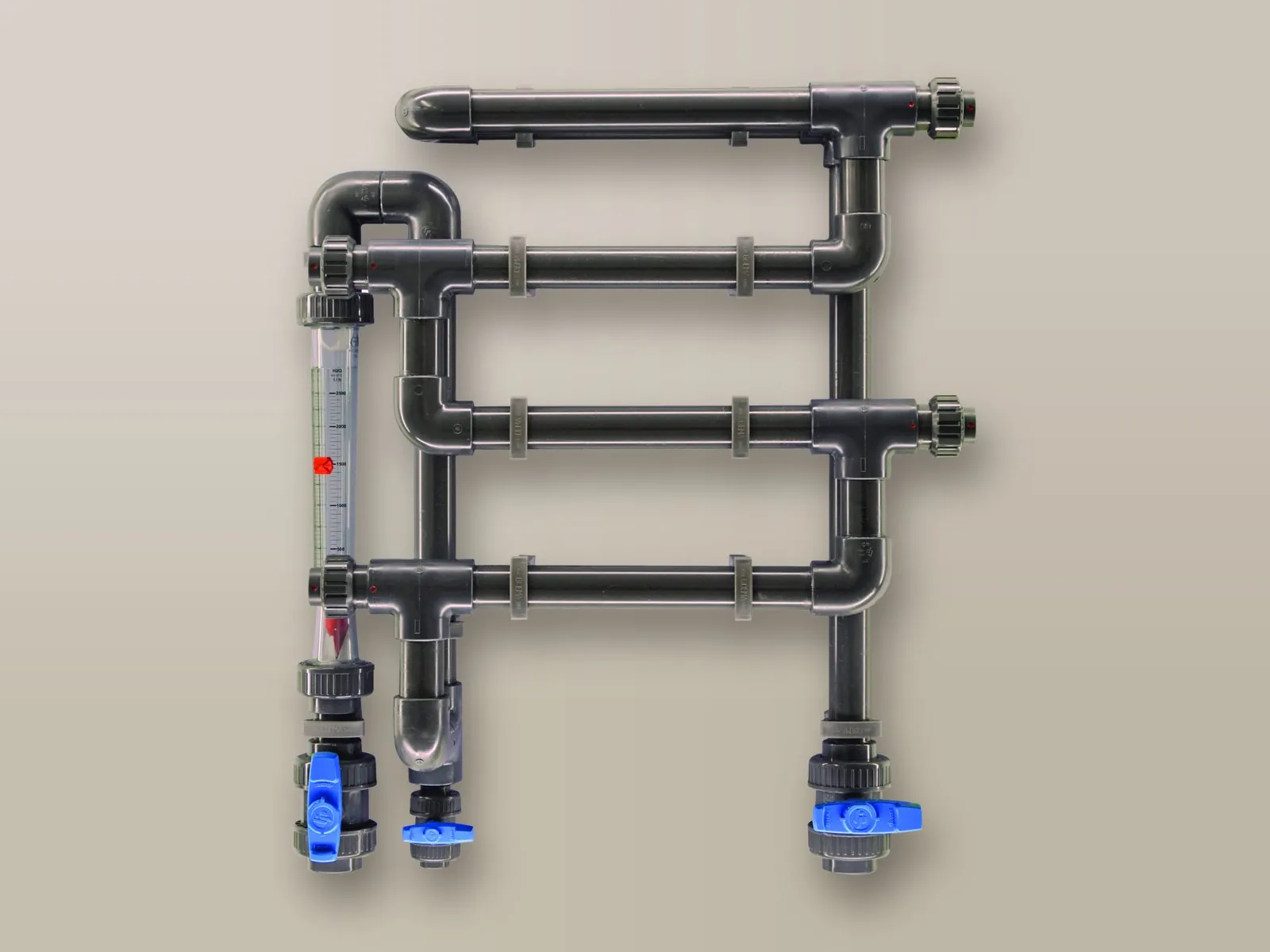
Rack with 4 coupon holders removable without tools, DN40 PN16 pipework, inlet and outlet isolation valves and drain valve; 600 × 900 mm, up to 40 °C.
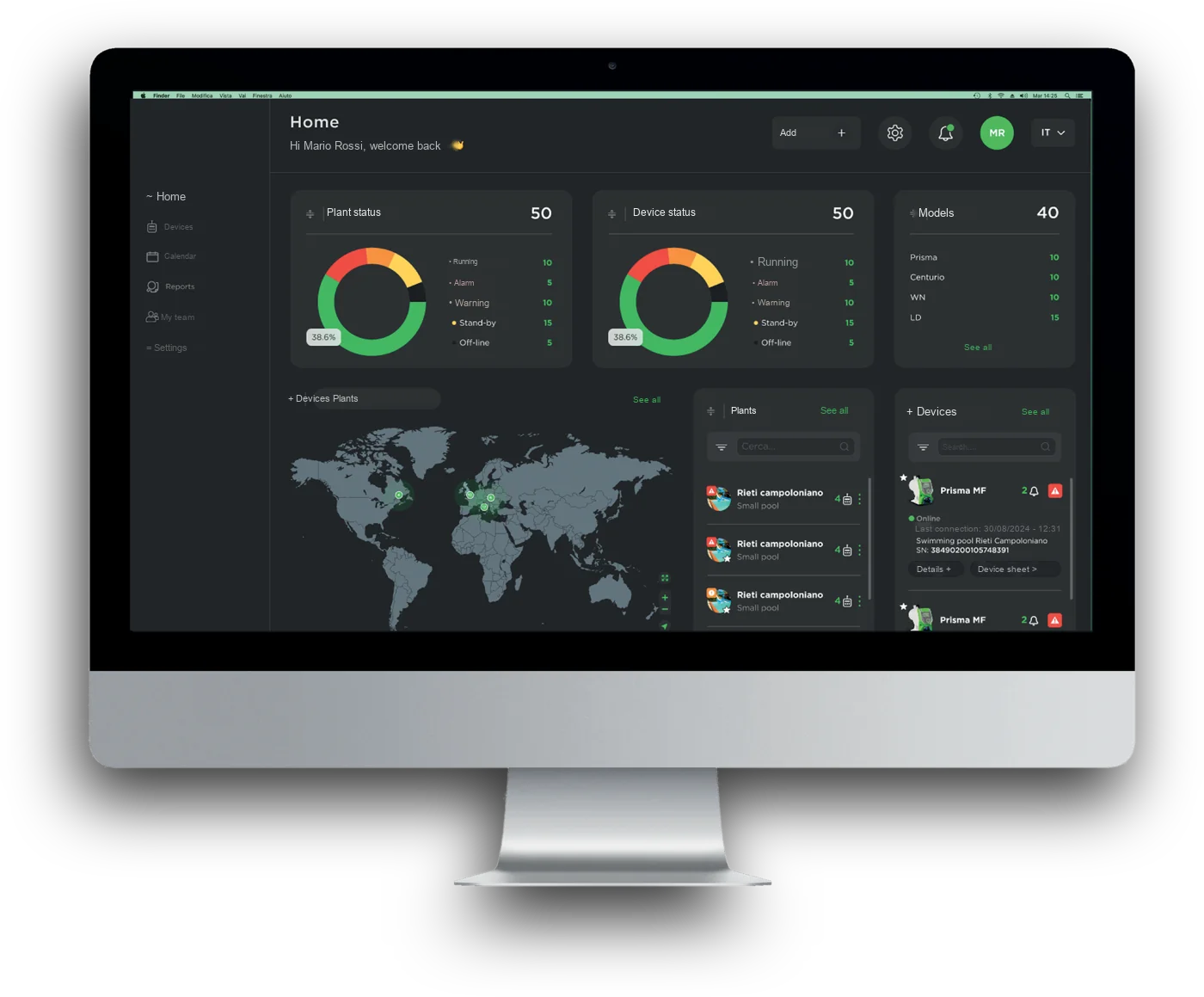
The controllers can be remotely controlled bidirectionally (read and write) from the web portal, from PC, tablet and smartphone: viewing of measurements, modification of set points, dosing and alarms, receipt of alarms and download of logs. Alternatively, integration into your PLC via Modbus is possible.
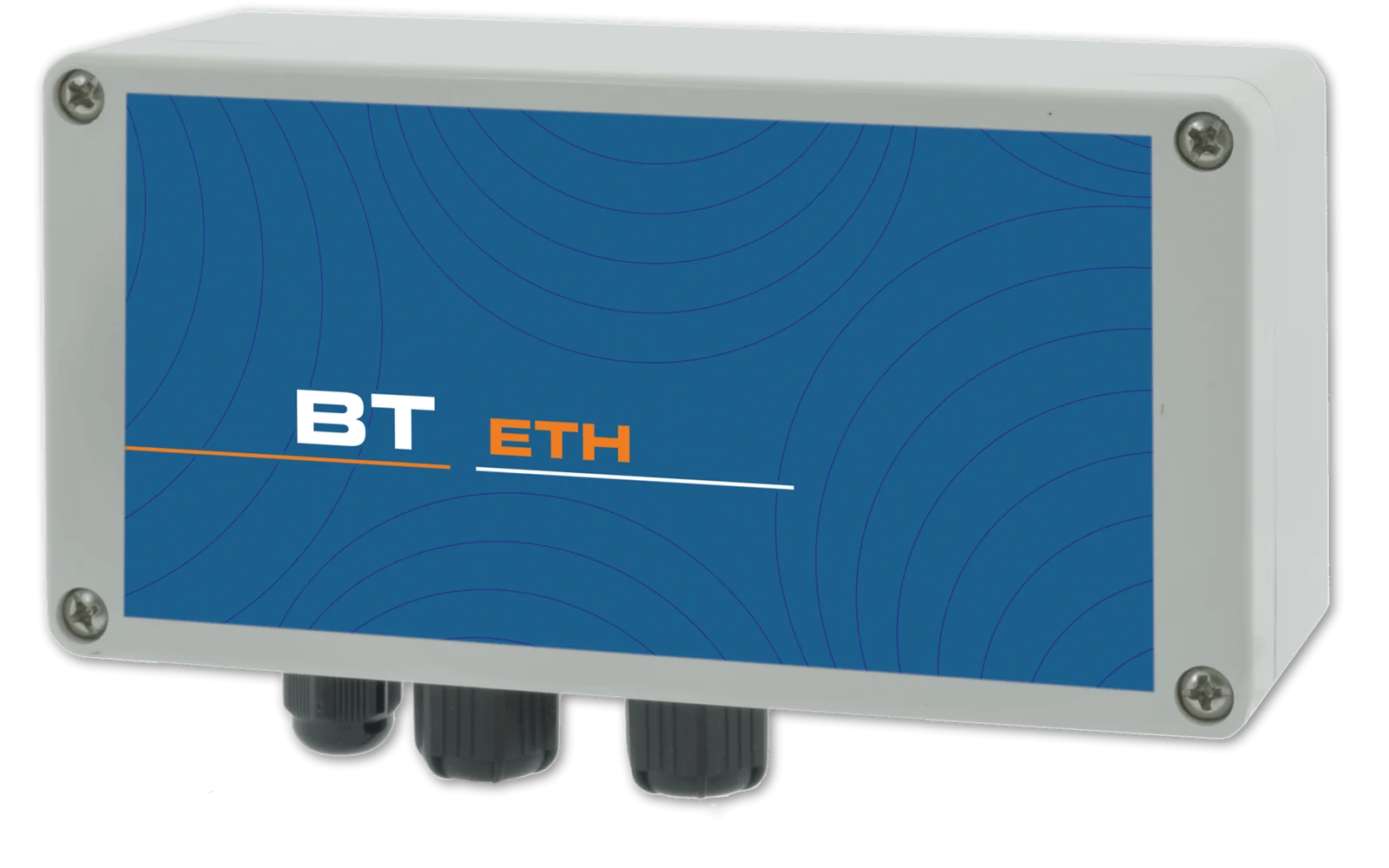
Connection to the web portal via network cable: measurements, set points, dosing and alarms accessible from PC, tablet and smartphone.
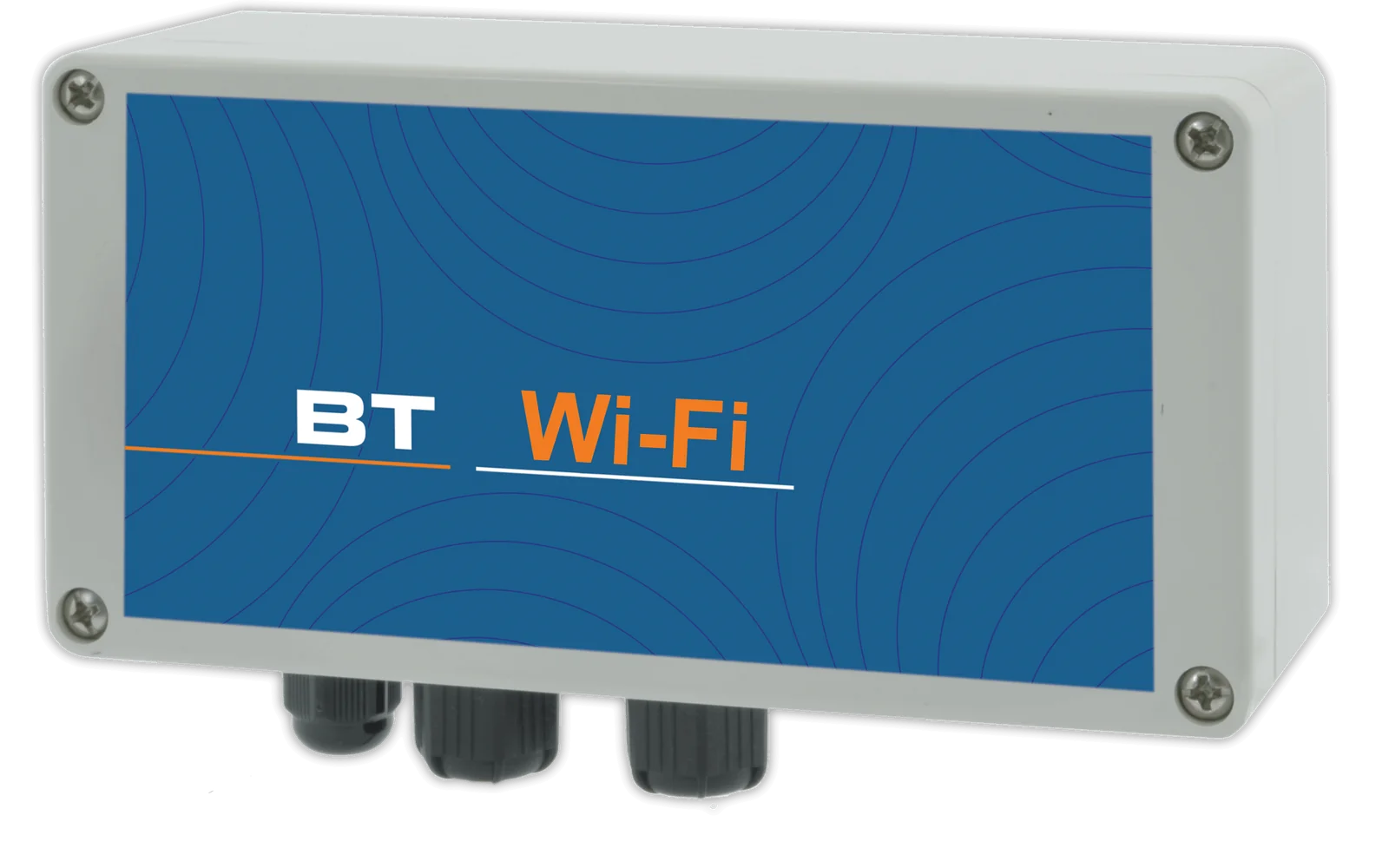
Wireless connection to the web portal, with the same functions as the cable connection.
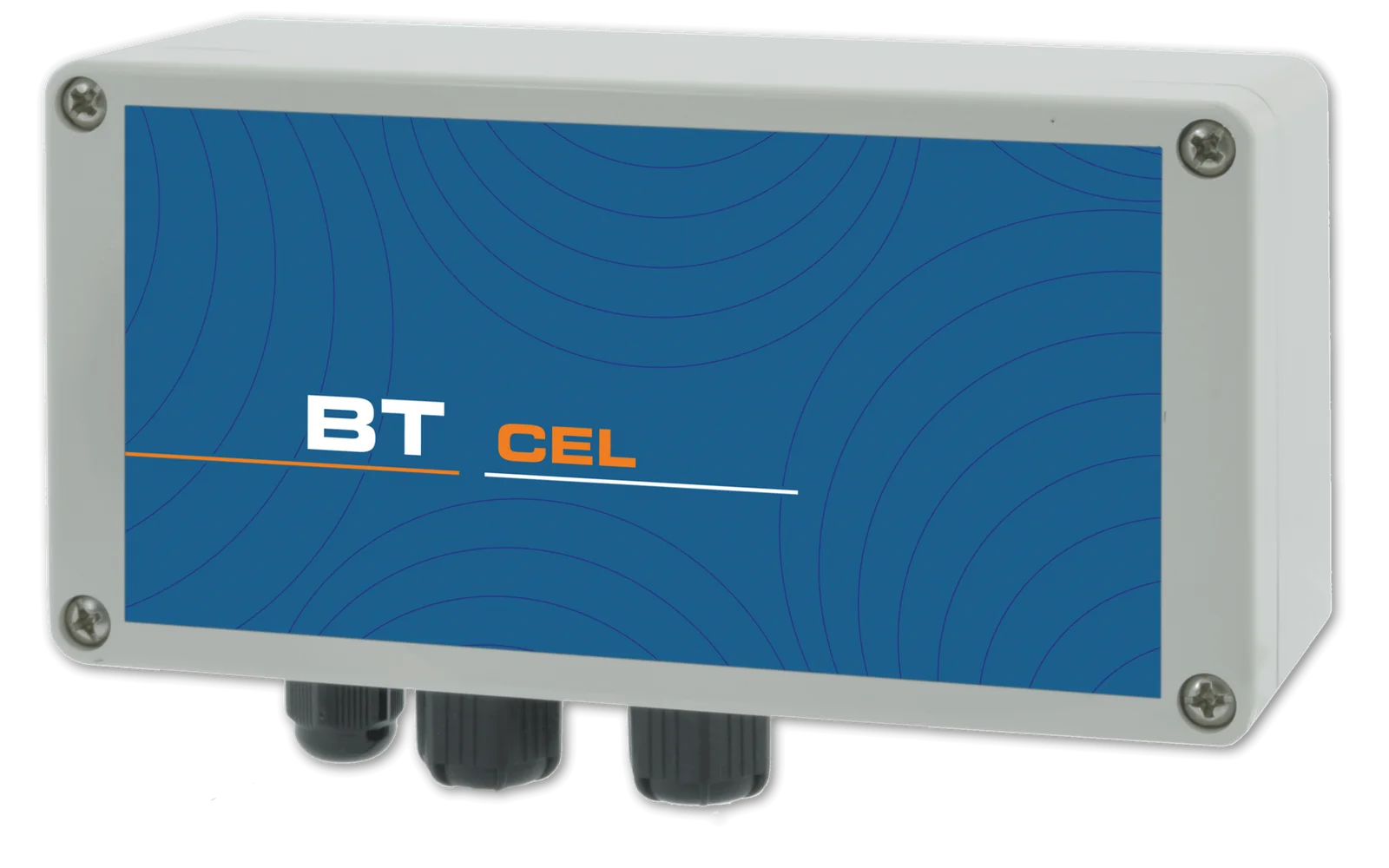
Connection via the cellular network for installations without a local network, with alarm notification by SMS or e-mail.
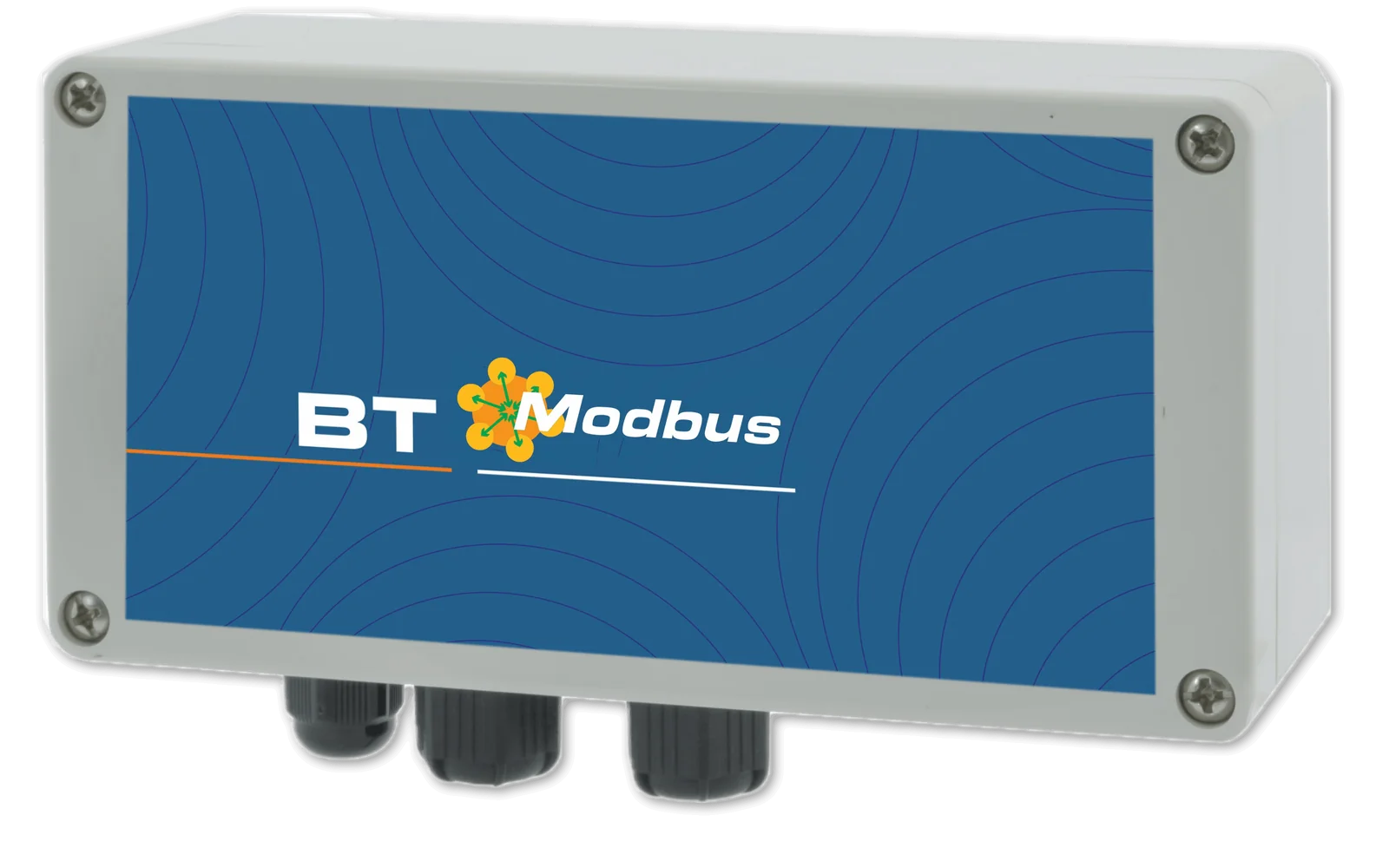
Integration into your PLC via serial port.
Integration into your PLC or SCADA via Ethernet network.

Current signal proportional to the measured value, for remote monitoring or for controlling pumps and other instrumentation.
A single account brings together all registered installations, each with its own devices: the web portal, free of charge and with no subscription, can be accessed from PC, Mac, tablet and smartphone and allows every parameter to be both viewed and changed, with an encrypted connection and protected access.
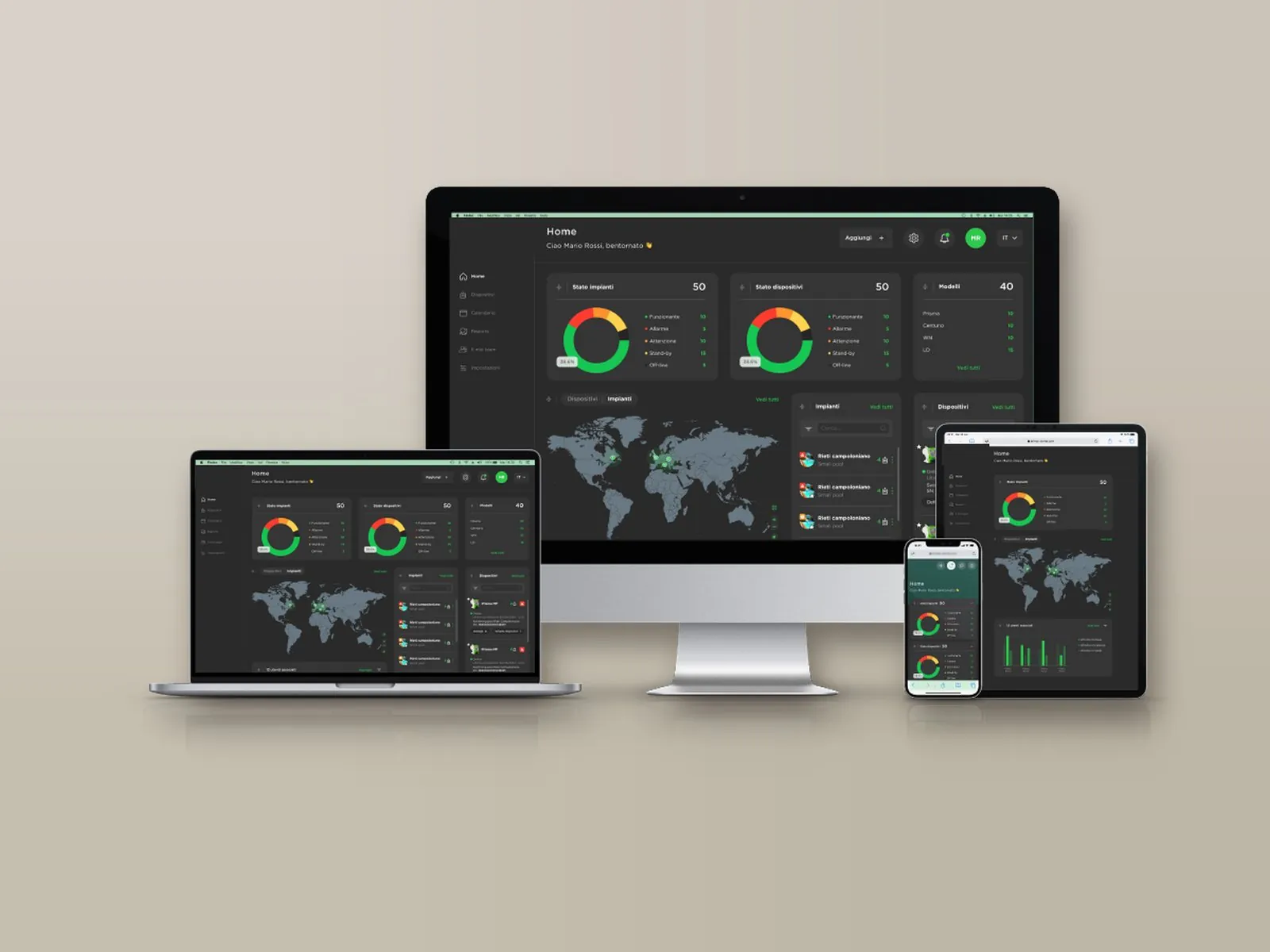
On a single screen: probe readings, chemical levels, pump activation thresholds and active alarms, with the status of installations and devices (normal, warning, alarm, standby, not connected).
Installations appear on an interactive map with their status and open with a click; for each one, the local weather conditions and temperature are also shown.
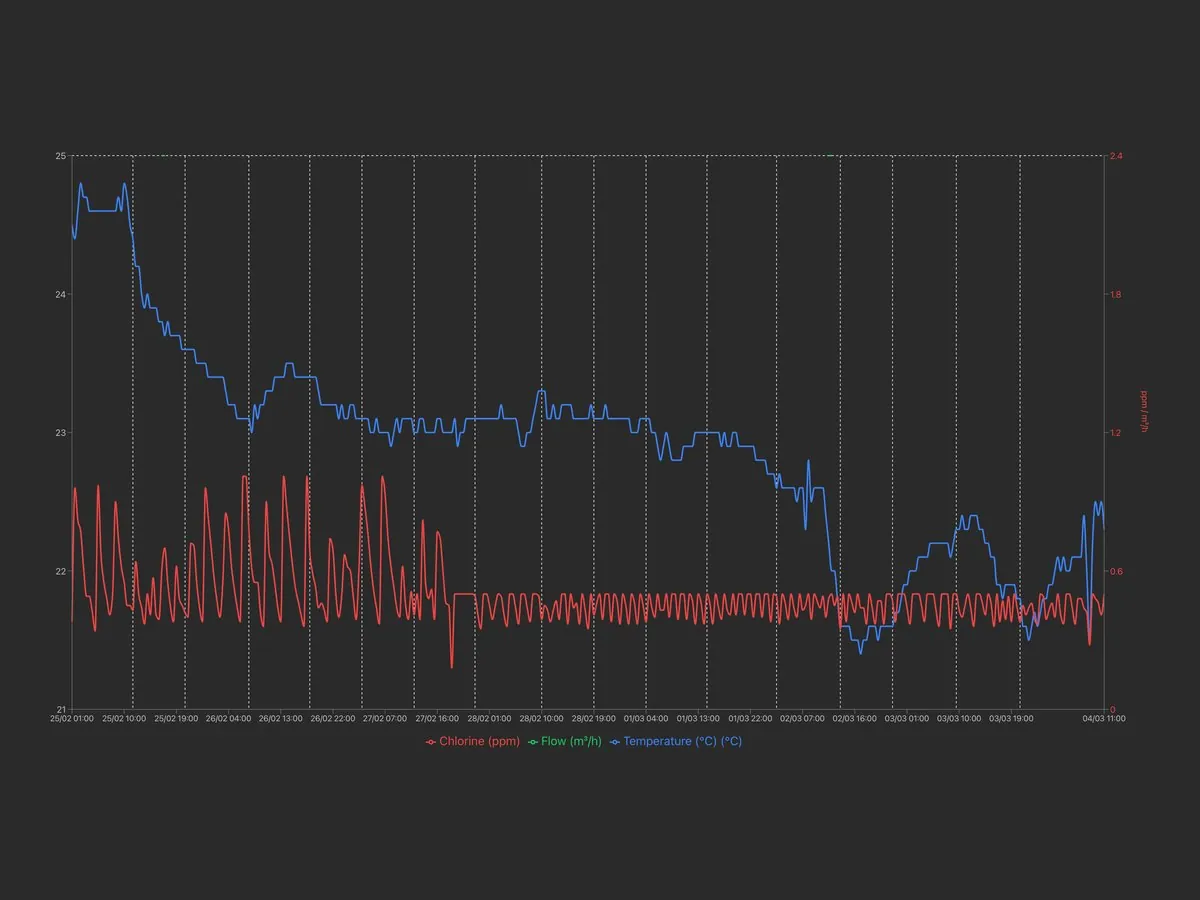
Archive of measurements and alarms, available for consultation at any time with charts and numerical reports exportable in Excel format.
Alarm thresholds for readings, dosing, faulty probe and out-of-range readings, with notification by e-mail or SMS depending on the communication system; a warning is also issued when an installation remains disconnected beyond the set time.
Remote modification of the set points, of the dosing pump activation thresholds and of the corresponding hourly flow rate.
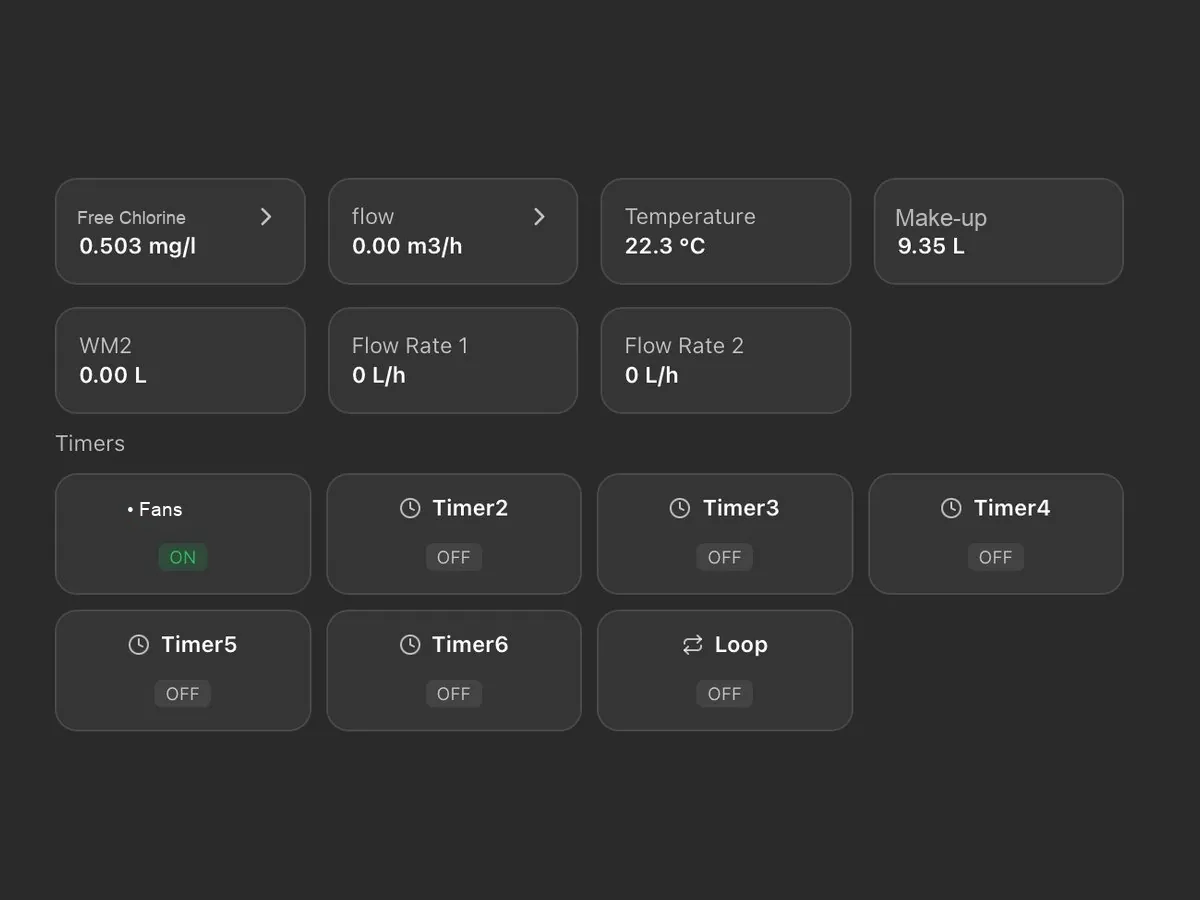
Status of relays, pulse outputs, digital inputs and current outputs, with the name assigned to each connection.
Tasks are scheduled by installation or by device and assigned to technicians; a reminder is sent by e-mail two days before the due date. Each task is shown as scheduled, due, overdue or completed.
The main account has full access and creates the technicians’ accounts, each enabled only for the assigned installations and devices; the last login and activity of each technician are visible.
Reports on devices, tasks and technicians, downloadable in PDF or CSV with the customer’s logo; the log keeps the history of operations and disconnections.
Logo, main colour and light or dark theme; the tiles on the main screen can be rearranged by dragging them. Two installations can be displayed side by side for comparison.
Each device is added through a guided procedure: the model is recognised automatically and associated with the installation, together with the technician to be contacted.
As an alternative to the portal, the Modbus RTU or TCP/IP port allows integration into the plant supervision system.
Hospitals, large residential buildings, shopping centres.
Food, paper, pharmaceutical, chemical, sugar refineries, through to steelworks.
Cooling tower manufacturers, water treatment companies and chemical suppliers.
When the conductivity set point is reached, the controller opens the drain valve, with opening delay, dead band and safety timer (timeout): beyond the set time the drain closes and the alarm is triggered.
Inputs for pulse-output water meters: counting of make-up and drain volumes and control of the cycles of concentration.
Models: Centurio Tower, MTOWER PLUS, MTOWER 2CH, MTOWER 1CH
The antiscalant is dosed in proportion to the make-up water (via a water meter or at constant ppm), together with the bleed-off or for a percentage of its duration.
Management of two different biocides with daily or weekly scheduling, alternated to prevent microorganisms from adapting to a single product.
Models: Centurio Tower, MTOWER PLUS, MTOWER 2CH, MTOWER 1CH
Two outputs dedicated to pre-biocides, dosed for the set time before the biocide: they generally act as activators of the subsequent dosing.
Models: Centurio Tower, MTOWER PLUS, MTOWER 2CH, MTOWER 1CH
Before biocide dosing the controller opens the drain, on a timed basis or down to a lower conductivity value; with conductivity-based pre-bleed, the bleed-off timeout applies.
After biocide dosing the drain remains inhibited for the set time, so as to ensure the necessary contact time and prevent loss of chemical through the drain.
pH measurement and dosing of acid or base, for pH-controlled towers.
Models: Centurio Tower, MTOWER PLUS, MTOWER 2CH
The oxidising biocide is dosed according to the Redox potential or the concentration in mg/l measured by an amperometric cell (chlorine, bromine, chlorine dioxide…).
Models: Centurio Tower, MTOWER PLUS, MTOWER 2CH
The fluorimeter measures the tracer added to the antiscalant, making it possible to determine the actual concentration of the product in the water.
Models: Centurio Tower
Corrosion probe in MPY and turbidity probe managed by the same controller.
Models: Centurio Tower
Controller and two dosing pumps (antiscalant and biocide) combined in a single unit, in peristaltic or solenoid version.
Models: WT
Colour touch screen, data logging with graphical display, simultaneous management of up to 10 measurement parameters.
Models: Centurio Tower
The biocide is dosed with scheduled daily or weekly activations, or in proportion to the litres of make-up water measured by the pulse-output water meter.
Models: WT
In the absence of flow in the probe holder (circulation pump stopped), dosing is suspended and the alarm is triggered.
For chlorine and other disinfectants the basic solution is the dosing station; to dose according to the concentration actually present in the water, measuring controllers are used.
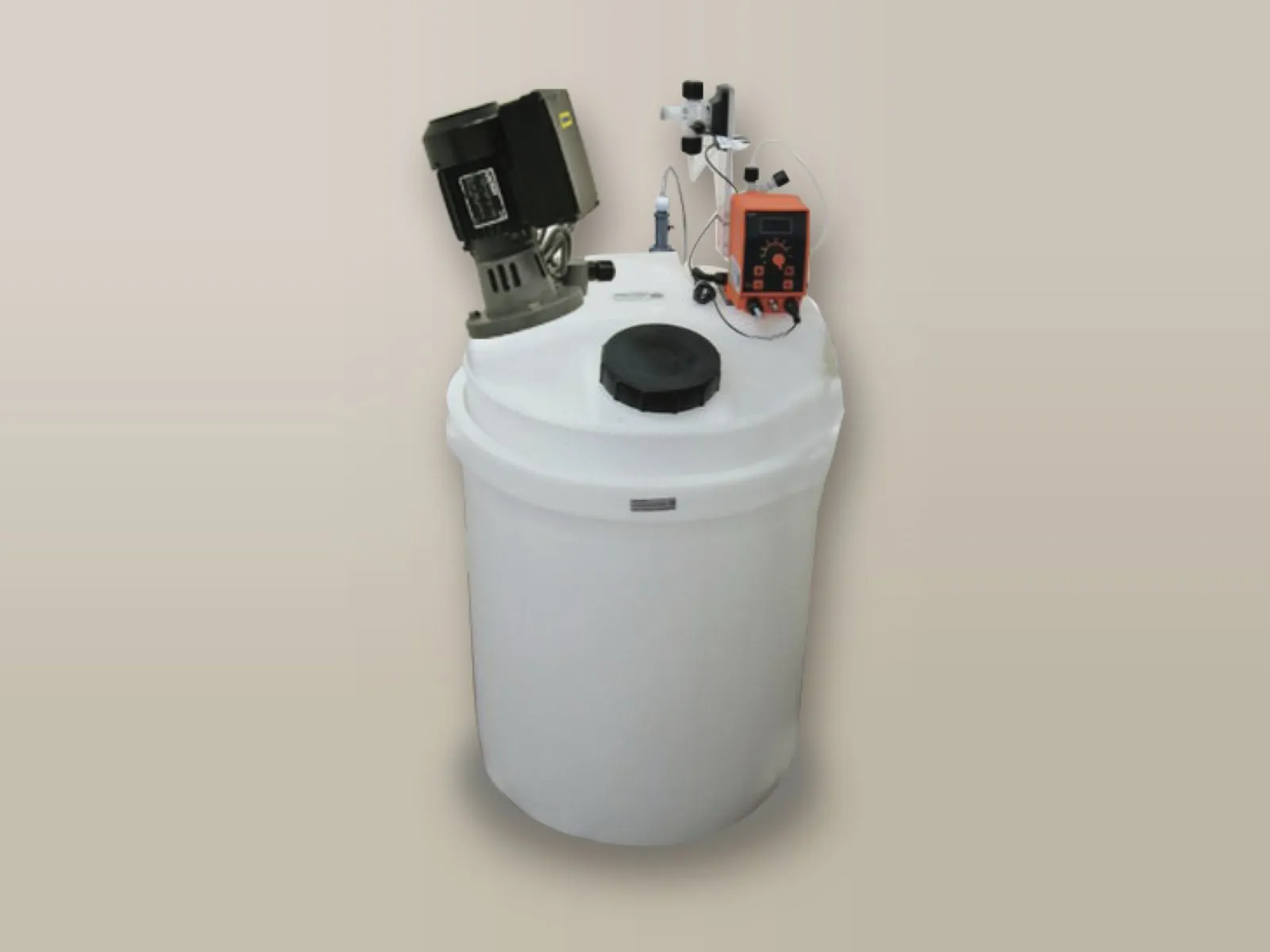
The simplest solution: the pump doses at a constant rate or in proportion to the volume of water measured by the pulse-output water meter.
Details →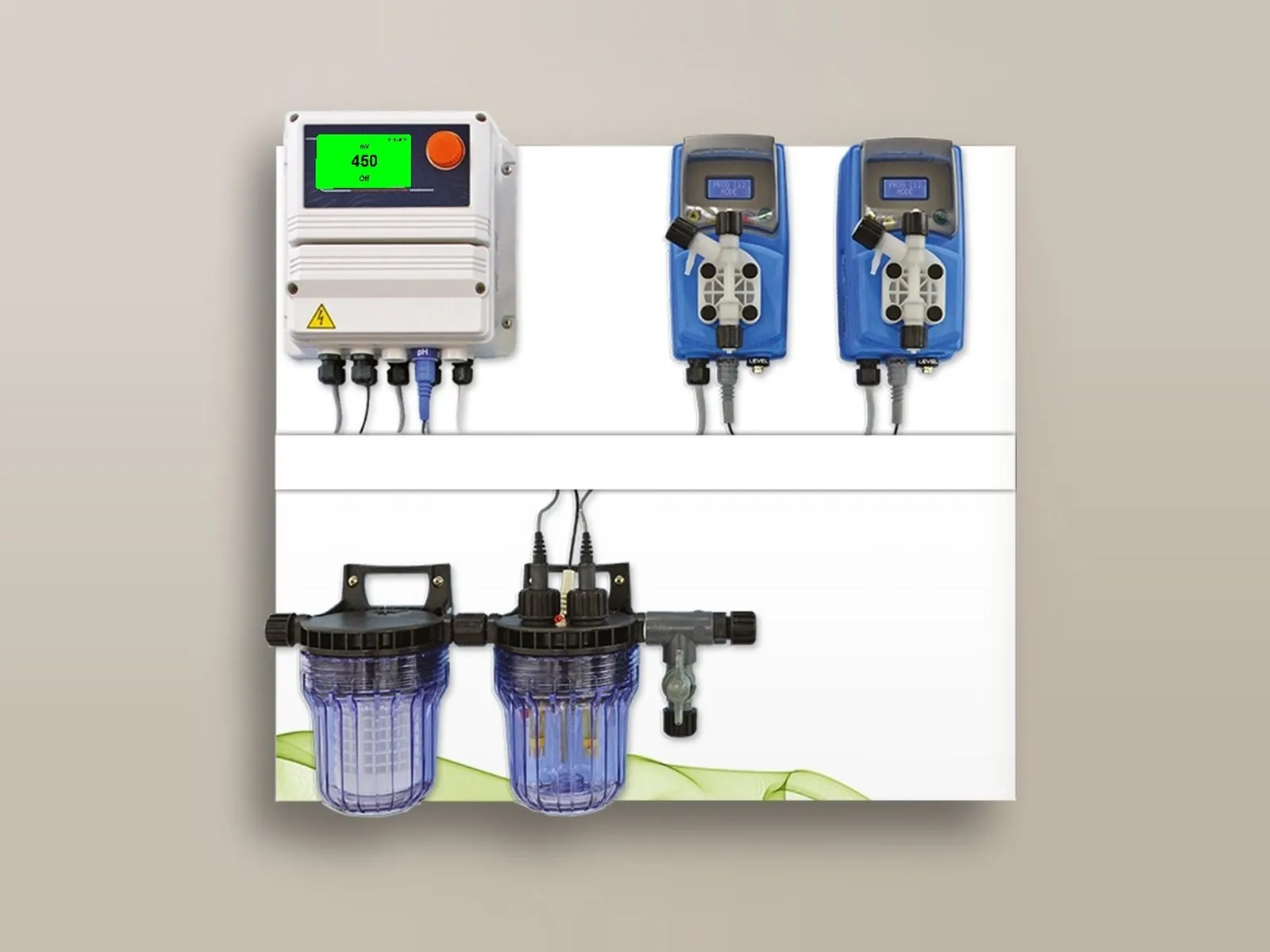
Dosing based on the Redox potential of the water: an economical solution, based on an indirect measurement.
Details →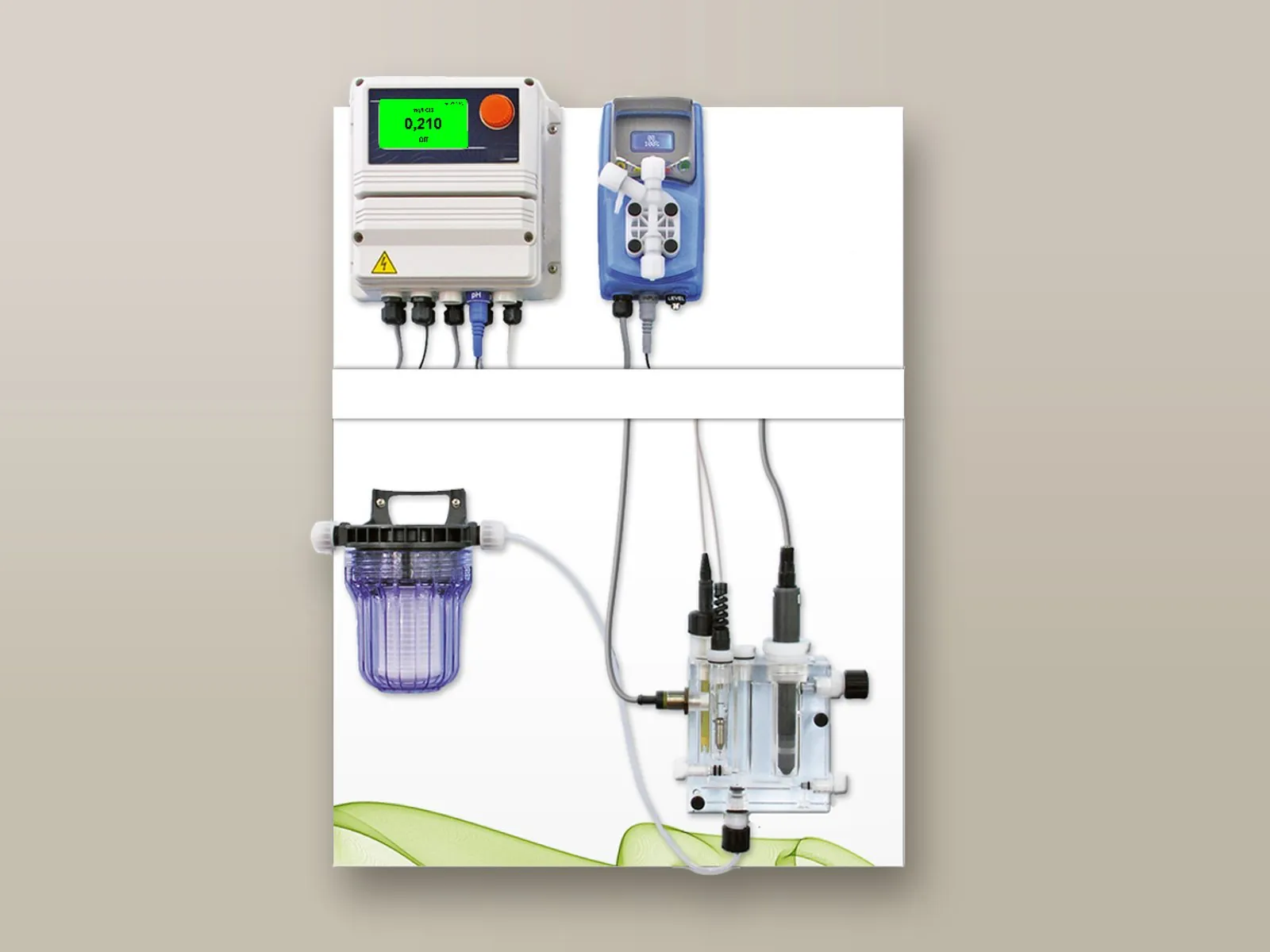
The amperometric cell directly measures the disinfectant concentration in mg/l, ensuring maximum dosing accuracy.
Details →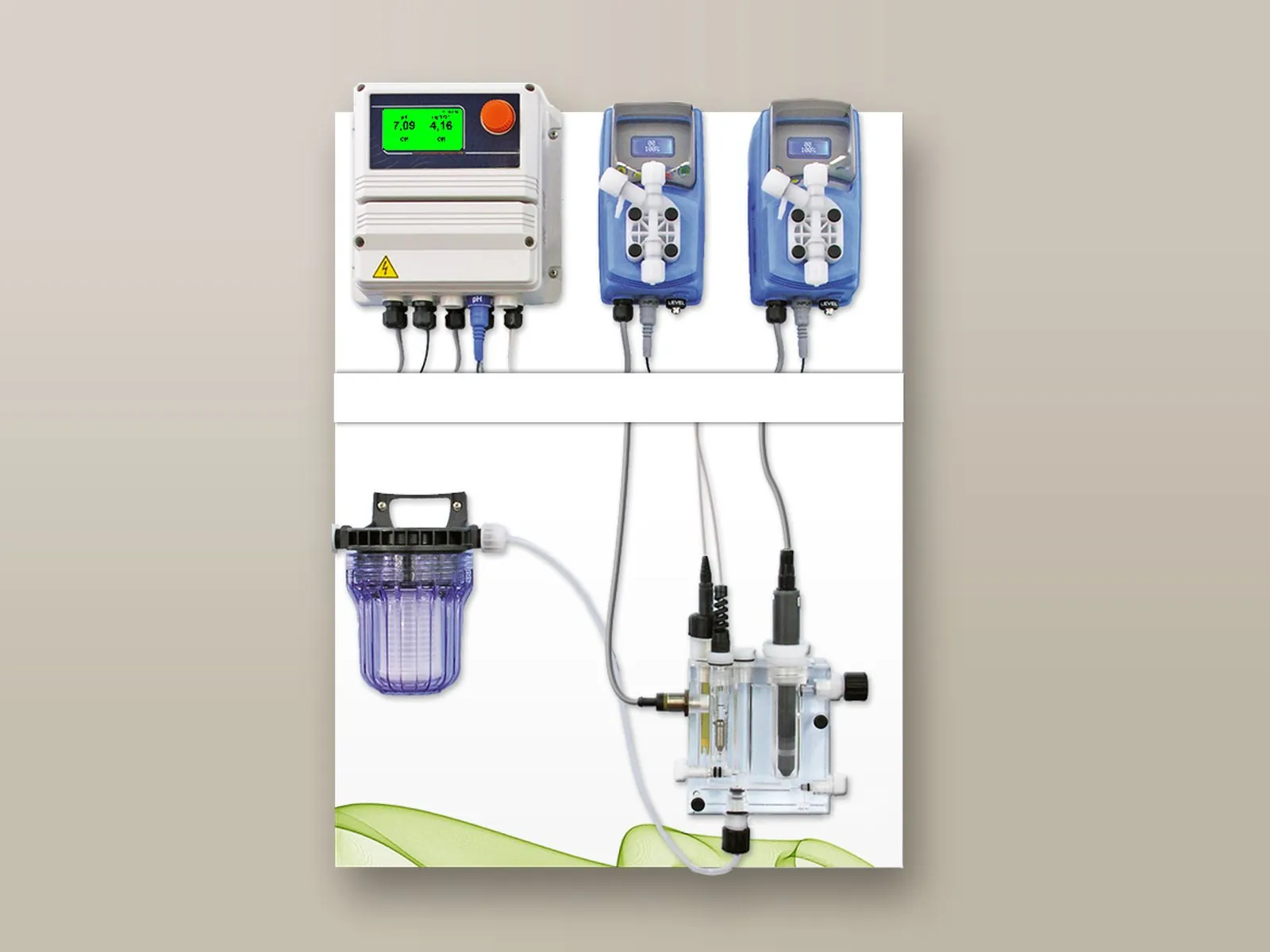
Simultaneous management of two parameters, for example pH and chlorine, with a single controller.
Details →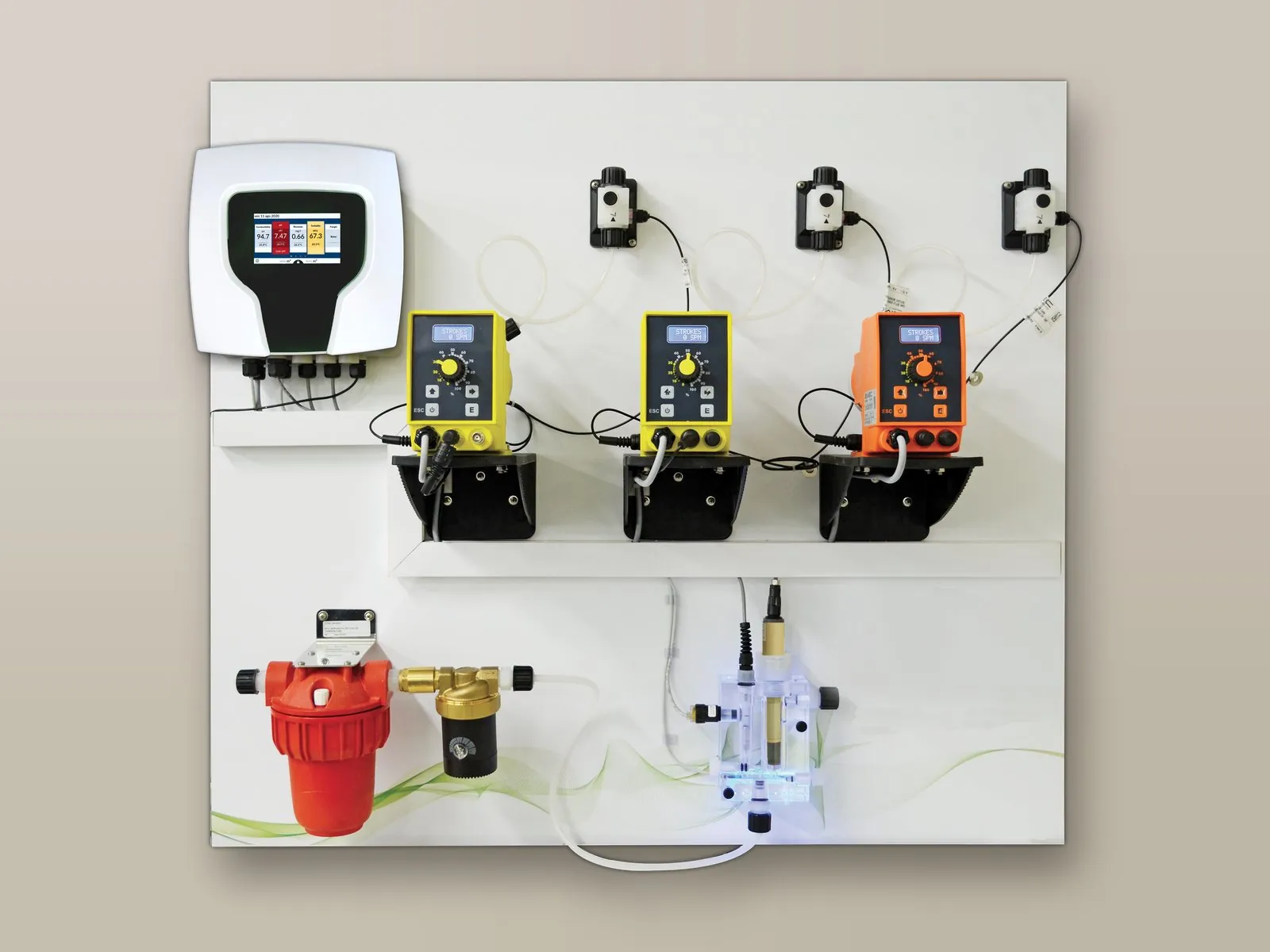
Management of up to 10 parameters and of all the pumps in the installation, with touch screen and remote control as standard.
Details →Tell us the characteristics of the tower, the recirculation flow rate and the products used: we will propose controller, probes, pumps and panel, supplied assembled and tested.
Call or write to us: a technician will reply with a tailored proposal of controllers, pumps, probes and accessories.