Linear polarisation
A small potential shift relative to the corrosion potential is applied to the test electrodes and the resulting current is measured: their ratio gives the instantaneous corrosion rate, expressed in MPY (mils per year).
Probes for the continuous monitoring of corrosion. In addition to the general corrosion rate, they measure electrochemical noise, from which they derive an index of localised corrosion (pitting), and compensate for the conductivity of the water. Two versions: E-CORR COLD for cold water and E-CORR HOT for hot water.
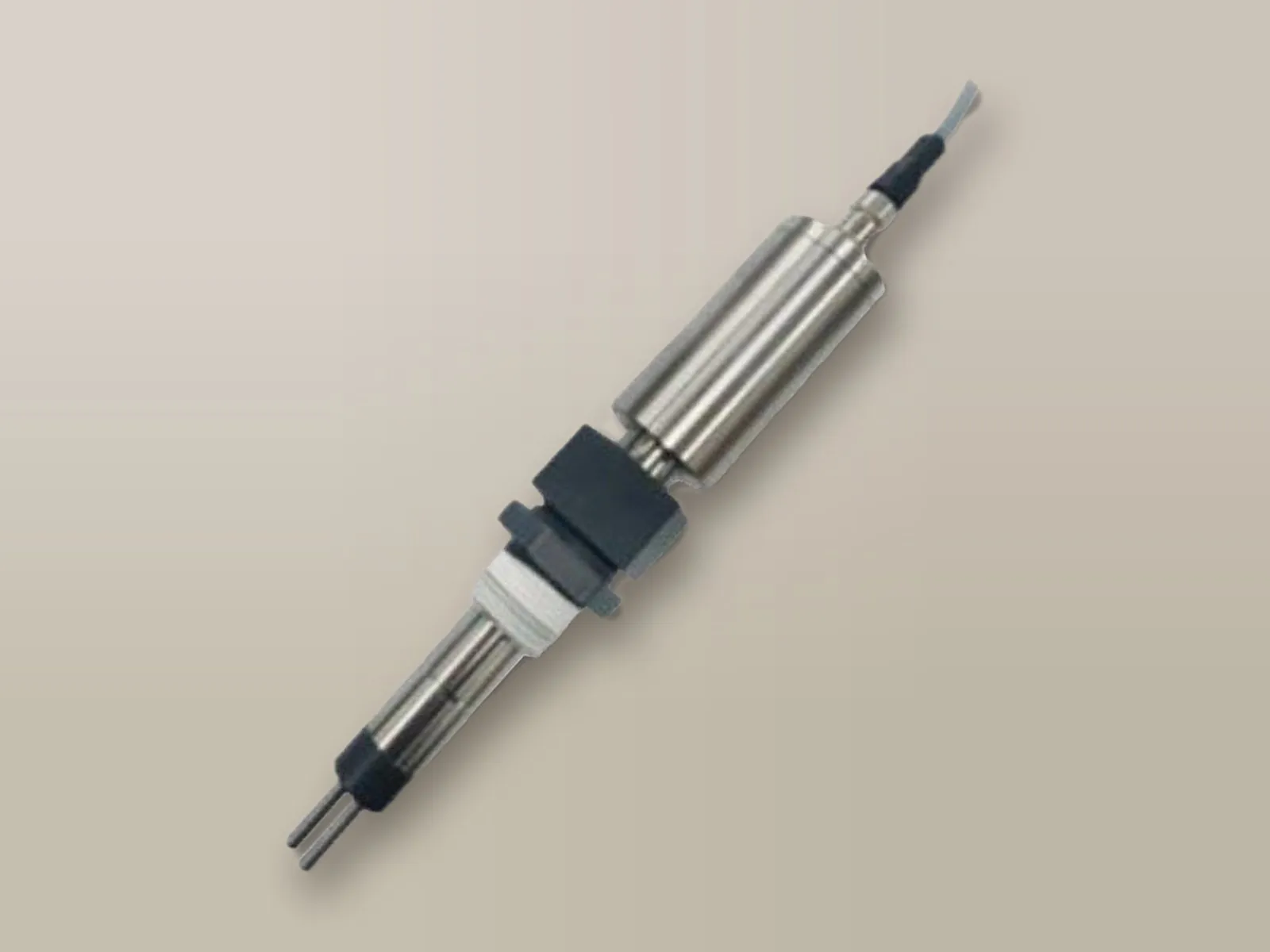
A small potential shift relative to the corrosion potential is applied to the test electrodes and the resulting current is measured: their ratio gives the instantaneous corrosion rate, expressed in MPY (mils per year).
The probe also measures electrochemical noise and derives from it an index from 0 to 100 of localised corrosion, or pitting: the value 100 corresponds to AISI 304 stainless steel in 10% ferric chloride.
The signal is conditioned, amplified and digitised inside the probe, without separate transmitters: this avoids the interference and attenuation caused by long cables. The probe also measures the conductivity of the water and compensates for its effect on the measurement.
For cold water: evaporative cooling towers, cooling towers and closed cooling circuits. AISI 304 stainless steel body with protection against electromagnetic interference; three O-rings on the body allow the insertion depth to be adjusted.
For hot water and the most demanding conditions: heating and district heating circuits, geothermal plants, process water at high temperature and pressure. Titanium and PEEK body, with integrated cooling fins for high-temperature applications.
Corrosion depends on the chemistry and physics of the water (composition, temperature, velocity, conductivity) and on the pipe material: continuous measurement makes it possible to assess the effects of the chemical treatment in real time and to correct it.
The probe measurement is instantaneous, whereas removable coupons give the average weight loss over a long period: the two values are correlated but not necessarily equal. The probe is used to follow the trend and adjust the treatment; coupons may be used alongside it for comparison.
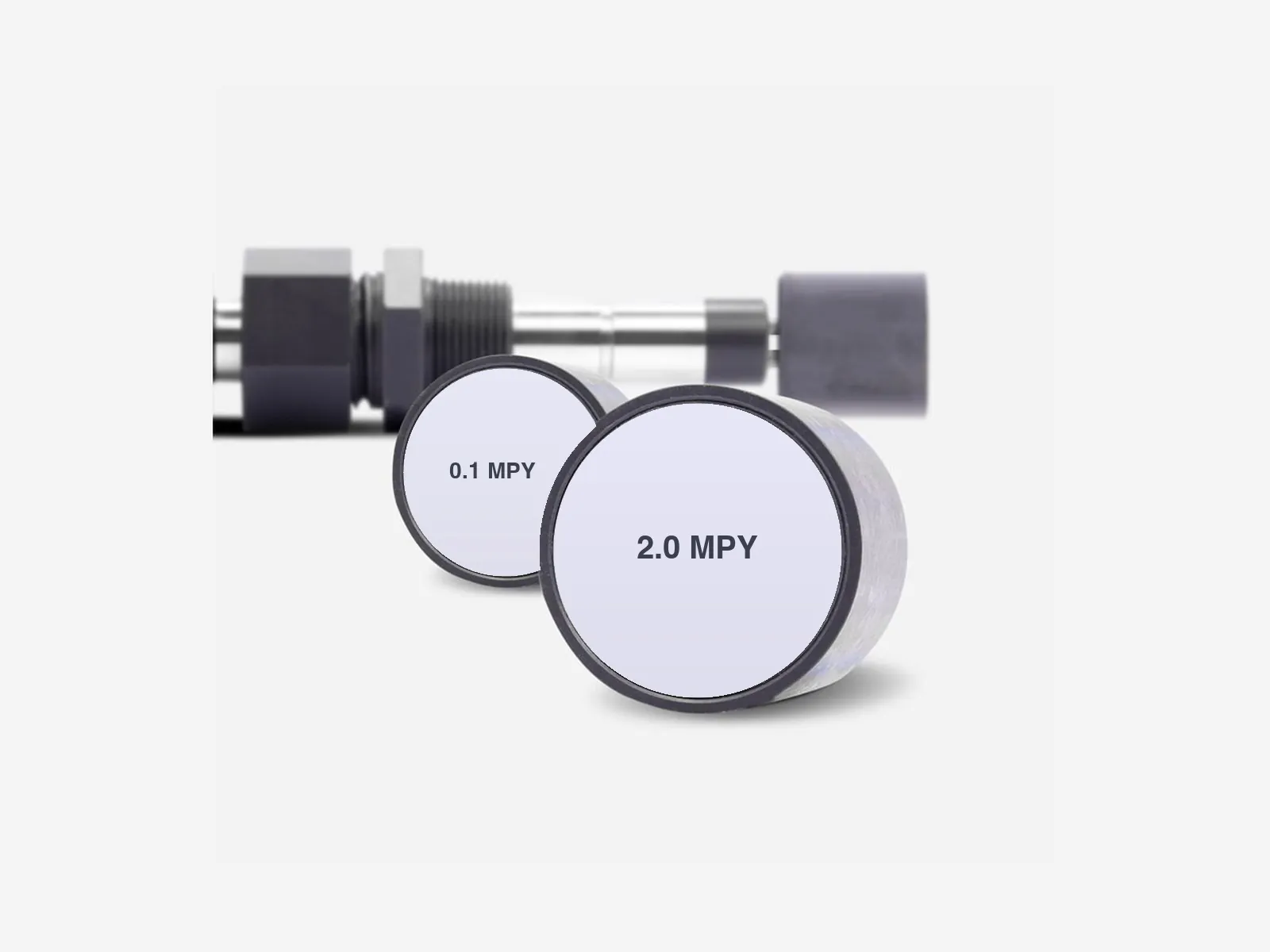
The electrodes must be replaced when heavily corroded; deposits not caused by corrosion, such as calcium carbonate, must be removed from the body and the base of the electrodes. The probe must not be left for long periods in stagnant water. Two test plugs, of 2.0 and 0.1 MPY, verify correct operation.
| E-CORR COLD | E-CORR HOT | |
|---|---|---|
| General corrosion | 0.001 – 10 MPY | 0.001 – 995 MPY |
| Localised corrosion | index 0 – 100 | index 0 – 100 |
| Resolution | 0.001 MPY | 0.001 MPY or 1% of reading |
| Conductivity compensation | 10 – 10,000 µS/cm | 10 – 50,000 µS/cm |
| Reading interval | 1, 2, 5 or 20 min | 3 – 1,440 min |
| Alloy factor | 0 – 3 | 0 – 3 |
| Operating temperature | −10 / +50 °C | −10 / +240 °C |
| Operating pressure | 7 bar | 34.5 bar |
| Power supply | 24 VDC, 2 W | 24 VDC, 2 W |
| Outputs | 2 × 4/20 mA (general and localised), RS485 | 2 × 4/20 mA (general and localised), RS485 Modbus |
| Installation | In-line, NPT threaded connection | In-line, 3/4" NPT or BSP connection |
| Body | AISI 304 | Titanium and PEEK |
| Dimensions | 281.5 mm, Ø 23 / 43 mm | 280 mm, Ø 52 mm |
| Weight | 687 g | 1,150 g |
| Cable | 1.5 m, extensions available | 1.5 m, extensions available |
| Protection | IP65 | IP68 |
Tell us about your application: our technical staff will recommend the most suitable model, configuration and accessories.
Call or write to us: a technician will reply with a tailored proposal of controllers, pumps, probes and accessories.