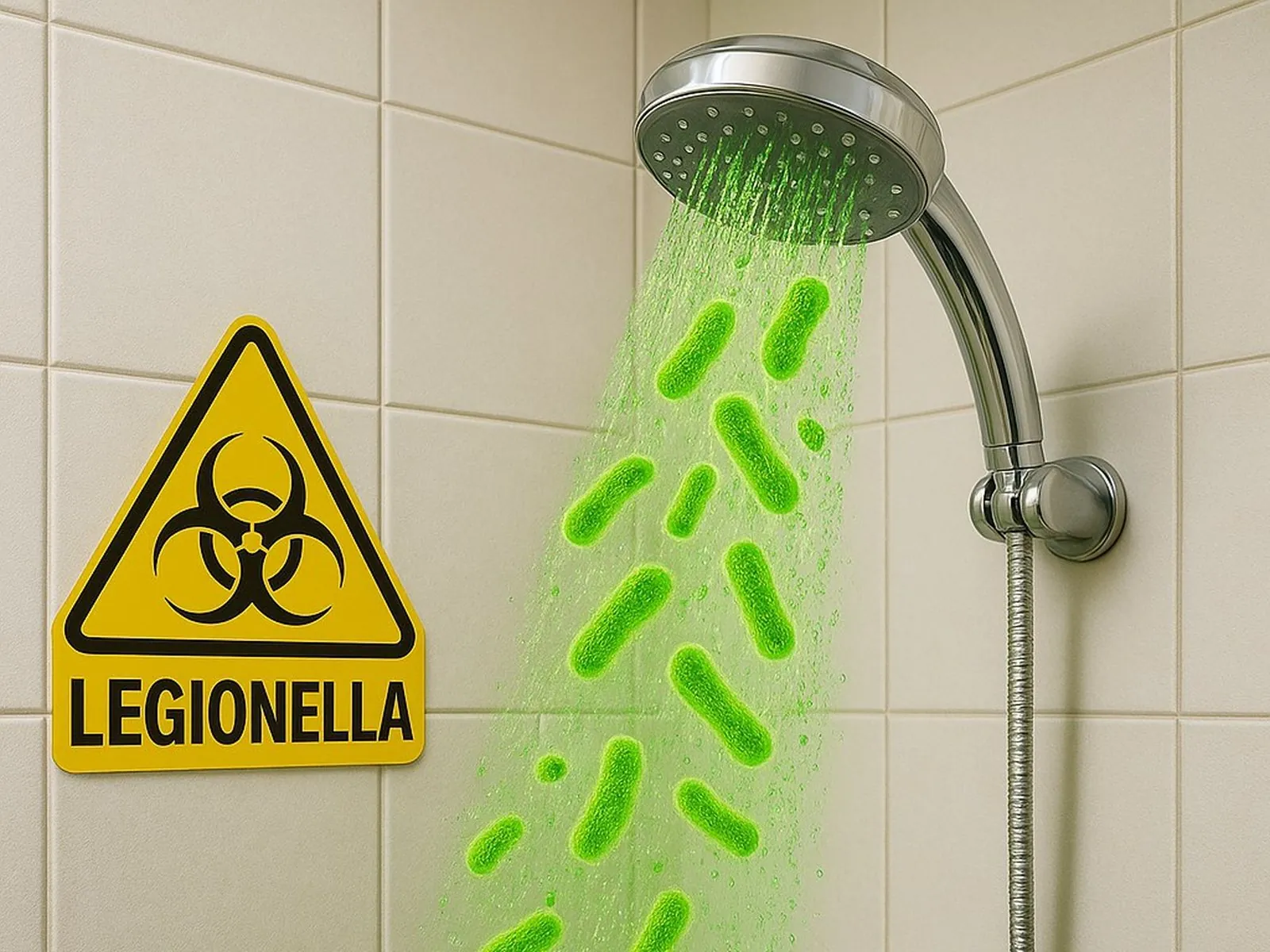
Showers and washbasins
Showers, washbasins, humidifiers and nebulisers: droplets of nebulised water are the route of infection.
Legionella is present at low concentrations in all natural waters and proliferates in water systems where there is stagnation, rust and biofilm, particularly between 25 and 55 °C. Transmission occurs through the inhalation of droplets of contaminated water. The prevention criteria and the available treatment systems are described below.
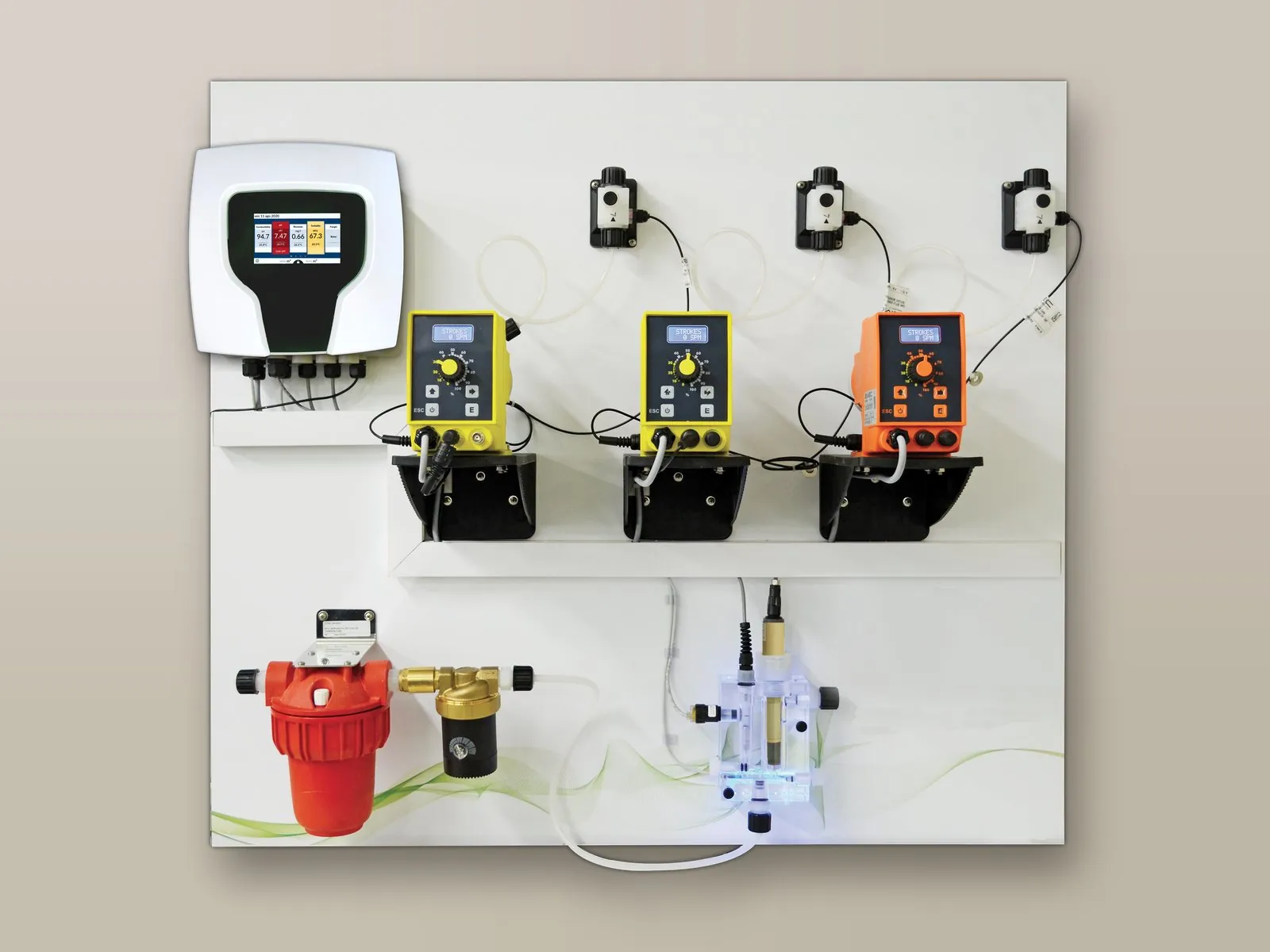
From natural environments (cold and thermal springs, rivers, lakes, soil) Legionella reaches municipal water networks and public and private water systems. Accommodation facilities (hotels, swimming pools), healthcare facilities (hospitals, care homes, nursing homes) and industrial facilities (cooling towers) require particular attention and appropriate treatment.
Showers, washbasins, humidifiers and nebulisers: droplets of nebulised water are the route of infection.
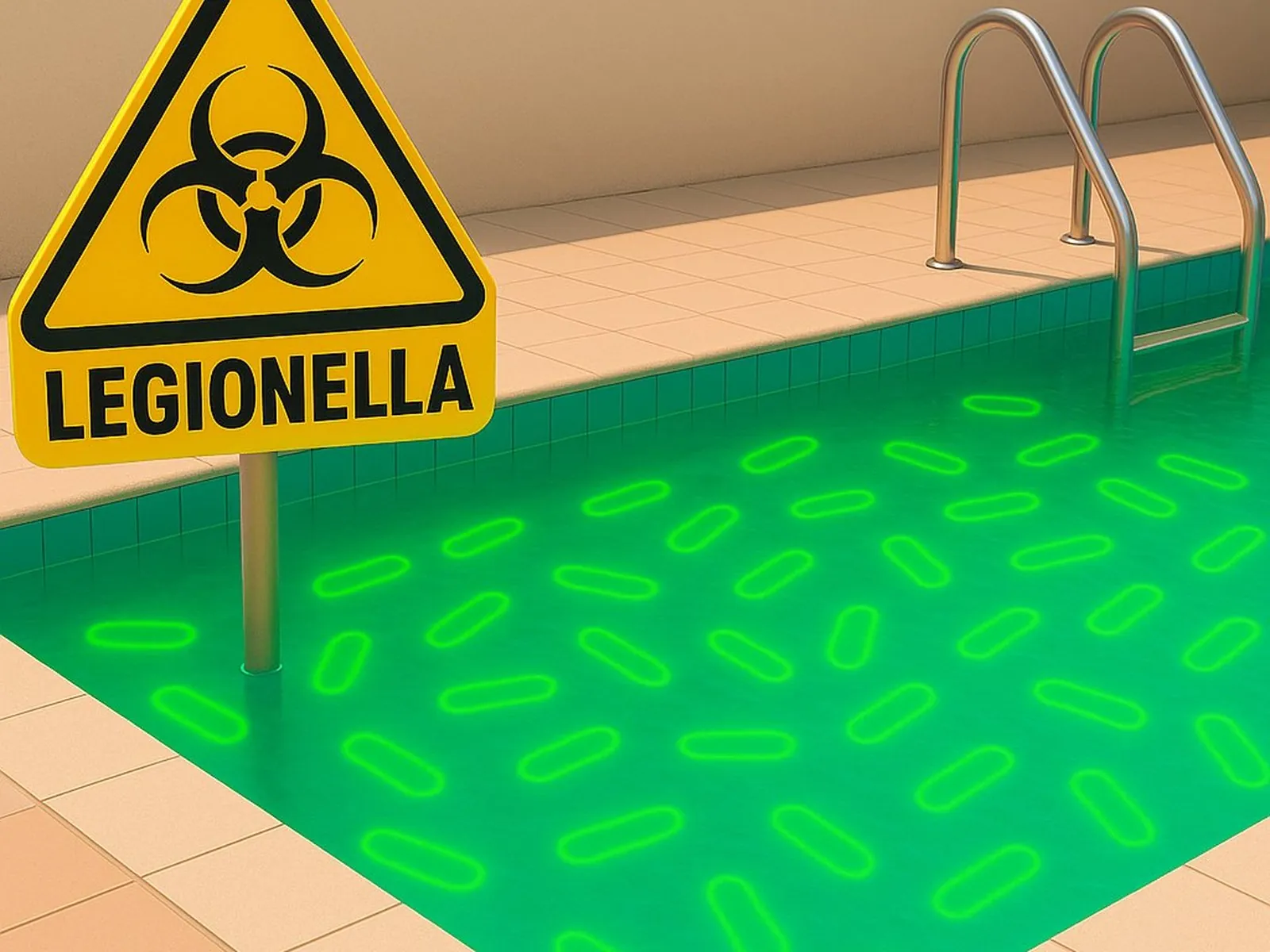
Swimming pools, saunas, steam rooms and whirlpool baths.
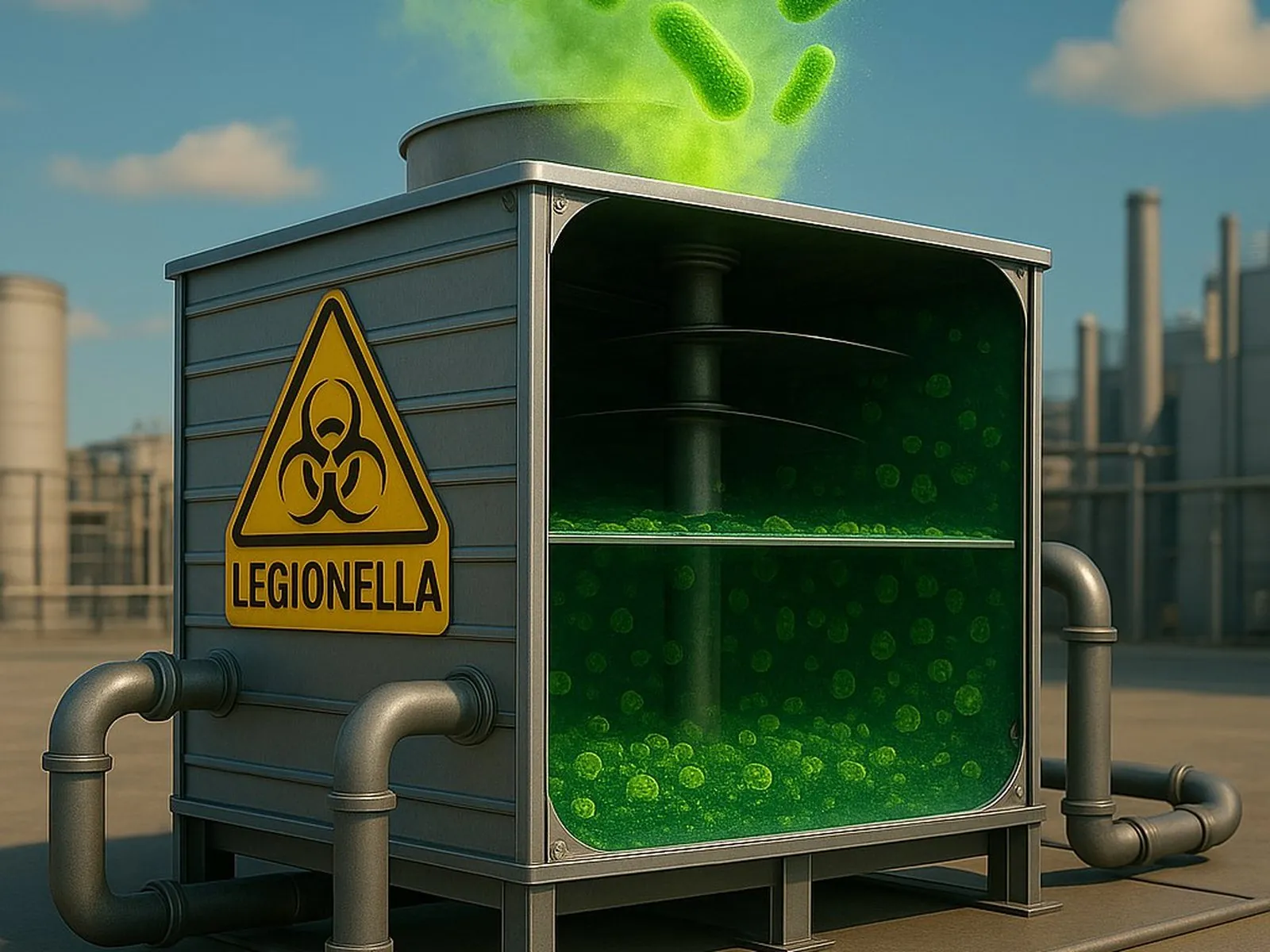
Evaporative cooling towers release water droplets into the atmosphere.
Cooling towers →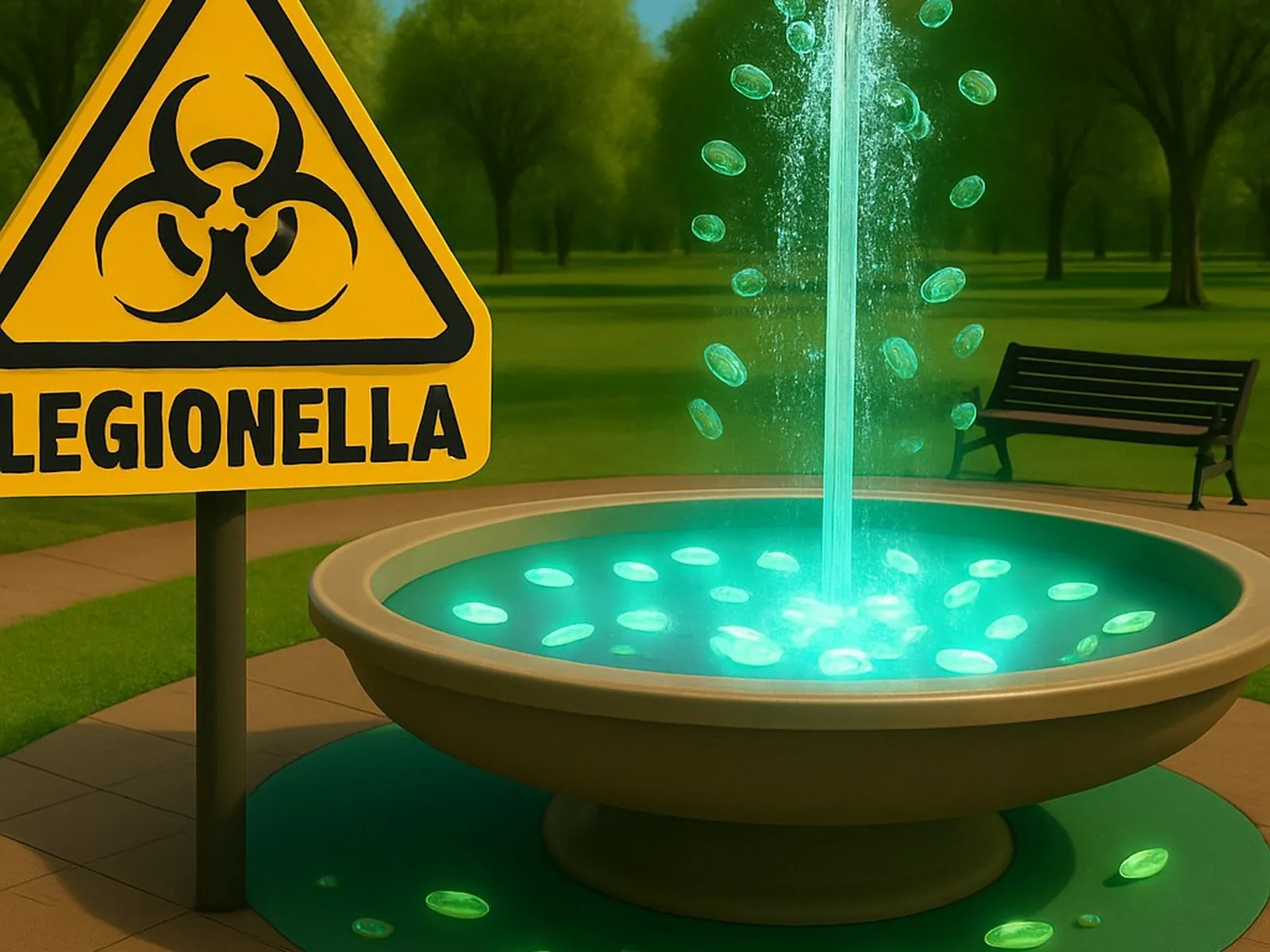
Fountains, sprinklers, water heaters, storage tanks, the lower part of hot water storage tanks and pipework with slow or no circulation.
Legionella and other microorganisms adhere to the walls of tanks and pipework, forming biofilm, similar to dental plaque or to the film that builds up on ship hulls. Rich in nutrients, biofilm protects bacteria from the action of disinfectants; it develops at points of slow flow (branches, bends, fittings, valves) or stagnation (dead legs, taps, shower heads, seals, aerators). With the water flow, fragments of biofilm detach and reach the outlets.
Insight: microorganisms and biofilm →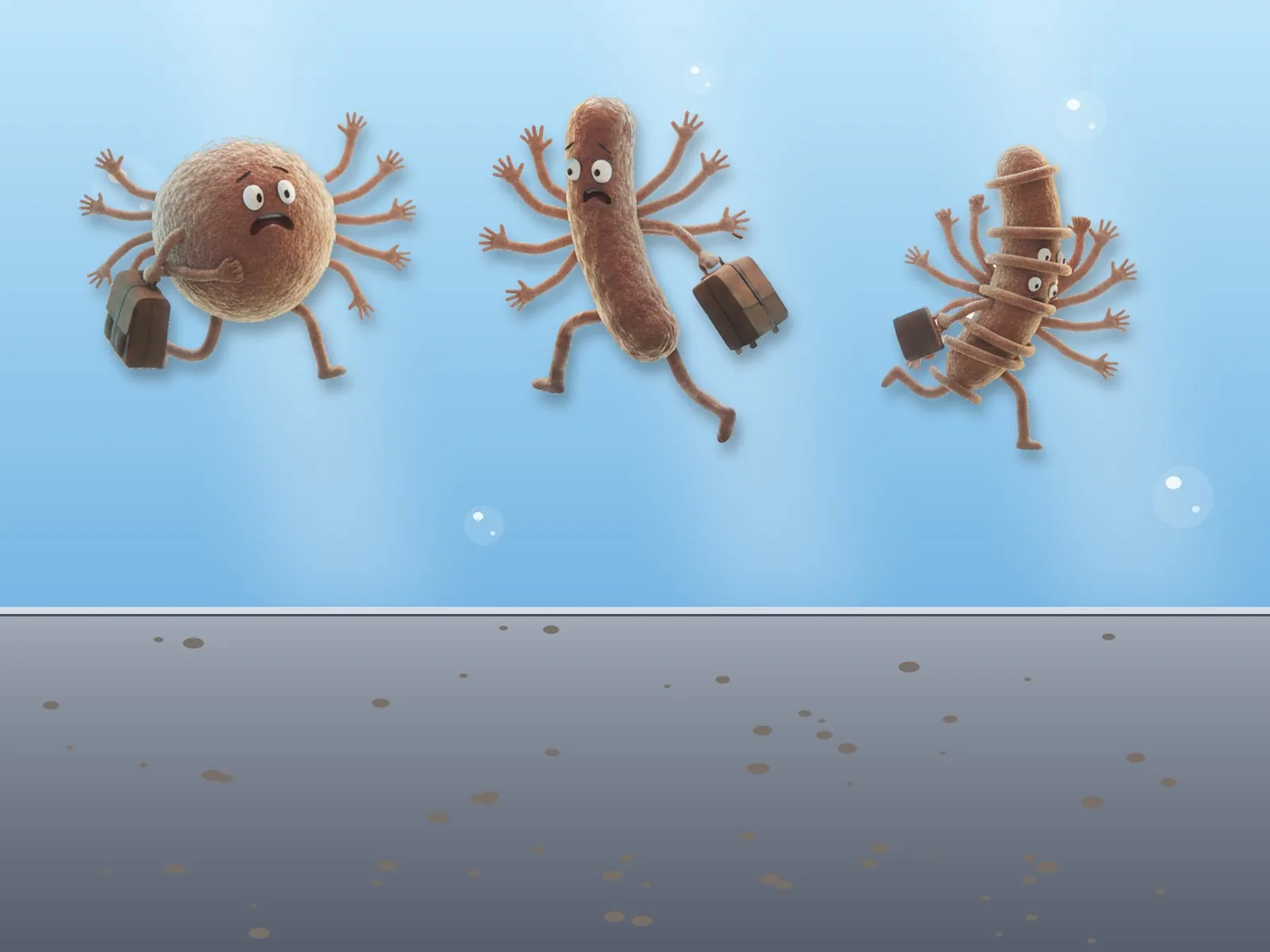
Bacteria, including Legionella, are present in free-floating form in the water coming from natural environments.
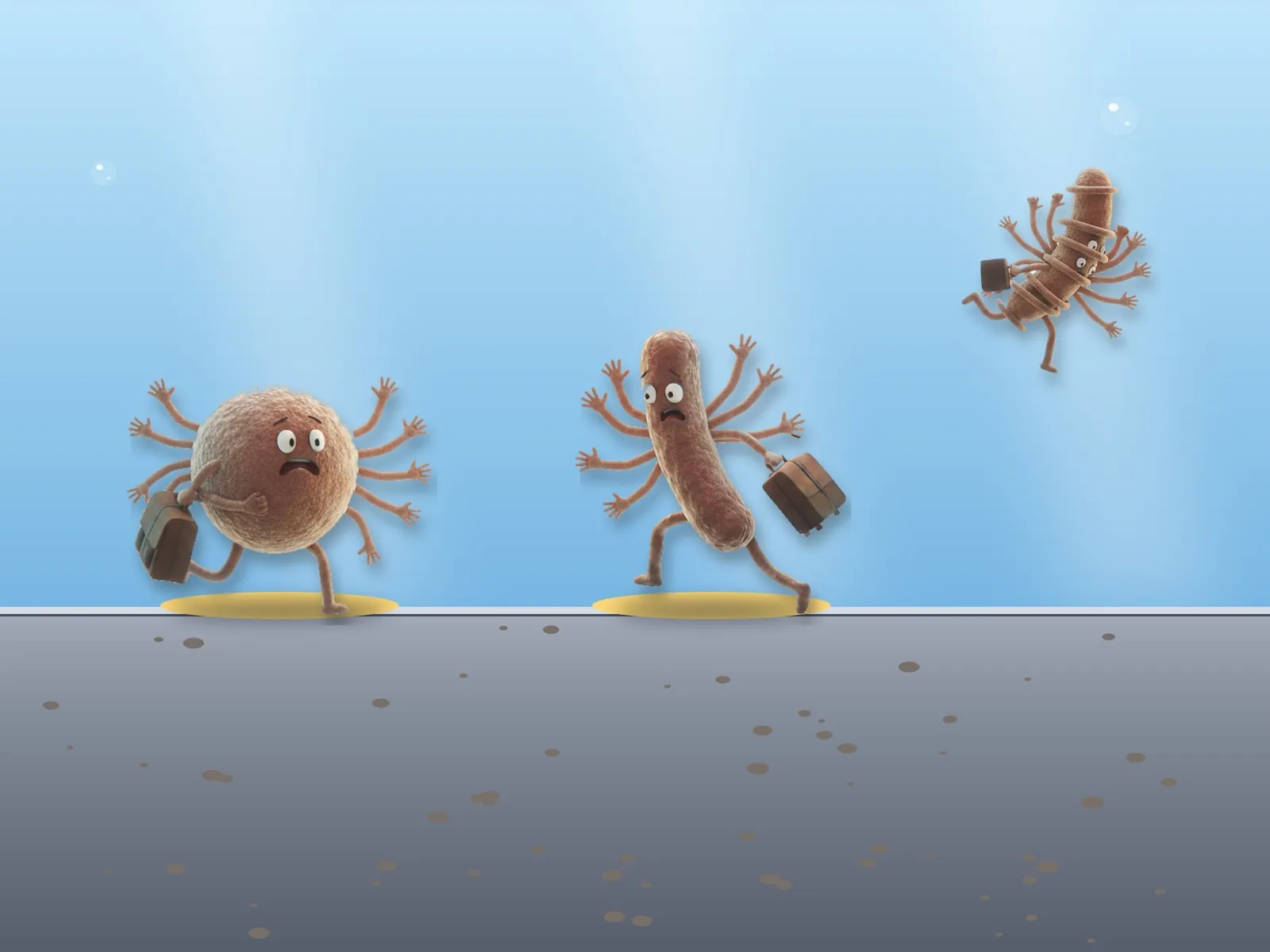
Some of the bacteria adhere to the pipe wall, particularly at points of slow flow or stagnation, producing the first adhesive substances.
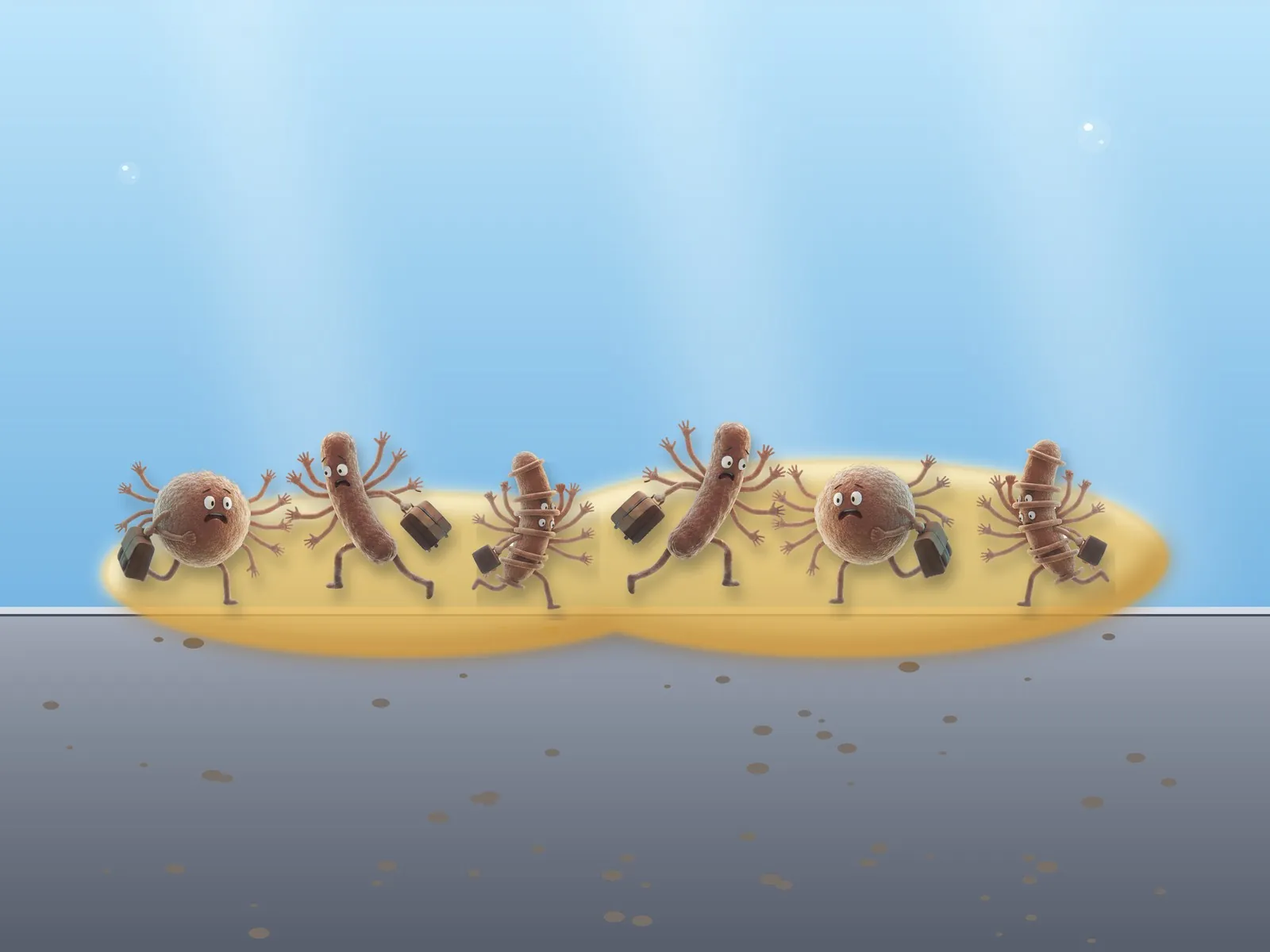
The bacteria multiply and surround themselves with a nutrient-rich gelatinous matrix that protects them from the action of disinfectants.
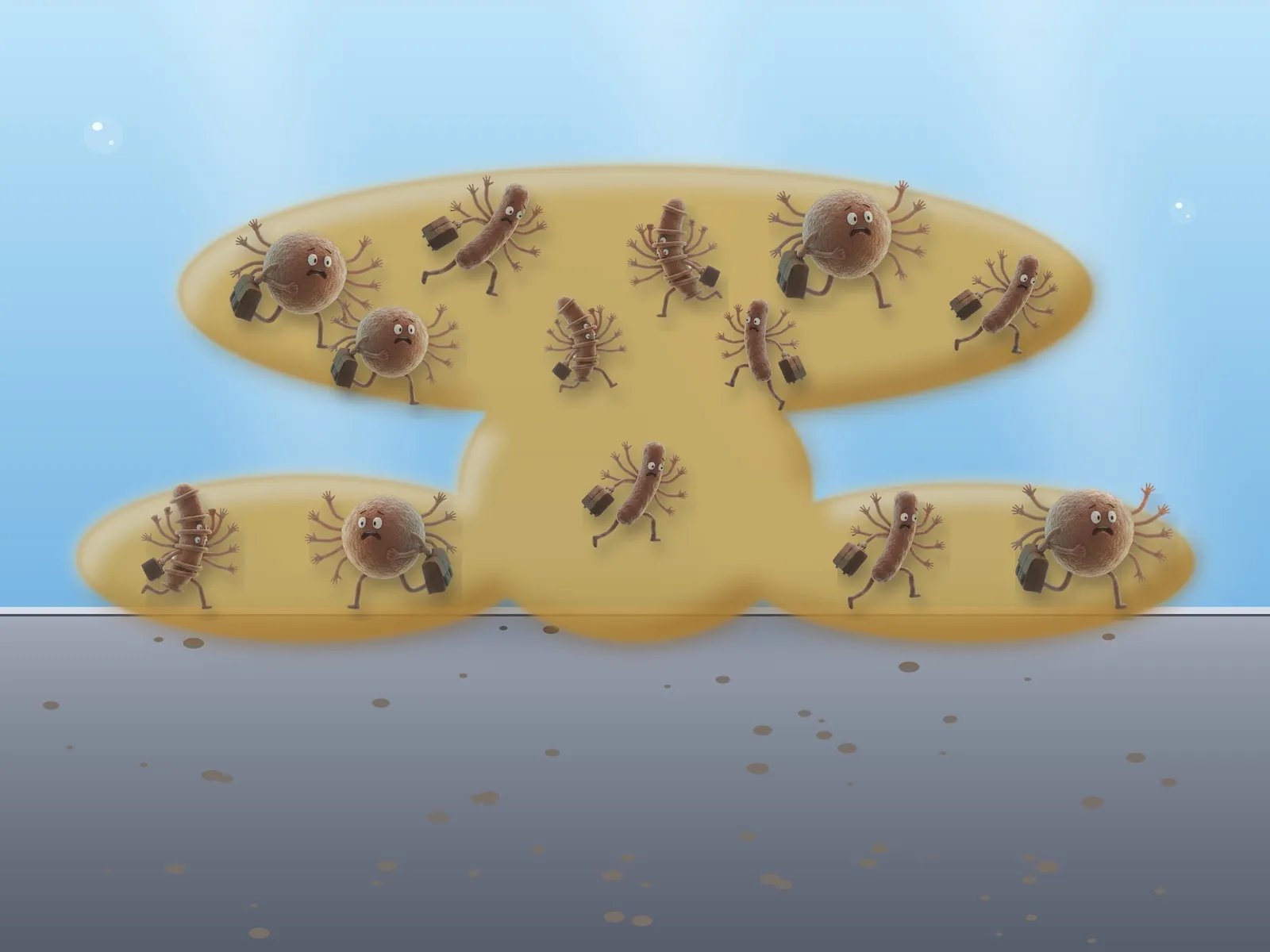
The biofilm grows and becomes organised; limescale and rust in the pipework promote its formation.
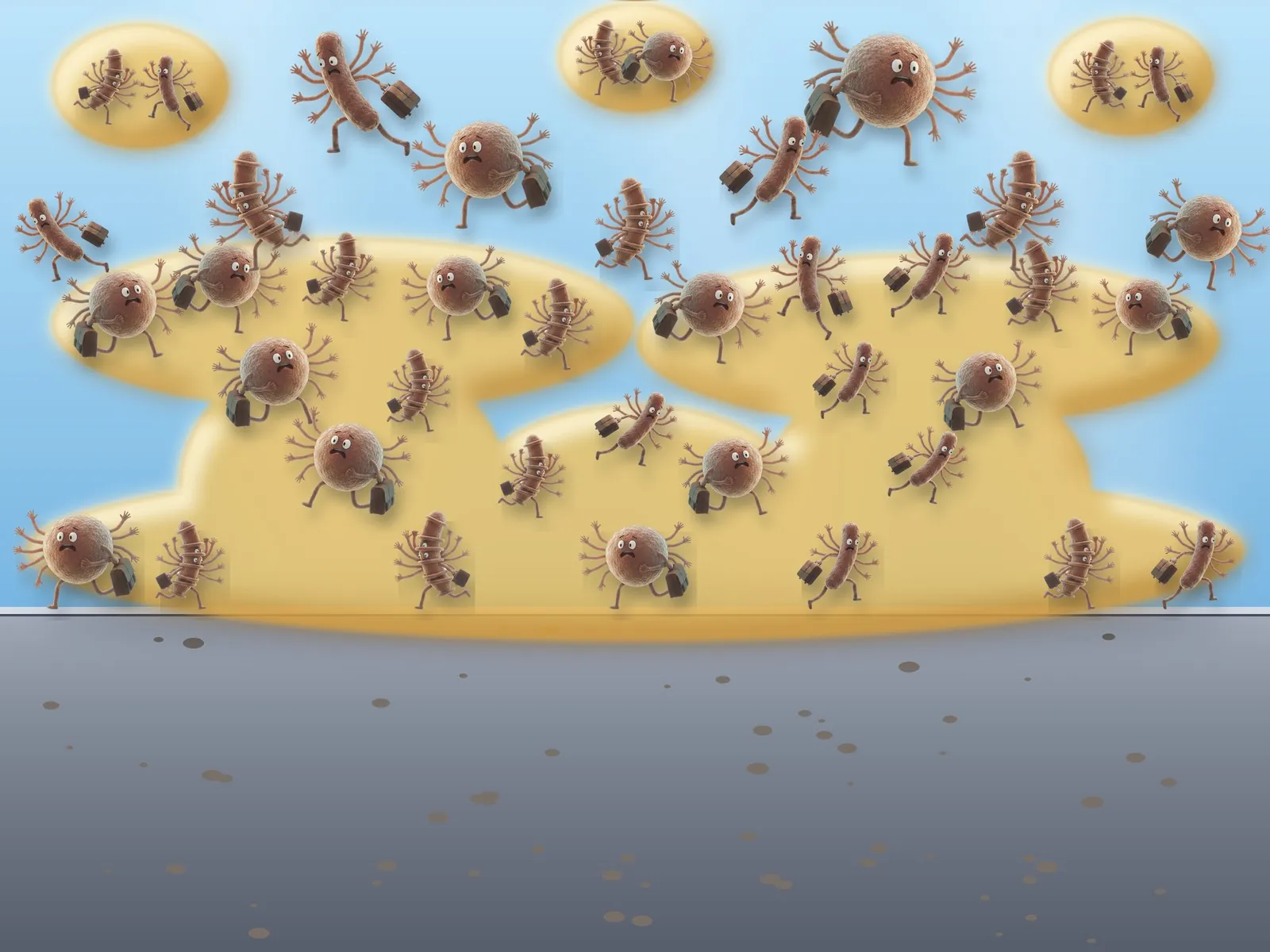
Owing to the flow, portions of biofilm detach: the bacteria reach the outlets and colonise other areas of the system.
Limescale and rust promote biofilm formation: it is advisable to reduce water hardness and to dose polyphosphates with an antiscalant and pipe-protecting action. To control Legionella, in addition to keeping hot water between 50 and 60 °C, chemical disinfection treatment is required.
Those responsible for water systems are required to draw up a risk assessment document specifying the planned measures, their frequency and the means adopted to reduce exposure. If an employee or a guest becomes infected, the person in charge of the facility is liable to criminal prosecution.

Italian Guidelines for the prevention and control of legionellosis (2000; 2005 for accommodation and thermal facilities; a single text since 2015): requirements for public and private facilities.
The guidelines →
Italian Legislative Decree 81/2008 (D.Lgs. 81/2008): Legionella is classified as a group 2 biological agent; the risk of exposure requires assessment, prevention and protection for all persons present.
Employer obligations →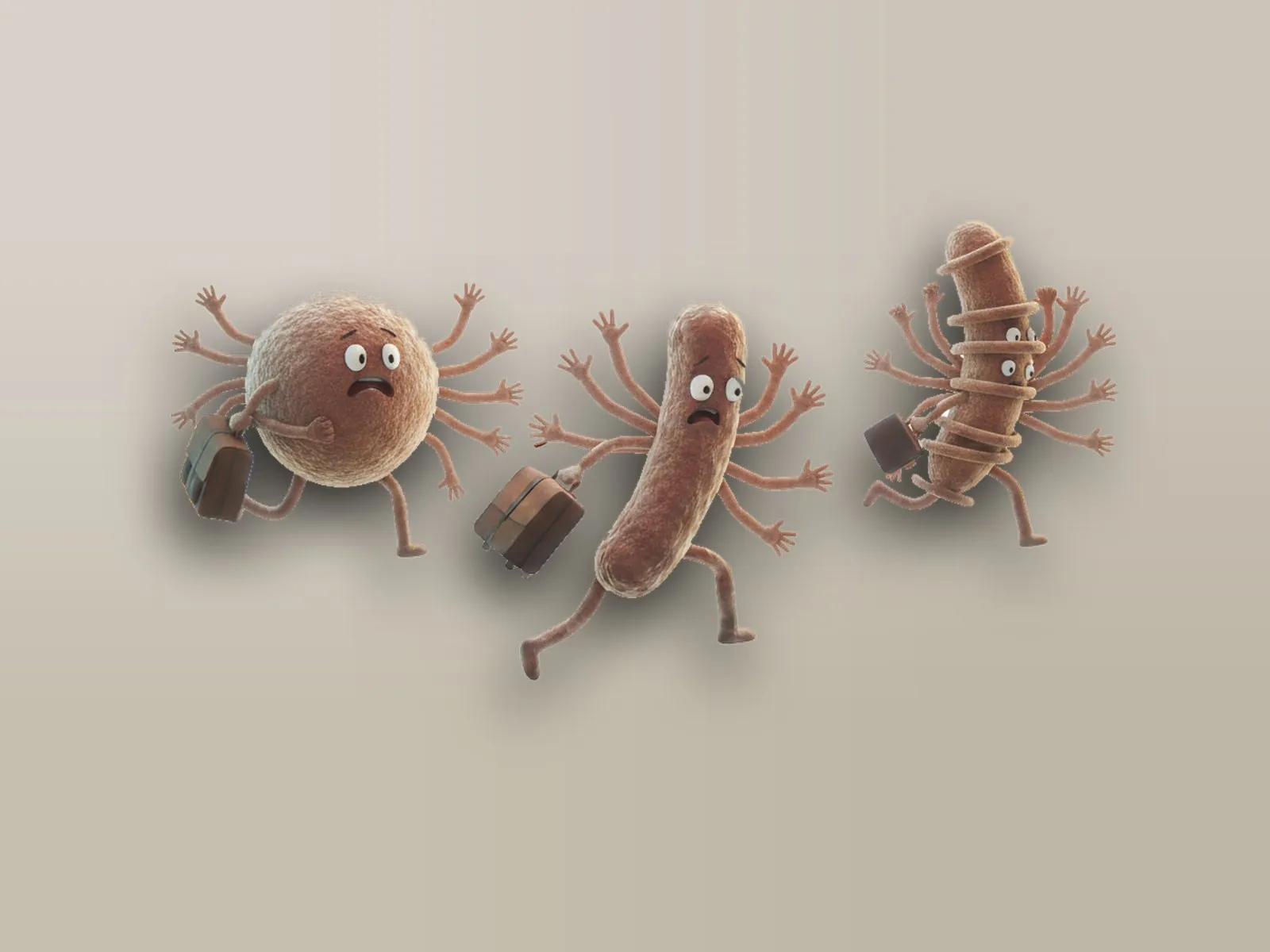
Italian Legislative Decree 18/2023 (D.Lgs. 18/2023, which replaced D.Lgs. 31/2001), amended by Legislative Decree 102/2025: quality of water intended for human consumption and Legionella risk assessment in priority buildings. UNI 8065 (Italian standard): treatment of water in civil heating systems.
Decrees and obligations →These measures are not sufficient on their own: they must be accompanied by a disinfection system that protects the installation fully and continuously.
Flushing of all hot and cold water pipework by opening showers, washbasins and taps.
Cleaning and disinfection of water filters and inspection of deposits.
Disinfection of the entire circuit, including the hot water storage tank, by shock treatment; draining, cleaning and disinfection of cooling towers, tanks, water heaters and pipework; descaling and disinfection of showers and taps; periodic replacement of aerators and flexible hoses.
In hotels and hospitals water must always be available: a treatment that does not interrupt the operation of the system is required. In large installations, on-site production of the disinfectant with a LOTUS generator is cost-effective.
LOTUS generator →Hardness, iron, manganese, zinc, pH, temperature, turbidity and organic substances influence both the choice of treatment and the degree of contamination.
Age, wear and state of corrosion, diameters and routing, joints and dead legs, storage and recirculation, state of maintenance.
Porous and rough surfaces, glass and plastics promote bacterial proliferation; polyethylene is not subject to corrosion but promotes biofilm formation.
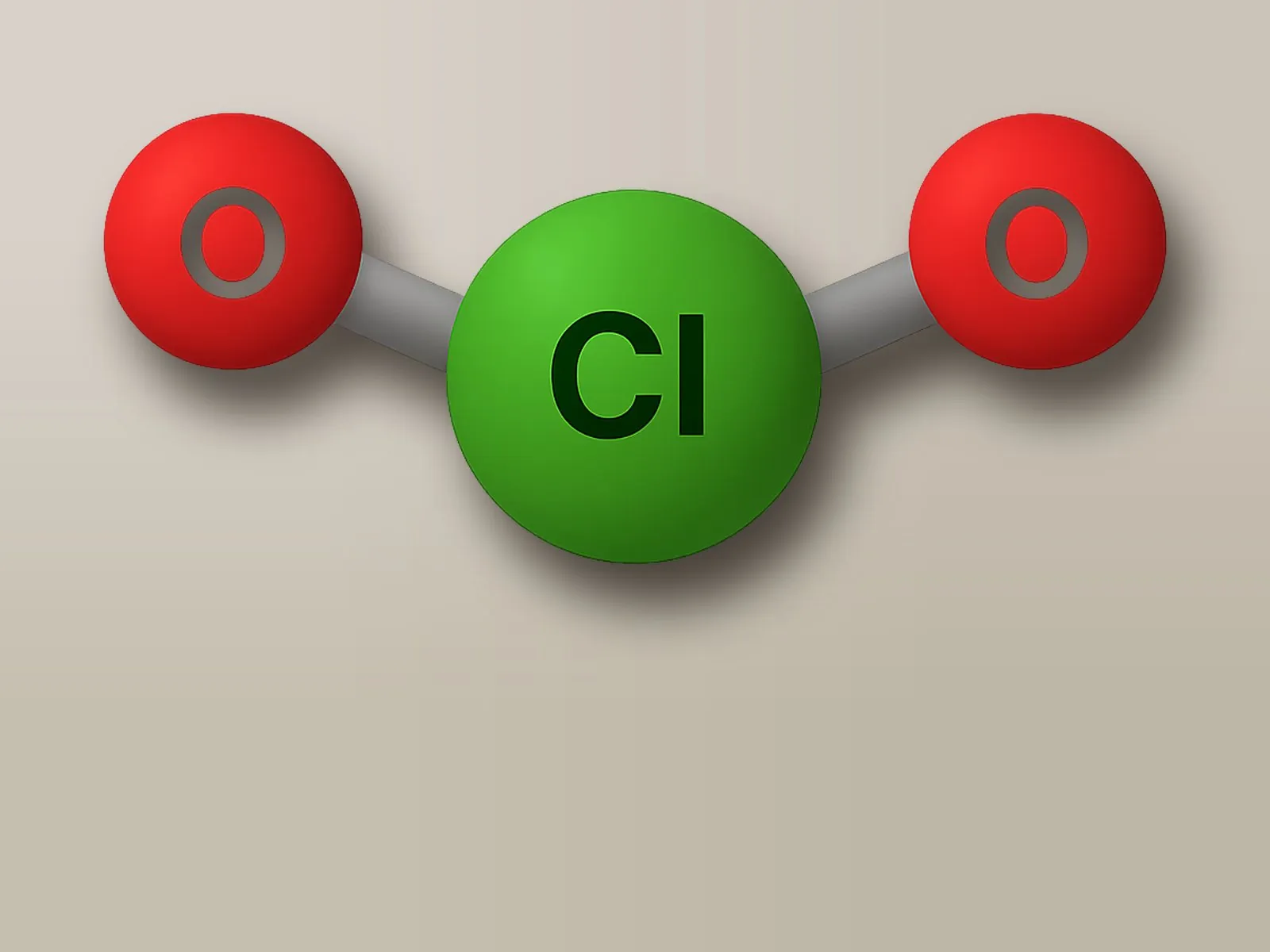
High effectiveness against biofilm, action independent of pH and of the presence of corrosion inhibitors, no formation of organohalogen compounds and greater residual effectiveness; less effective on copper, not suitable for galvanised steel. Concentration 0.1 – 1.0 mg/l; shock treatment 5 – 10 mg/l. On-site production avoids the formation of chlorites and chlorates.
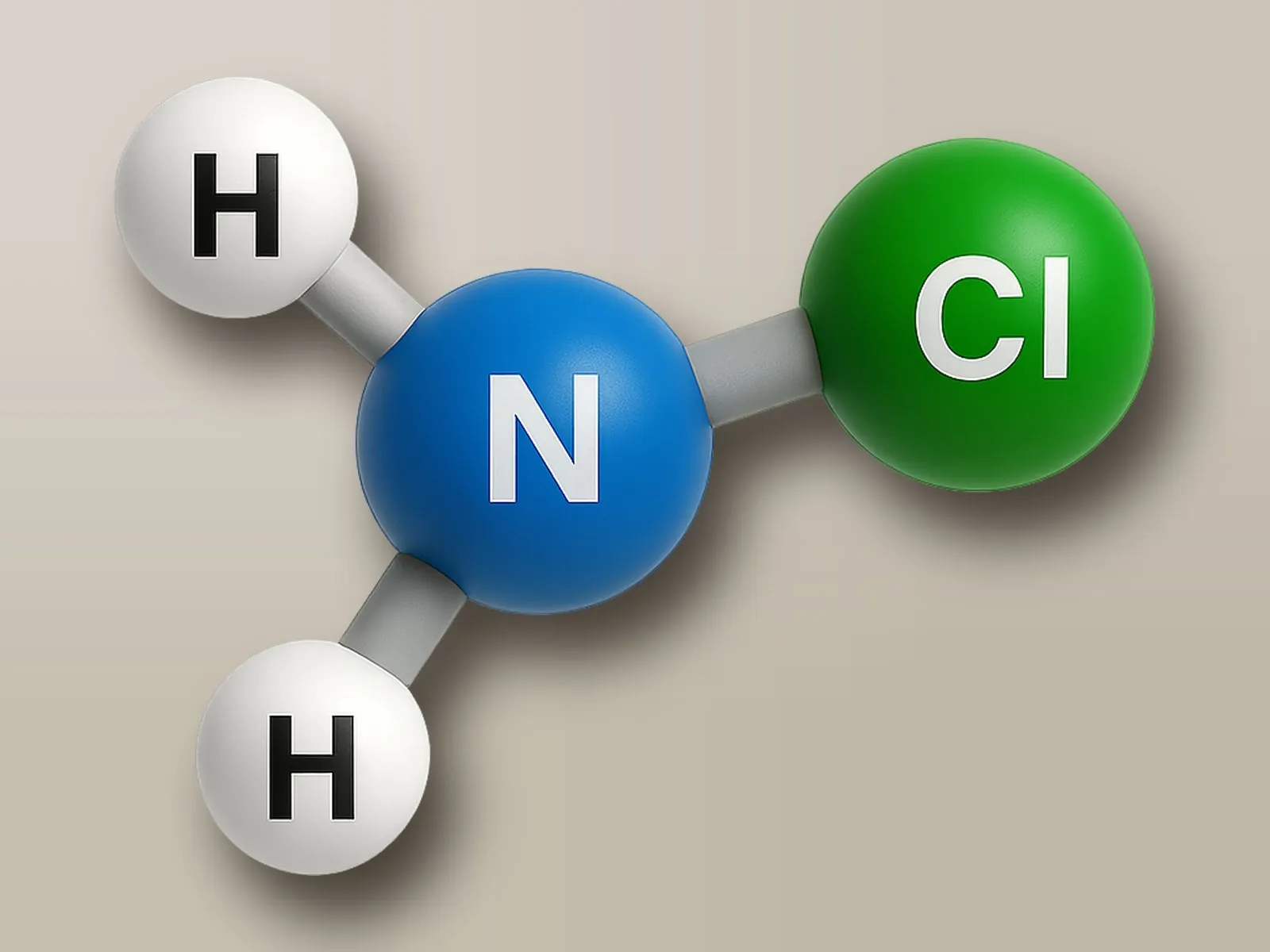
Good effectiveness against biofilm, action independent of pH, concentration of approximately 3 mg/l and high stability: it allows the disinfection of extensive and complex hot and cold water networks and is only slightly aggressive. Produced on site, it is cost-effective for large volumes of water.
MDS system →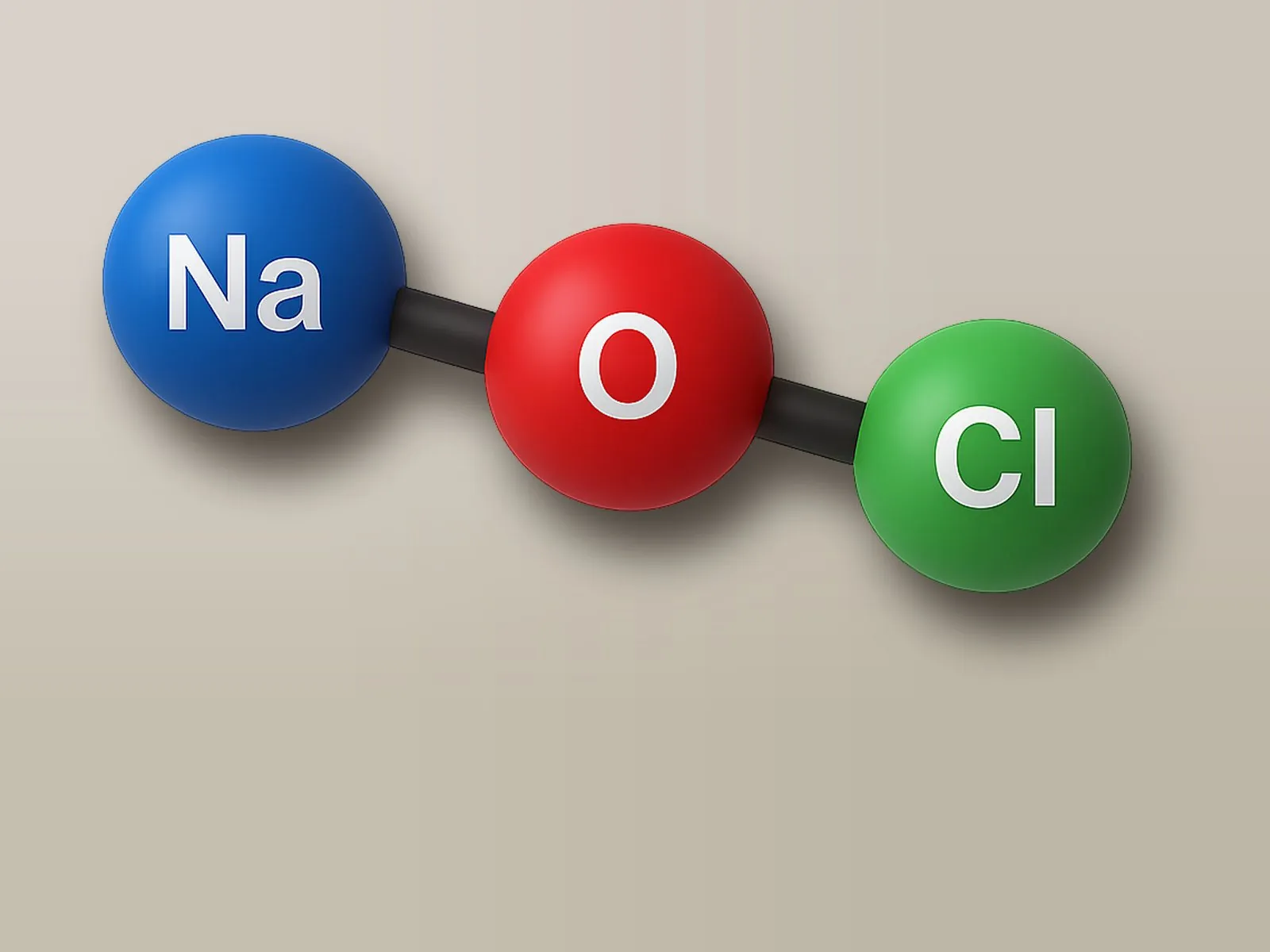
Residual chlorine of 1 – 3 mg/l throughout the network, including the distal points. Chlorine is corrosive; at these concentrations the water is no longer drinkable (maximum 0.2 mg/l) and trihalomethanes are formed. Reduced effectiveness above 30 °C and pH 7 and against biofilm.
LDsCL system → With the system at a temperature below 30 °C, 20 – 50 mg/l of chlorine (2 hours at 20 mg/l or 1 hour at 50 mg/l), followed by draining and restoration of 0.5 – 1 mg/l at the distal points. An effective but temporary treatment: recolonisation occurs within weeks or months; highly corrosive, it requires the use of hot water to be suspended.
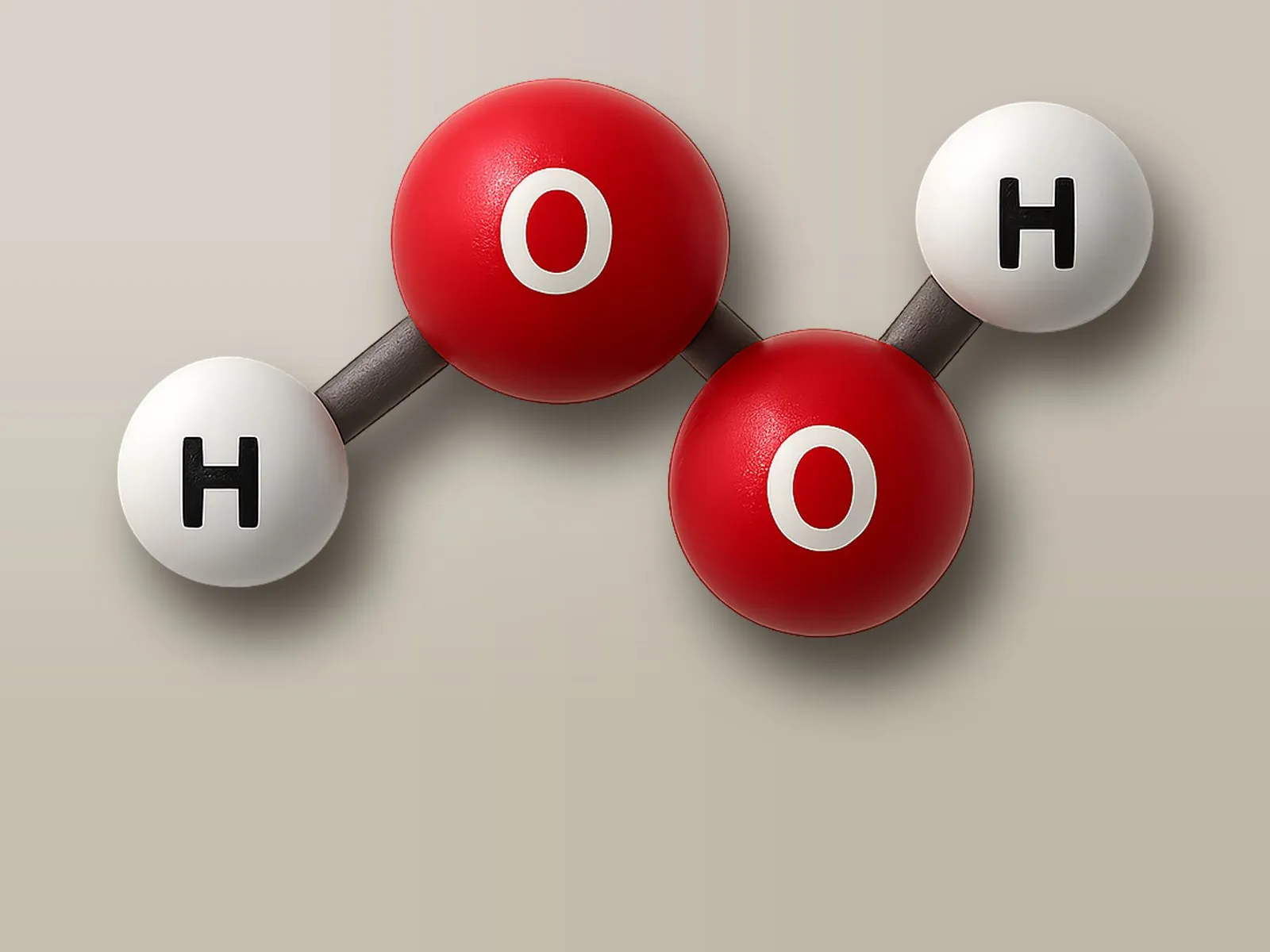
10 mg/l of peroxide and 10 µg/l of silver, dosed with a pump and water meter: less aggressive than chlorine and chlorine dioxide, with no known by-products; more effective at pH below 8, not suitable for galvanised steel.
A highly effective biocide, 1 – 2 mg/l produced by a generator; it decomposes rapidly into oxygen and has no residual effect, so it must be combined with another disinfectant. Poor effectiveness against biofilm, formation of by-products and, at high concentrations, damage to pipework.
Ozone measurement →
Radiation at 254 nm inactivates bacteria close to the point of installation, without by-products or changes in taste. With no residual effect, it is not sufficient for an entire building: it requires clear water, a water layer only a few centimetres thick and a complementary chemical treatment.
Hot water storage tank at 70 – 80 °C for three days, with at least 30 minutes of daily flow through all branches. 60 °C is not always reached at all points, there is a risk of scalding (not applicable in facilities open to the public) and its effectiveness is limited in time.
Ions produced by electrolysis, effective up to pH 9; they require continuous measurement (copper 0.20 – 0.40 mg/l, silver 0.02 – 0.04 mg/l) and water with hardness up to 15 °f, free from zinc, nitrates and chlorine; maintenance costs are high.
The solutions are presented from the most complete to the simplest: dosing proportional to the water meter disinfects the water as it enters the system; residual control dosing keeps the disinfectant concentration constant even when no water is drawn off, compensating for its rapid decomposition due to temperature.
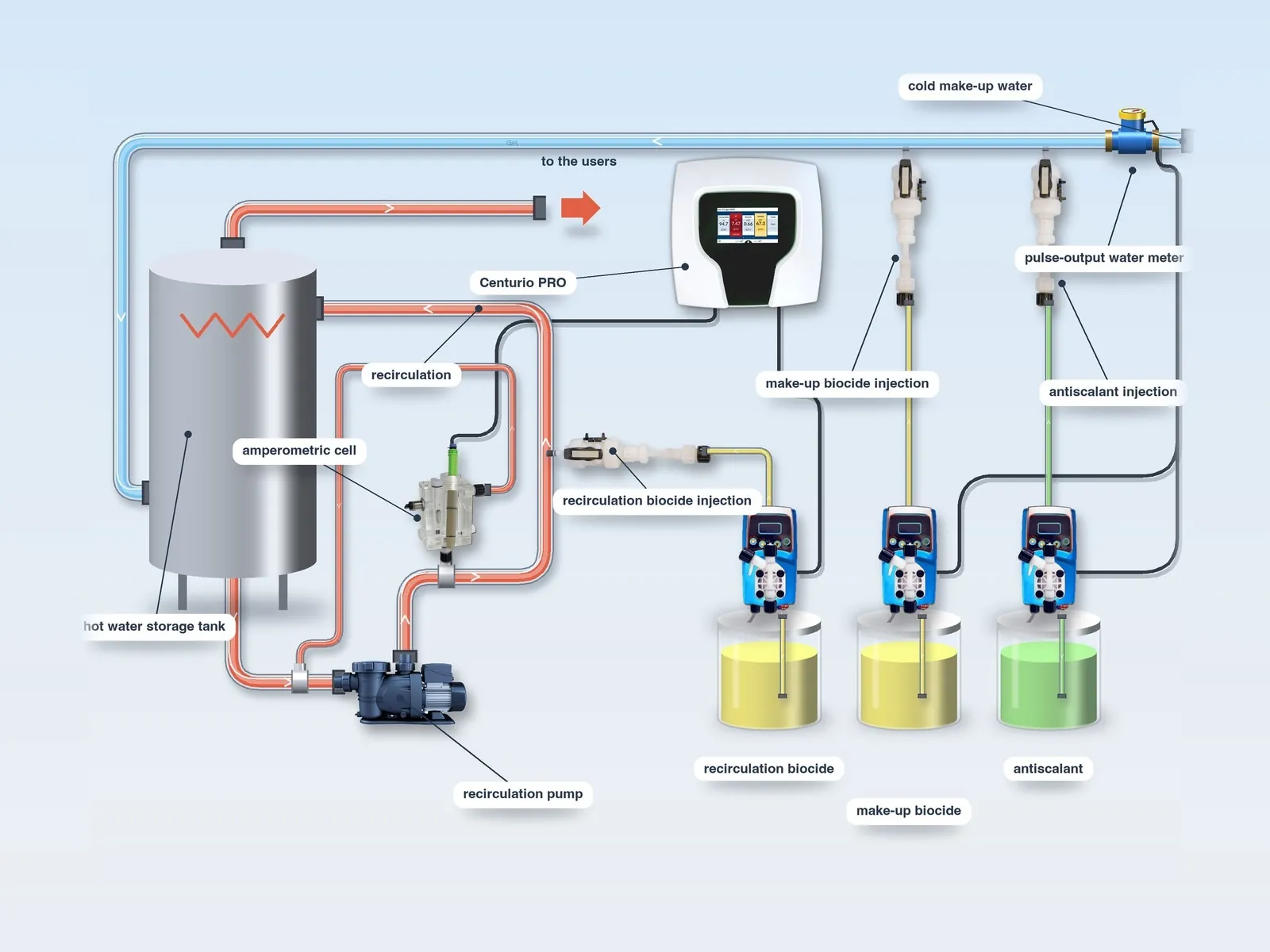
The water meter is connected to the controller, which controls all three pumps: dosing proportional to the water meter is also set and controlled from the Centurio PRO and remotely.
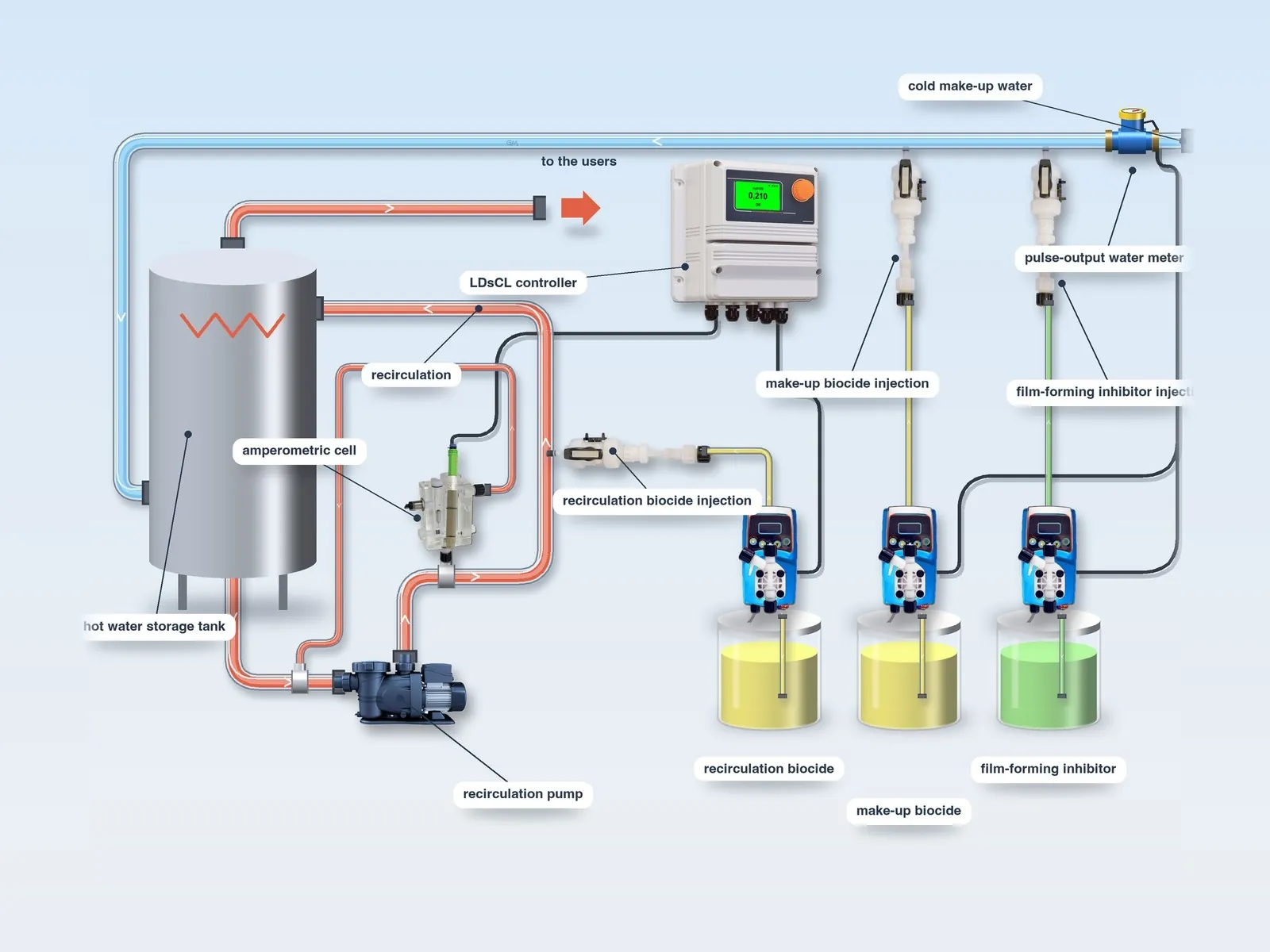
The water meter directly controls the biocide and film-forming inhibitor pumps on the make-up water; the LDsCL controller measures the residual with the cell on the recirculation and controls the third pump.
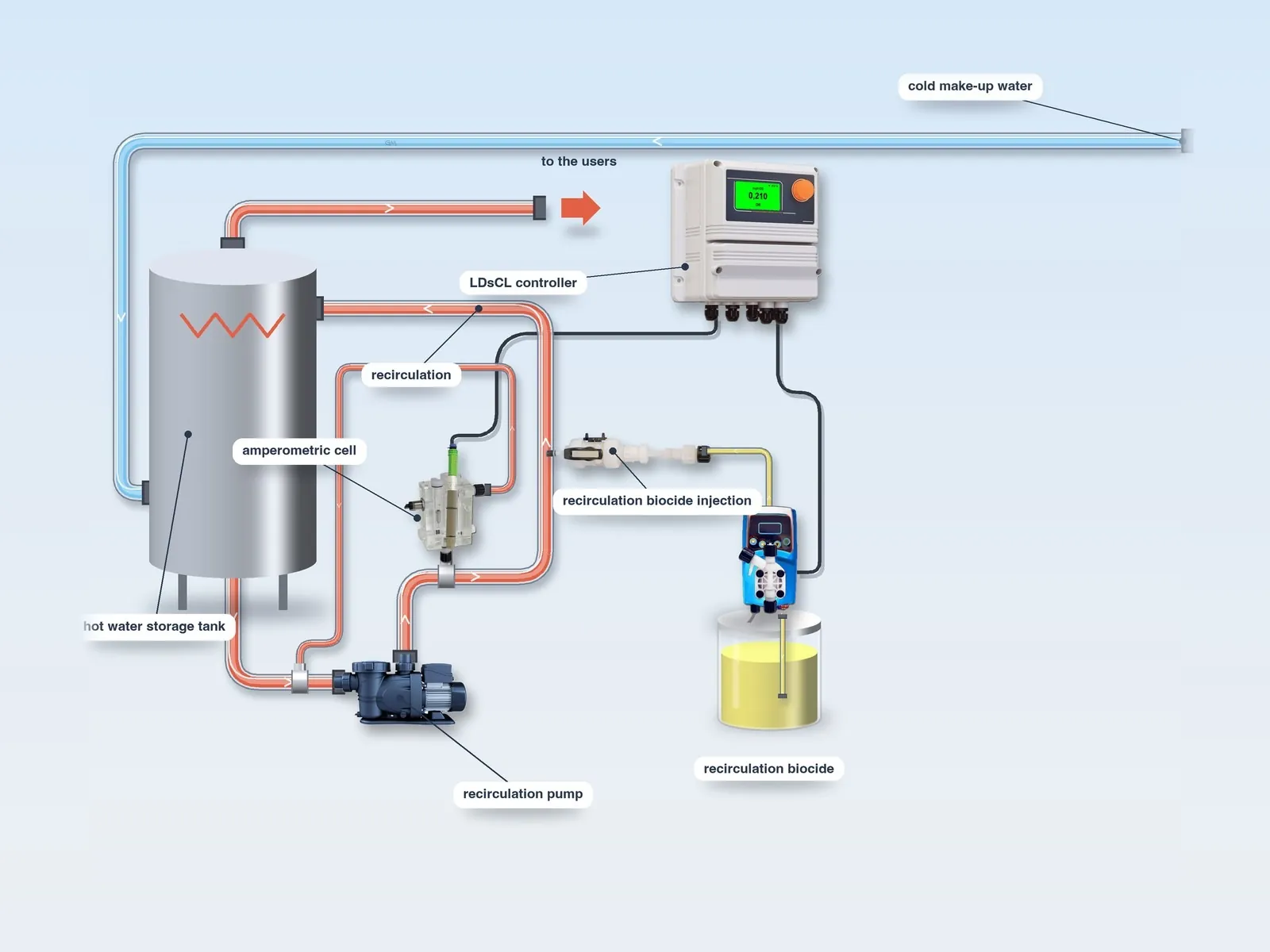
Cell and pump on the recirculation only: the LDsCL controller doses the biocide when the residual falls below the set value.
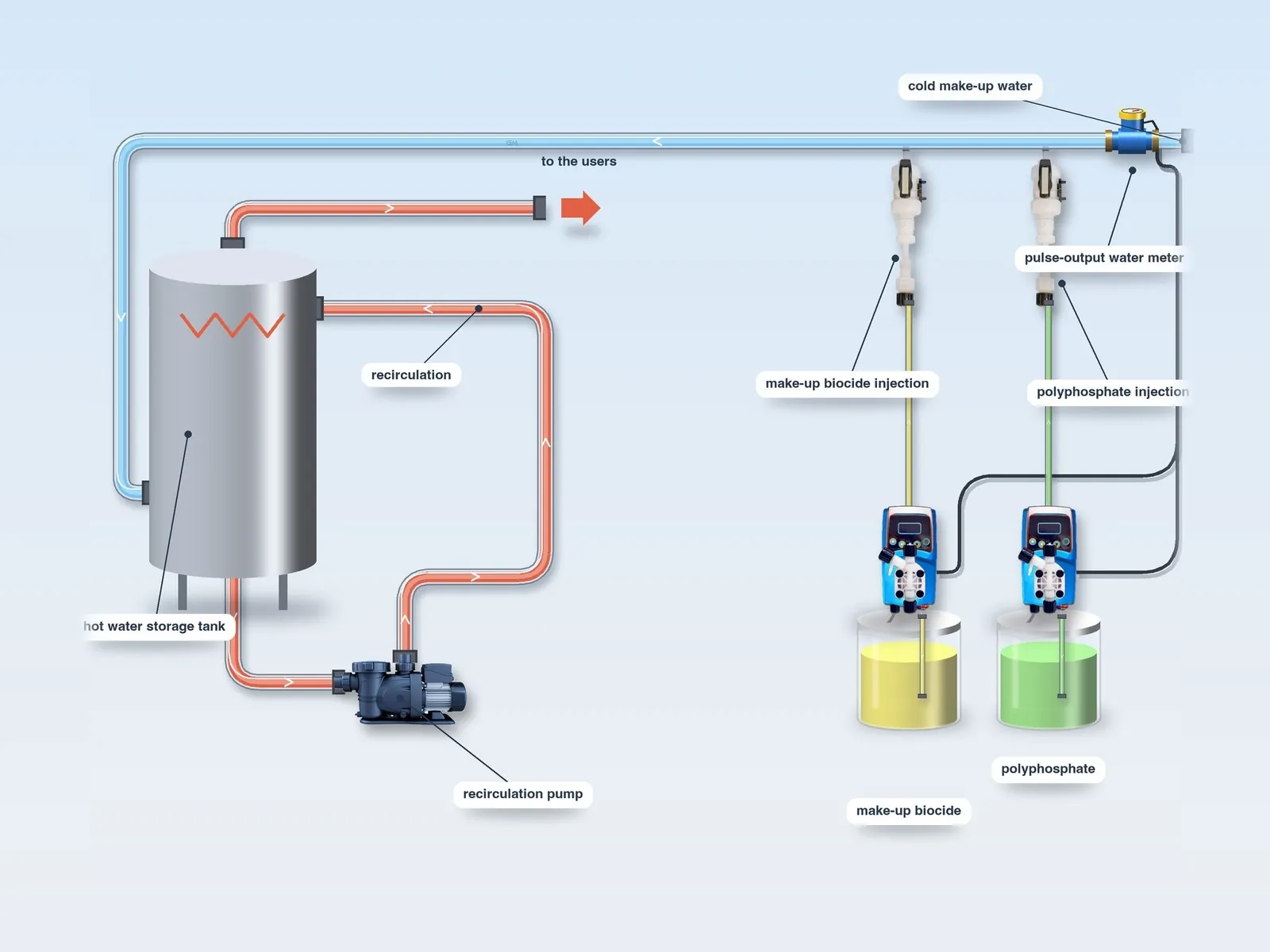
Biocide and protective food-grade polyphosphate in proportion to the make-up water measured by the water meter.
The biocide alone, in proportion to the make-up water: pump on a panel (Type 4) or installed on the tank (Type 5).
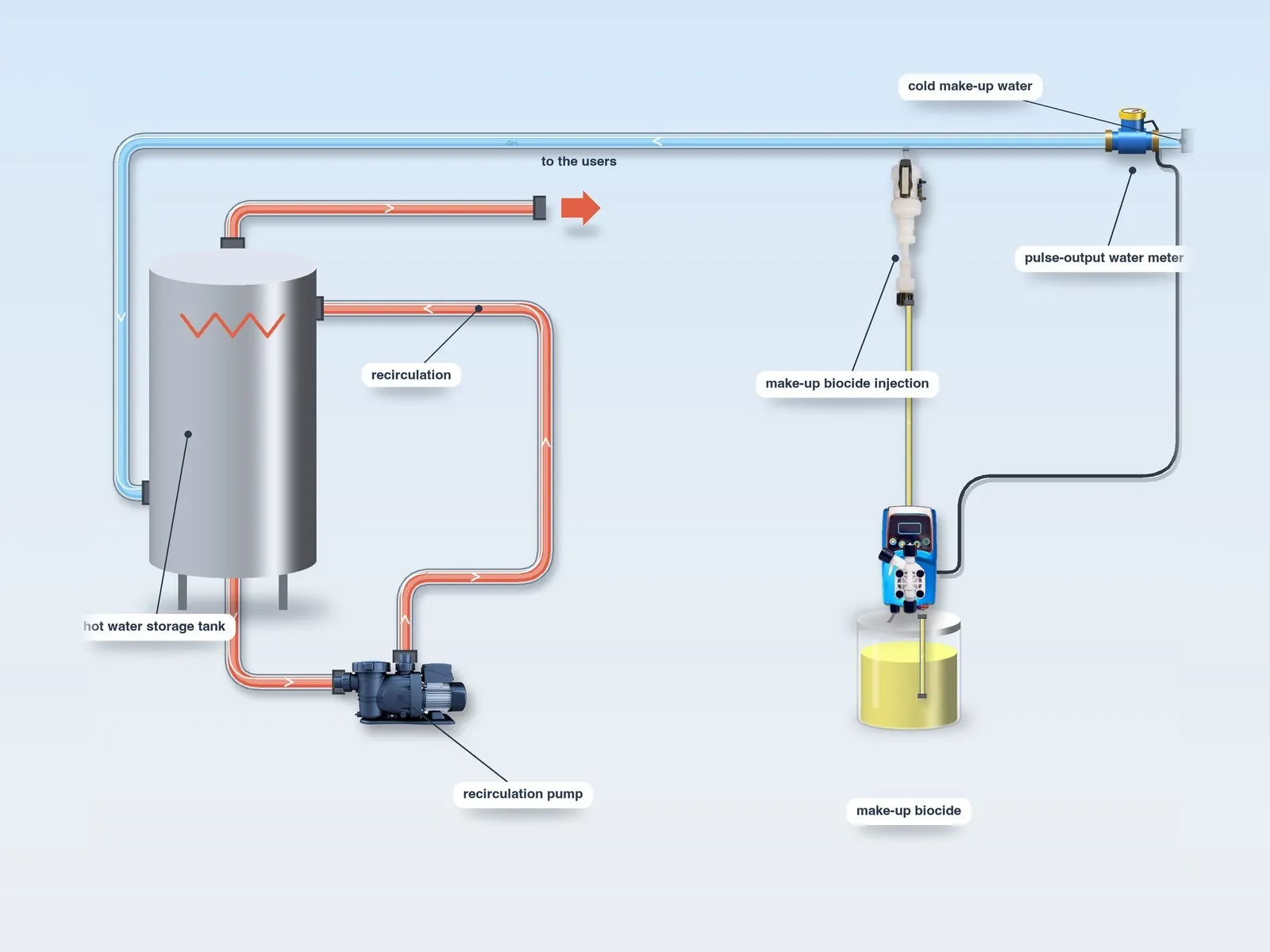
The biocide and the film-forming inhibitor are dosed into the make-up water in proportion to the quantity of water measured by the pulse-output water meter; a third pump, controlled by the measurement of the residual biocide, doses the disinfectant into the hot water recirculation. The system is managed by the LDsCL controller or by the Centurio PRO, which can control all three pumps, also remotely.
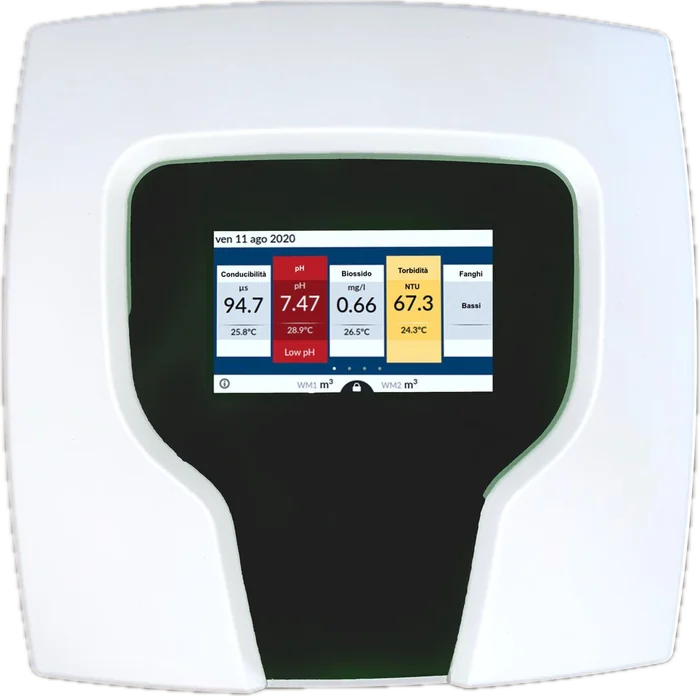
Multichannel controller with touch screen: it controls the make-up pumps and the residual control pump on the recirculation.
Centurio PRO →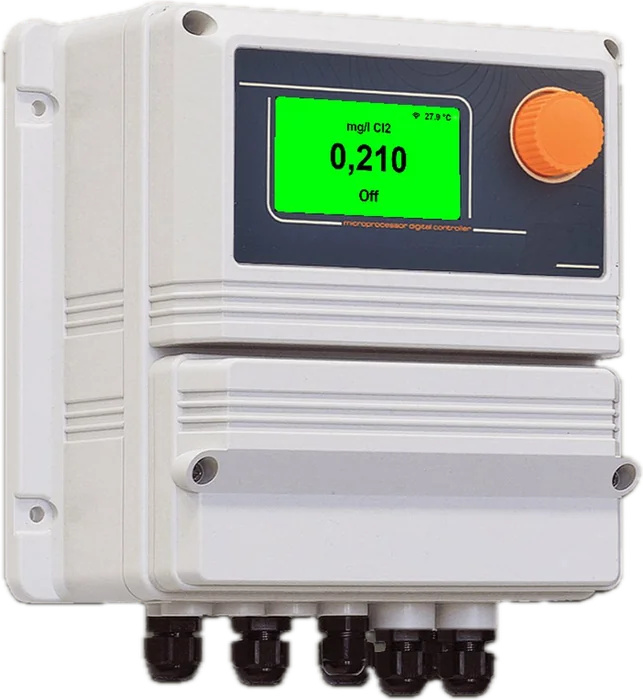
As an alternative to the Centurio PRO: it controls the pump on the recirculation, while the water meter directly controls the make-up pumps.
LDsCL controller →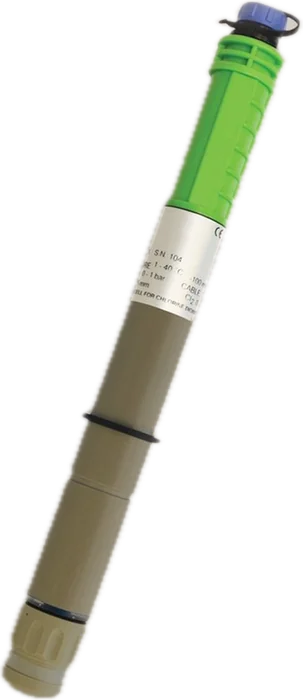
Self-cleaning amperometric cells for the biocide residual on the hot water recirculation.
SCL17 and SCL18 →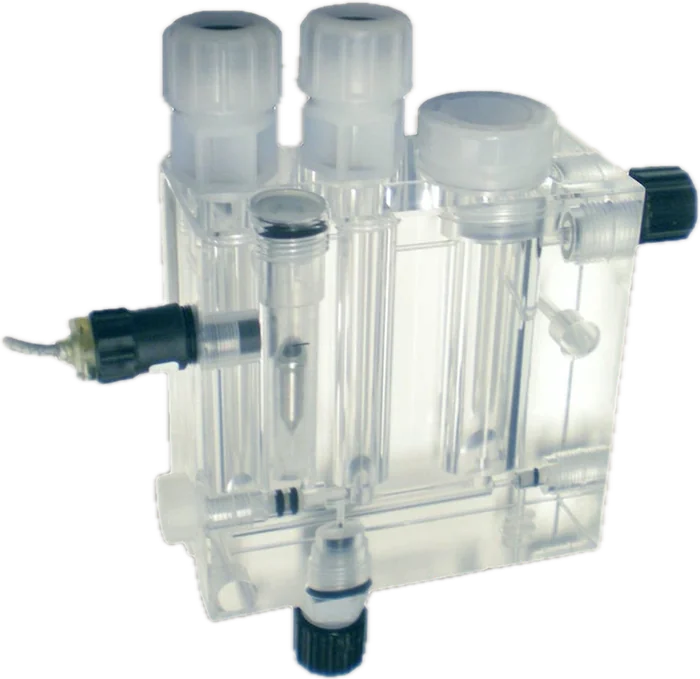
In PMMA, with sample flow rate adjustment and flow sensor, which stops dosing when there is no circulation.
Probe holders →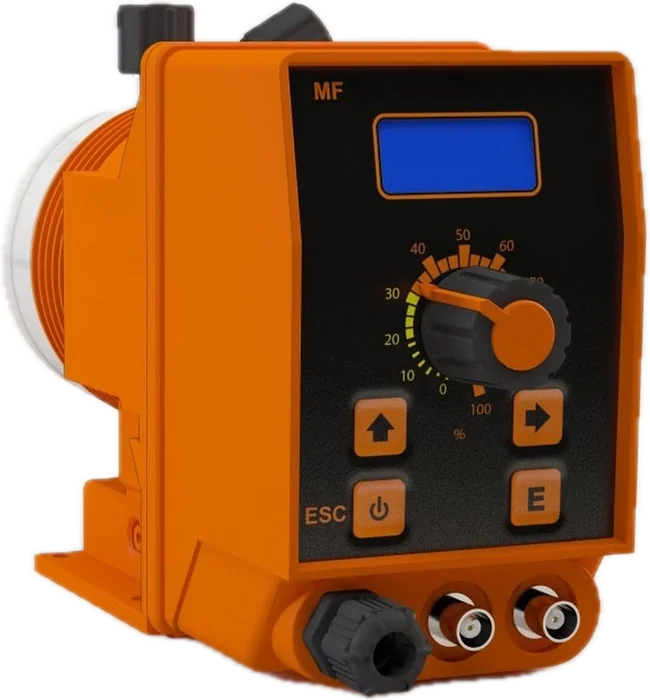
Multifunction solenoid dosing pump with adjustable flow rate, controlled by the controller or by the pulses of the water meter.
KMS MF pump →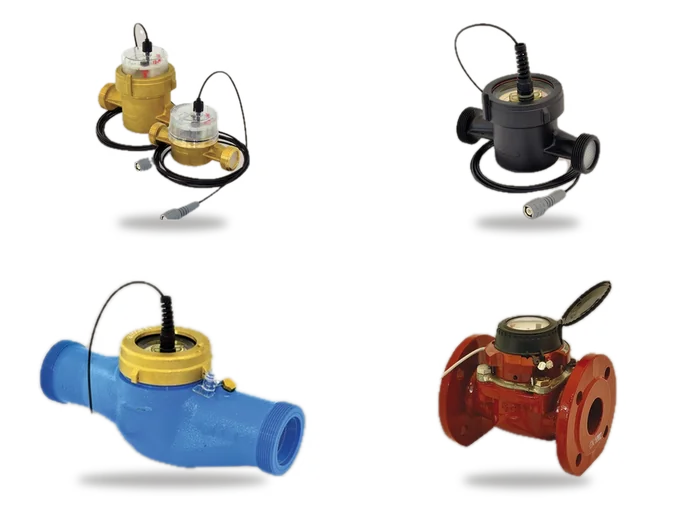
Turbine or Woltmann type, on the pipe: it sends the pump a pulse for each set volume of water.
Water meters →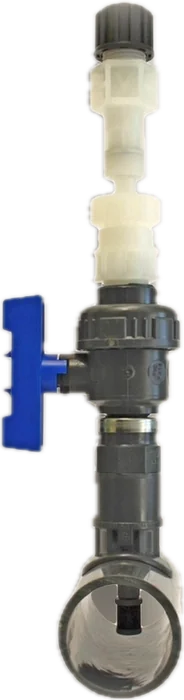
It introduces the product into the centre of the pipe, improving mixing; it can be withdrawn with the pipe under pressure.
Lances →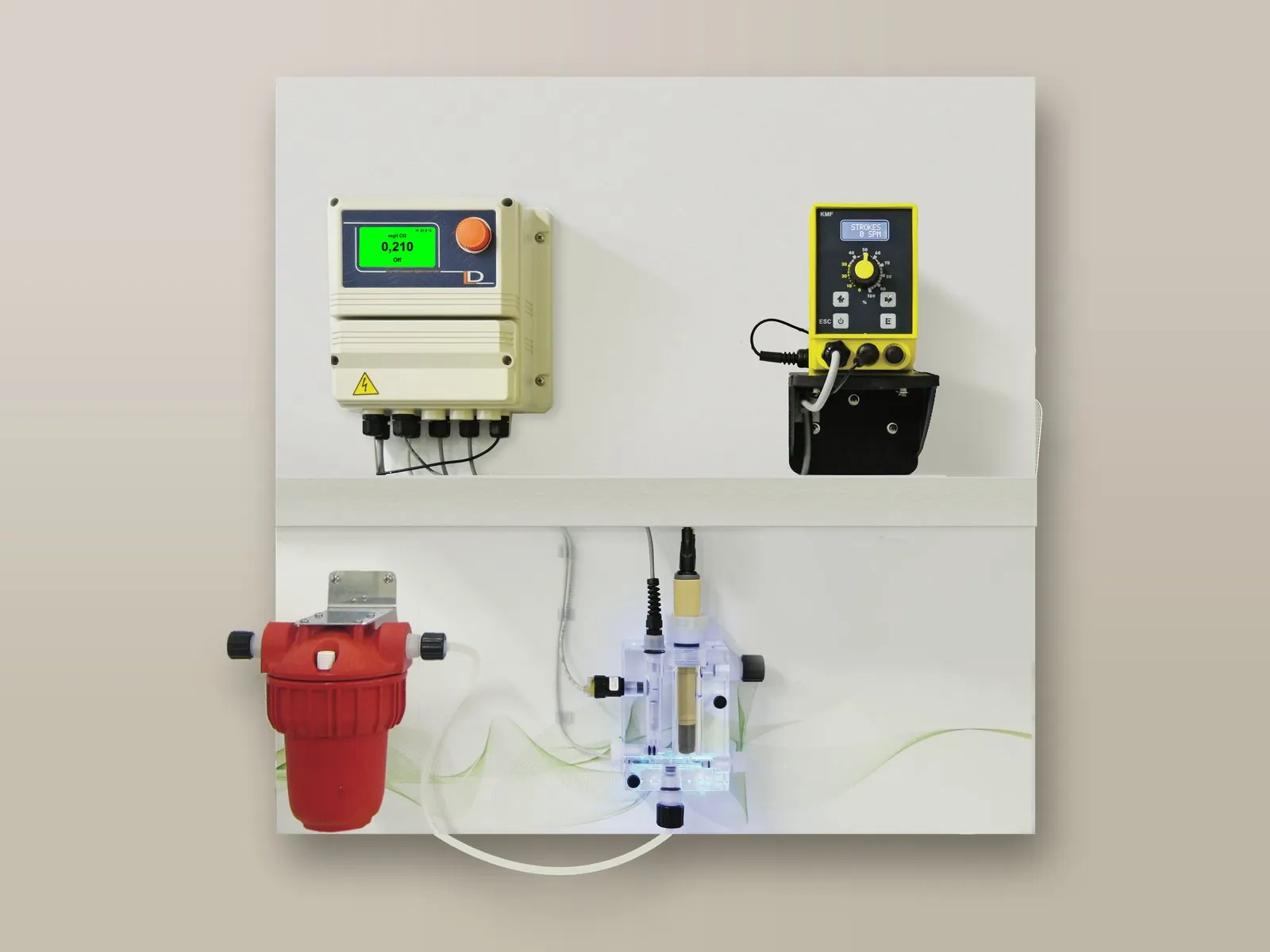
The biocide is dosed only into the hot water recirculation: when the biocide concentration falls below the set value, the LDsCL controller activates the dosing pump.
It measures the residual disinfectant with the amperometric cell and controls the dosing pump in proportion to the measured value.
LDsCL controller →Self-cleaning amperometric cells for the biocide residual on the hot water recirculation.
SCL17 and SCL18 →In PMMA, with sample flow rate adjustment and flow sensor, which stops dosing when there is no circulation.
Probe holders →Multifunction solenoid dosing pump with adjustable flow rate, controlled by the controller according to the measured residual.
KMS MF pump →It introduces the product into the centre of the pipe, improving mixing; it can be withdrawn with the pipe under pressure.
Lances →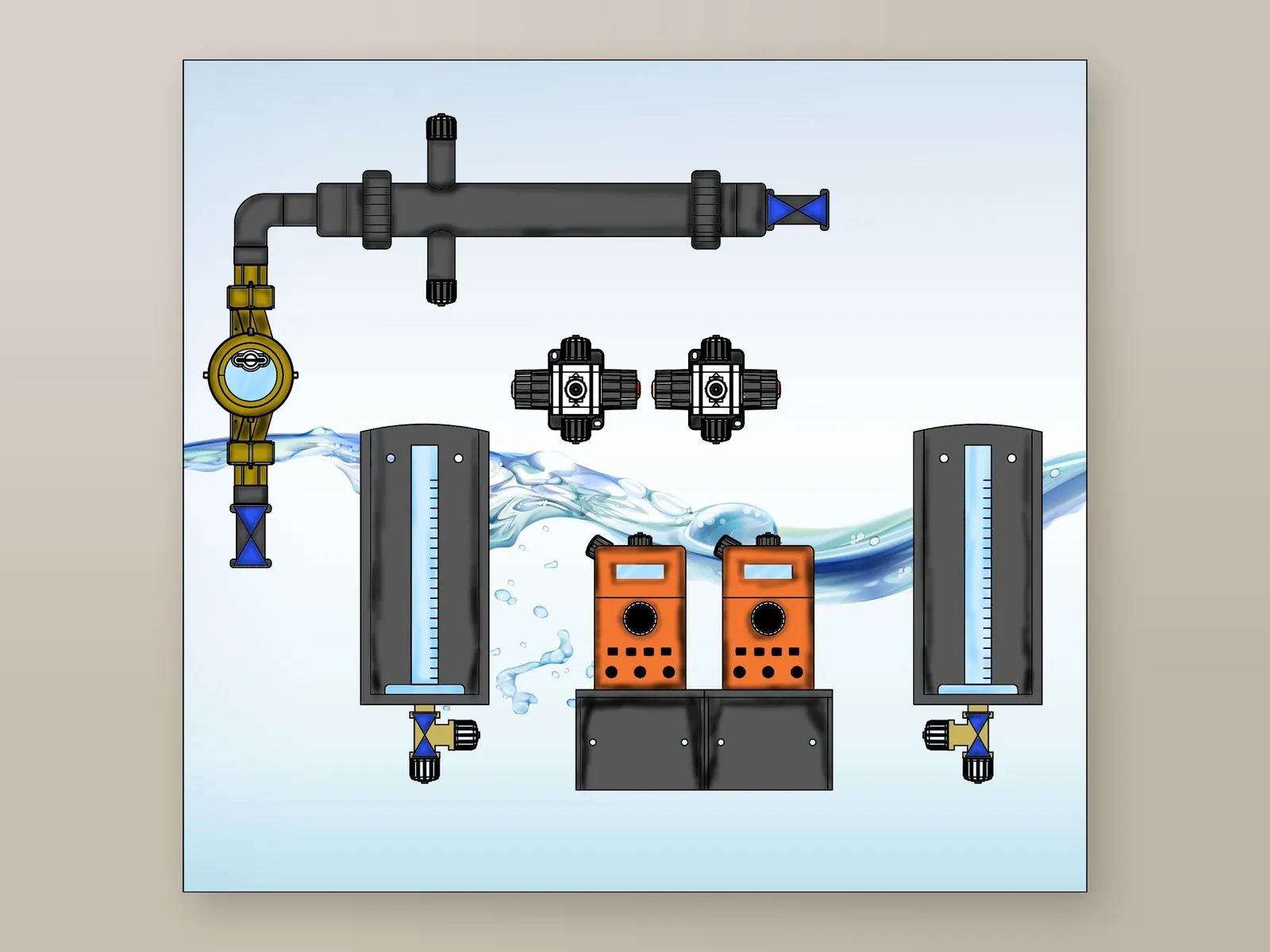
Combined dosing of biocide and protective food-grade polyphosphate, in proportion to the quantity of make-up water measured by the pulse-output water meter.
Turbine or Woltmann type, on the pipe: it sends the pump a pulse for each set volume of water.
Water meters →Multifunction solenoid dosing pump with adjustable flow rate, controlled by the controller or by the pulses of the water meter.
KMS MF pump →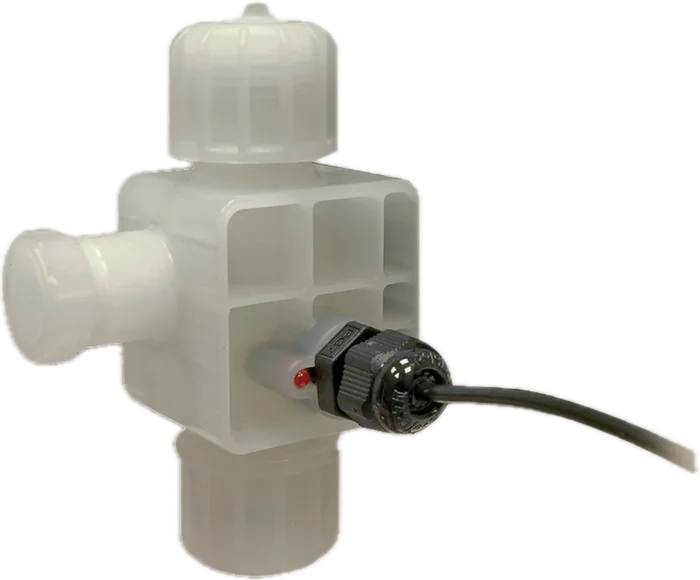
It verifies that the product is actually injected and generates an alarm in the event of a malfunction.
Flow sensor →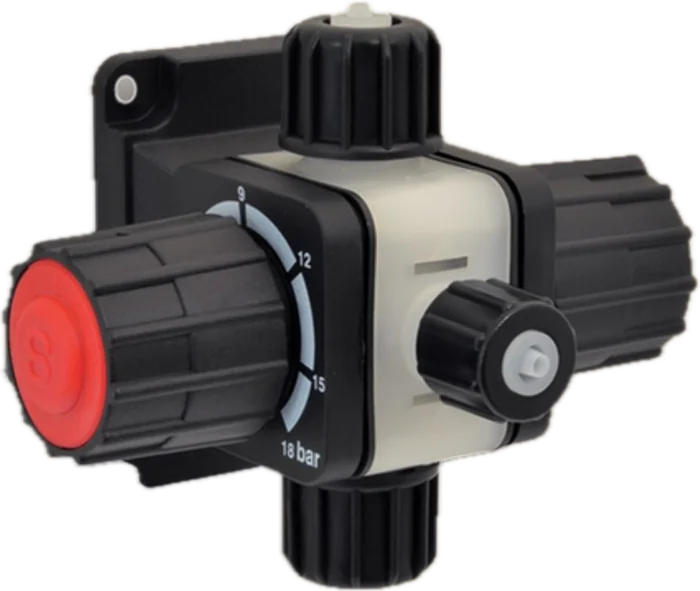
Safety, anti-siphon and drain valve on the pump delivery.
Valves →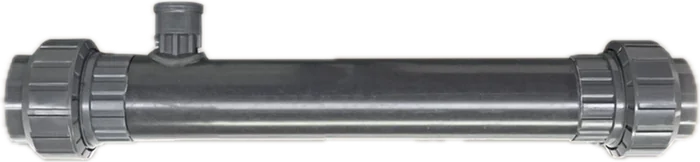
It distributes the product injected into the pipe evenly.
Static mixers →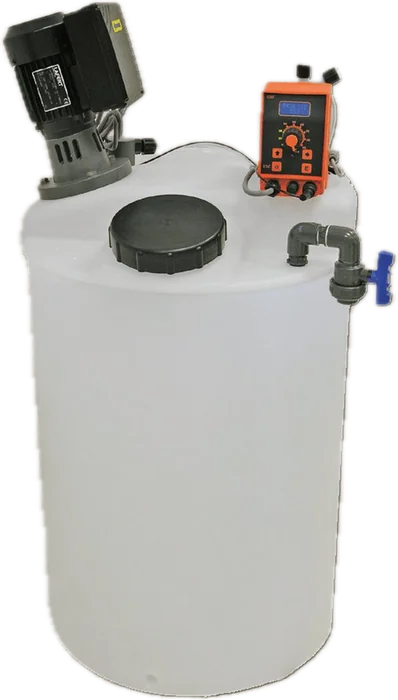
In PE, with suction lance fitted with foot filter and level probe, and safety bund.
Tanks →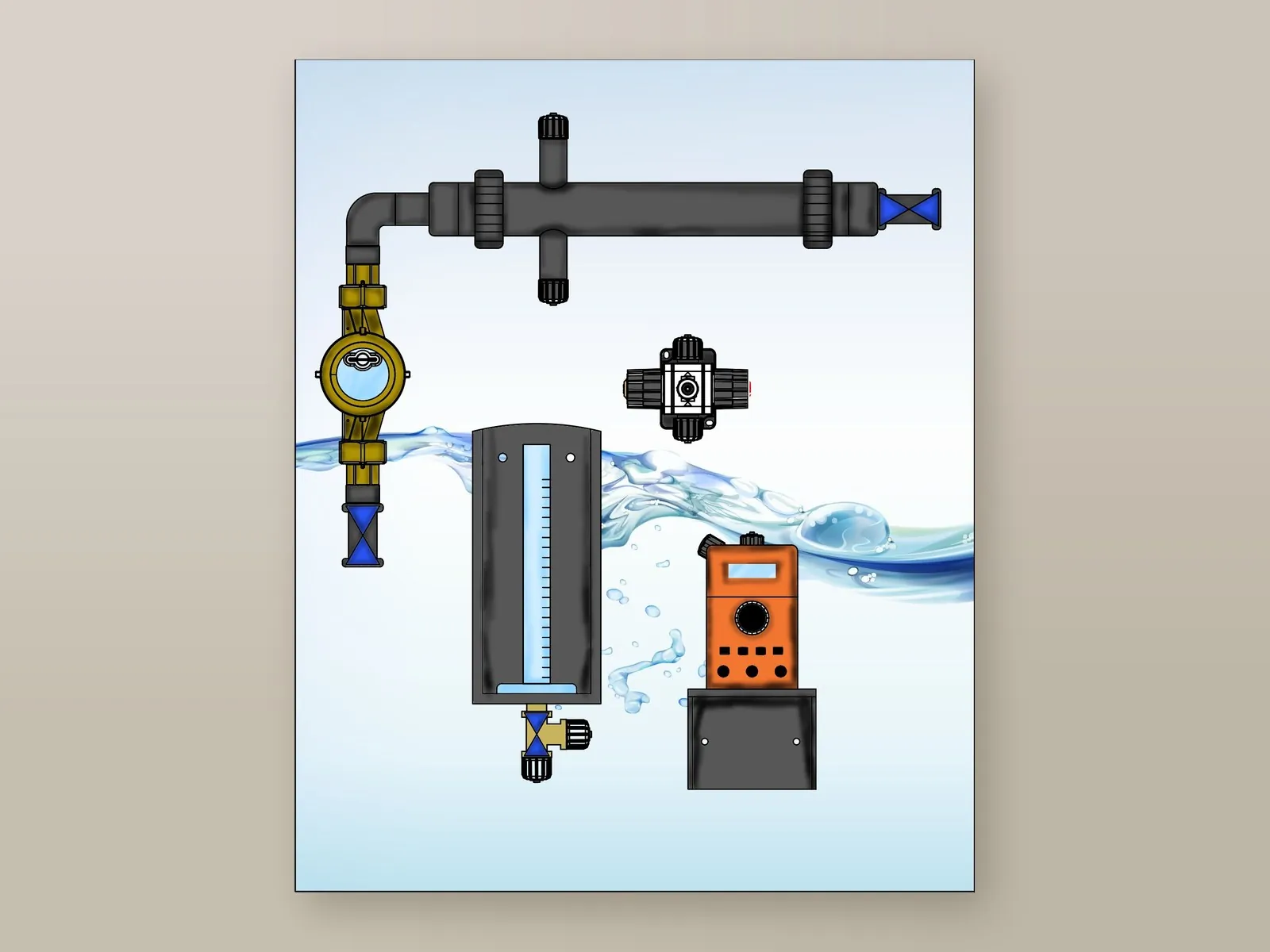
Dosing of the biocide alone in proportion to the quantity of make-up water measured by the pulse-output water meter.
Turbine or Woltmann type, on the pipe: it sends the pump a pulse for each set volume of water.
Water meters →Multifunction solenoid dosing pump with adjustable flow rate, controlled by the controller or by the pulses of the water meter.
KMS MF pump →It verifies that the product is actually injected and generates an alarm in the event of a malfunction.
Flow sensor →Safety, anti-siphon and drain valve on the pump delivery.
Valves →It distributes the product injected into the pipe evenly.
Static mixers →In PE, with suction lance fitted with foot filter and level probe, and safety bund.
Tanks →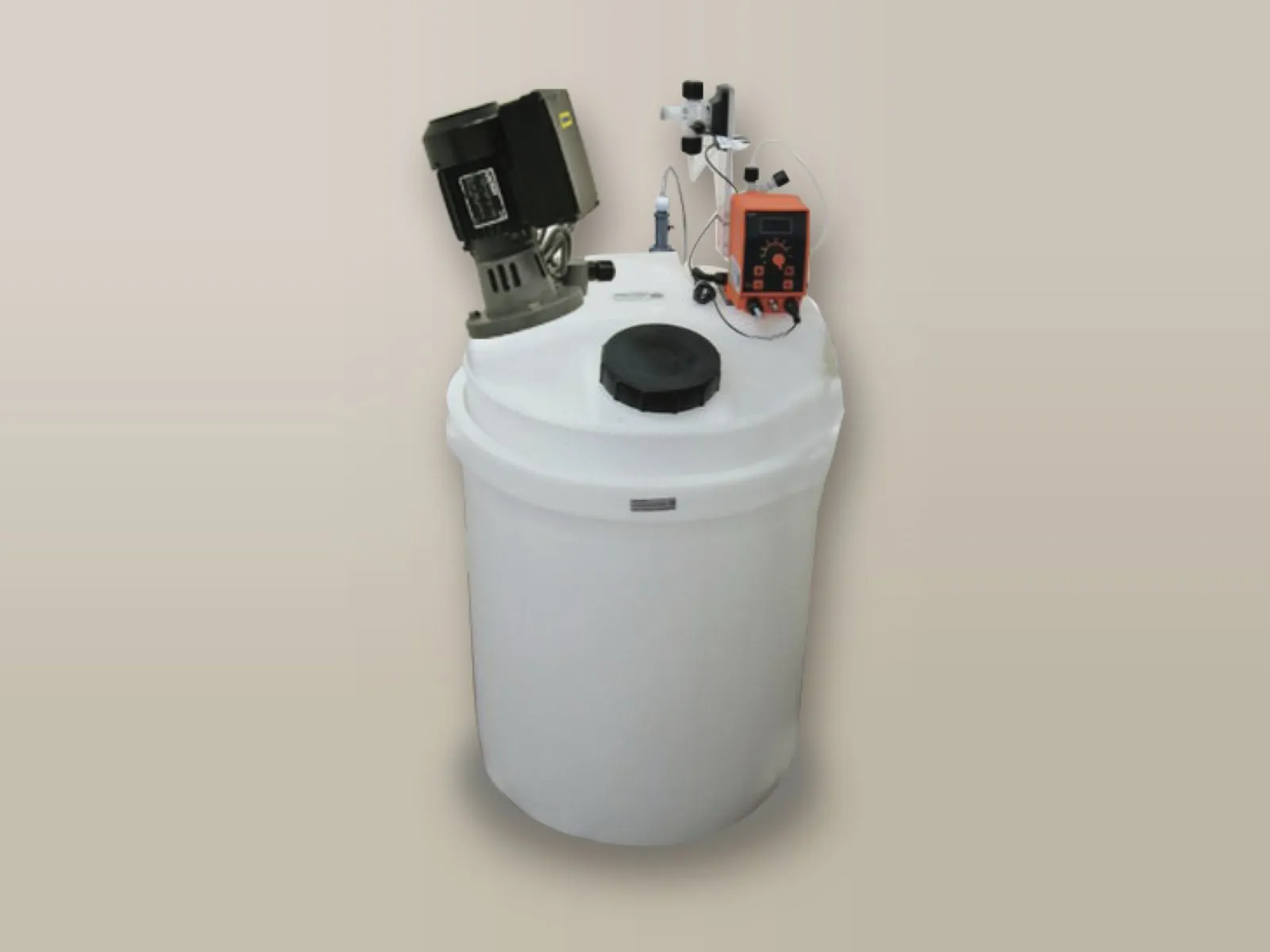
The dosing pump, installed on the biocide tank, is controlled by the pulse-output water meter on the pipe carrying the water to be heated: the quickest solution to implement.
Turbine or Woltmann type, on the pipe: it sends the pump a pulse for each set volume of water.
Water meters →Multifunction solenoid dosing pump with adjustable flow rate, controlled by the controller or by the pulses of the water meter.
KMS MF pump →It verifies that the product is actually injected and generates an alarm in the event of a malfunction.
Flow sensor →Safety, anti-siphon and drain valve on the pump delivery.
Valves →It distributes the product injected into the pipe evenly.
Static mixers →In PE, with suction lance fitted with foot filter and level probe, and safety bund.
Tanks →| Type 1 | Type 2 | Type 3 | Type 4 | Type 5 | |
|---|---|---|---|---|---|
| Dosing into the make-up water (water meter) | Yes | No | Yes | Yes | Yes |
| Measurement of the residual on the recirculation | Yes | Yes | No | No | No |
| Pipe-protecting product | Yes | No | Yes | No | No |
| Dosing pumps | 3 | 1 | 2 | 1 | 1 |
| Controller | LDsCL or Centurio PRO | LDsCL | – | – | – |
| Installation | Panel | Panel | Panel | Panel | On the tank |
As an alternative to stabilised chlorine dioxide, where water consumption justifies it, chlorine dioxide can be produced directly in the installation using the LOTUS AIR generator.
Chlorine dioxide is stabilised to allow storage and transport; at the user’s premises it must be activated with a second product and is dosed with a dosing station or with the LDsCL system.
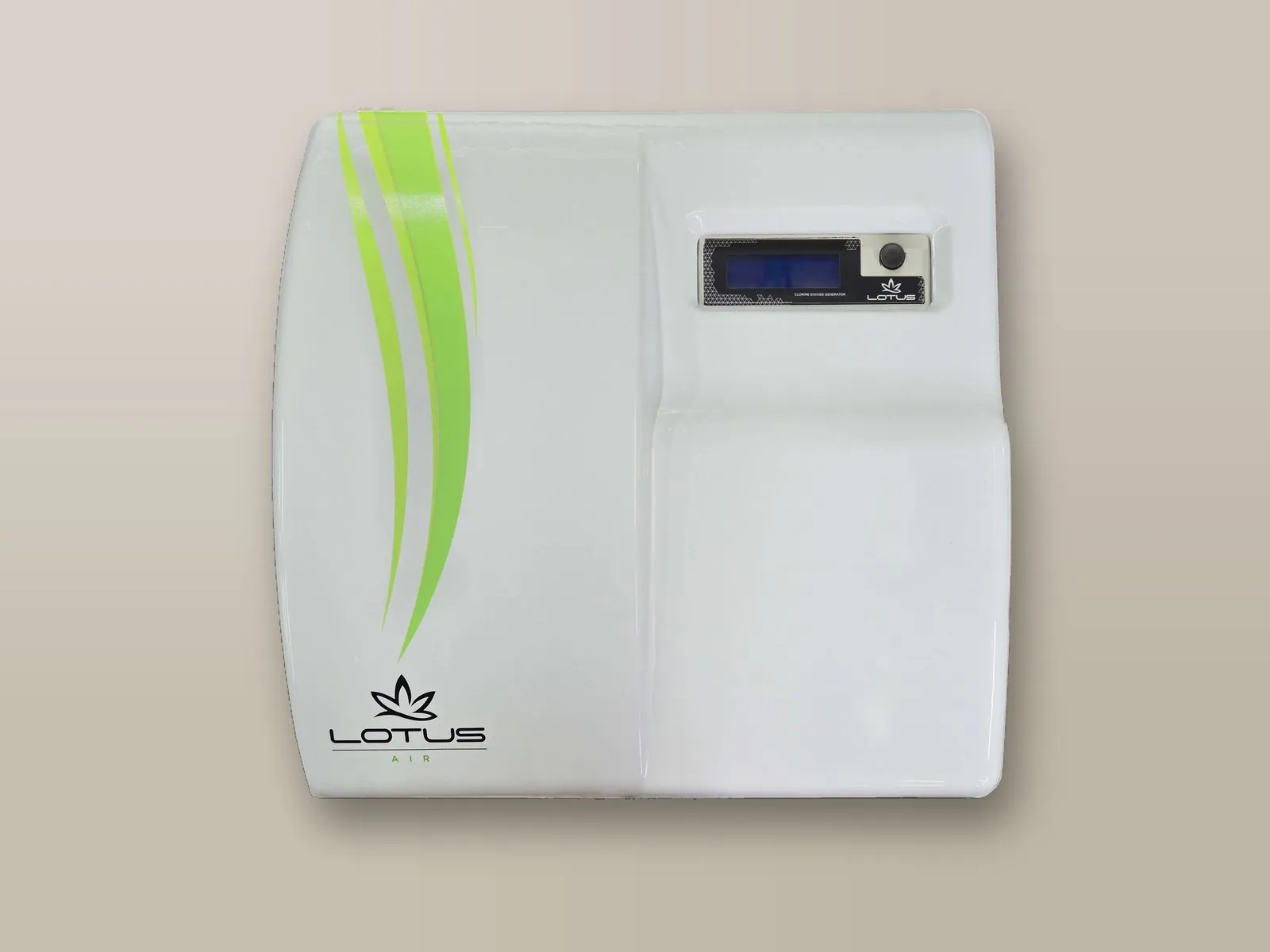
The LOTUS AIR generator combines hydrochloric acid (HCl 9%) and sodium chlorite (NaClO2 7.5%) in a reactor at ambient pressure; it produces, doses and measures chlorine dioxide.
Measurement of the residual on the recirculation, dosing into the make-up water and the pipe-protecting product determine the type.
Answer the questions: the recommended system appears below.
The water meter is connected to the controller, which controls the biocide and film-forming inhibitor pumps on the make-up water and the recirculation pump: all dosing is set and controlled from the Centurio PRO, also remotely.
Multichannel controller with touch screen: it controls the make-up pumps and the residual control pump on the recirculation.
Centurio PRO →Self-cleaning amperometric cells for the biocide residual on the hot water recirculation.
SCL17 and SCL18 →In PMMA, with sample flow rate adjustment and flow sensor, which stops dosing when there is no circulation.
Probe holders →Multifunction solenoid dosing pump with adjustable flow rate, controlled by the controller or by the pulses of the water meter.
KMS MF pump →Turbine or Woltmann type, on the pipe: it sends the pump a pulse for each set volume of water.
Water meters →It introduces the product into the centre of the pipe, improving mixing; it can be withdrawn with the pipe under pressure.
Lances →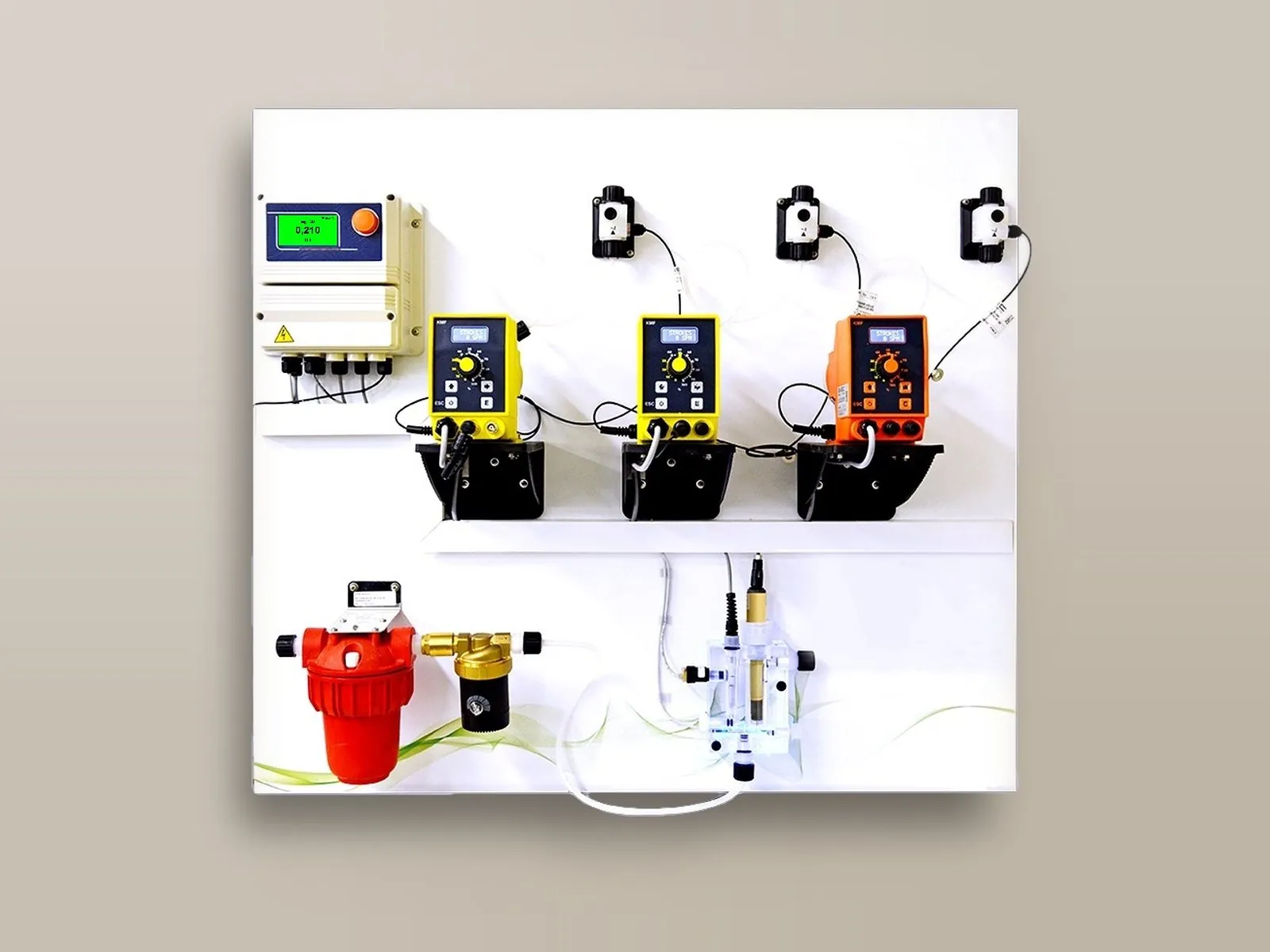
The water meter directly controls the biocide and film-forming inhibitor pumps on the make-up water; the LDsCL controller measures the residual on the recirculation and controls the third pump.
Measures the residual with the cell on the recirculation and controls the recirculation pump; the water meter controls the make-up pumps.
LDsCL controller →Self-cleaning amperometric cells for the biocide residual on the hot water recirculation.
SCL17 and SCL18 →In PMMA, with sample flow rate adjustment and flow sensor, which stops dosing when there is no circulation.
Probe holders →Multifunction solenoid dosing pump with adjustable flow rate, controlled by the controller or by the pulses of the water meter.
KMS MF pump →Turbine or Woltmann type, on the pipe: it sends the pump a pulse for each set volume of water.
Water meters →It introduces the product into the centre of the pipe, improving mixing; it can be withdrawn with the pipe under pressure.
Lances →Measurement of the residual and dosing of the biocide on the recirculation only, with the LDsCL controller.
It measures the residual disinfectant with the amperometric cell and controls the dosing pump in proportion to the measured value.
LDsCL controller →Self-cleaning amperometric cells for the biocide residual on the hot water recirculation.
SCL17 and SCL18 →In PMMA, with sample flow rate adjustment and flow sensor, which stops dosing when there is no circulation.
Probe holders →Multifunction solenoid dosing pump with adjustable flow rate, controlled by the controller according to the measured residual.
KMS MF pump →It introduces the product into the centre of the pipe, improving mixing; it can be withdrawn with the pipe under pressure.
Lances →Biocide and protective food-grade polyphosphate in proportion to the make-up water.
Turbine or Woltmann type, on the pipe: it sends the pump a pulse for each set volume of water.
Water meters →Multifunction solenoid dosing pump with adjustable flow rate, controlled by the controller or by the pulses of the water meter.
KMS MF pump →It verifies that the product is actually injected and generates an alarm in the event of a malfunction.
Flow sensor →Safety, anti-siphon and drain valve on the pump delivery.
Valves →It distributes the product injected into the pipe evenly.
Static mixers →In PE, with suction lance fitted with foot filter and level probe, and safety bund.
Tanks →Biocide in proportion to the make-up water, with the pump on a panel and the flow sensor.
Turbine or Woltmann type, on the pipe: it sends the pump a pulse for each set volume of water.
Water meters →Multifunction solenoid dosing pump with adjustable flow rate, controlled by the controller or by the pulses of the water meter.
KMS MF pump →It verifies that the product is actually injected and generates an alarm in the event of a malfunction.
Flow sensor →Safety, anti-siphon and drain valve on the pump delivery.
Valves →It distributes the product injected into the pipe evenly.
Static mixers →In PE, with suction lance fitted with foot filter and level probe, and safety bund.
Tanks →Biocide in proportion to the make-up water, with the pump installed on the tank.
Turbine or Woltmann type, on the pipe: it sends the pump a pulse for each set volume of water.
Water meters →Multifunction solenoid dosing pump with adjustable flow rate, controlled by the controller or by the pulses of the water meter.
KMS MF pump →It verifies that the product is actually injected and generates an alarm in the event of a malfunction.
Flow sensor →Safety, anti-siphon and drain valve on the pump delivery.
Valves →It distributes the product injected into the pipe evenly.
Static mixers →In PE, with suction lance fitted with foot filter and level probe, and safety bund.
Tanks →Systems are supplied pre-assembled and tested, in the form best suited to the plant room: on a panel, in a cabinet or on a skid (with cover, in a box or on a frame), also tailor-made. Some examples.
Controller, pumps, probe holder and accessories mounted and wired on a wall panel.
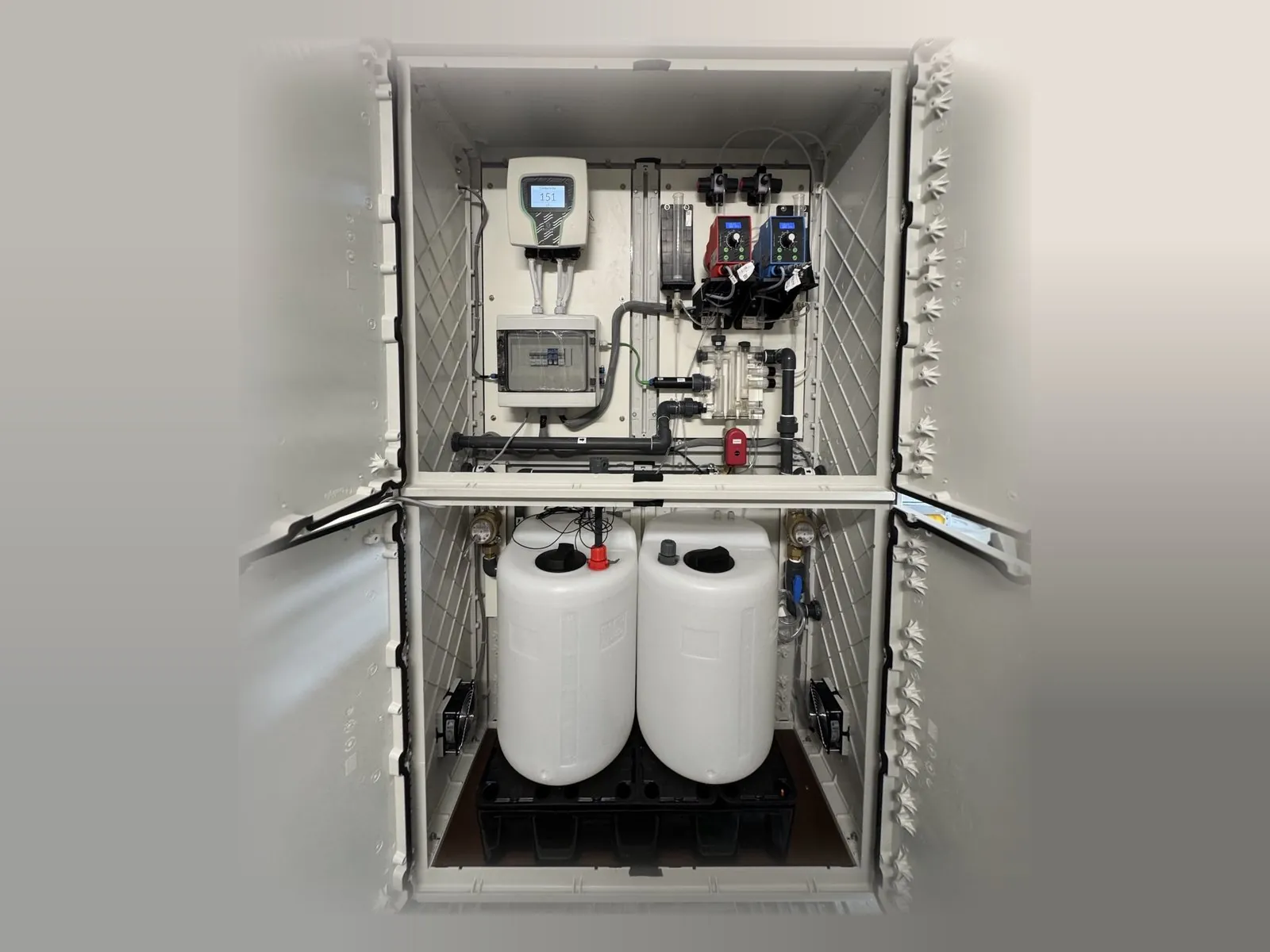
System panel and chemical tanks housed in a single cabinet.
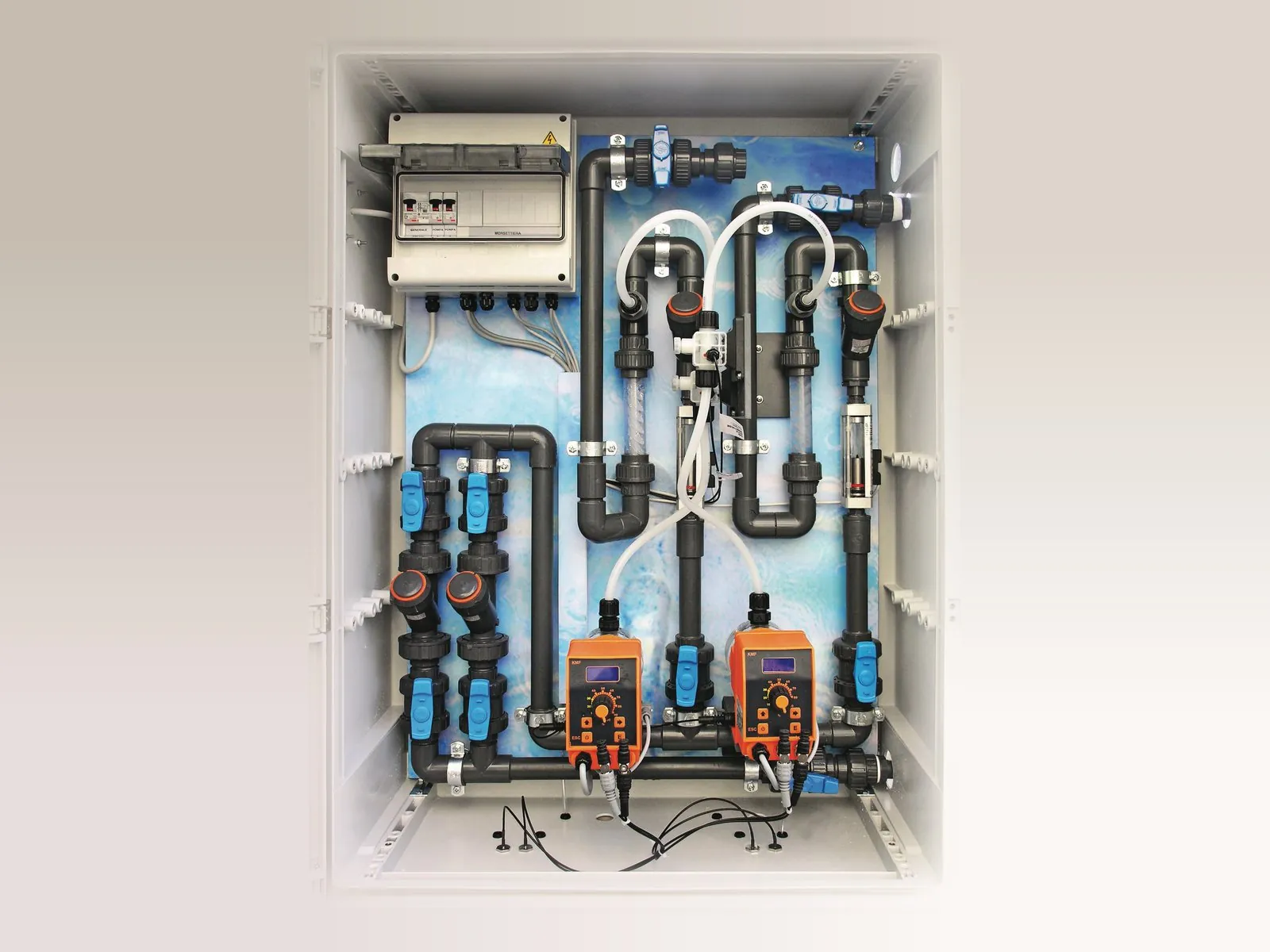
Pipework, pumps and electrical panel in a wall cabinet with door.
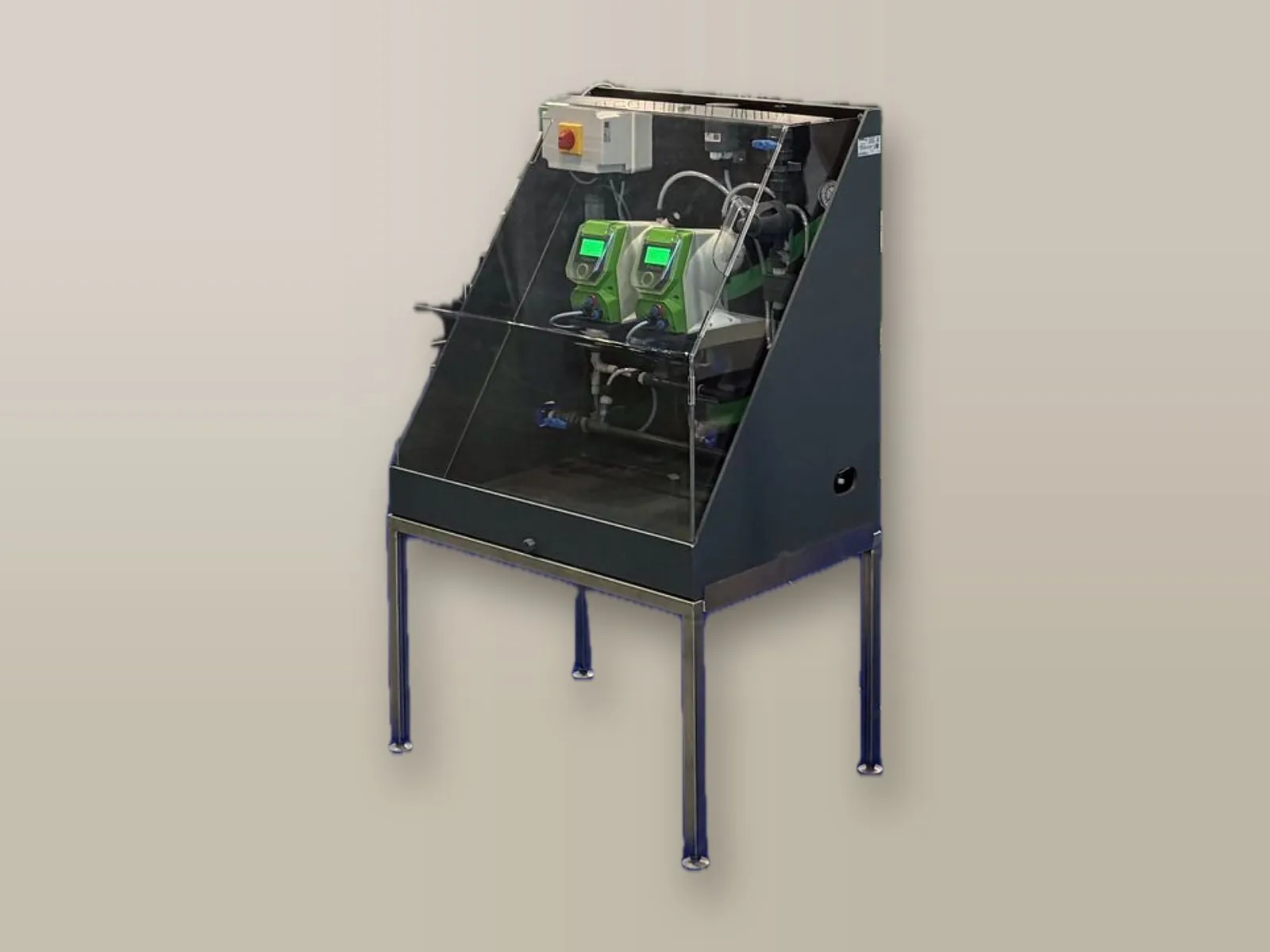
Skid with raised stainless steel frame and protective PMMA cover.
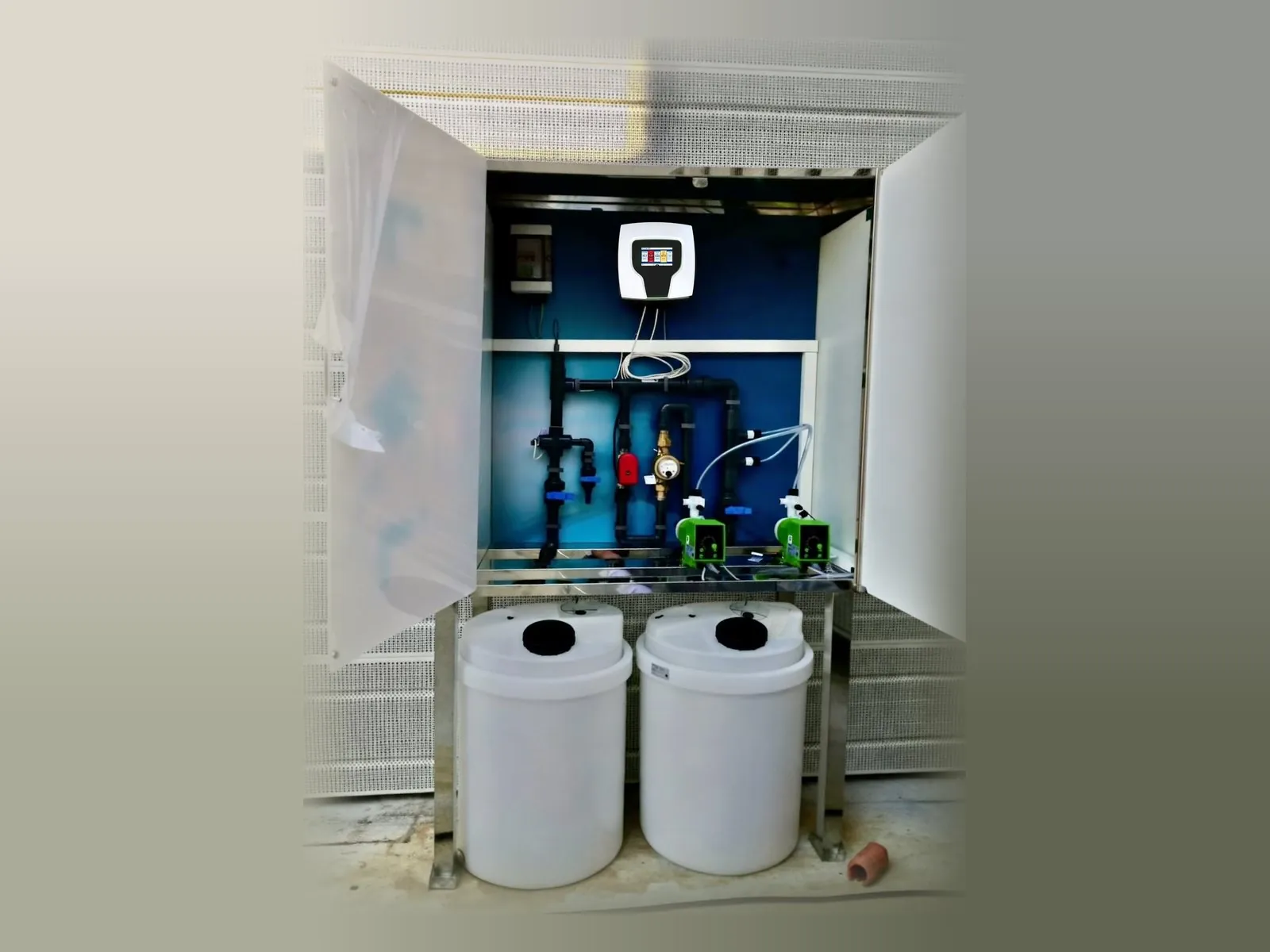
Skid enclosed in a box with door, with the chemical tanks at the base.
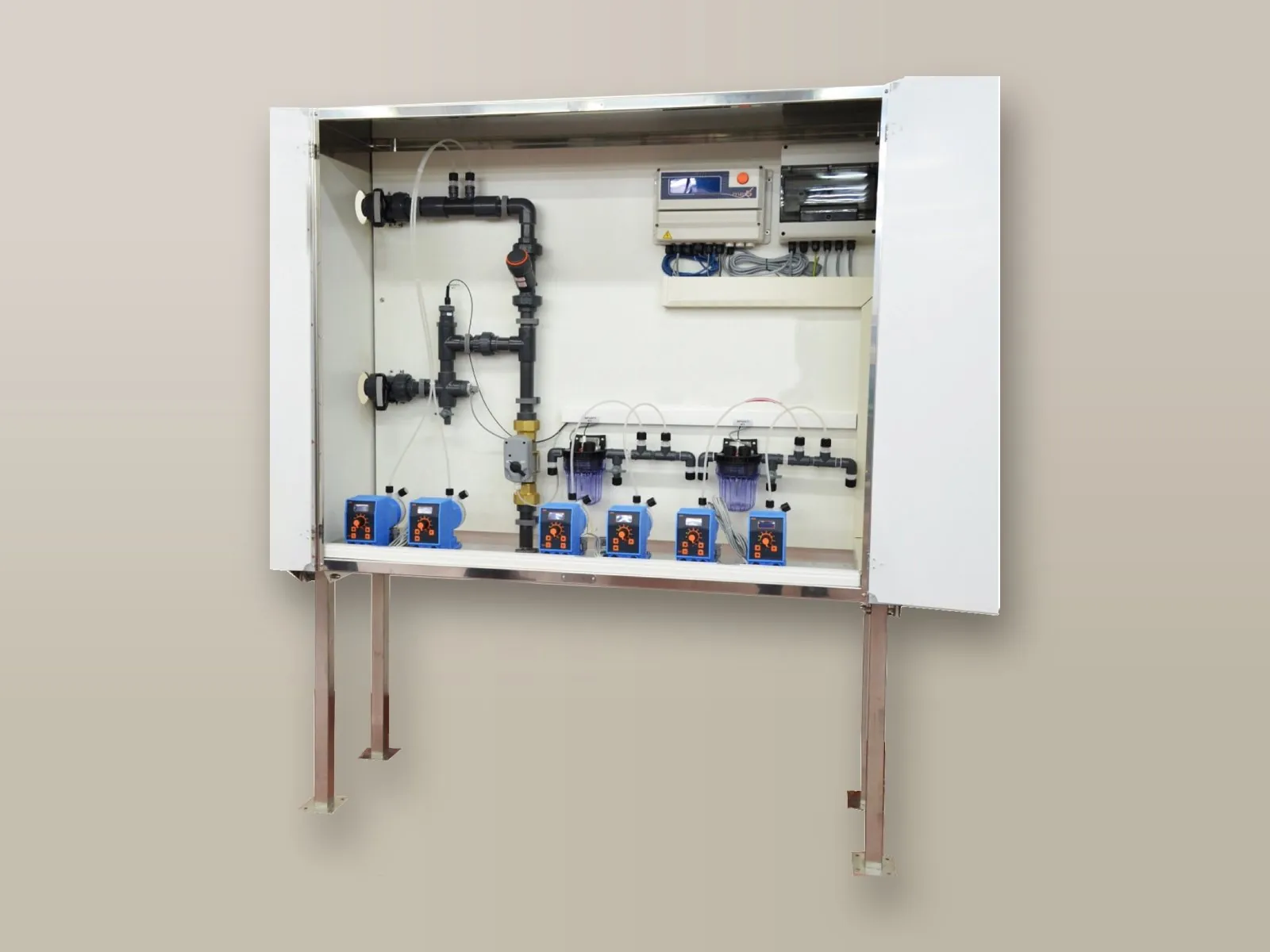
Skid on a frame with doors, pre-assembled and ready for connection.
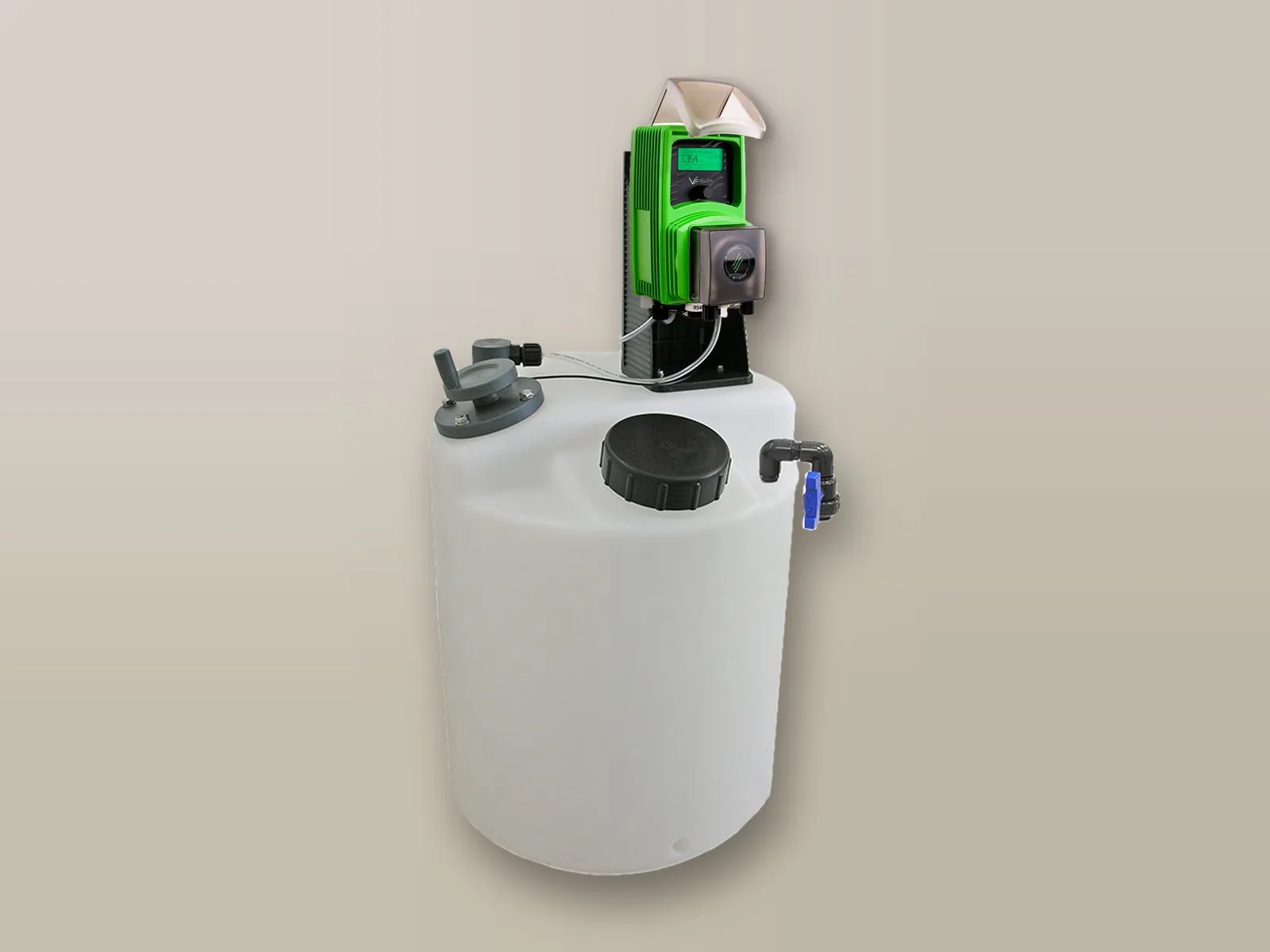
Dosing pump mounted directly on the tank: the most compact solution.
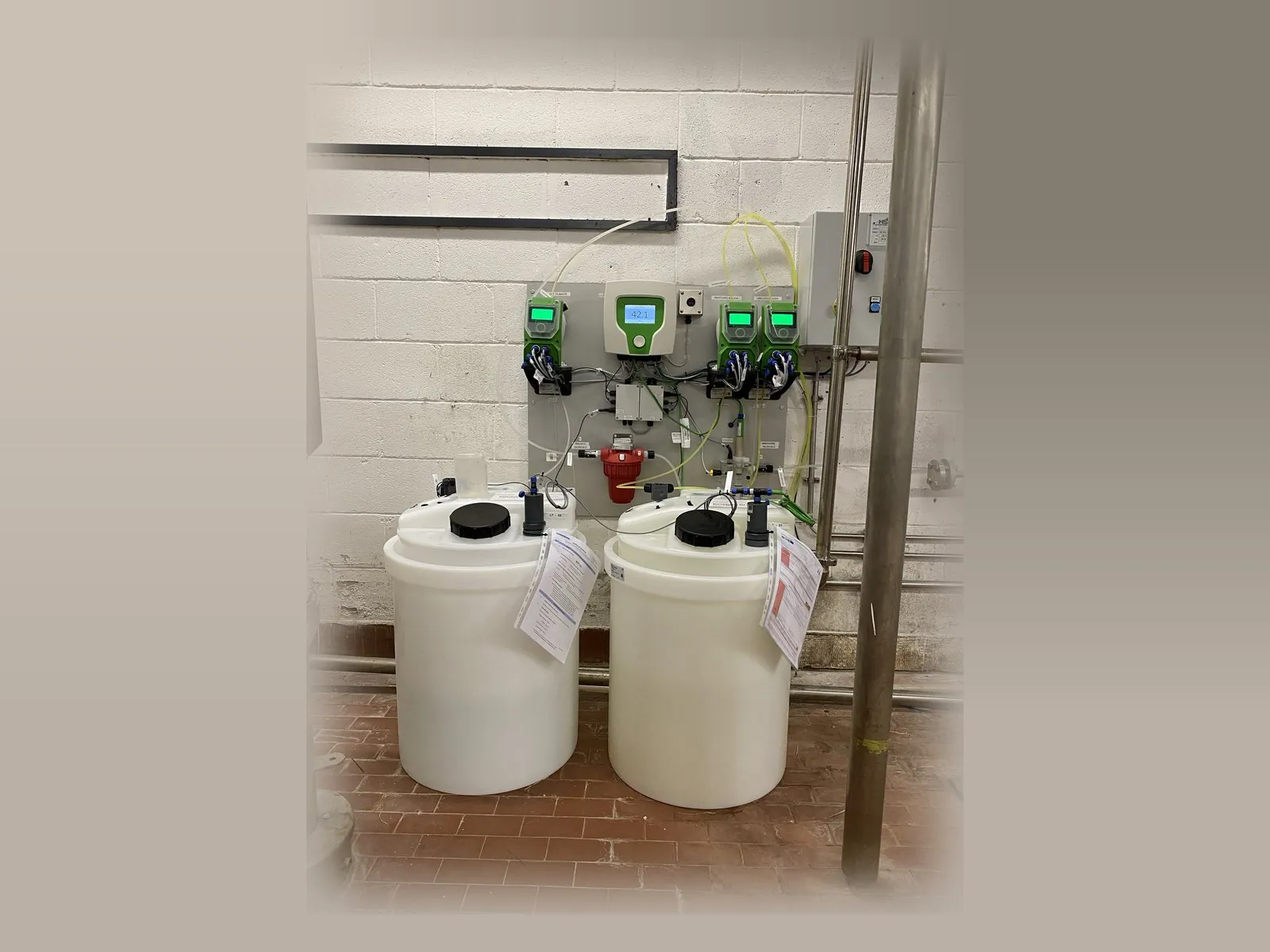
Wall installation in the plant room, with the chemical tanks on the floor.
Pumps, controllers or components supplied by the customer can also be fitted, with custom dimensions, back panel and electrical panel. Dosing stations and skids →
For chlorine and other disinfectants the basic solution is the dosing station; to dose according to the concentration actually present in the water, measuring controllers are used.
The simplest solution: the pump doses at a constant rate or in proportion to the volume of water measured by the pulse-output water meter.
Details →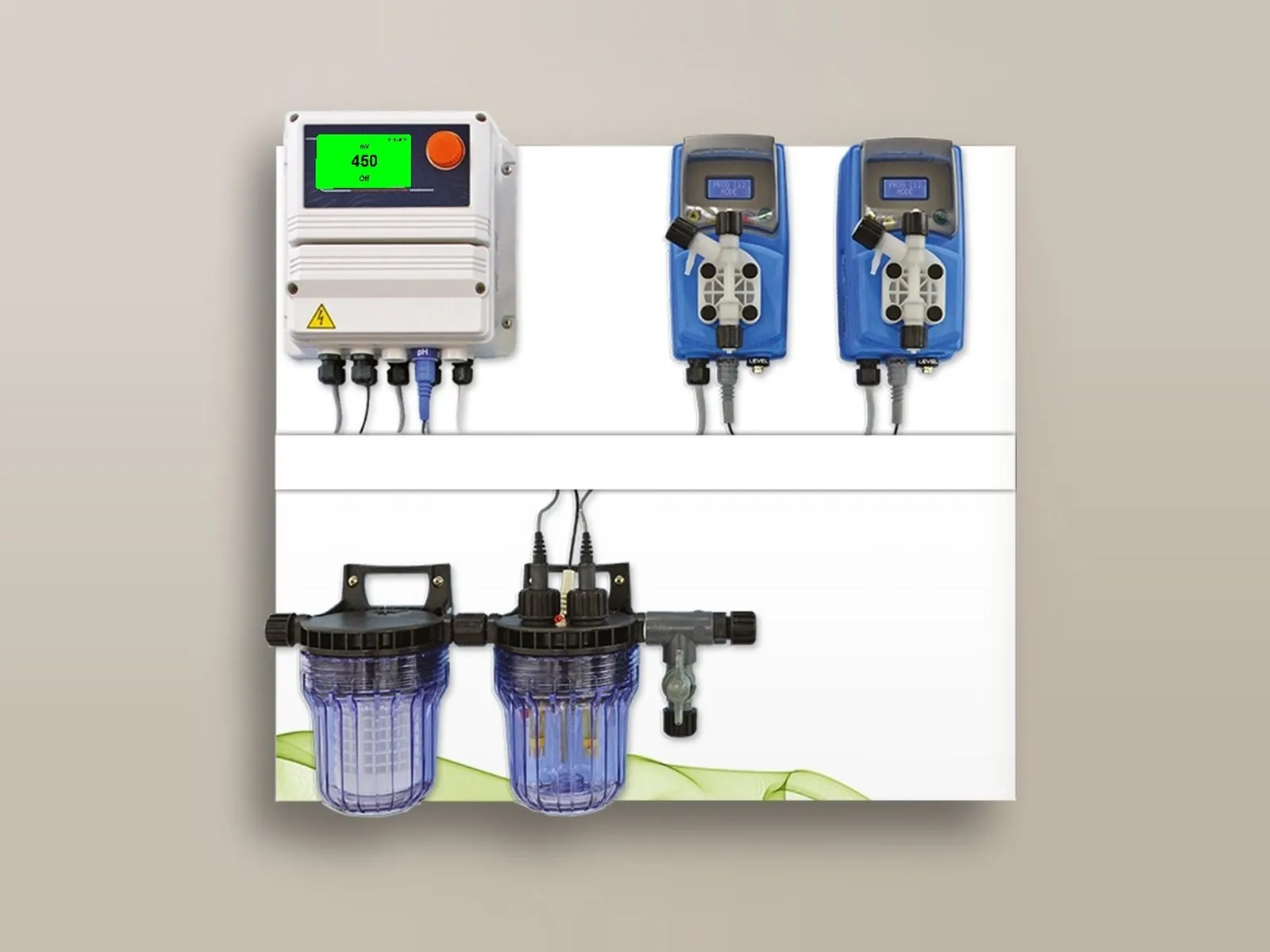
Dosing based on the Redox potential of the water: an economical solution, based on an indirect measurement.
Details →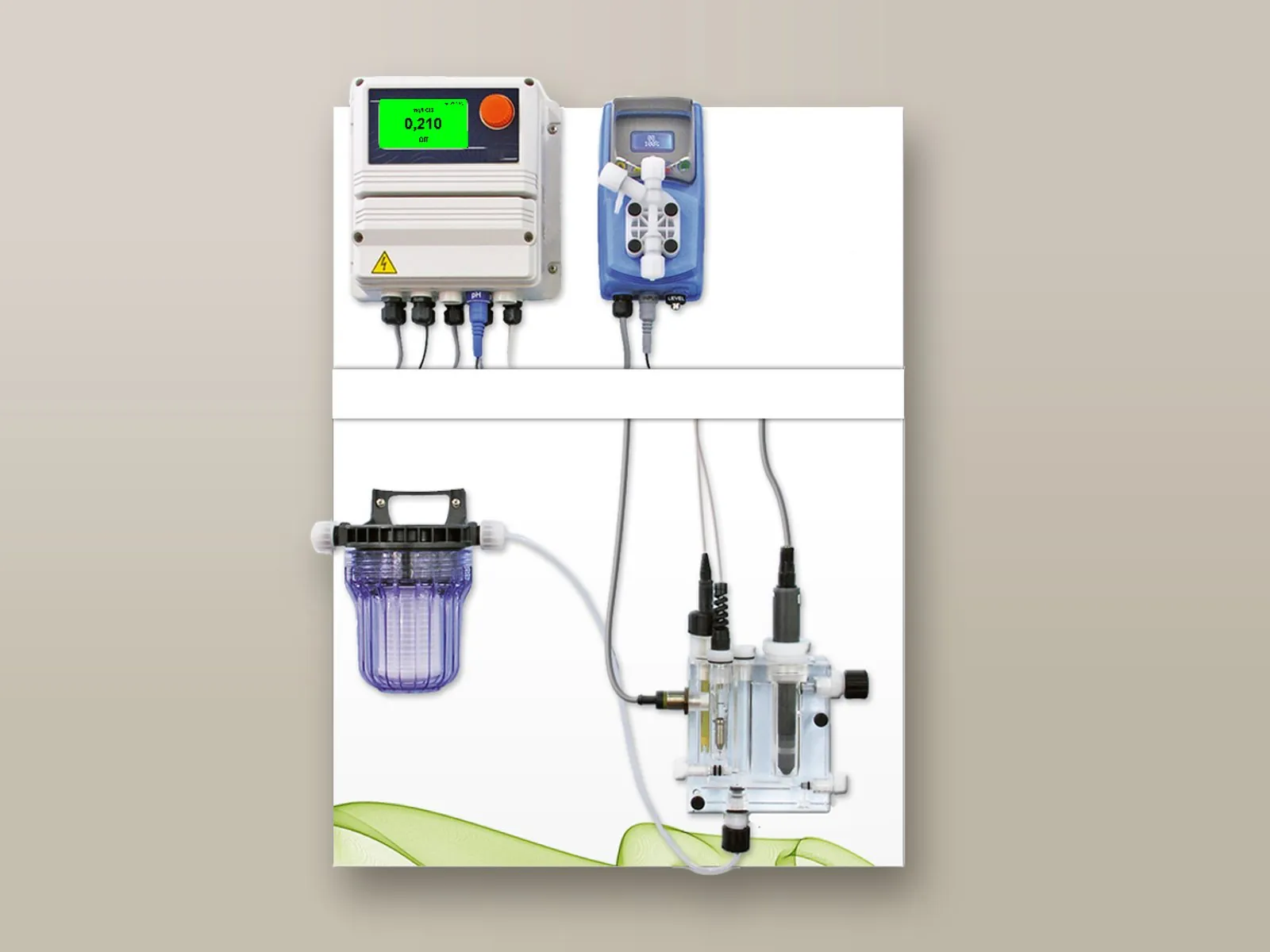
The amperometric cell directly measures the disinfectant in mg/l, whether chlorine or chlorine dioxide, stabilised or produced on site by the LOTUS, ensuring maximum dosing accuracy.
Details →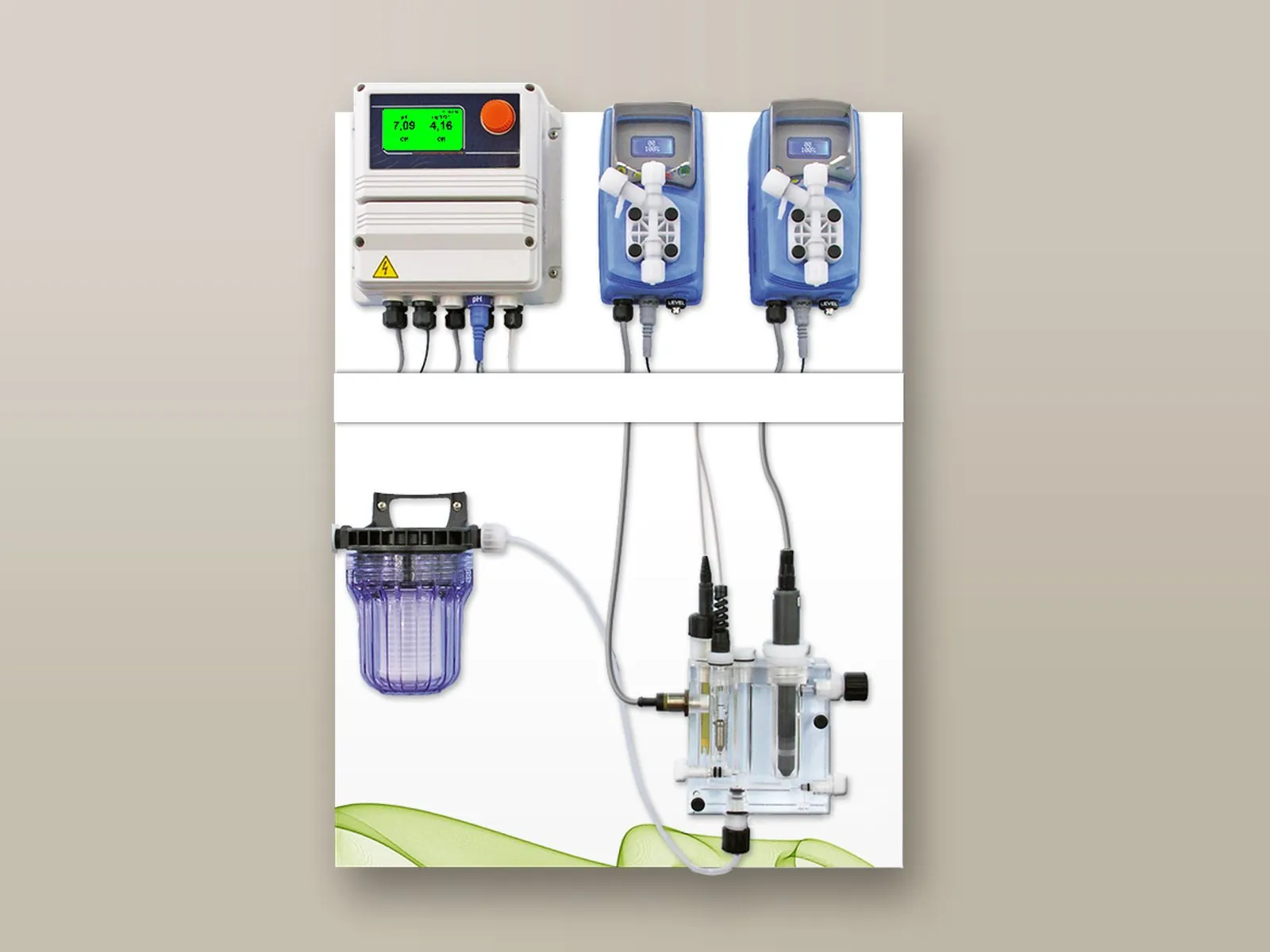
Simultaneous management of two parameters, for example pH and chlorine, with a single controller.
Details → Management of up to 10 parameters and of all the pumps in the installation, with touch screen and remote control as standard.
Details → Chlorine dioxide generator: it produces the disinfectant on site from the precursors and doses it in proportion to the water meter or to the measured residual.
Details →Tell us the characteristics of the facility, the water and the installation: we will propose the most suitable Legionella control treatment, from analysis to remote monitoring.
Call or write to us: a technician will reply with a tailored proposal of controllers, pumps, probes and accessories.