Continuous measurement
A sampling pump sends the water from the storage tank to the amperometric cell, installed in a flow-through probe holder; the analysed water returns to the tank and a temperature probe shows its temperature on the display.
The system continuously measures the free chlorine residual, that is the hypochlorous acid available for disinfection, with an amperometric cell, and controls the hypochlorite dosing pump in proportion to the deviation from the set point: the residual remains constant even when the flow rate, the water quality or its chlorine demand change.
The free chlorine concentration to be maintained in the water is set (set point), typically 0.2 mg/l in drinking water: the system maintains it automatically and continuously.
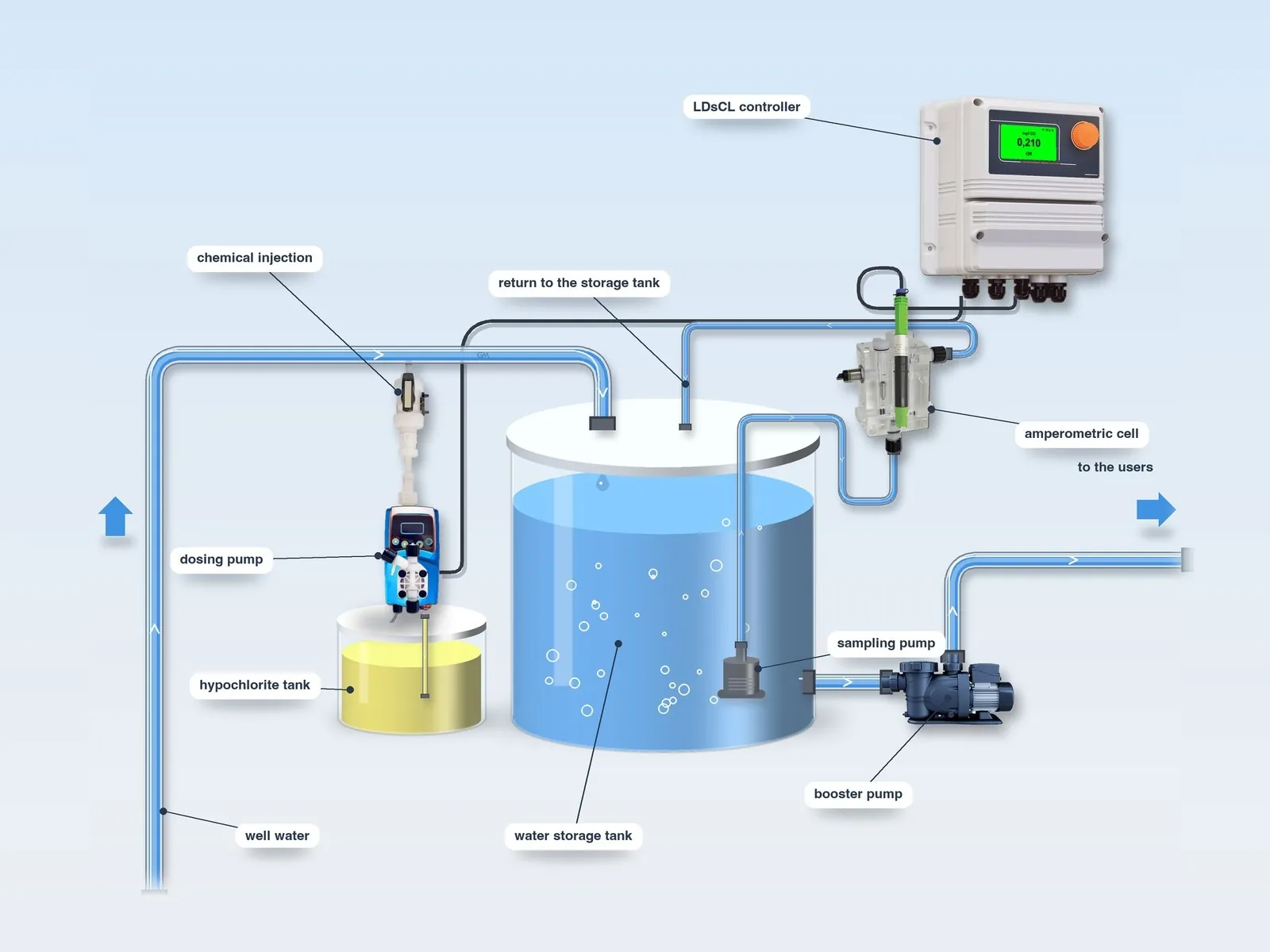
A sampling pump sends the water from the storage tank to the amperometric cell, installed in a flow-through probe holder; the analysed water returns to the tank and a temperature probe shows its temperature on the display.
When free chlorine falls below the set point, the controller activates the hypochlorite pump, at a frequency that increases the further the reading is from the set point; when the set point is reached, the pump is stopped.
The water entering the storage tank immediately comes into contact with chlorine, while the pump restores the set value: the constant presence of free chlorine eliminates bacteria and biofilm.
The action of chlorine requires a contact time appropriate to the organisms present, and in any case no less than 20 minutes.
Sodium hypochlorite, commonly referred to as chlorine, is the reference disinfectant for the microbiological safety of drinking water: it inactivates bacteria at molecular level and makes water fit for human consumption. Its effectiveness is checked by measuring the free chlorine remaining in the water after treatment.
Learn more: well water →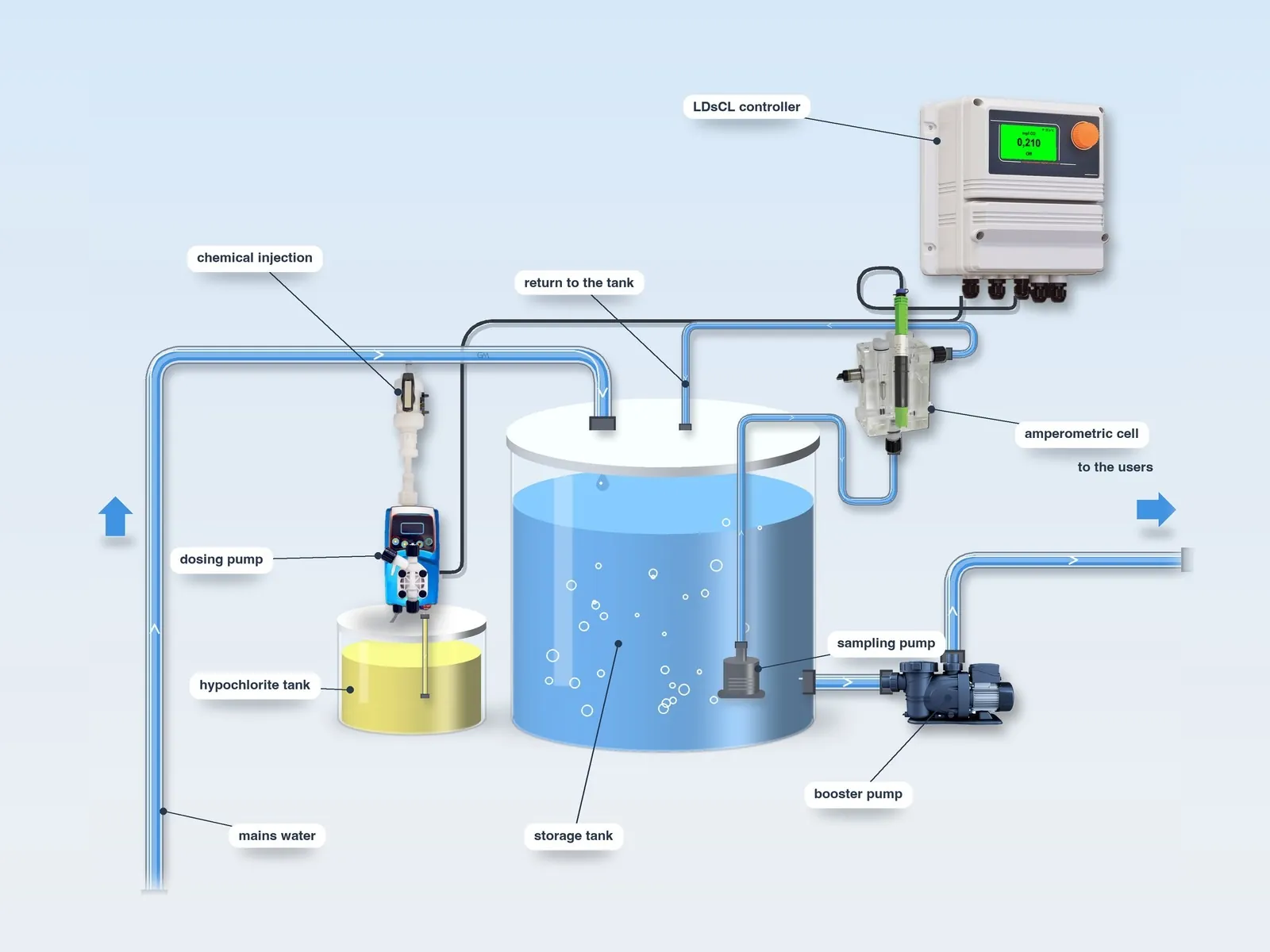
Chlorine requires a contact time: without a storage tank, the water supplied contains chlorine but is not completely disinfected.
The dosed chlorine is first consumed by the bacterial load. If the reading falls, for example from 0.2 to 0.15 mg/l, the pump starts; if the value continues to decrease, owing to the inflow of new or heavily contaminated water, the pump frequency increases up to its maximum, reached at a reading of 0.0 mg/l.
The continuous and constant presence of free chlorine in the water eliminates bacteria and biofilm and prevents their proliferation.
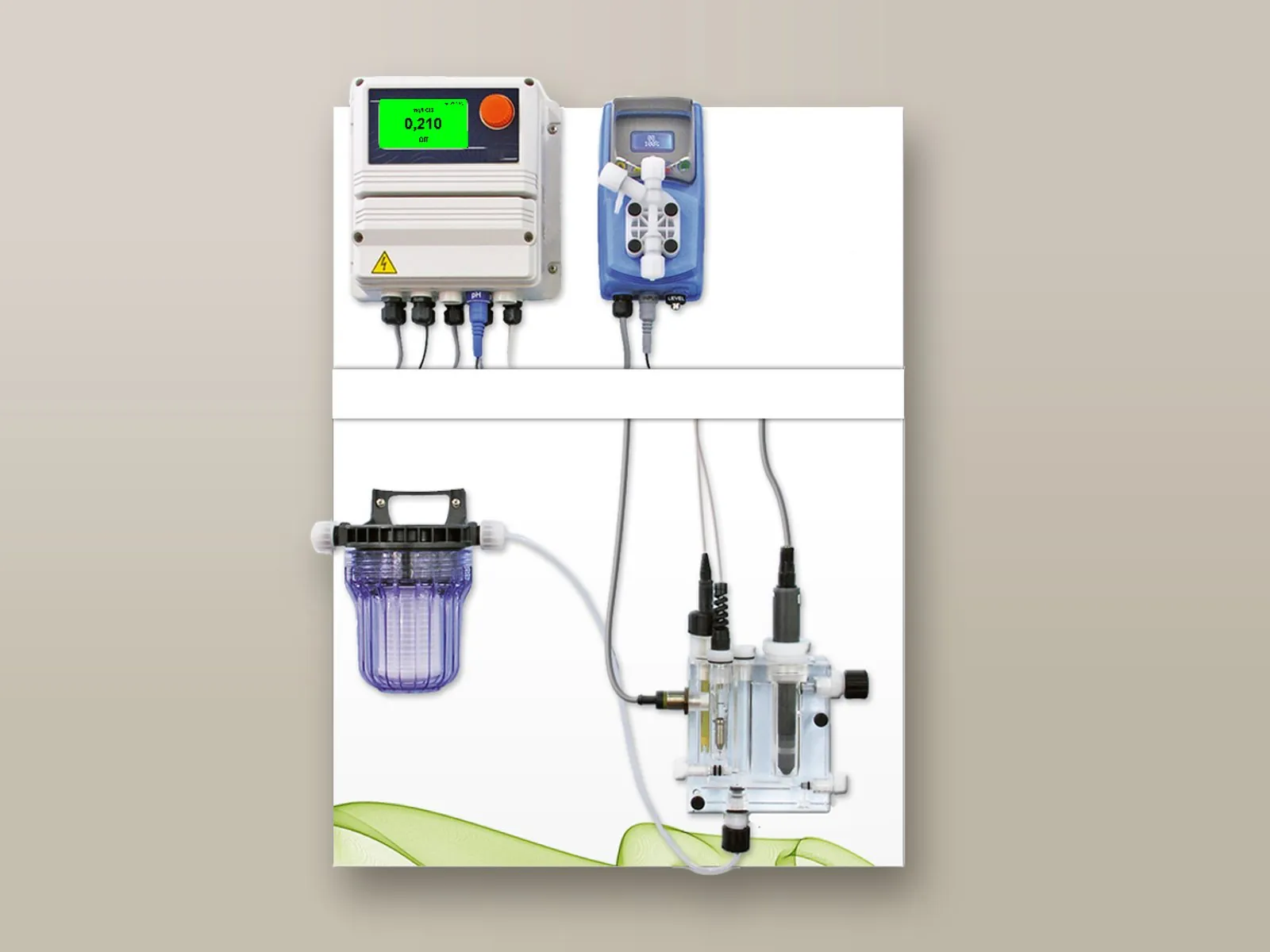
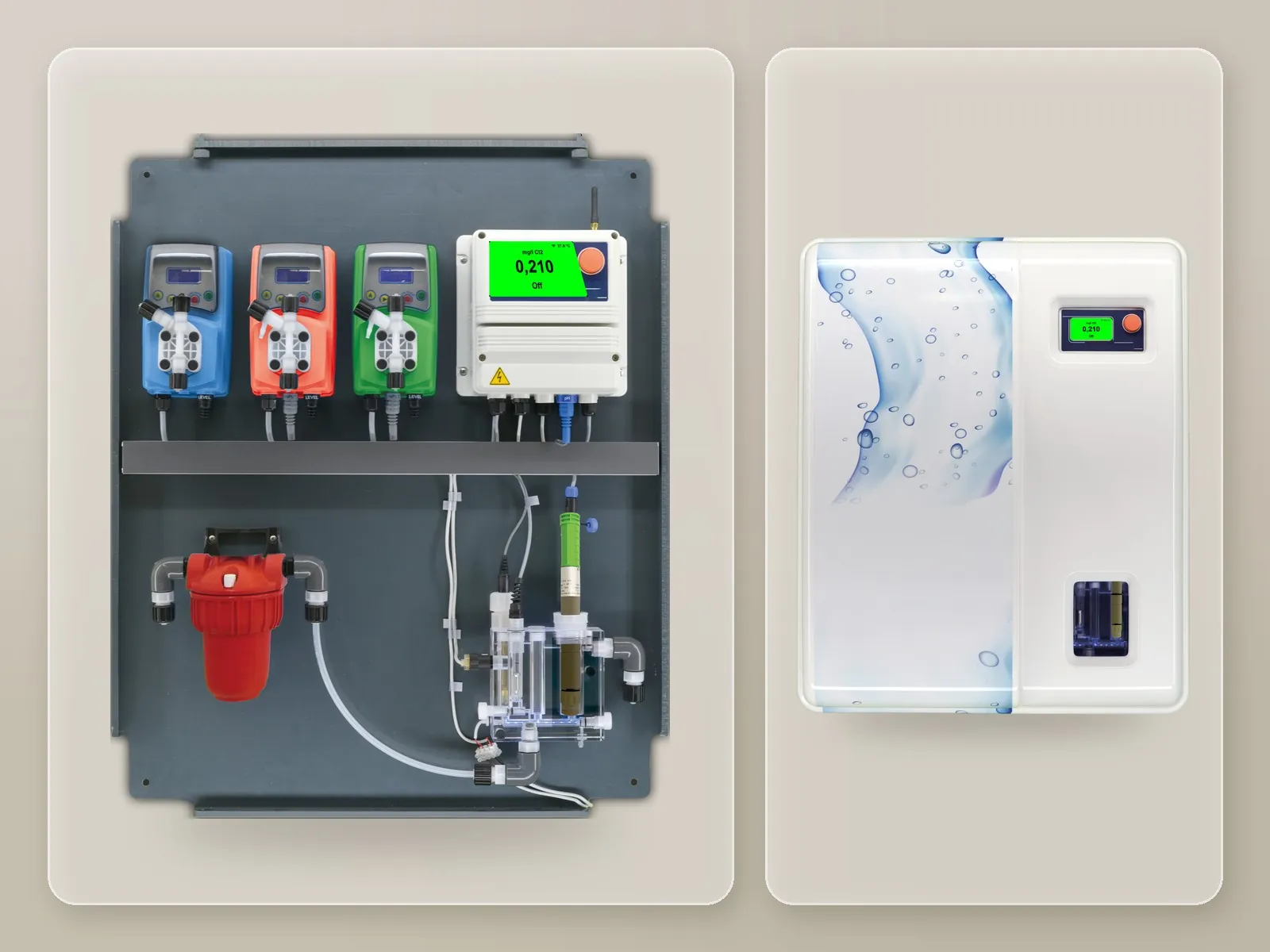
The system is supplied pre-assembled on a panel, ready for connection to the installation.
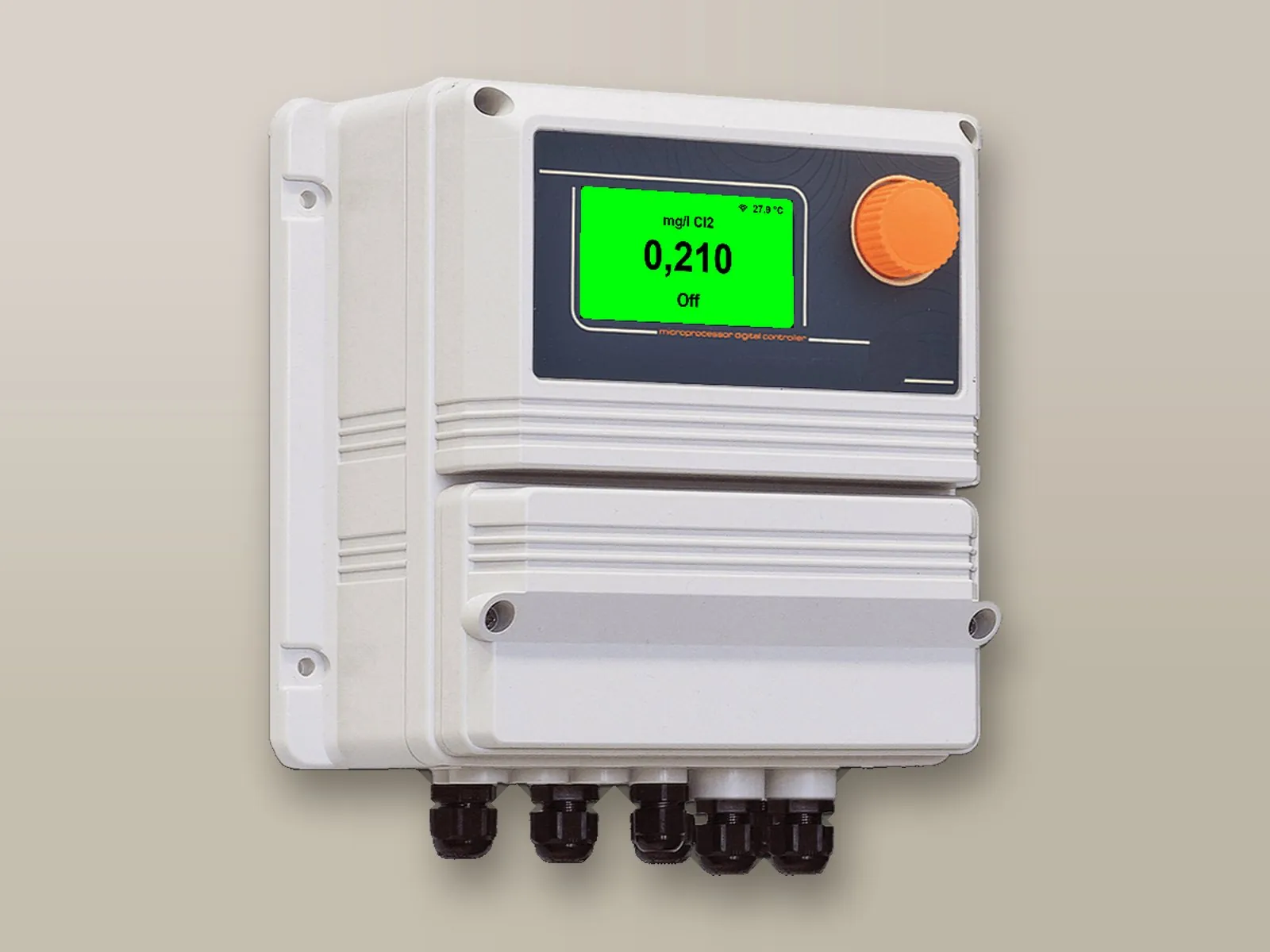
It acquires the free chlorine measurement from the cell and controls the hypochlorite pump in proportion to the deviation from the set point.
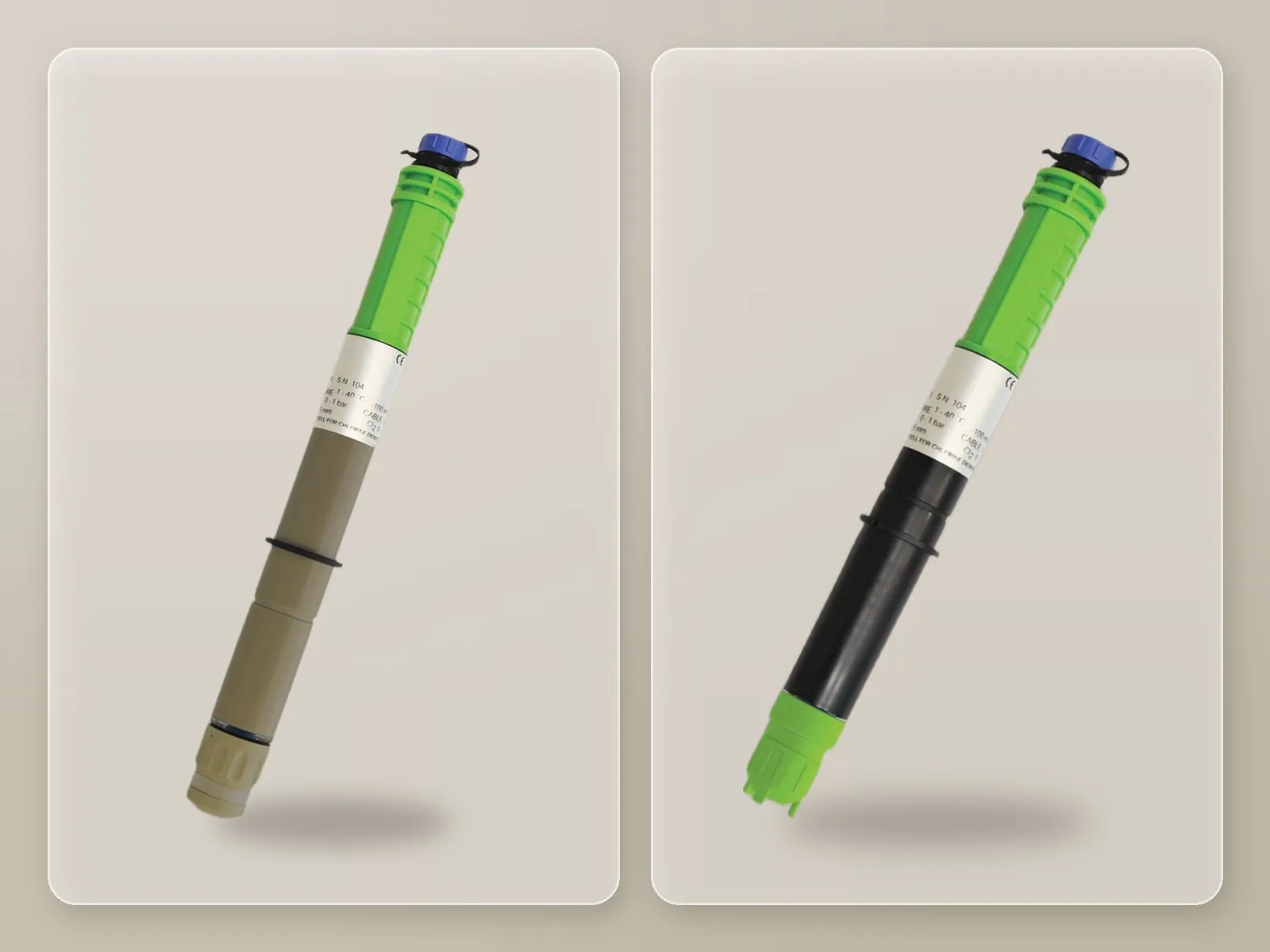
The controller → The cell is chosen according to the water to be treated: SCL3N or SCL3S closed amperometric cell for cold water, SCL18 self-cleaning cell for domestic hot water, ECL open amperometric cell for swimming pools.
The cells →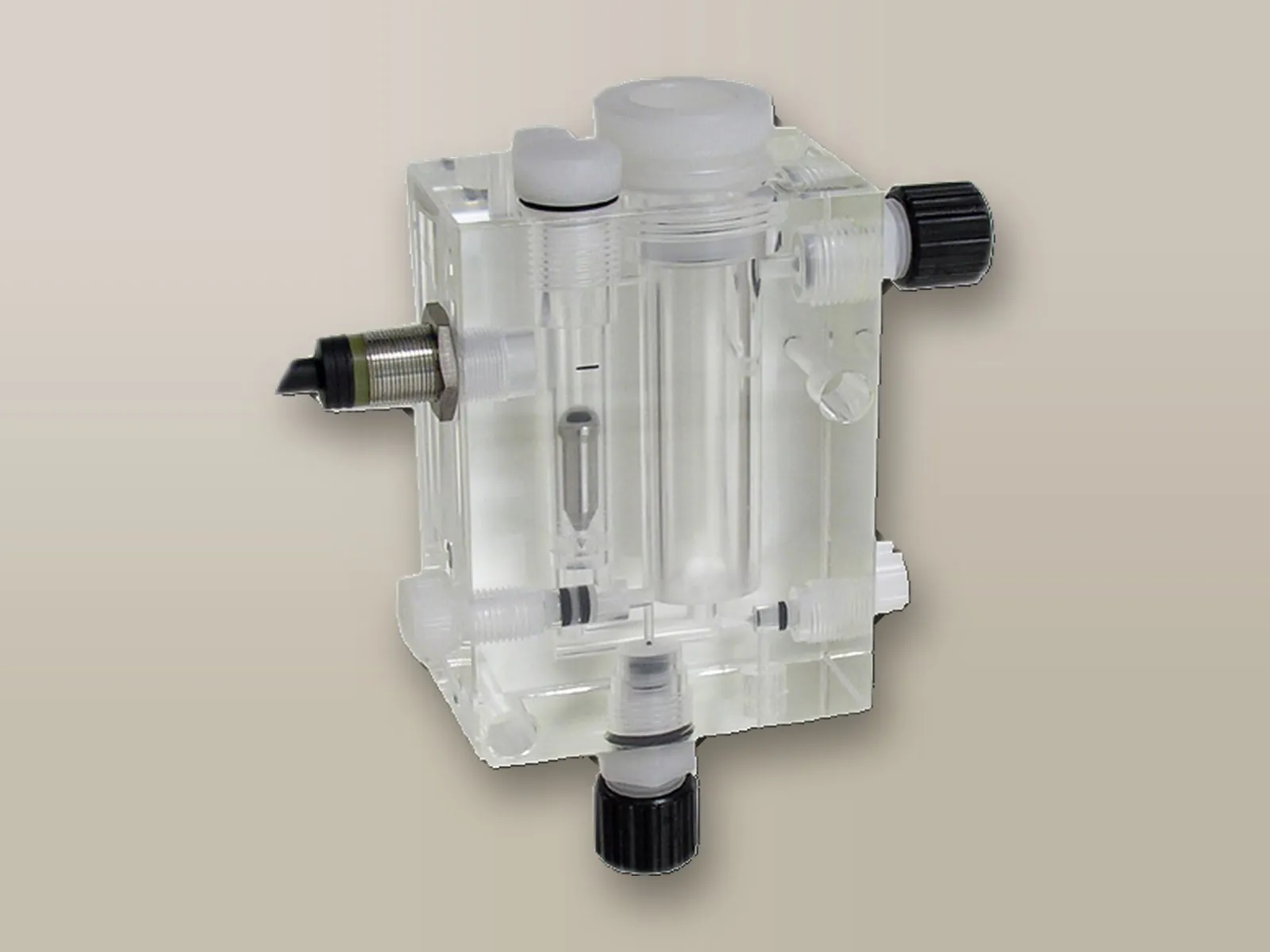
It is made of PMMA, with sample flow rate adjustment and flow sensor, which stops dosing when there is no circulation. A filter with washable cartridge is installed upstream to protect the cell from impurities.
Probe holders →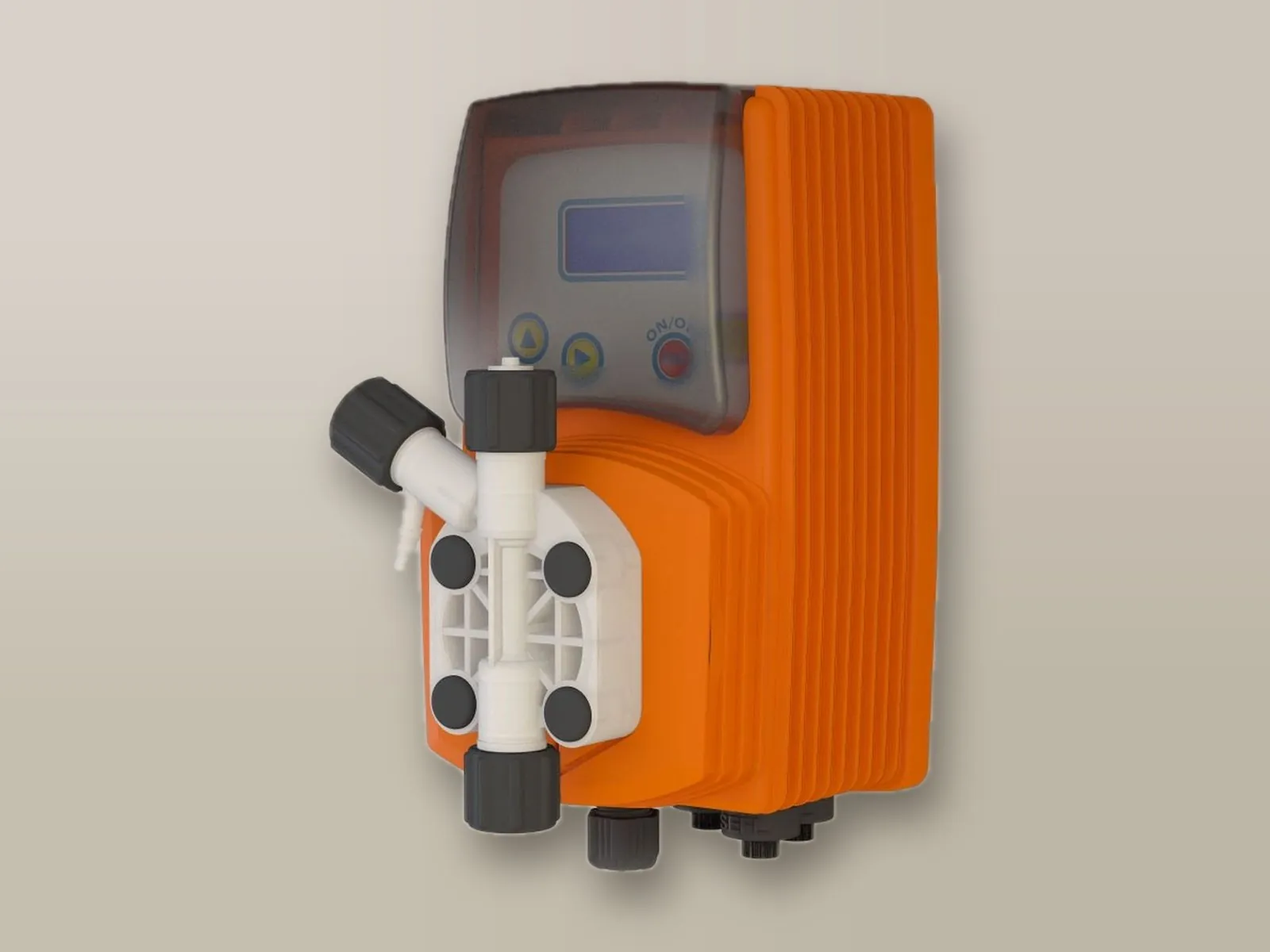
It is a solenoid diaphragm pump with self-venting head, with flow rate and back pressure defined at the time of ordering; for larger volumes, stepper motor or motor-driven pumps are used.
Dosing pumps →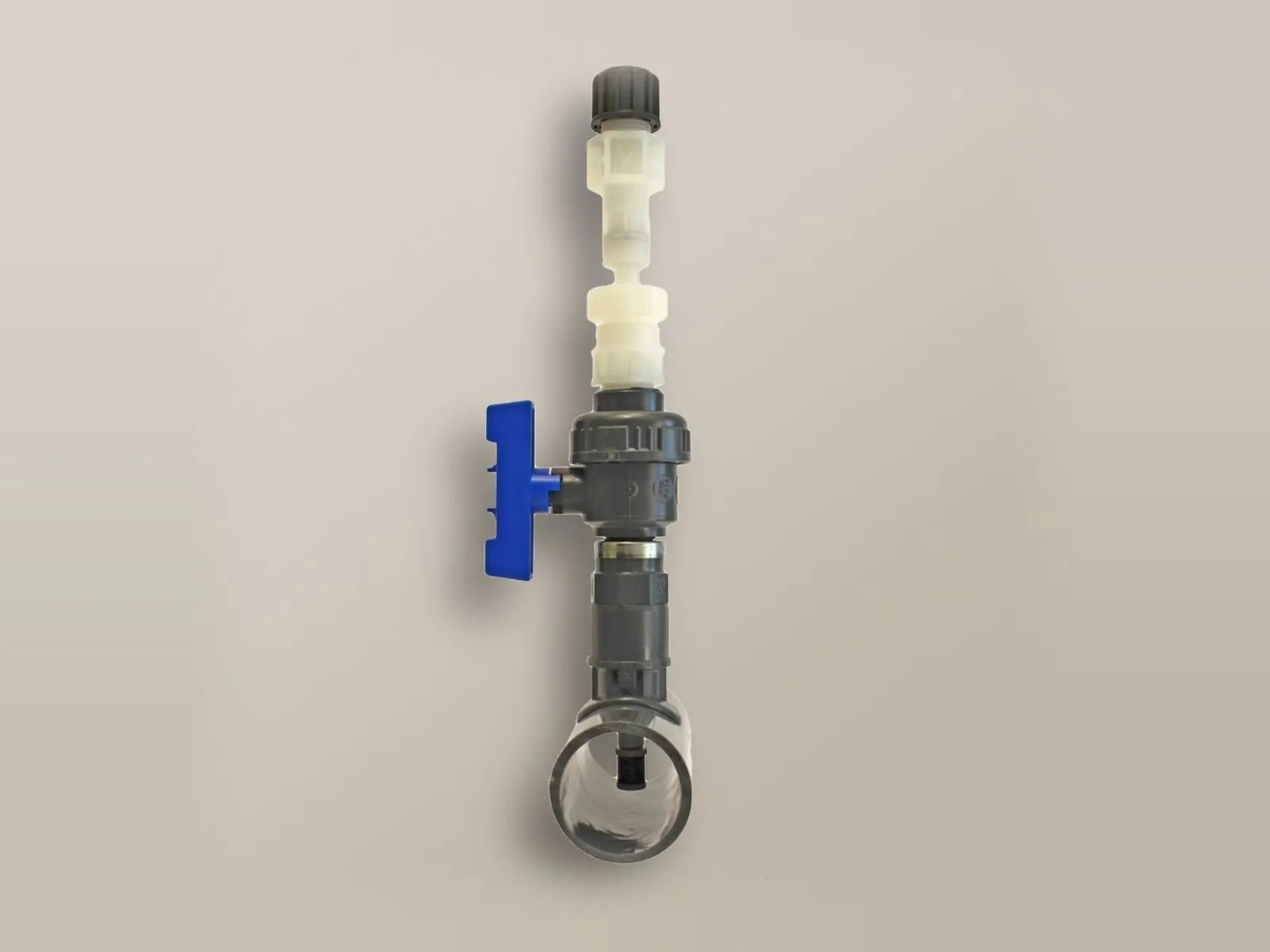
It introduces the hypochlorite into the centre of the pipe, improving mixing, and it can be withdrawn with the pipe under pressure.
Lances →Free chlorine is measured with different cells depending on the temperature, the salinity and the type of chlorine present in the water; the controller and the rest of the system remain the same.
Learn more: Redox, open amperometric cell and closed amperometric cell →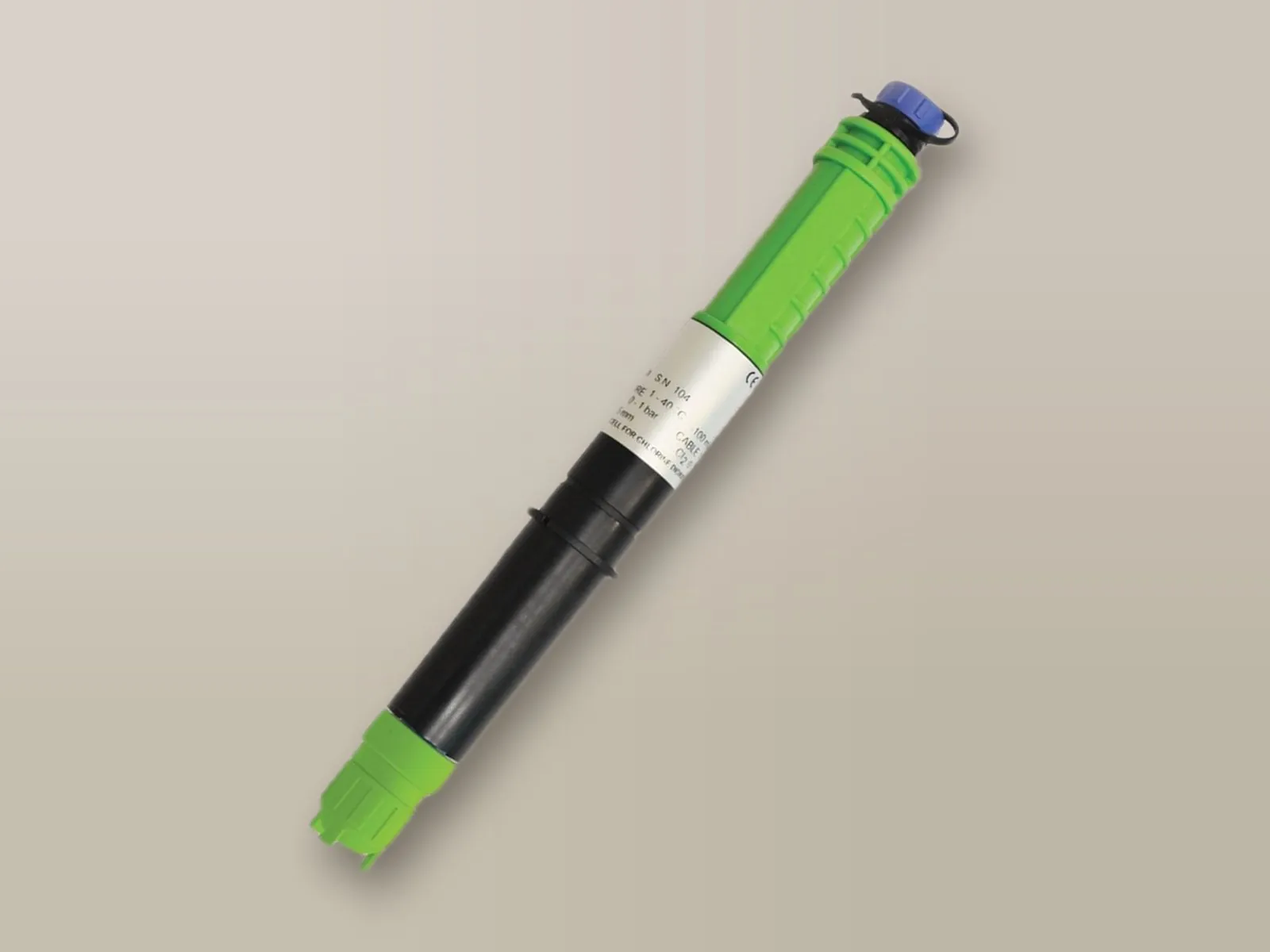
They are closed amperometric cells with selective membrane. The SCL3N, for fresh water and inorganic chlorine, automatically compensates pH and temperature, so that the measurement remains reliable even between pH 6 and 8, where free chlorine dissociates into hypochlorous acid and hypochlorite ion. The SCL3S measures organic and inorganic chlorine, including in salt water, with temperature compensation.
SCL cells →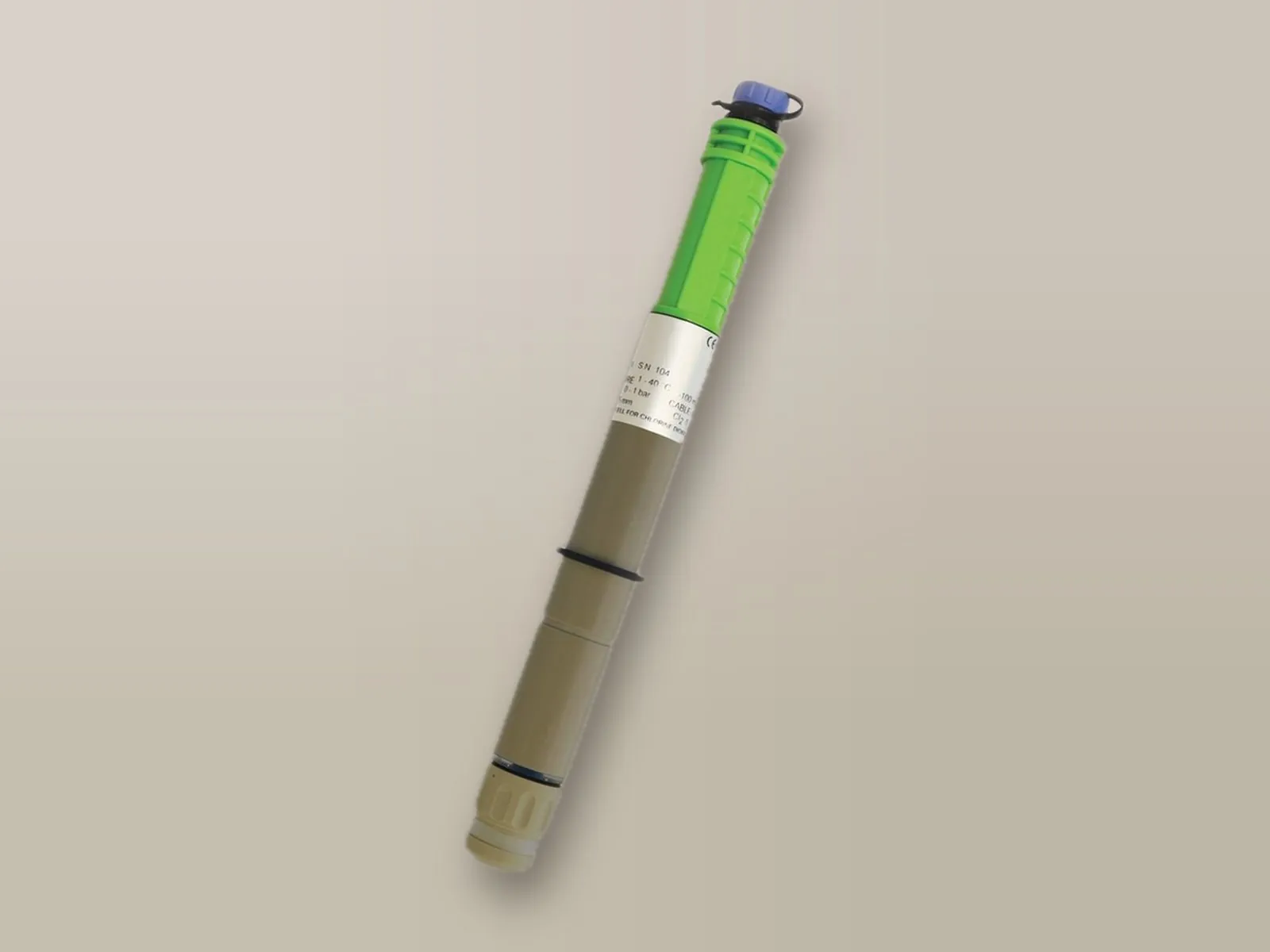
It is a self-cleaning cell with three electrodes (one measuring and two reference), without membrane, with pH and temperature compensation: the balls moved by the flow keep the electrodes free from deposits. It operates from 5 to 70 °C, on the recirculation of domestic hot water circuits.
SCL18 cell →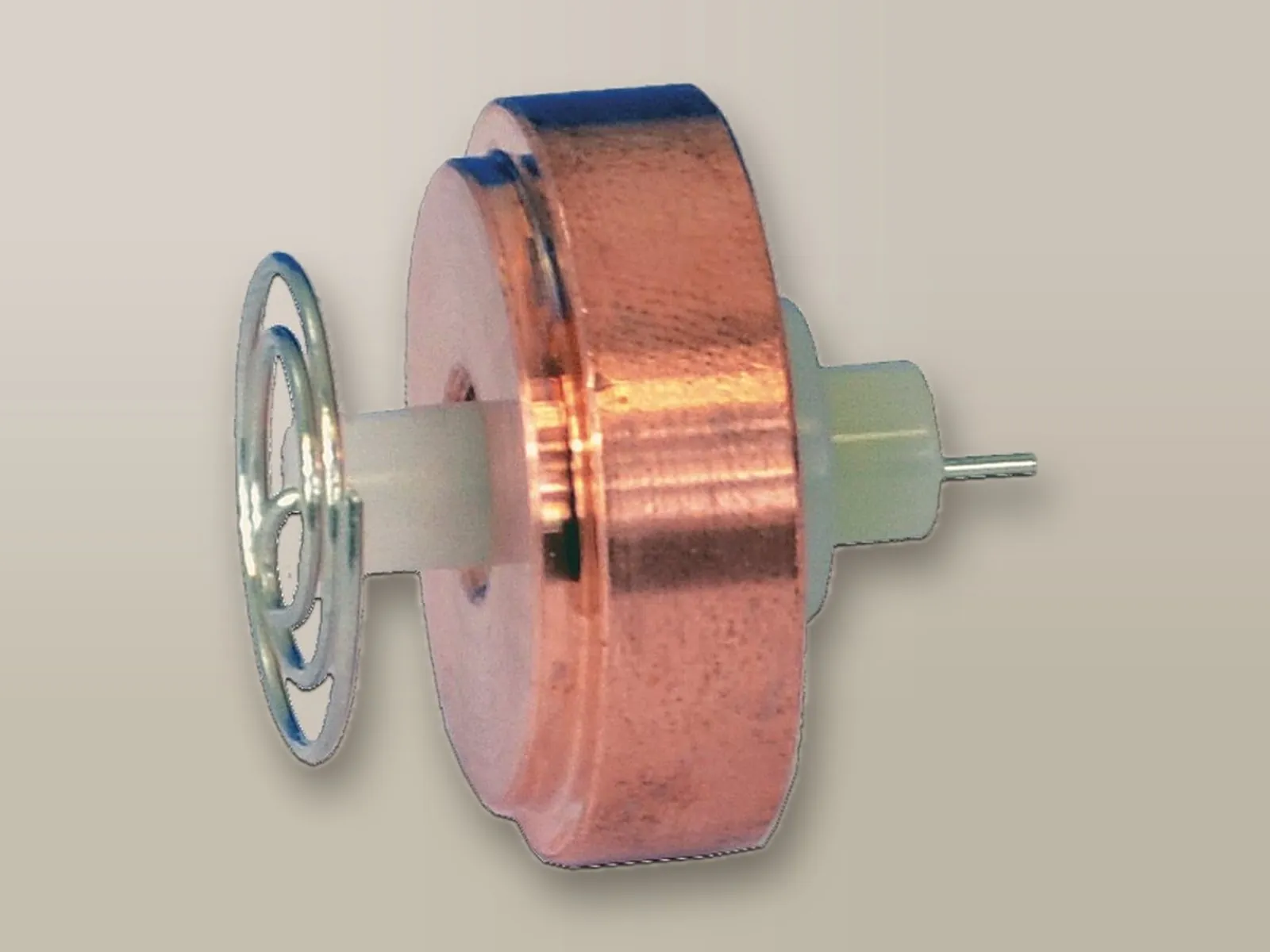
The open amperometric cell directly measures free chlorine in mg/l in swimming pool water, including salt water, without pH compensation.
ECL cells →Closed amperometric cells work in water containing chlorine: an absence of chlorine lasting more than 100 consecutive hours damages the cell. For this reason, a filter should be installed upstream of the probe holder.
The water to be analysed flows through the filter and the flow-through probe holder, connected in a bypass line to the installation, and returns to the circuit or storage tank.
Hypochlorite dosing can be proportional, ON/OFF, PWM or PID, with delayed start of dosing.
With the PLUS version of the controller, which has the input for the pulse-output water meter, dosing proportional to the volume of water treated is combined with correction based on the measured free chlorine.
The controller signals out-of-range readings, a faulty probe, the hypochlorite level and no flow in the probe holder, which suspends dosing.
In domestic hot water circuits, the system doses chlorine into the cold make-up water and controls free chlorine on the hot recirculation by means of the SCL18 self-cleaning cell. Where necessary, a pump for the film-forming inhibitor is added.
Legionella: risks, legislation and treatments →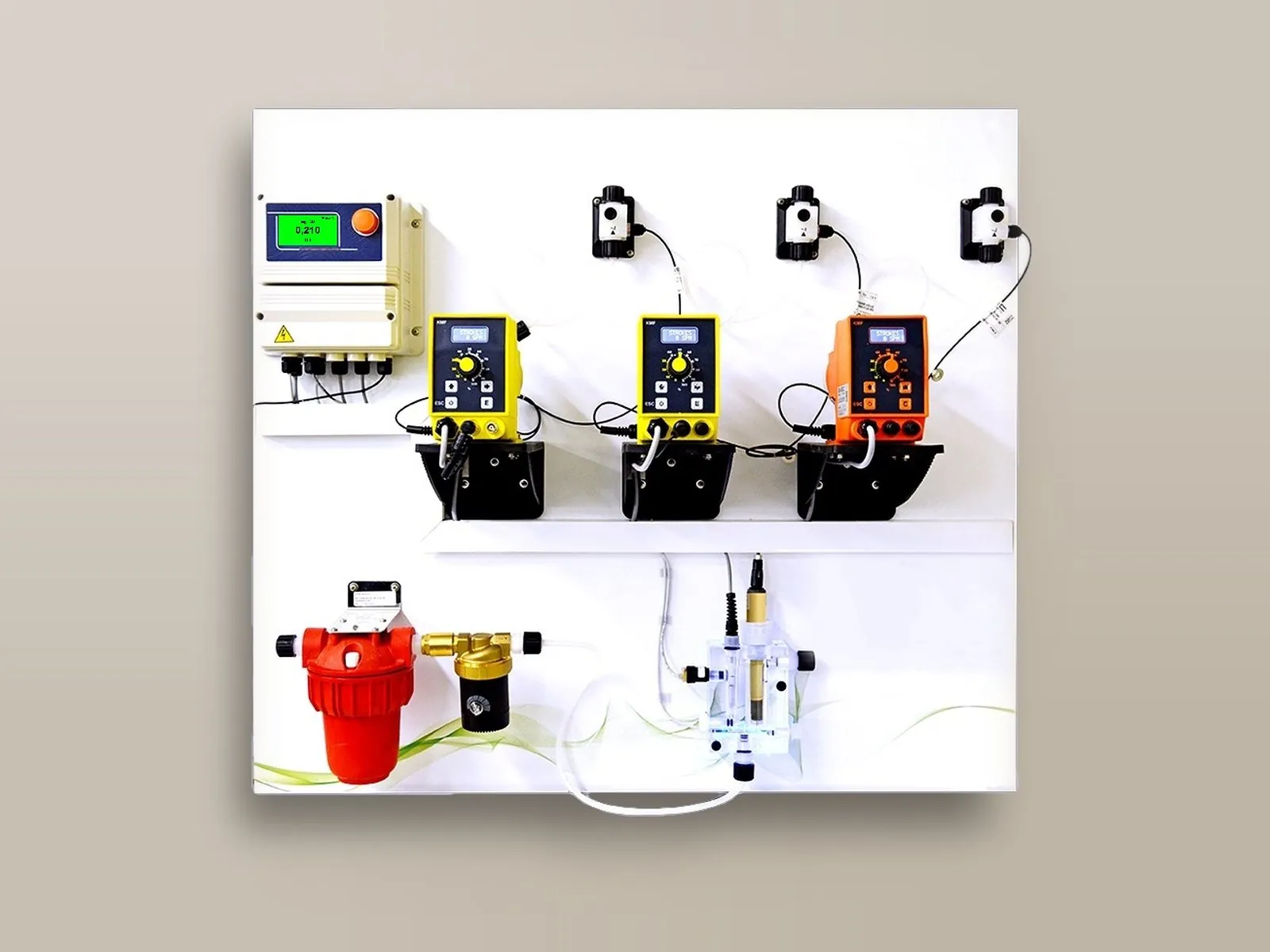
The panel combines the LDsCL controller, the pumps for disinfectant, make-up product and film-forming inhibitor, the filter and the probe holder.
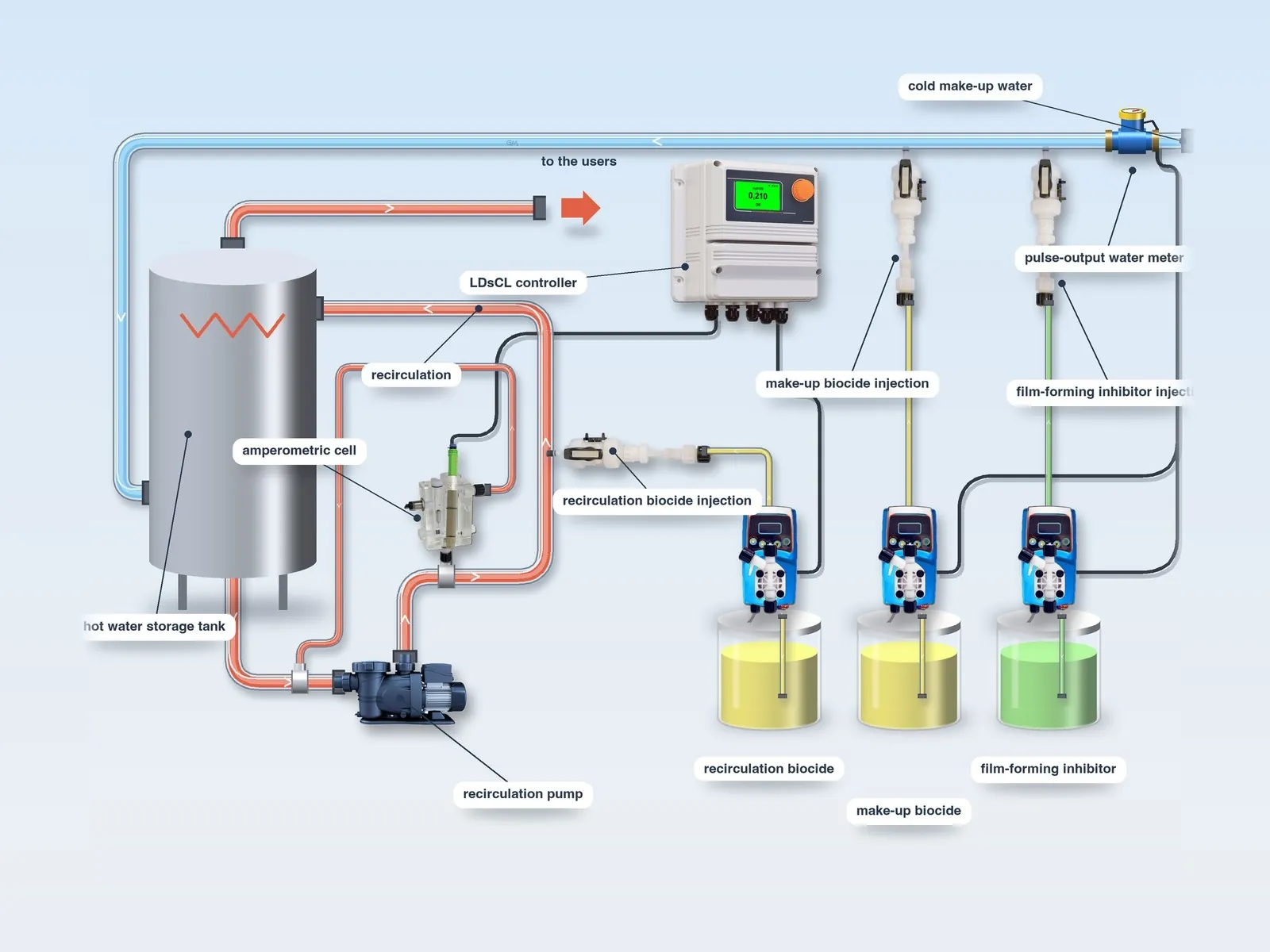
Dosing takes place on the circuit, on the make-up water and, for the film-forming inhibitor, with a dedicated pump.
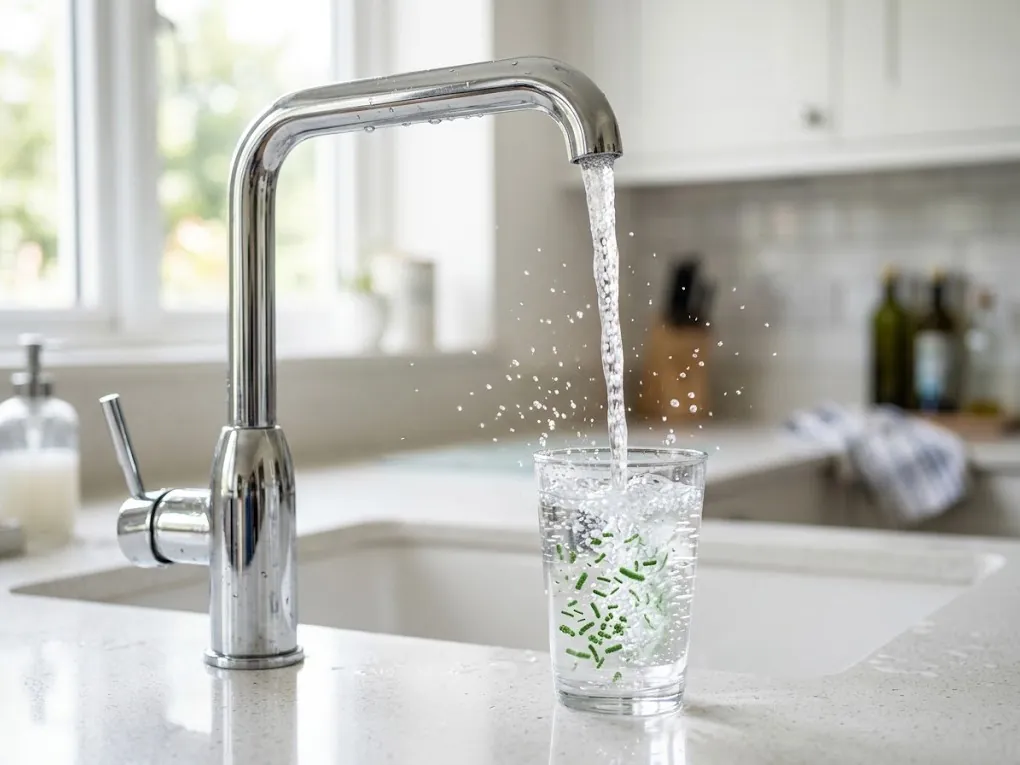
The system controls the free chlorine residual in water from private wells and springs and from public water supply networks, and in storage tanks.
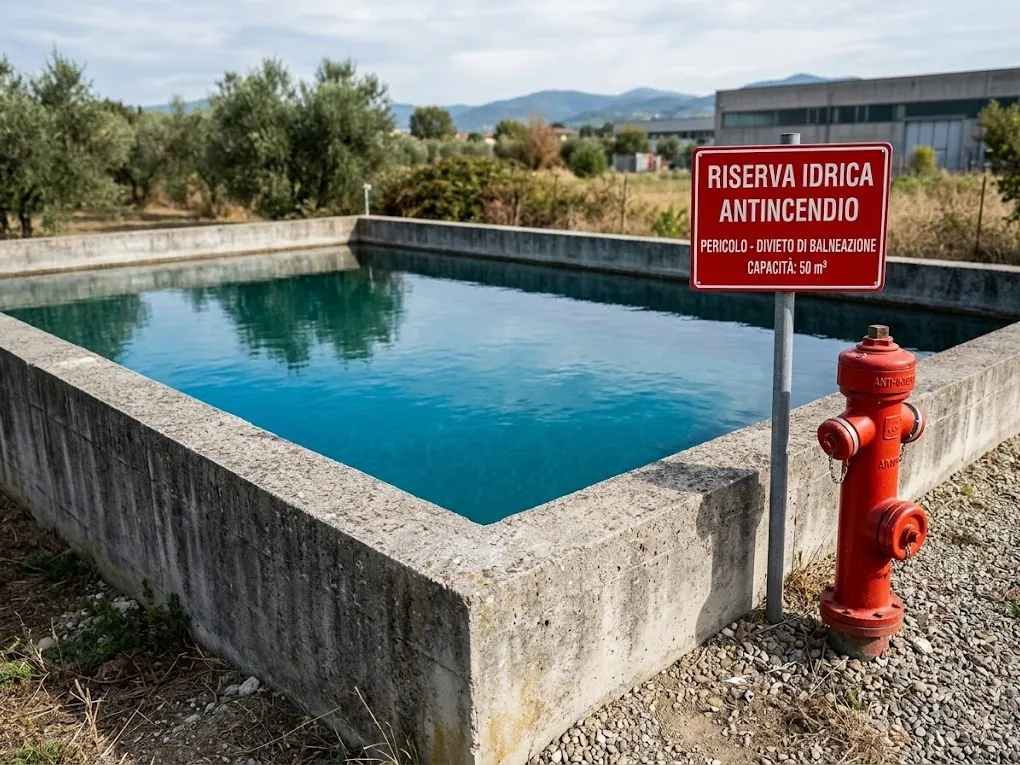
In fire-fighting water reserves, free chlorine is kept at the set point by injecting hypochlorite into the make-up line of the tank.
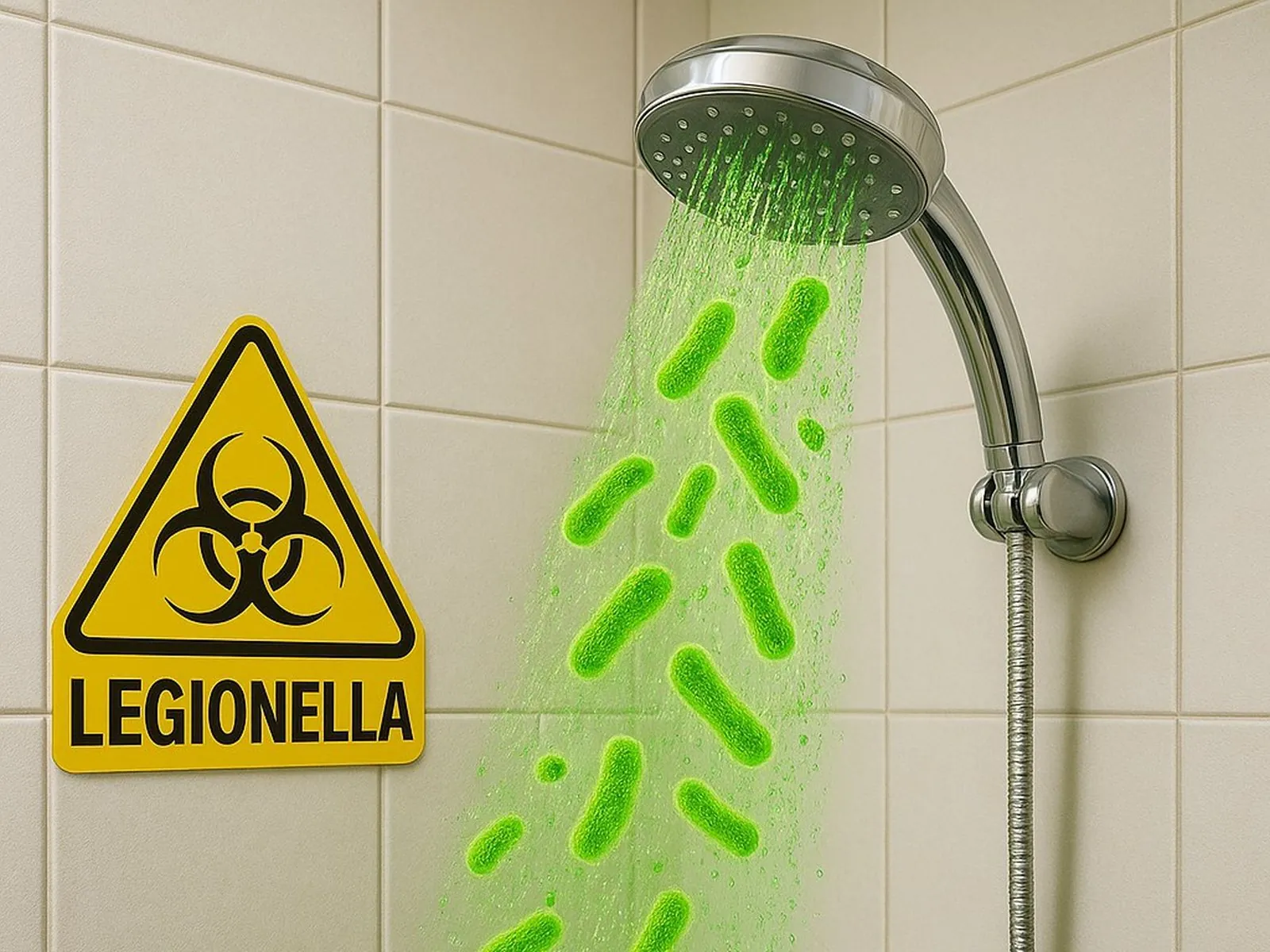
In domestic water circuits, both cold and hot, chlorine is used as anti-Legionella treatment, with the SCL18 cell on the hot recirculation.
Anti-Legionella →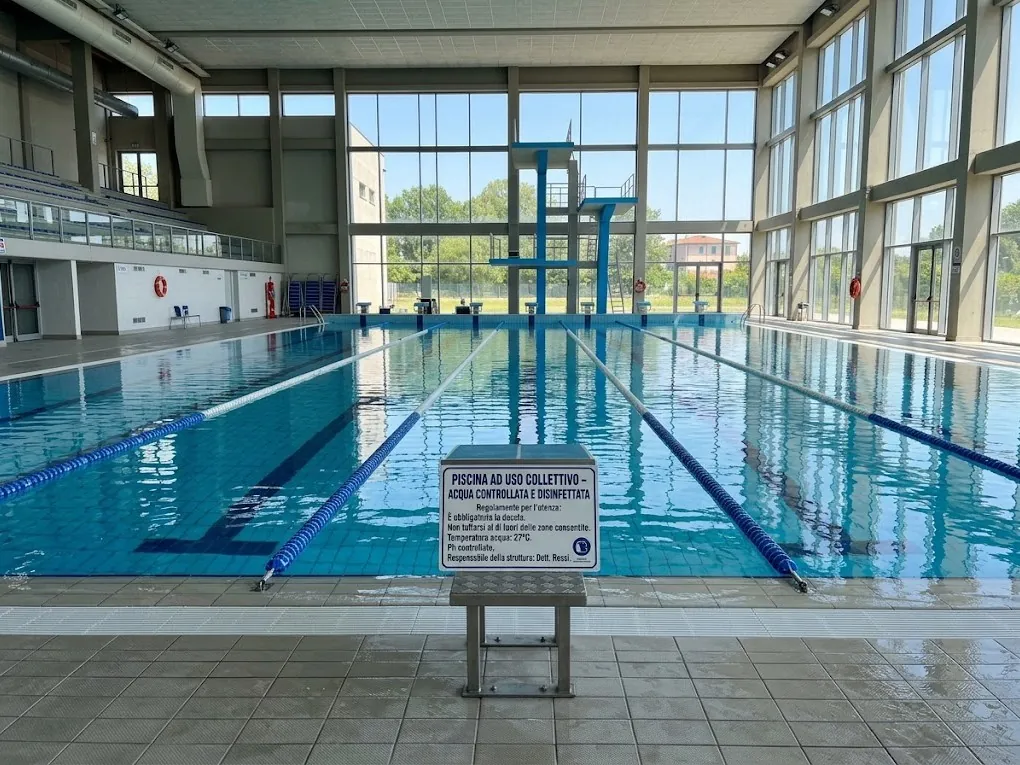
In swimming pools, free chlorine measurement, with a closed amperometric cell or an ECL open amperometric cell, is combined with pH control in dedicated systems.
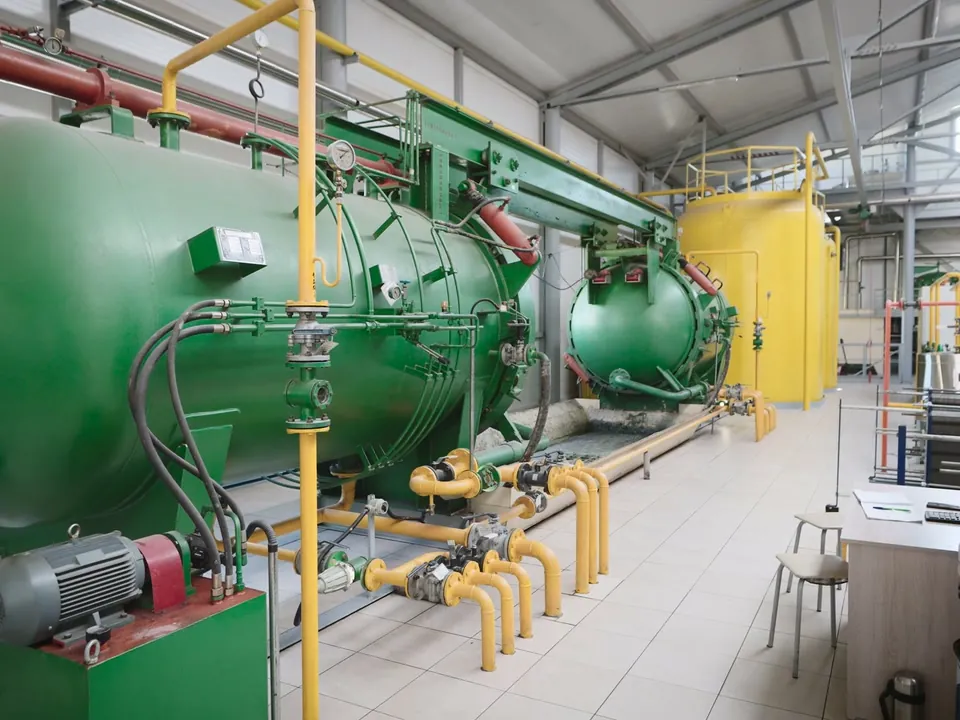
In water used in industrial processes, free chlorine remains at the set value as the flow rate and load vary.
Learn more: industrial water →Controller, dosing pumps, filter and probe holder are supplied mounted on a panel, to be connected in a bypass line to the water circuit to be treated: the photo shows a panel with LDsCL controller, three dosing pumps, filter and amperometric cell in the flow-through probe holder.
Accessories available on request to adapt the system to the requirements of the installation.
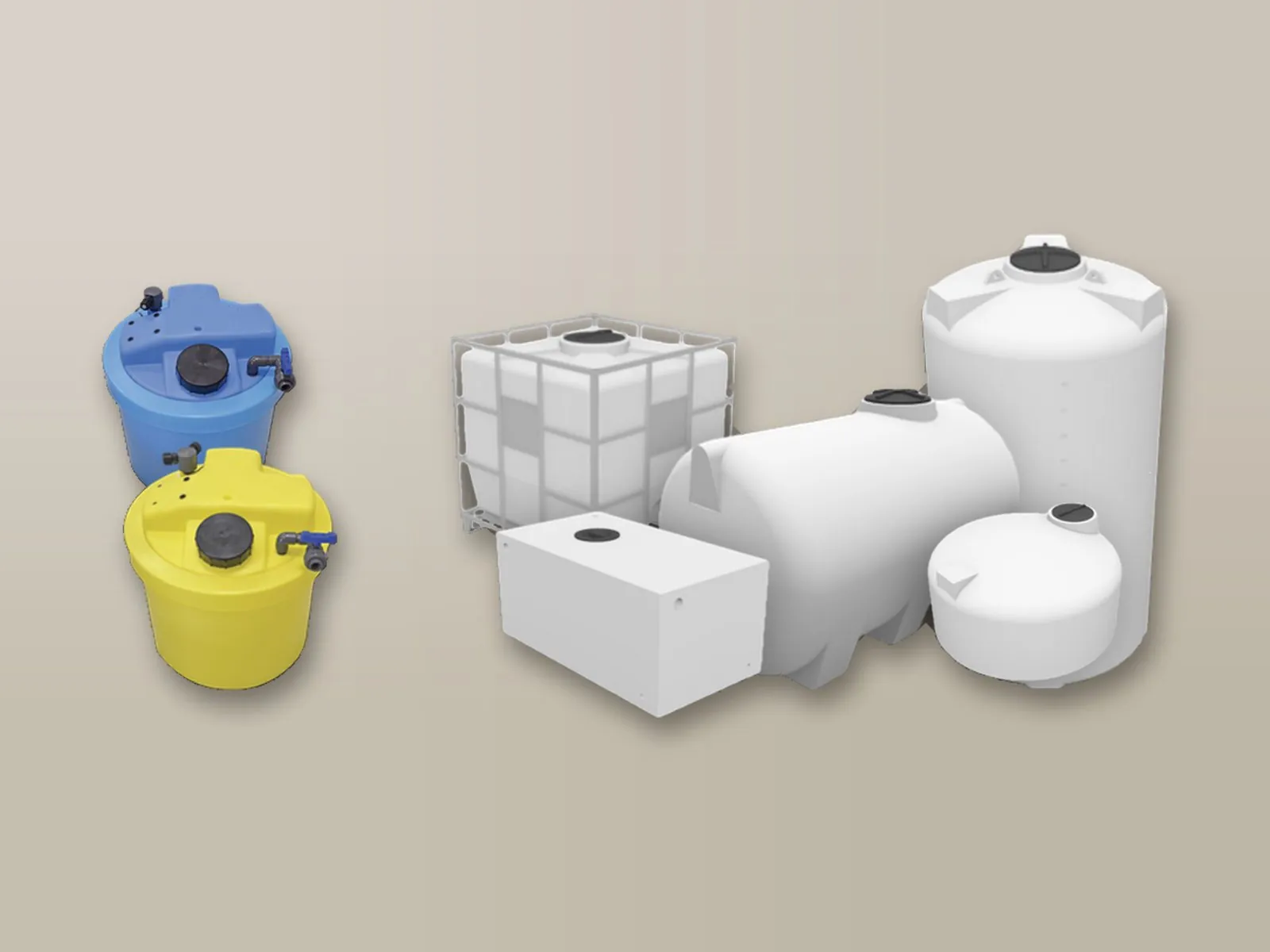
PE tanks for the chemical, with safety bund.
Details →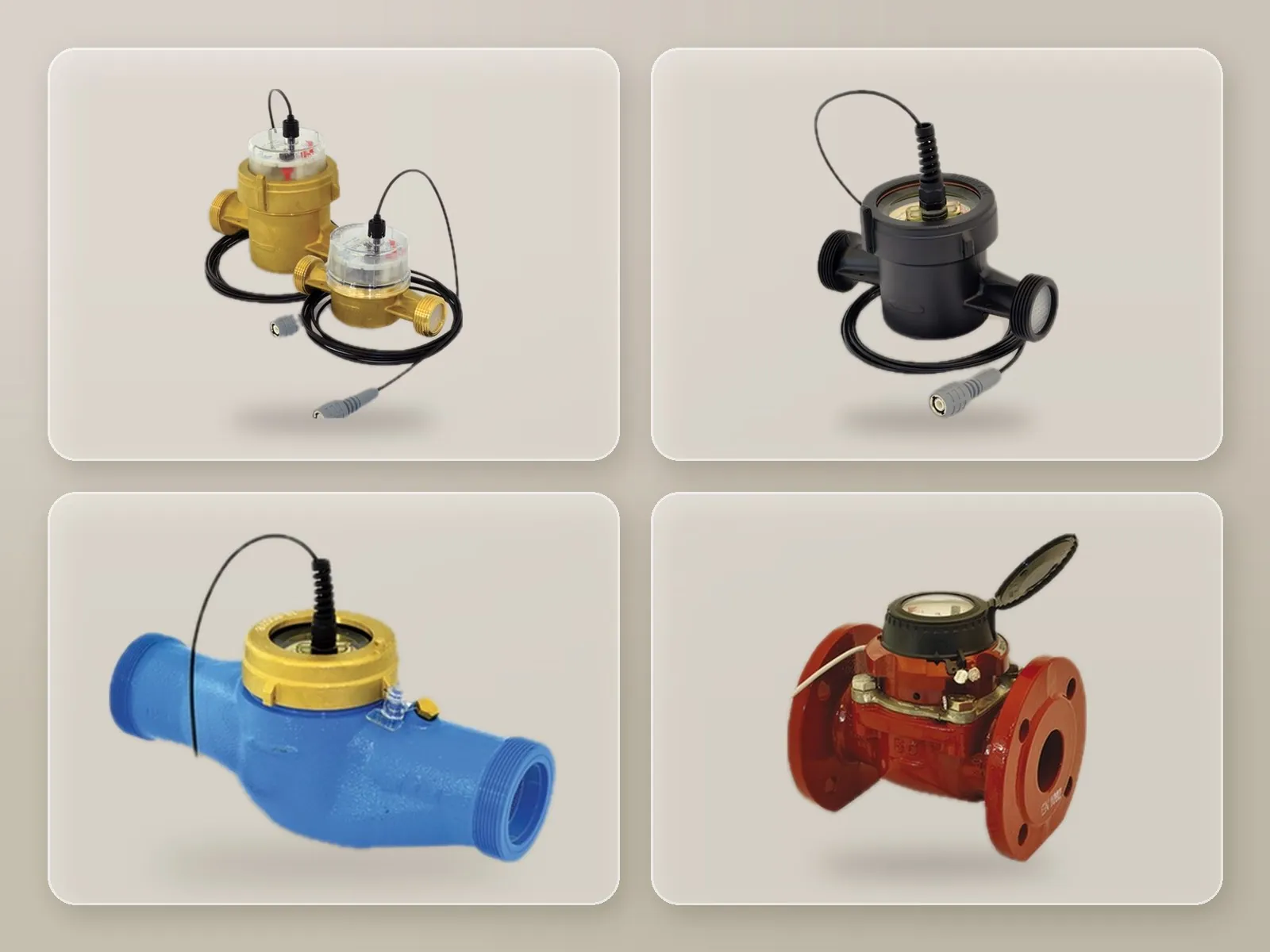
Enables dosing proportional to the volume of water actually treated.
Details →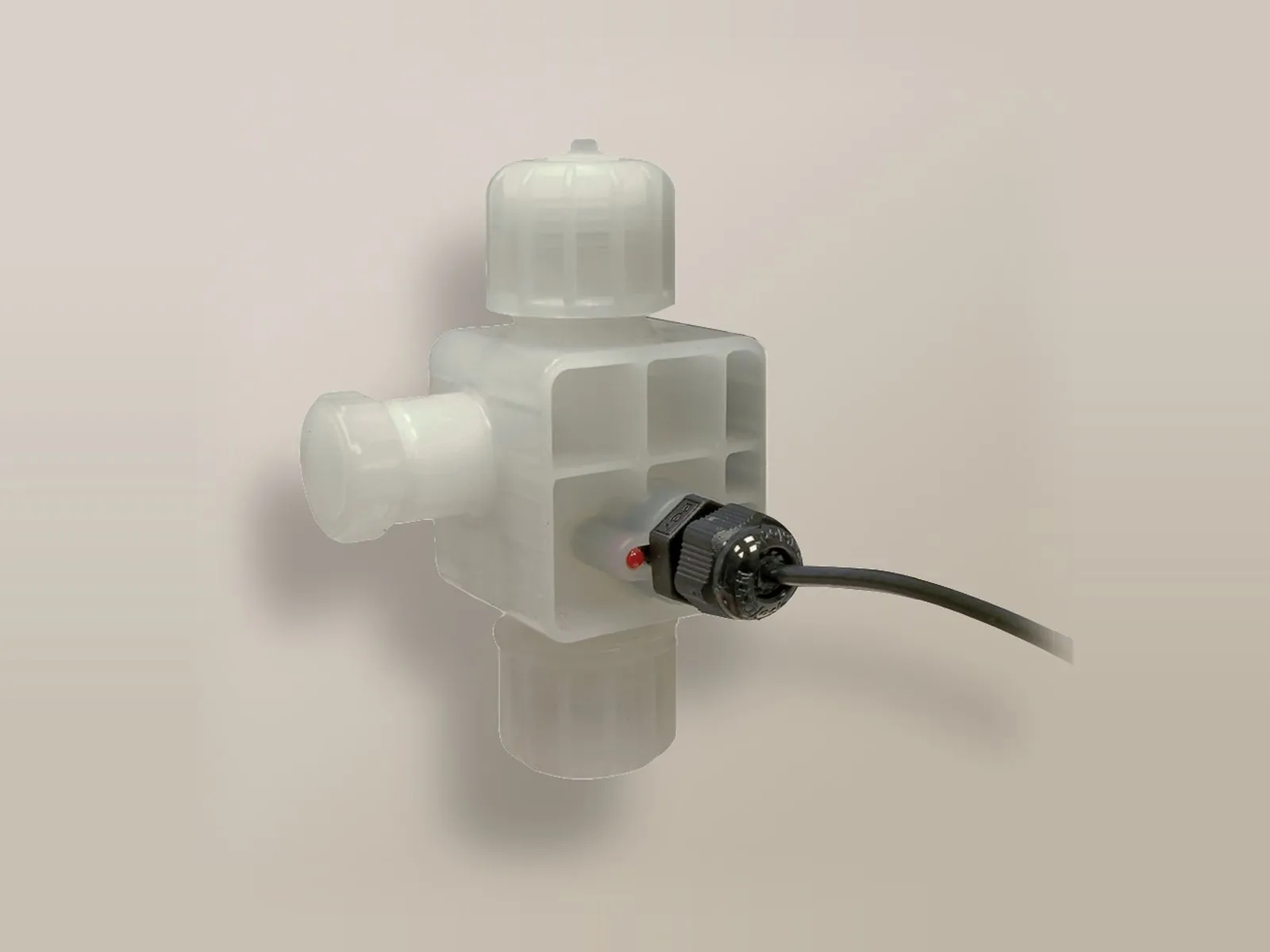
Installed on the pump delivery line, it verifies that dosing actually takes place.
Details →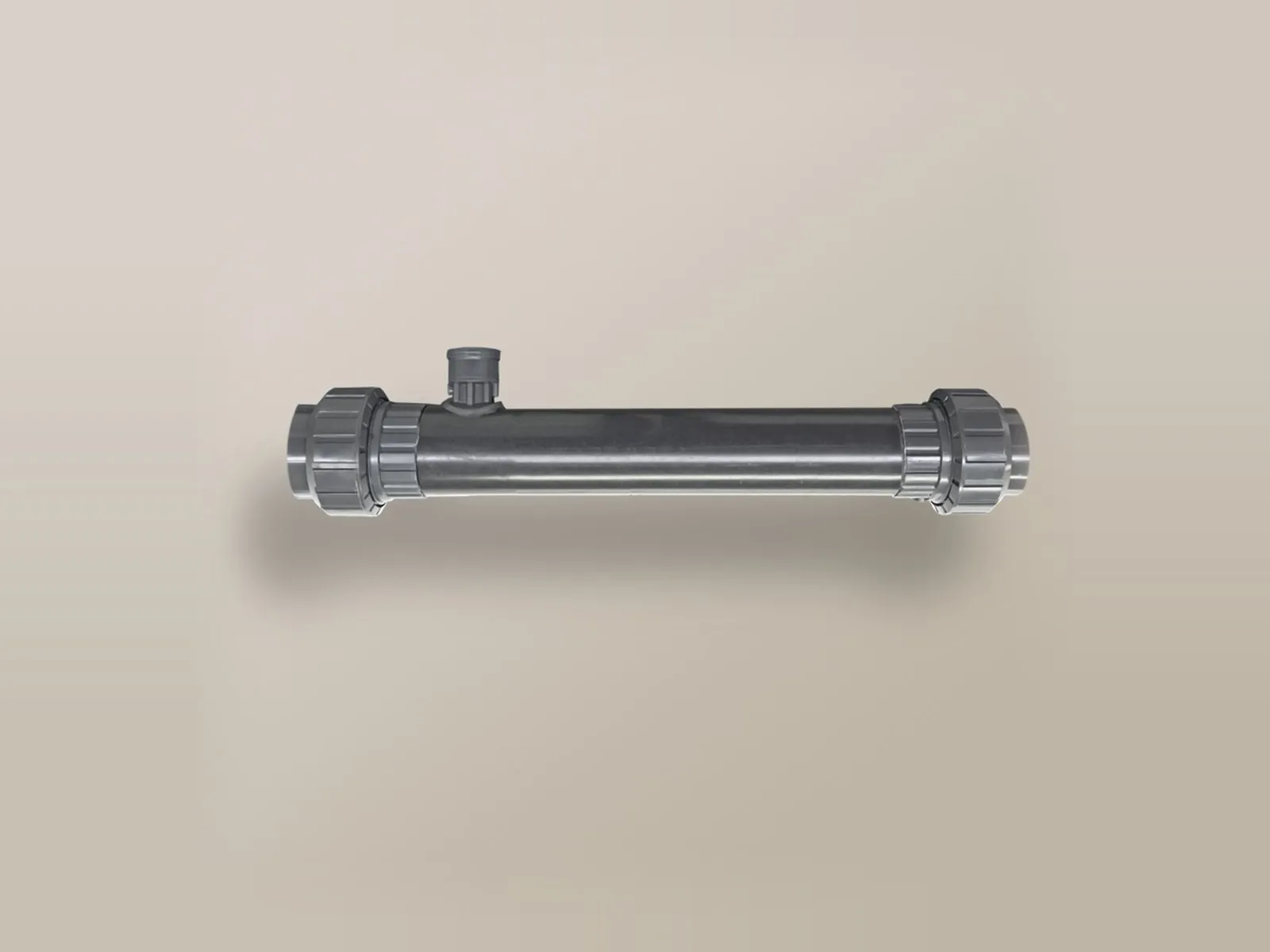
Ensures the chemical is mixed with the water and protects the pipe from direct contact with it.
Details →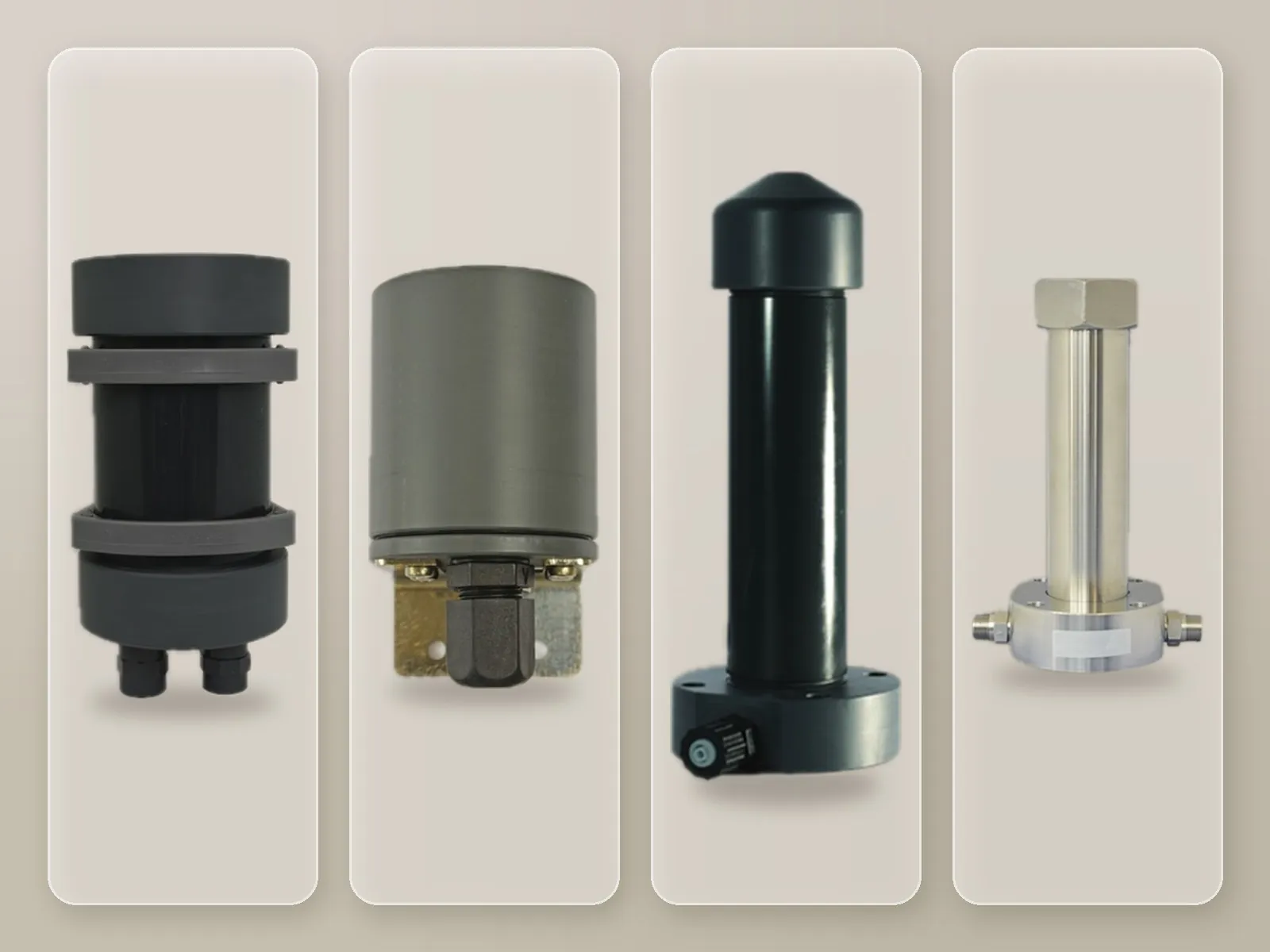
Attenuates the pulsations generated by the dosing pump.
Details →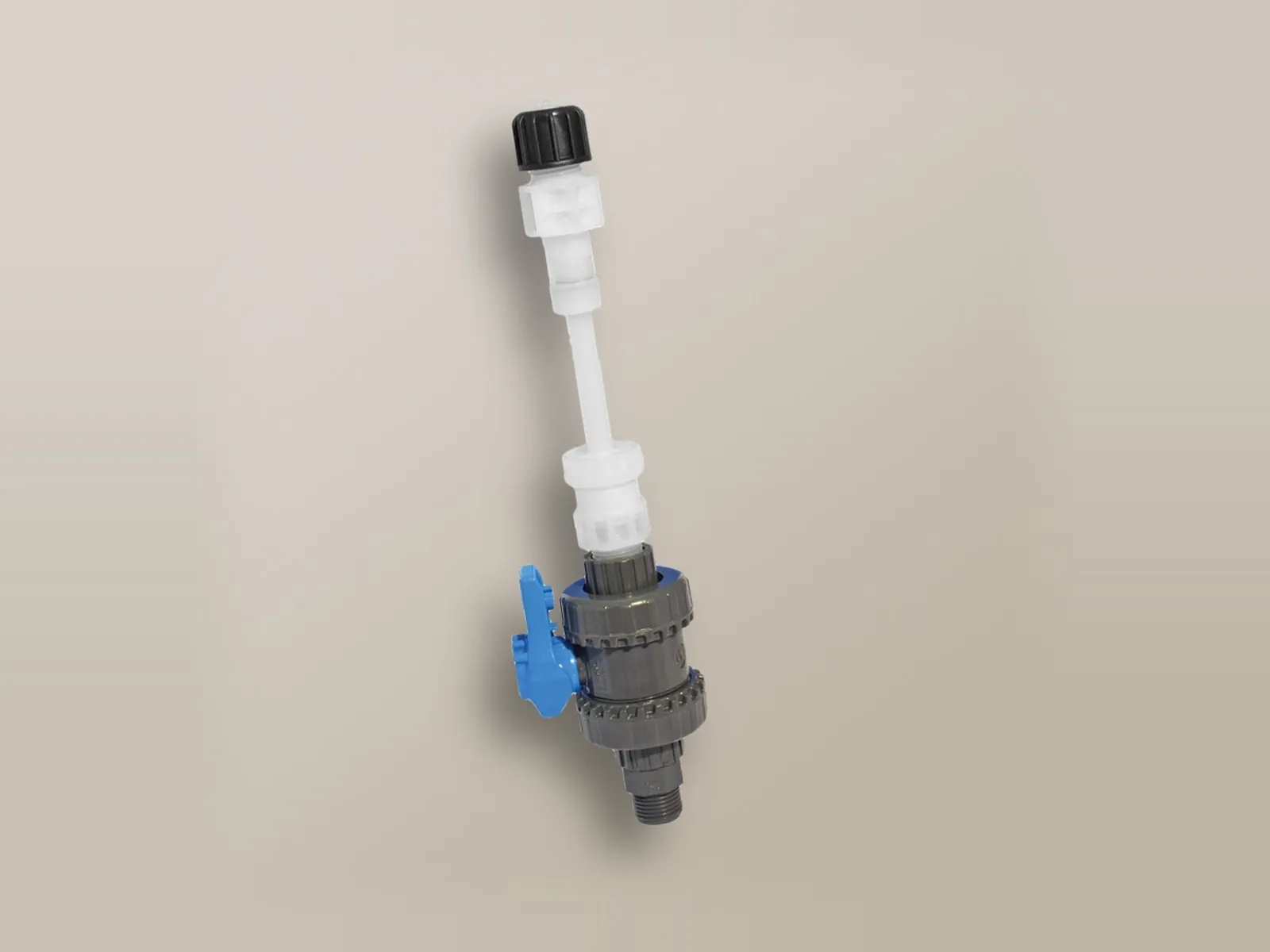
Injects the chemical into the centre of the pipe.
Details →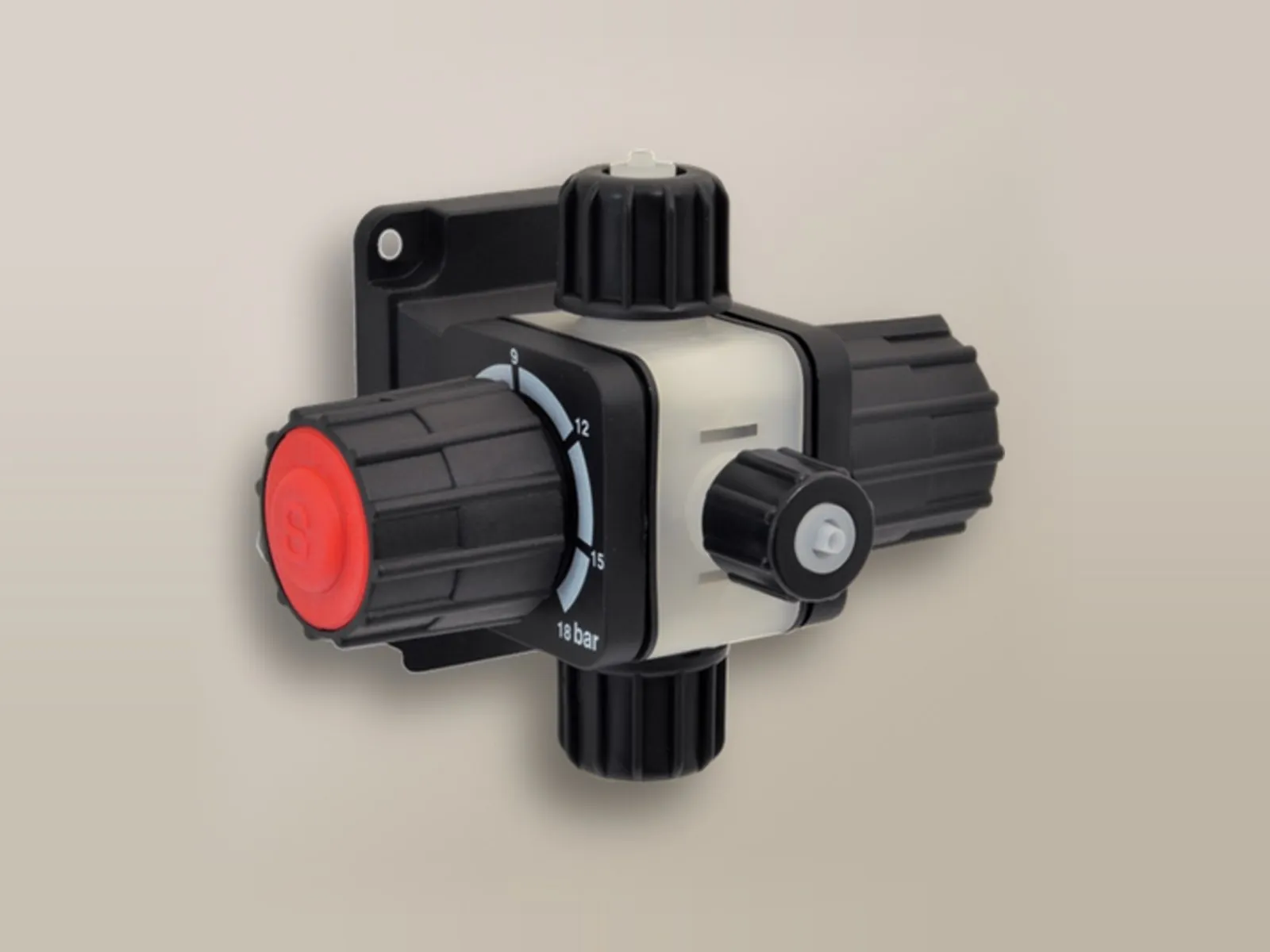
Pressure, safety and anti-siphon functions combined in a single valve.
Details →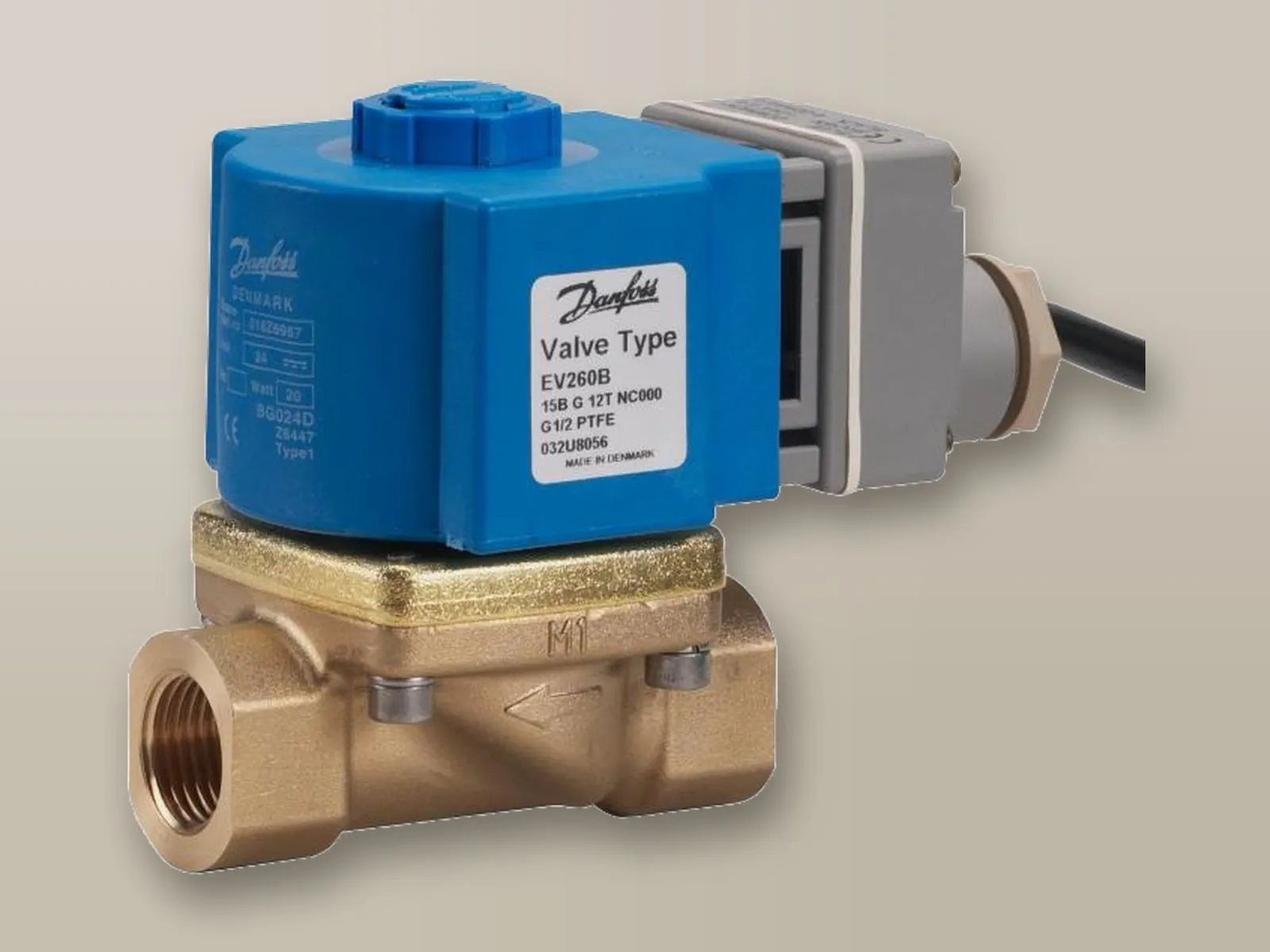
Operated by the controller according to the measured value.
Systems are supplied pre-assembled and tested, in the form best suited to the plant room: on a panel, in a cabinet or on a skid (with cover, in a box or on a frame), or custom-built. Some examples are shown below.
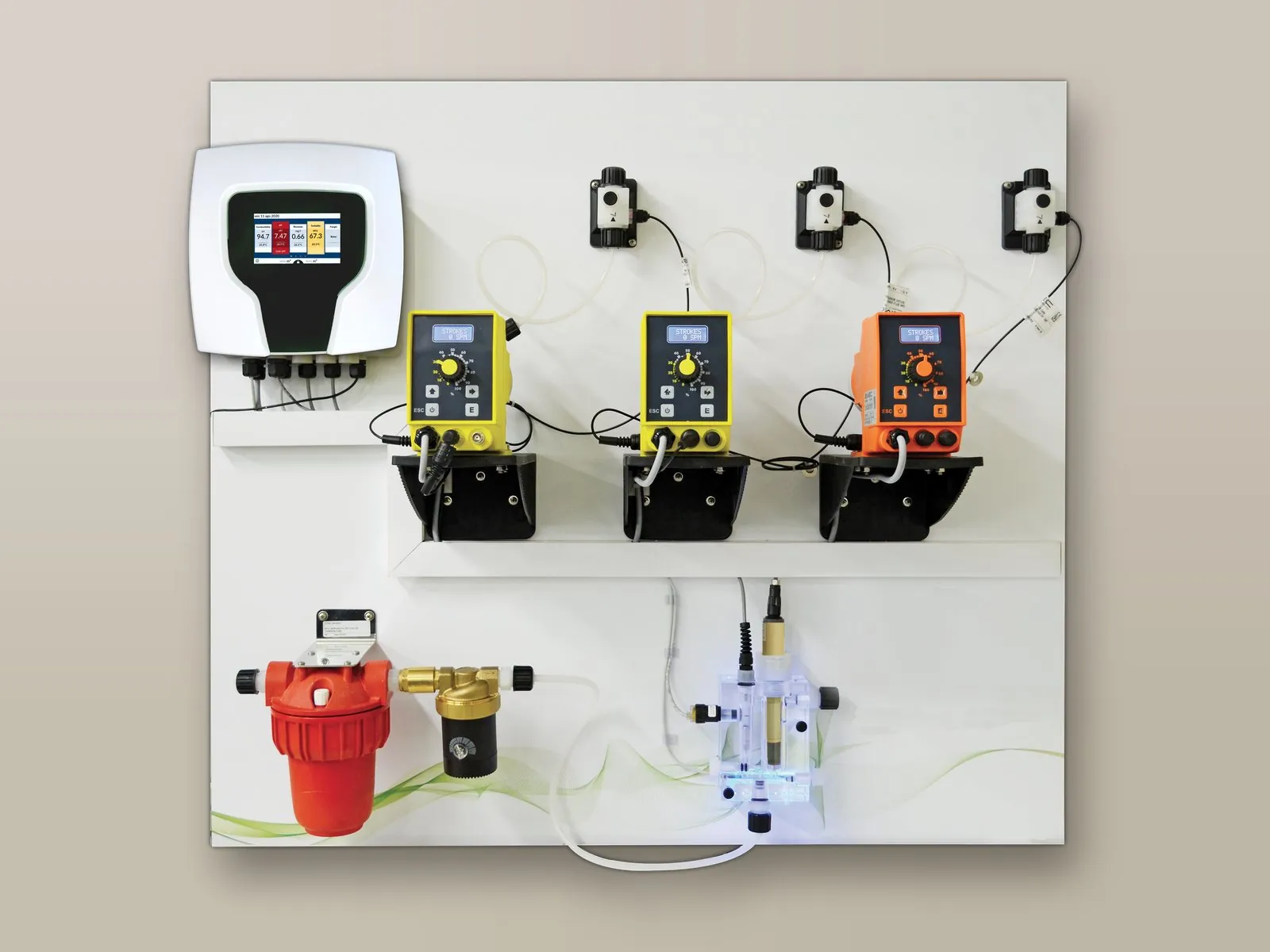
Controller, pumps, probe holder and accessories mounted and wired on a wall panel.
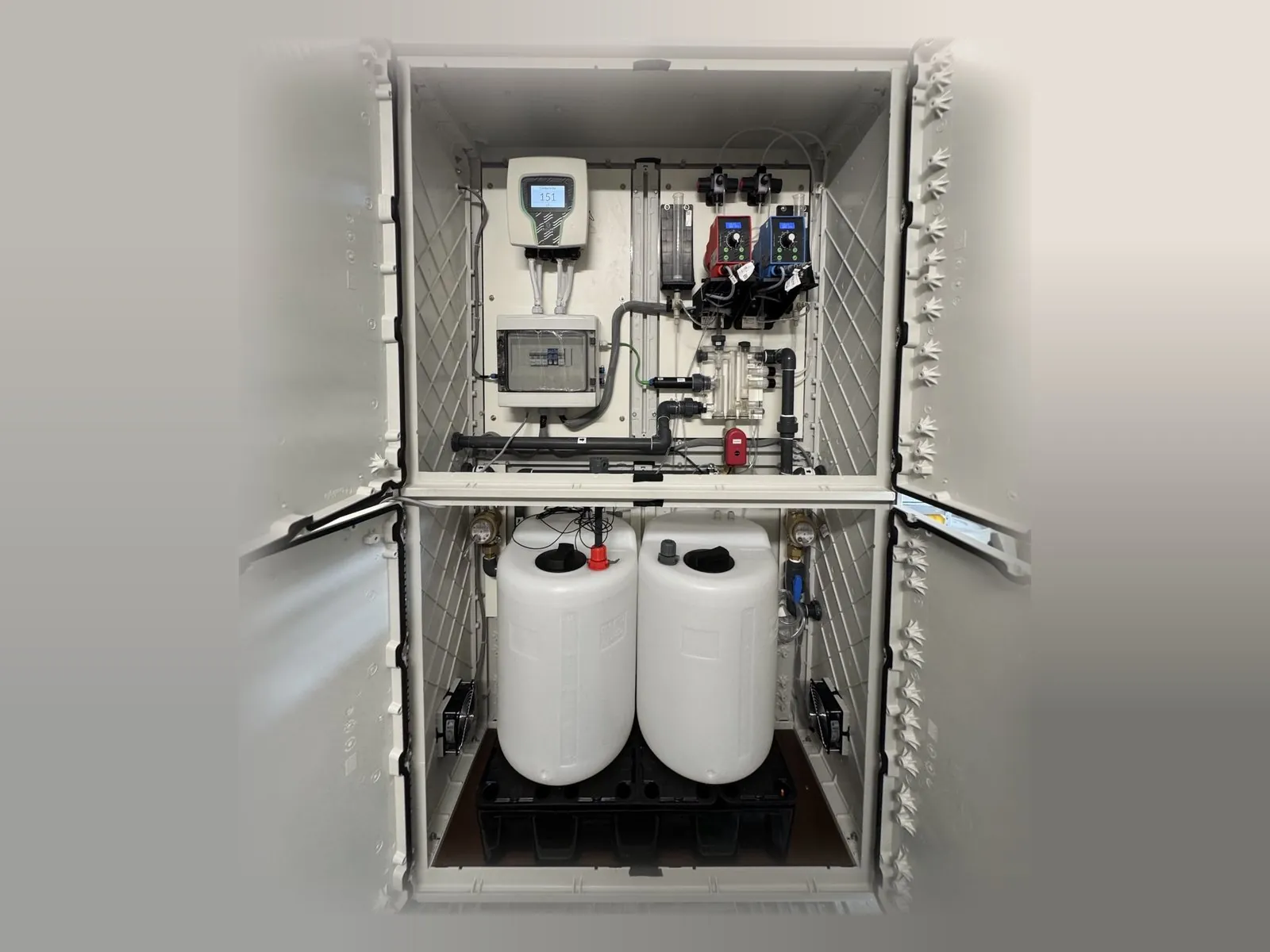
System panel and chemical tanks housed in a single cabinet.
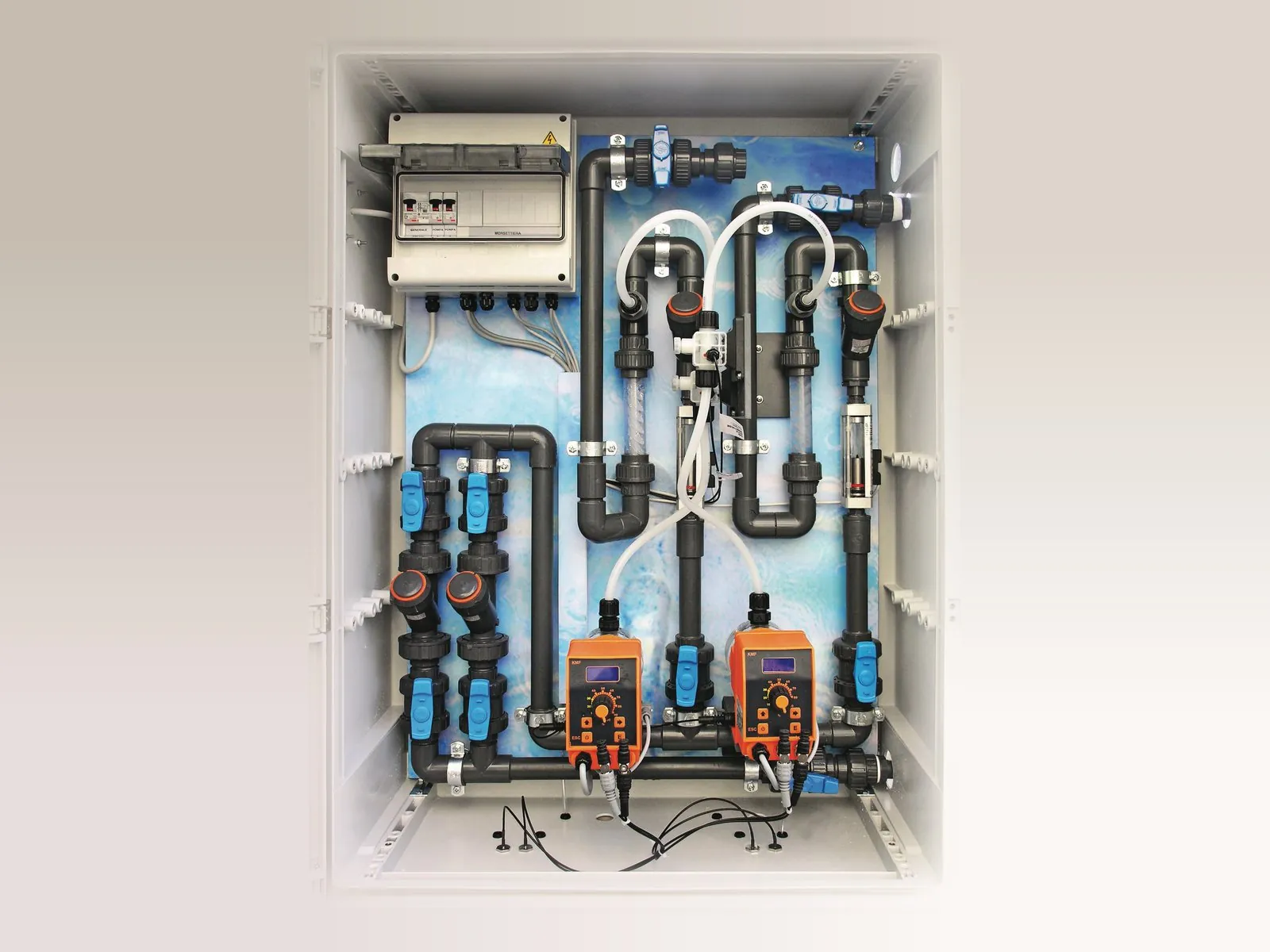
Pipework, pumps and electrical panel in a wall cabinet with door.
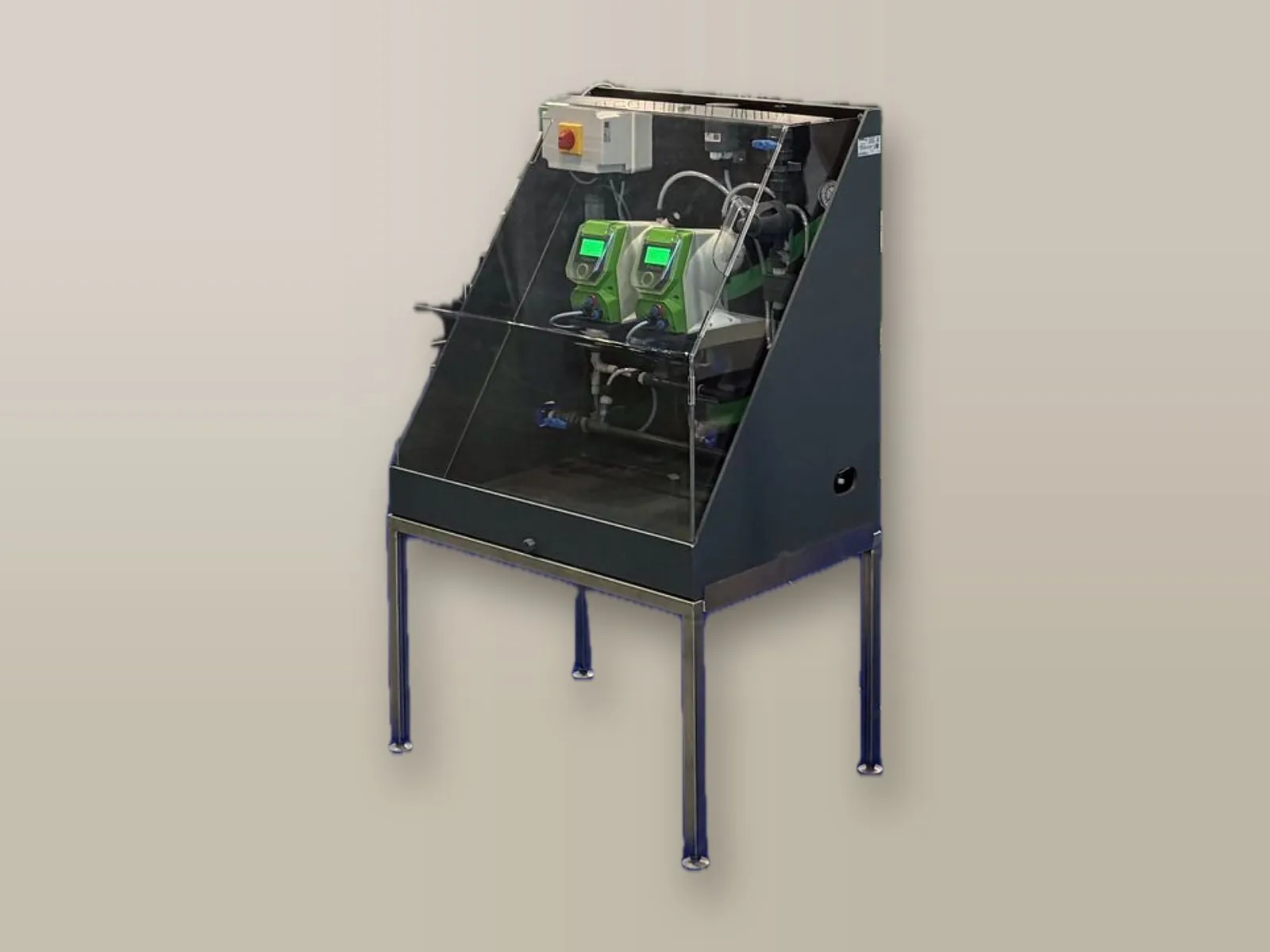
Skid with raised stainless steel frame and protective PMMA cover.
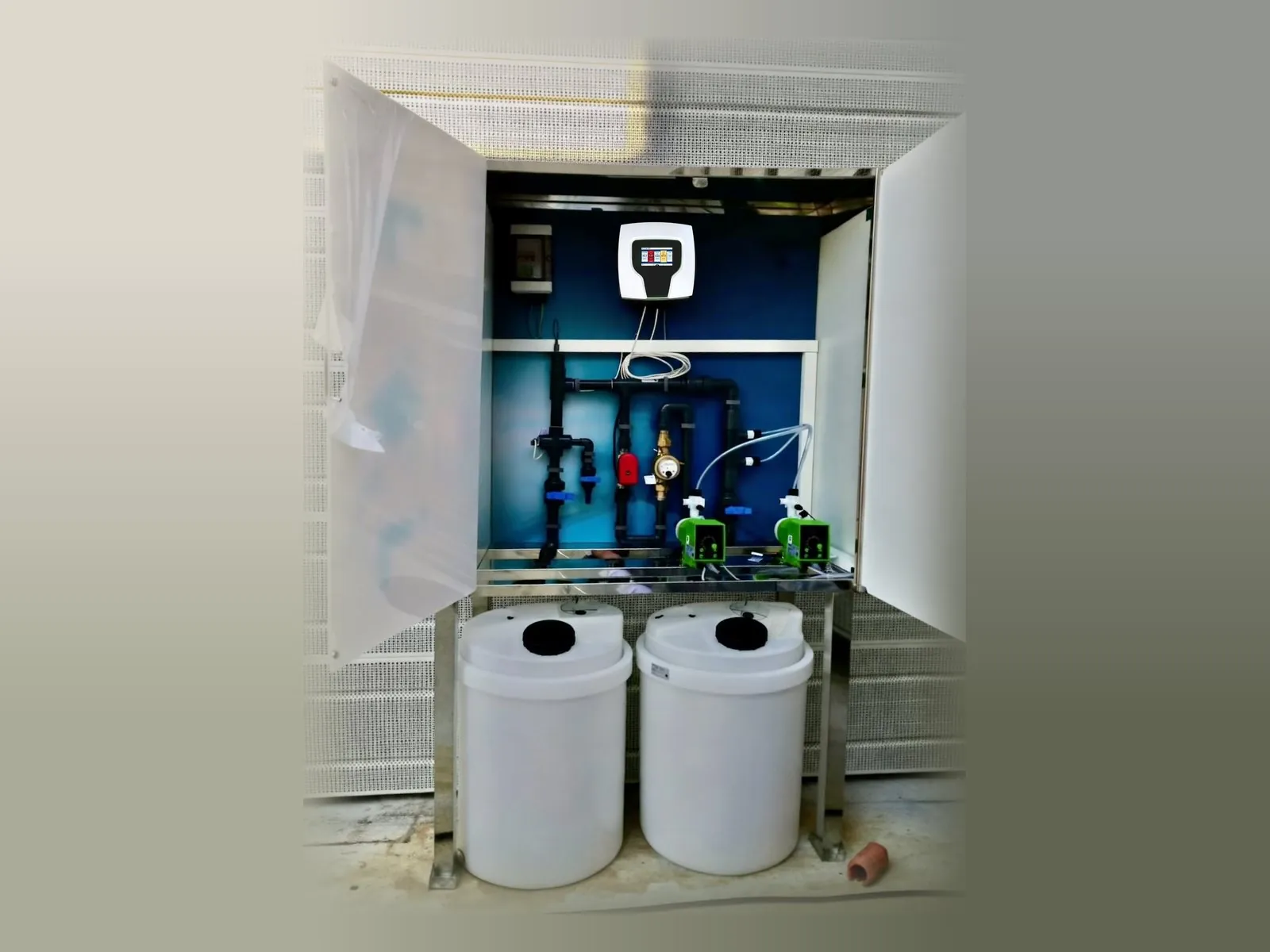
Skid enclosed in a box with door, with the chemical tanks at the base.
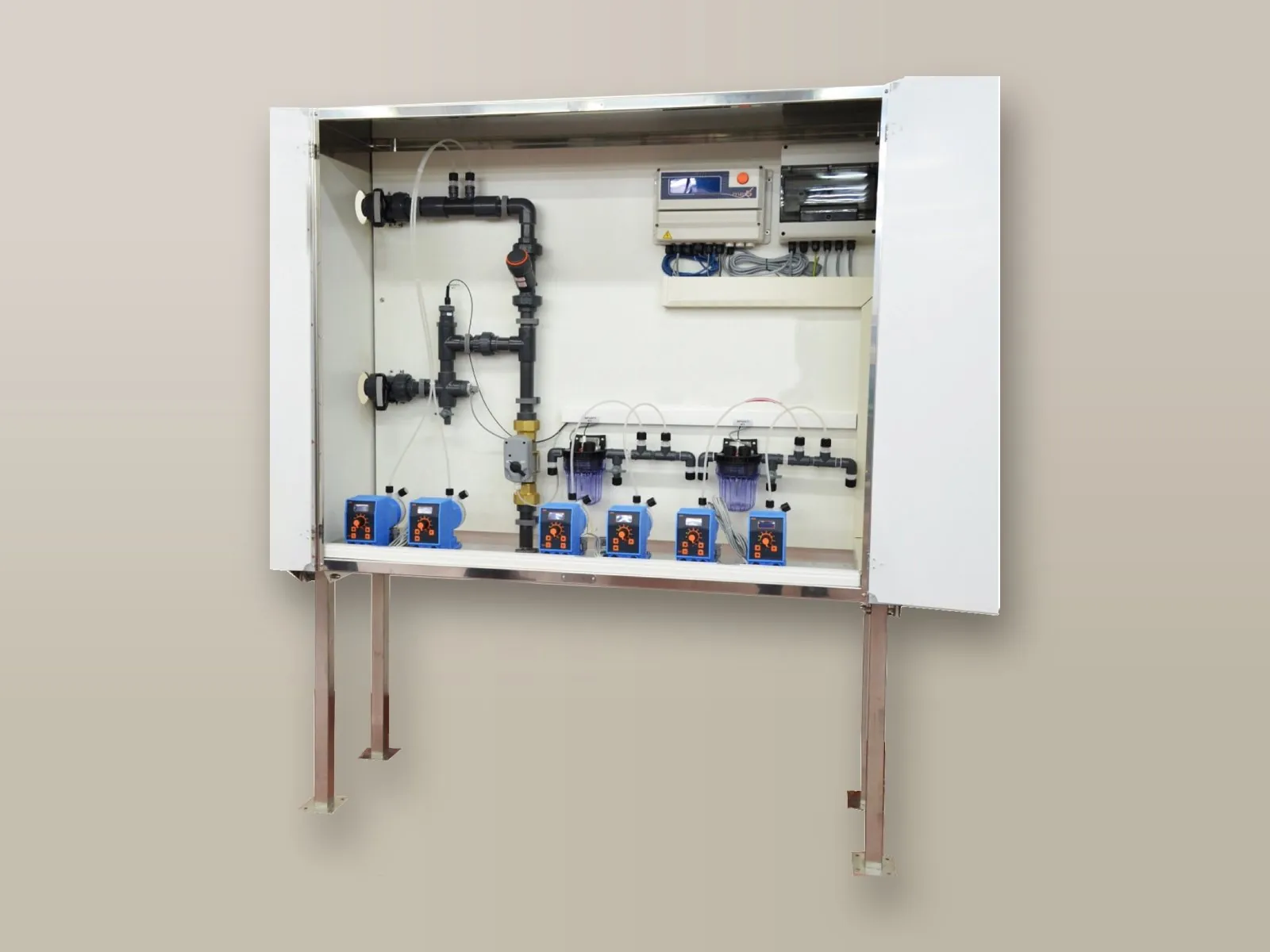
Skid on a frame with doors, pre-assembled and ready for connection.
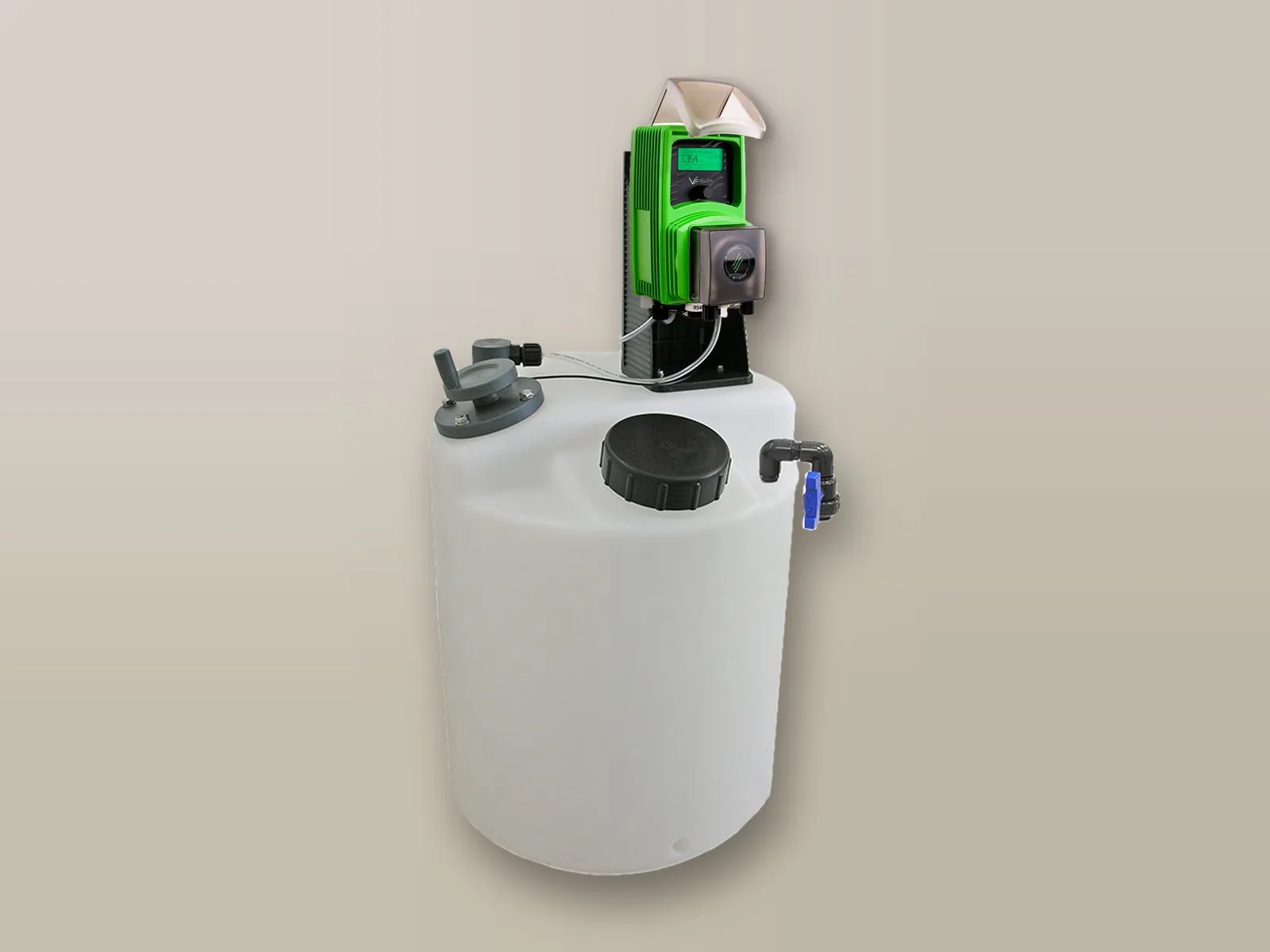
Dosing pump mounted directly on the tank: the most compact solution.
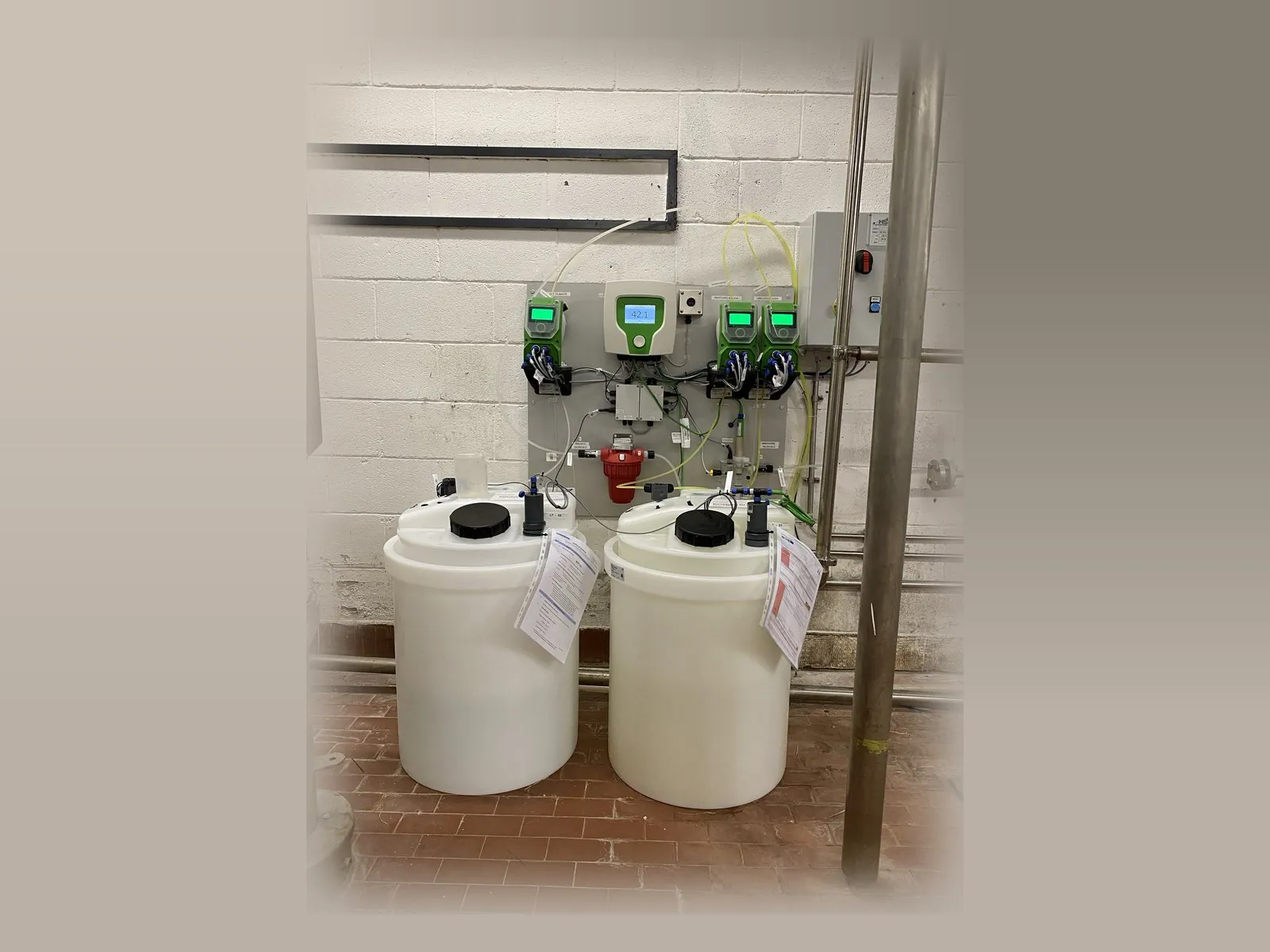
Wall installation in the plant room, with the chemical tanks on the floor.
Pumps, controllers or components supplied by the customer can also be fitted, with custom dimensions, back panel and electrical panel. Dosing stations and skids →
Measuring ranges, resolution, cell and controller characteristics, display and remote control are described on the controller page.
For chlorine and other disinfectants the basic solution is the dosing station; to dose according to the concentration actually present in the water, measuring controllers are used.
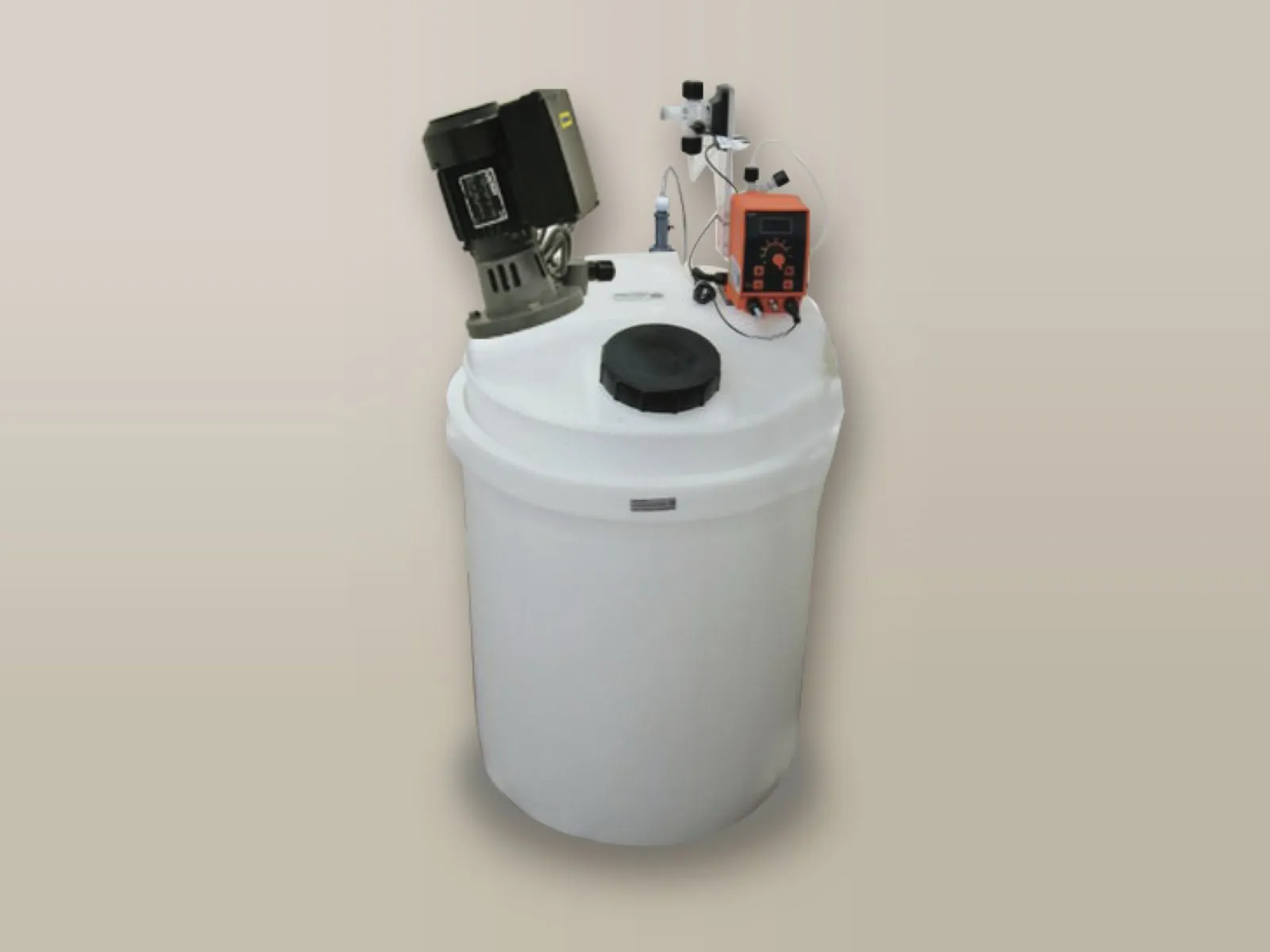
The simplest solution: the pump doses at a constant rate or in proportion to the volume of water measured by the pulse-output water meter.
Details →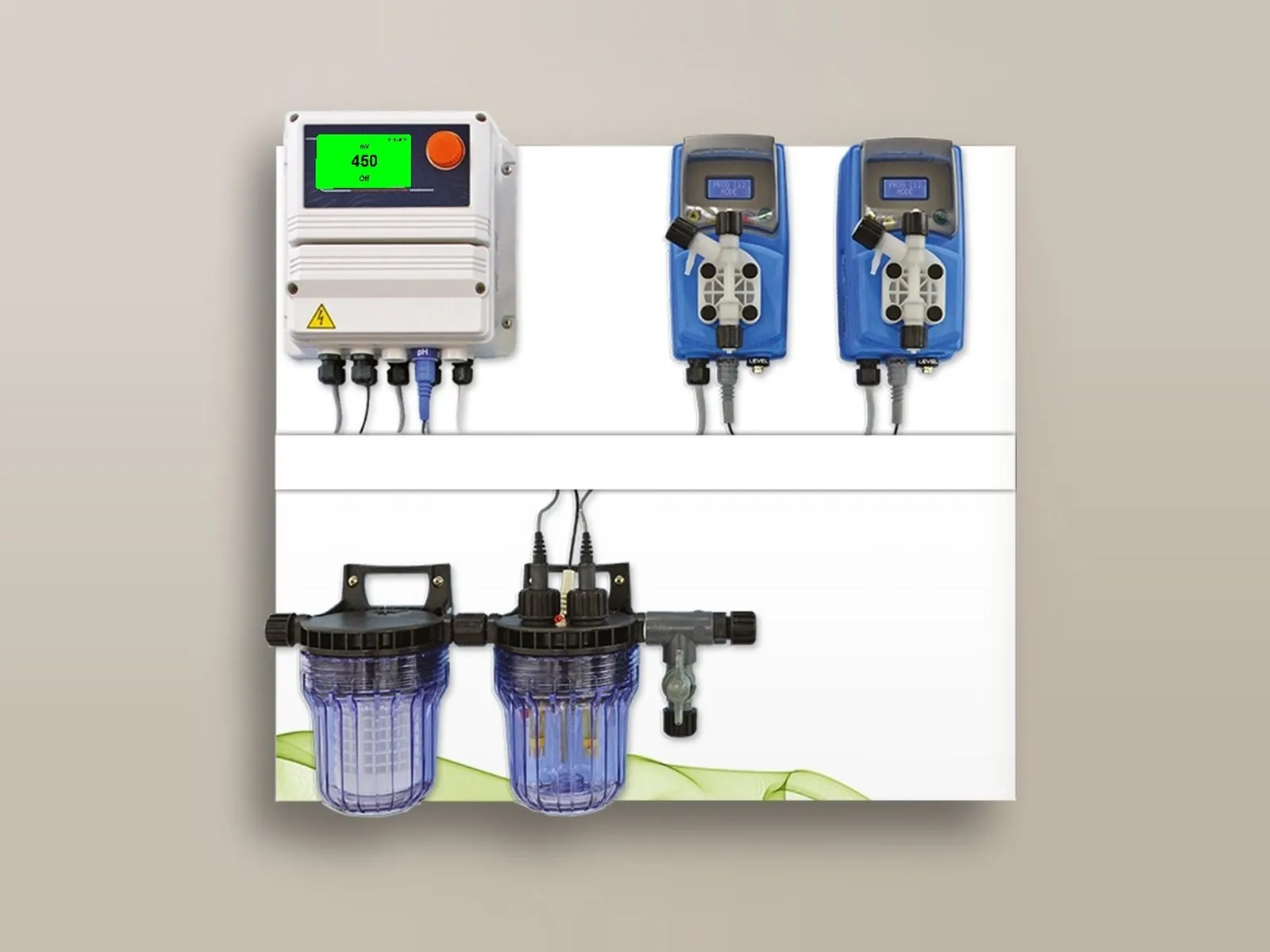
Dosing based on the Redox potential of the water: an economical solution, based on an indirect measurement.
Details → The amperometric cell directly measures the disinfectant concentration in mg/l, ensuring maximum dosing accuracy.
Details →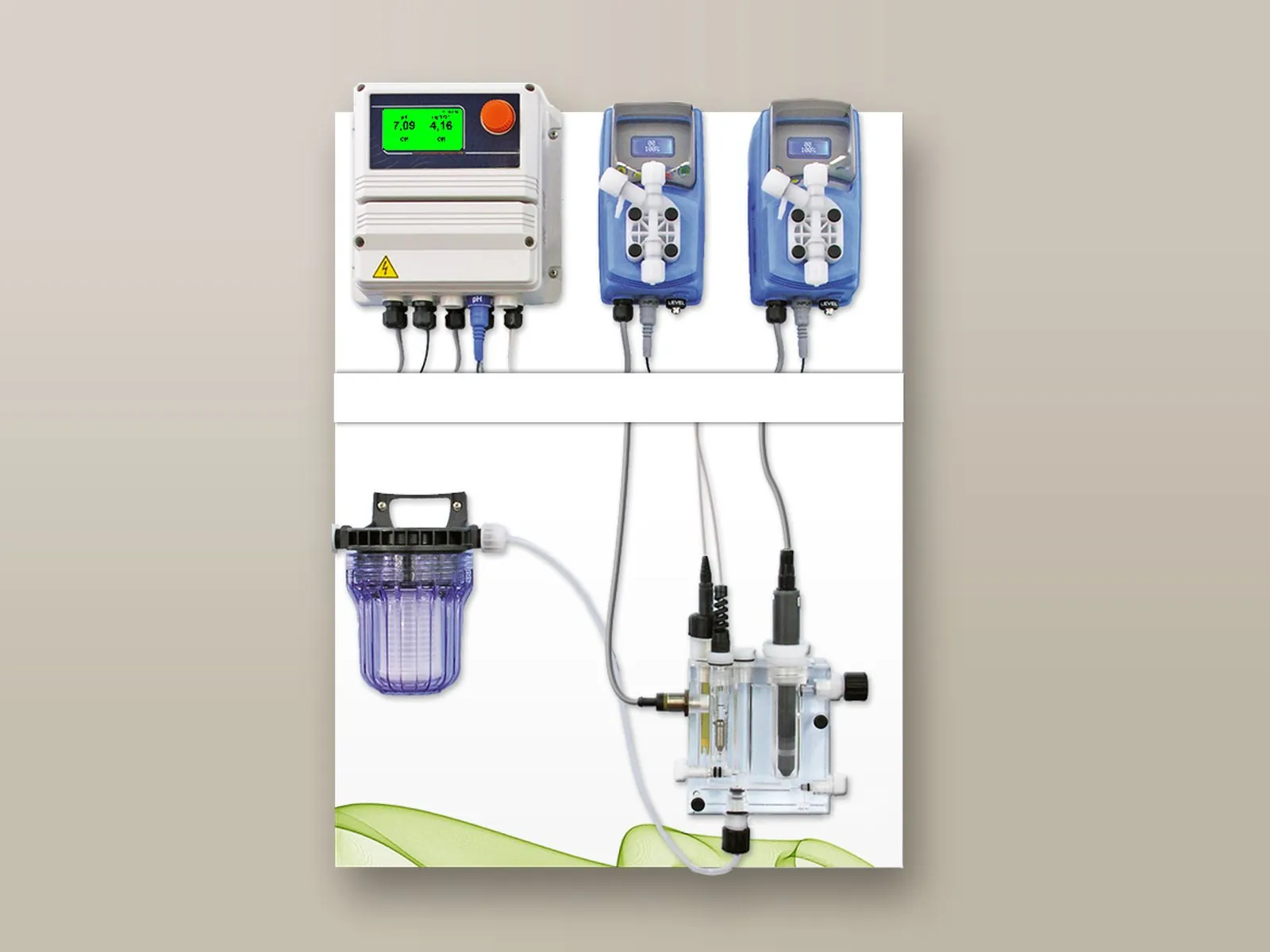
Simultaneous management of two parameters, for example pH and chlorine, with a single controller.
Details → Management of up to 10 parameters and of all the pumps in the installation, with touch screen and remote control as standard.
Details →The controllers support two-way remote access (read and write) through the web portal from a PC, tablet or smartphone: measurements can be viewed, set points, dosing and alarms changed, alarms received and logs downloaded. Alternatively, they can be integrated into your PLC via Modbus.
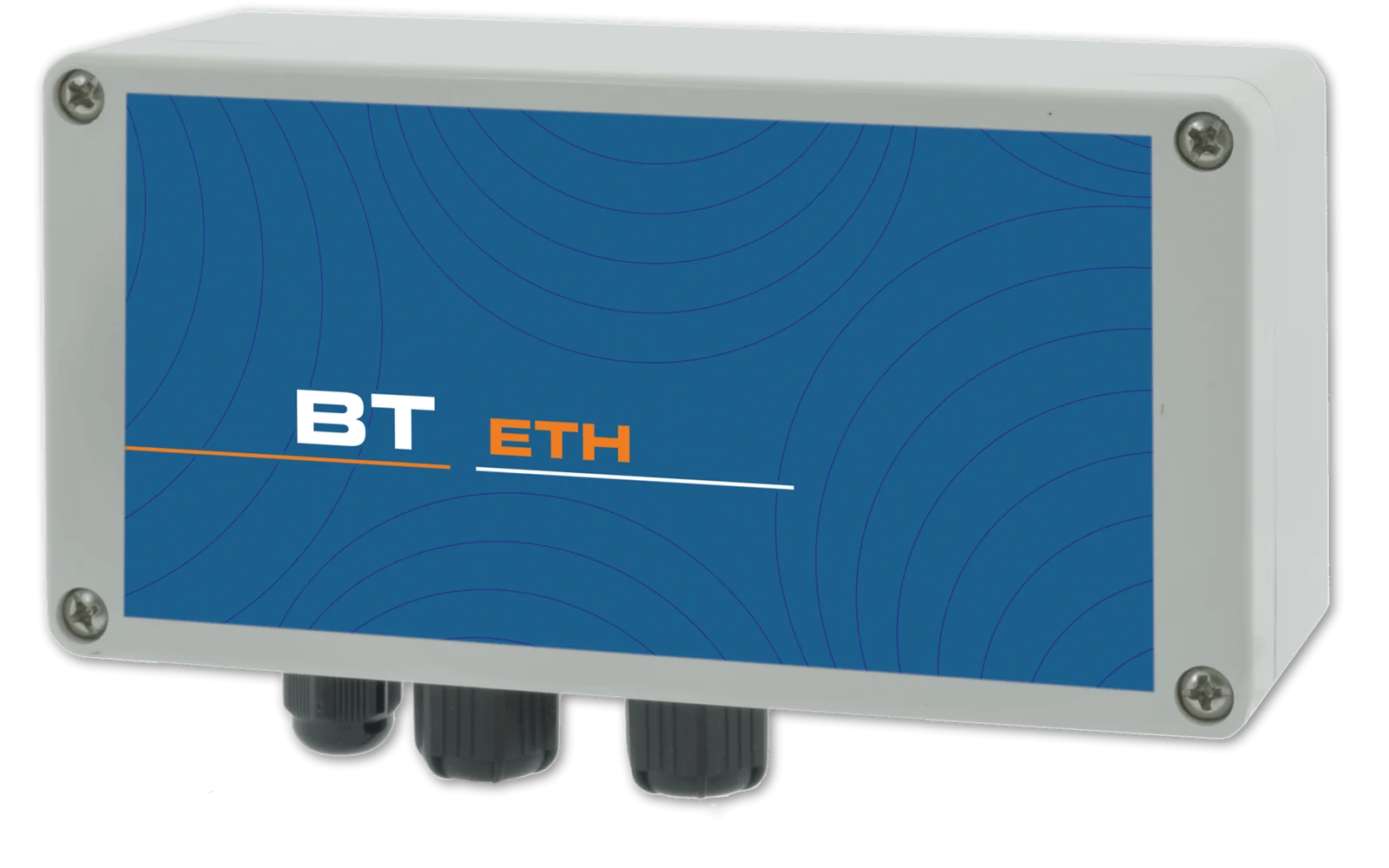
Connection to the web portal via network cable: measurements, set points, dosing and alarms accessible from a PC, tablet or smartphone.
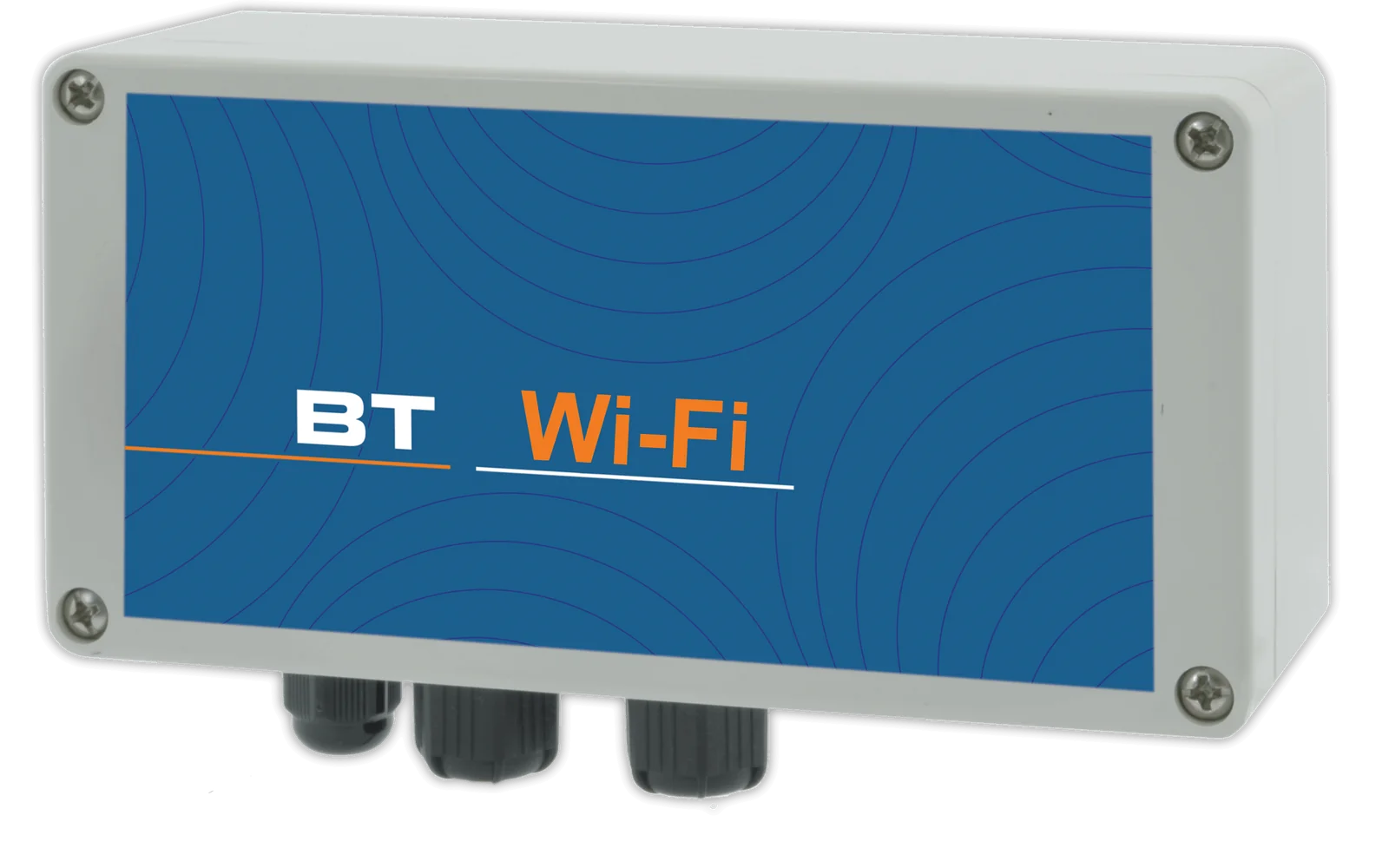
Wireless connection to the web portal, with the same functions as the cable connection.
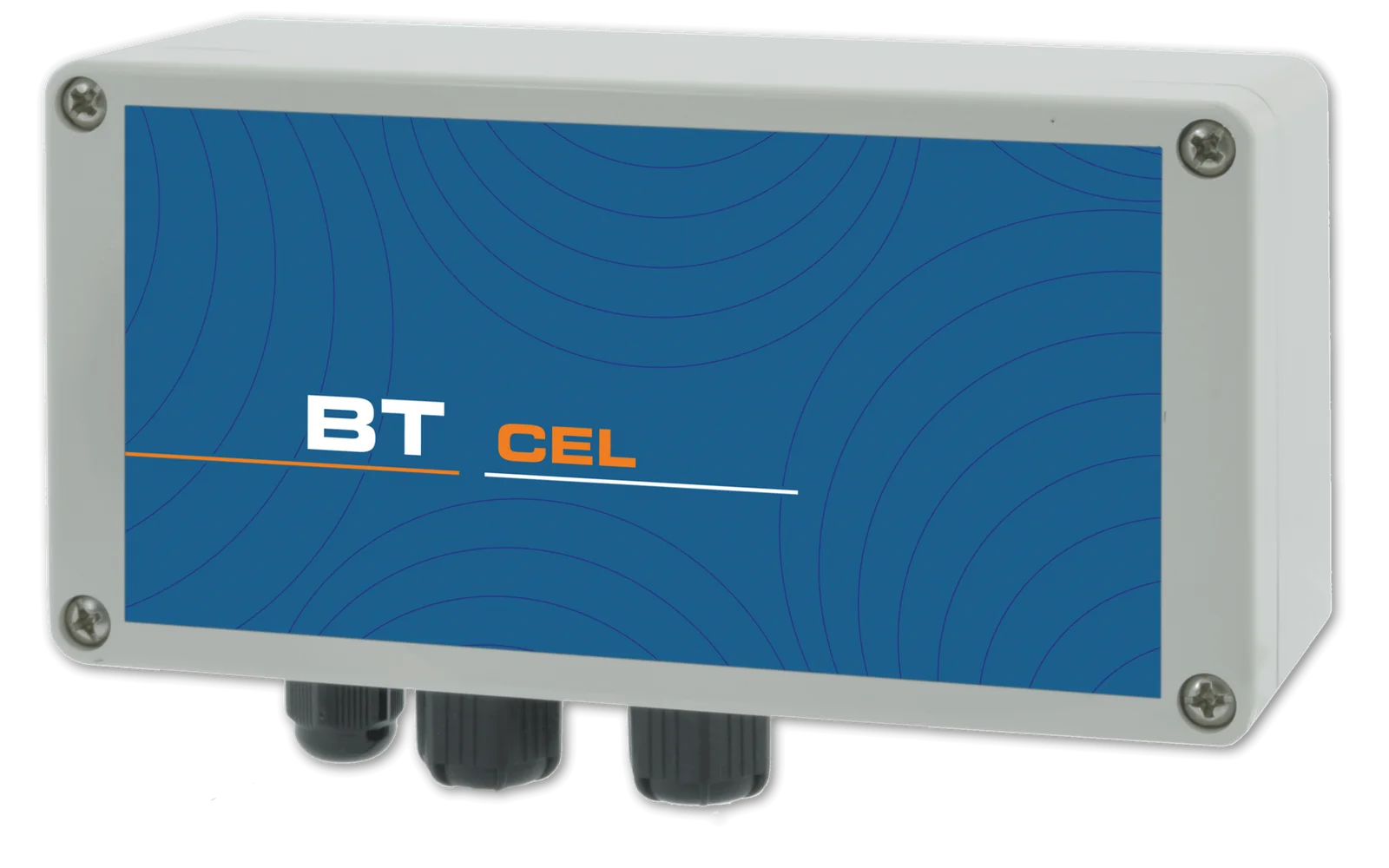
Connection via the 4G network for installations without a local network, with alarm notification by SMS or e-mail.
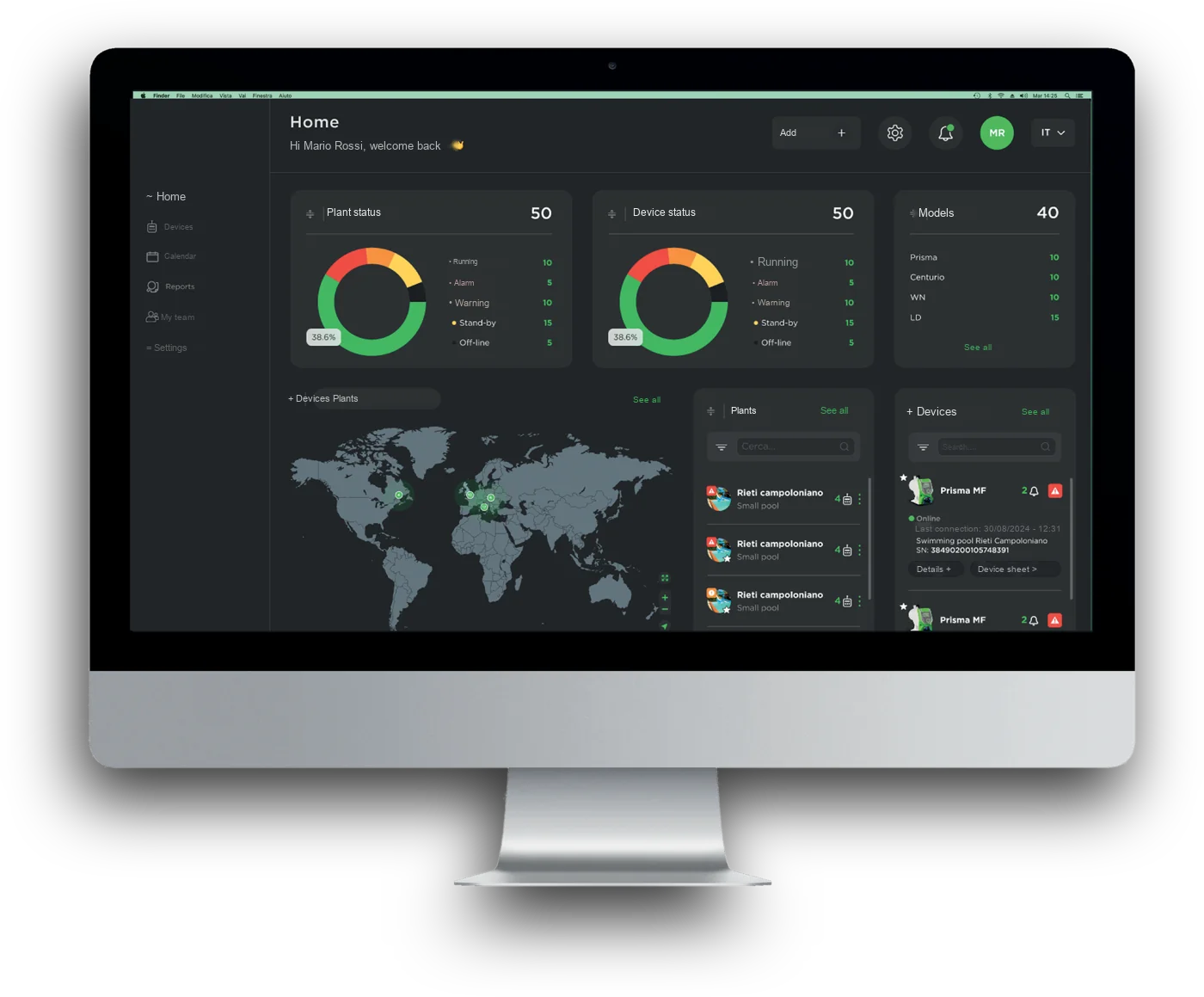 Web portalPC, tablet and smartphone
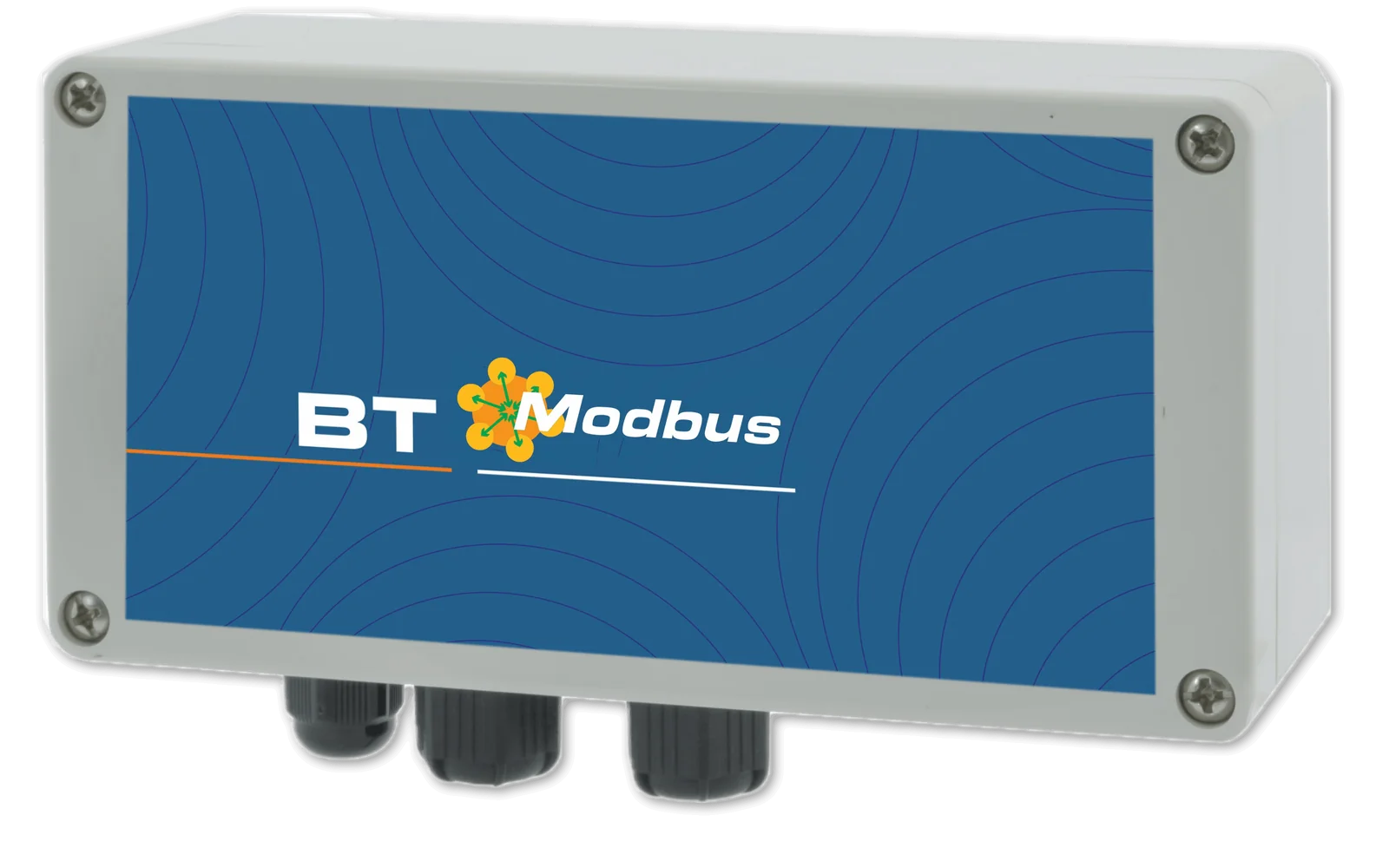
Integration into your PLC via serial port.

Current signal proportional to the measured value, for remote monitoring or for controlling pumps and other instrumentation.

Download of the logged data to a USB memory stick, for archiving and analysis with a spreadsheet.
One communication type at a time: Ethernet, Wi-Fi, 4G or Modbus RTU (built into the BASIC versions, optional on the PLUS versions). 0-4/20 mA current loop outputs standard on the PLUS versions, optional on the BASIC versions; meter input on the PLUS versions only.
A single account brings together all registered installations, each with its own devices: the web portal, free of charge and with no subscription, can be accessed from a PC, Mac, tablet or smartphone and allows every parameter to be both viewed and changed, with an encrypted connection and protected access.
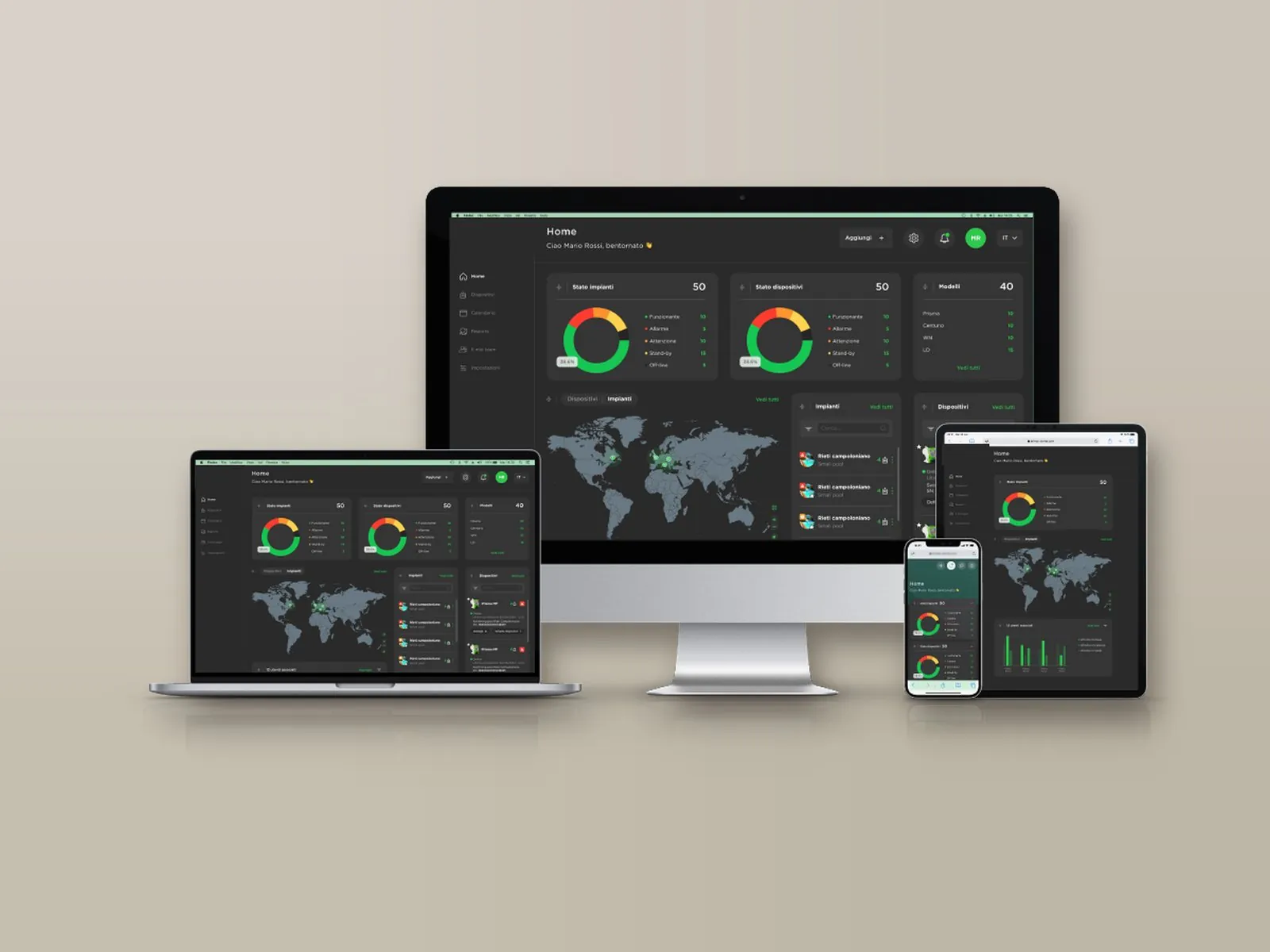
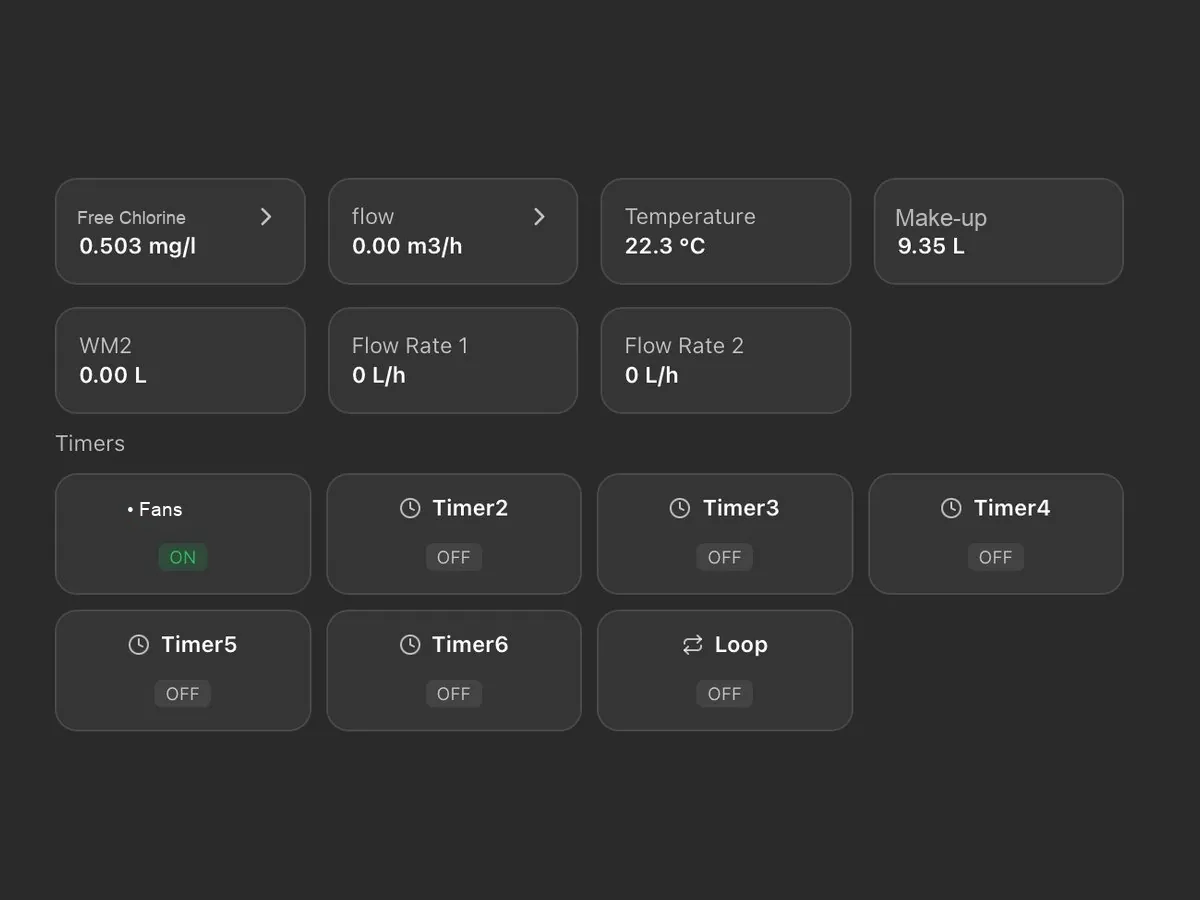
On a single screen: probe readings, chemical levels, pump activation thresholds and active alarms, with the status of installations and devices (normal, warning, alarm, standby, not connected).
Installations appear on an interactive map with their status and open with a click; for each one, the local weather conditions and temperature are also shown.
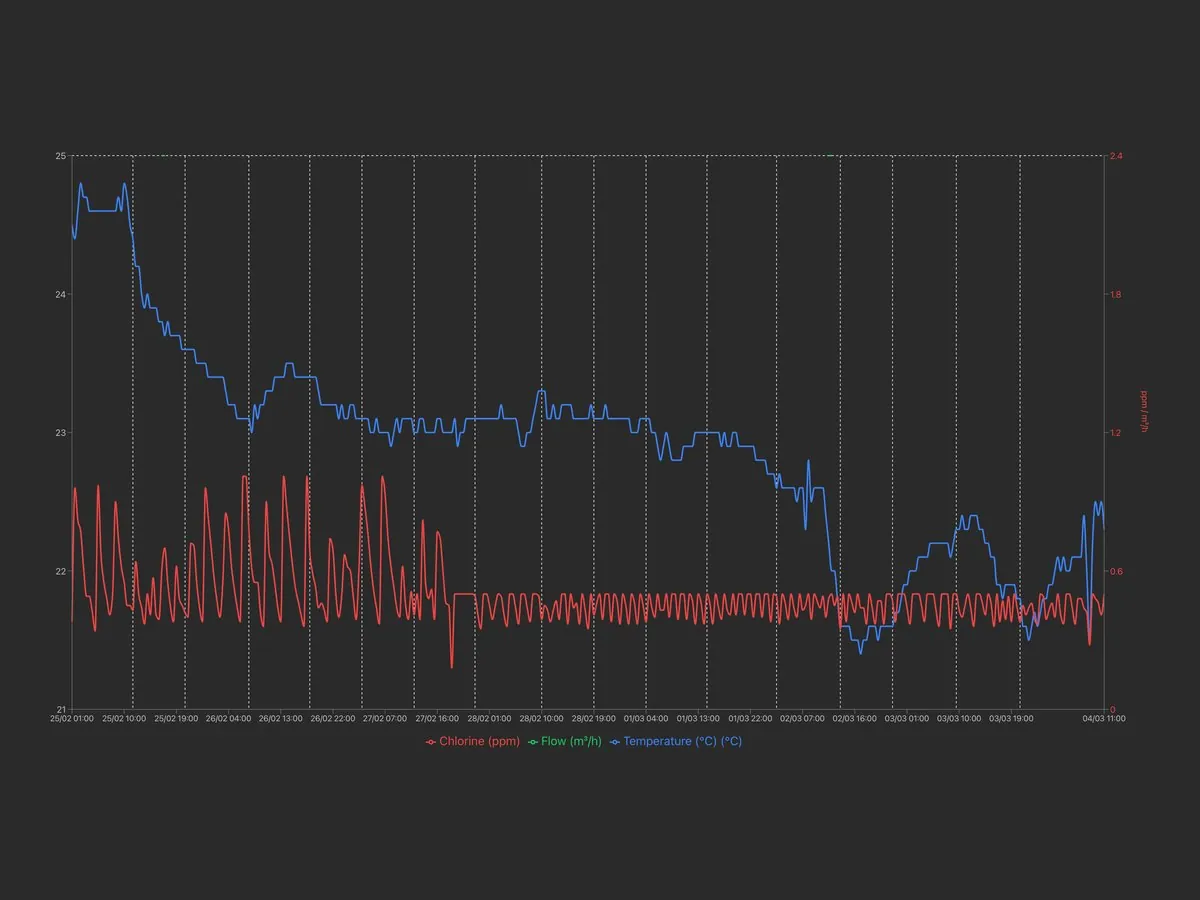
Archive of measurements and alarms, available for consultation at any time with charts and numerical reports exportable in Excel format.
Alarm thresholds for readings, dosing, faulty probe and out-of-range readings, with notification by e-mail or SMS depending on the communication system; a warning is also issued when an installation remains disconnected beyond the set time.
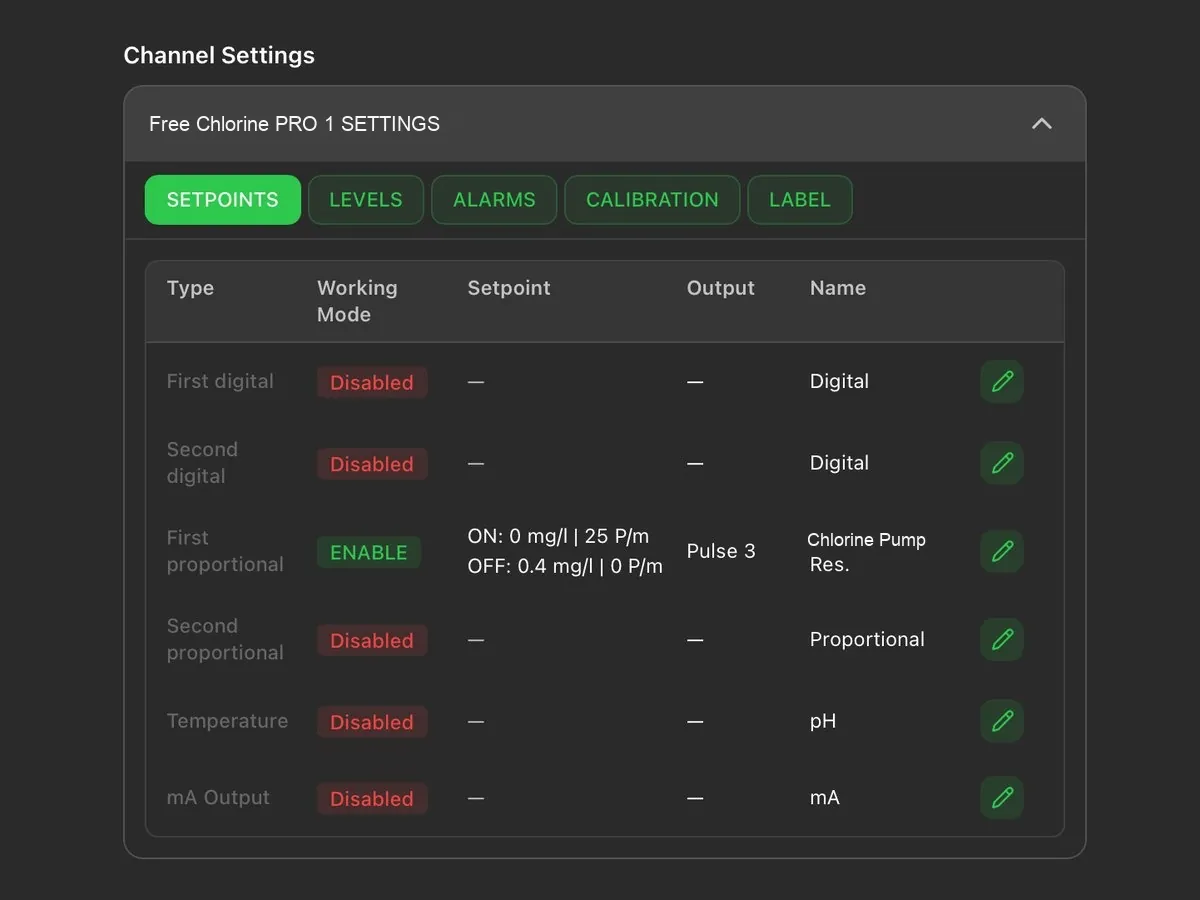
Remote modification of the set points, of the dosing pump activation thresholds and of the corresponding hourly flow rate.
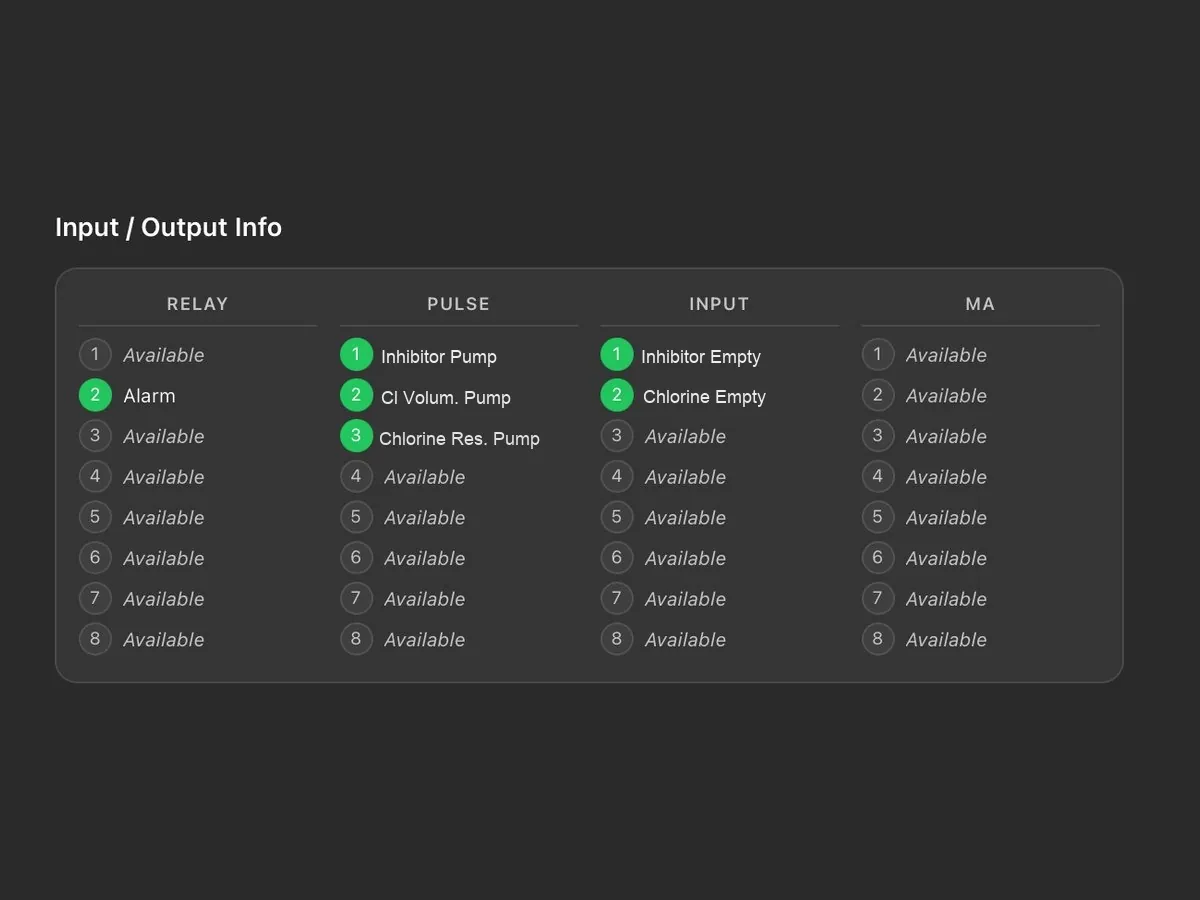
Status of relays, pulse outputs, digital inputs and current outputs, with the name assigned to each connection.
Tasks are scheduled by installation or by device and assigned to technicians; a reminder is sent by e-mail two days before the due date. Each task is shown as scheduled, due, overdue or completed.
The main account has full access and creates the technicians’ accounts, each enabled only for the assigned installations and devices; the last login and activity of each technician are visible.
Reports on devices, tasks and technicians, downloadable in PDF or CSV with the customer’s logo; the log keeps the history of operations and disconnections.
Logo, main colour and light or dark theme; the tiles on the main screen can be rearranged by dragging them. Two installations can be displayed side by side for comparison.
Each device is added through a guided procedure: the model is recognised automatically and associated with the installation, together with the technician to be contacted.
As an alternative to the portal, the Modbus RTU port allows integration into the plant supervision system.
Describe your plant and the flow rate and temperature of the water to be treated: we will choose the cell and size the controller, pumps and accessories.
Call or write to us: a technician will reply with a tailored proposal of controllers, pumps, probes and accessories.