Water supply network
It is the safest method: the water already has chemical, physical and bacteriological characteristics compatible with swimming pool use.
Pool water is in contact with the skin and is partly swallowed: it must have characteristics similar to those of drinking water, checked at every stage, from filling to discharge. Free chlorine coexists with the combined chlorine produced by bathers and, if trichlor and dichlor are used, with cyanuric acid; it is measured indirectly with the Redox probe, directly and continuously with an amperometric cell, either open or closed, or on a sample with the DPD method. Knowing their differences makes it possible to interpret the measurements, calibrate the instruments and choose the most suitable system.
Depending on the local regulations in force, the pool may be filled with water from:
It is the safest method: the water already has chemical, physical and bacteriological characteristics compatible with swimming pool use.
Before filling, a chemical-physical and bacteriological analysis is advisable to identify the parameters to be corrected. This type of filling normally requires very intensive chemical treatment and filtration.
In this case too, the analysis establishes whether the water is suitable. A high concentration of iron, copper and manganese colours the water on contact with an oxidant such as hypochlorite; excessive hardness causes scaling and precipitates in the pool.
Once the characteristics of the water have been checked, the unsuitable parameters are corrected. Evaporation, bathers and filter backwashing make periodic top-ups necessary, with the treatments repeated.
It indicates the concentration of calcium and magnesium ions. Continuous variations in pH and temperature, together with the natural tendency of hardness to precipitate, form limescale on the floor, walls, fittings, pipes and filter, eventually blocking the filtration circuit. Products that prevent precipitation or softening systems that remove calcium and magnesium are used.
It indicates the concentration of carbonates, which must be between 80 and 130 ppm (mg/l): lower values make the water aggressive for bathers and fittings, higher values make pH control difficult.
With well water, pre-filtration may be necessary to prevent soil and small debris from entering the pool.
Iron, copper and manganese in high concentrations, besides being harmful on human contact, cloud and colour the water on contact with hypochlorite: a metal sequestrant or an iron removal system is used.
Swimming pool water is a closed circuit: the incoming water may contain microorganisms, bathers introduce sweat, urine, hair, skin, suntan oils and bacteria, and the external environment (rain, wind, leaves) contributes to microbiological contamination.
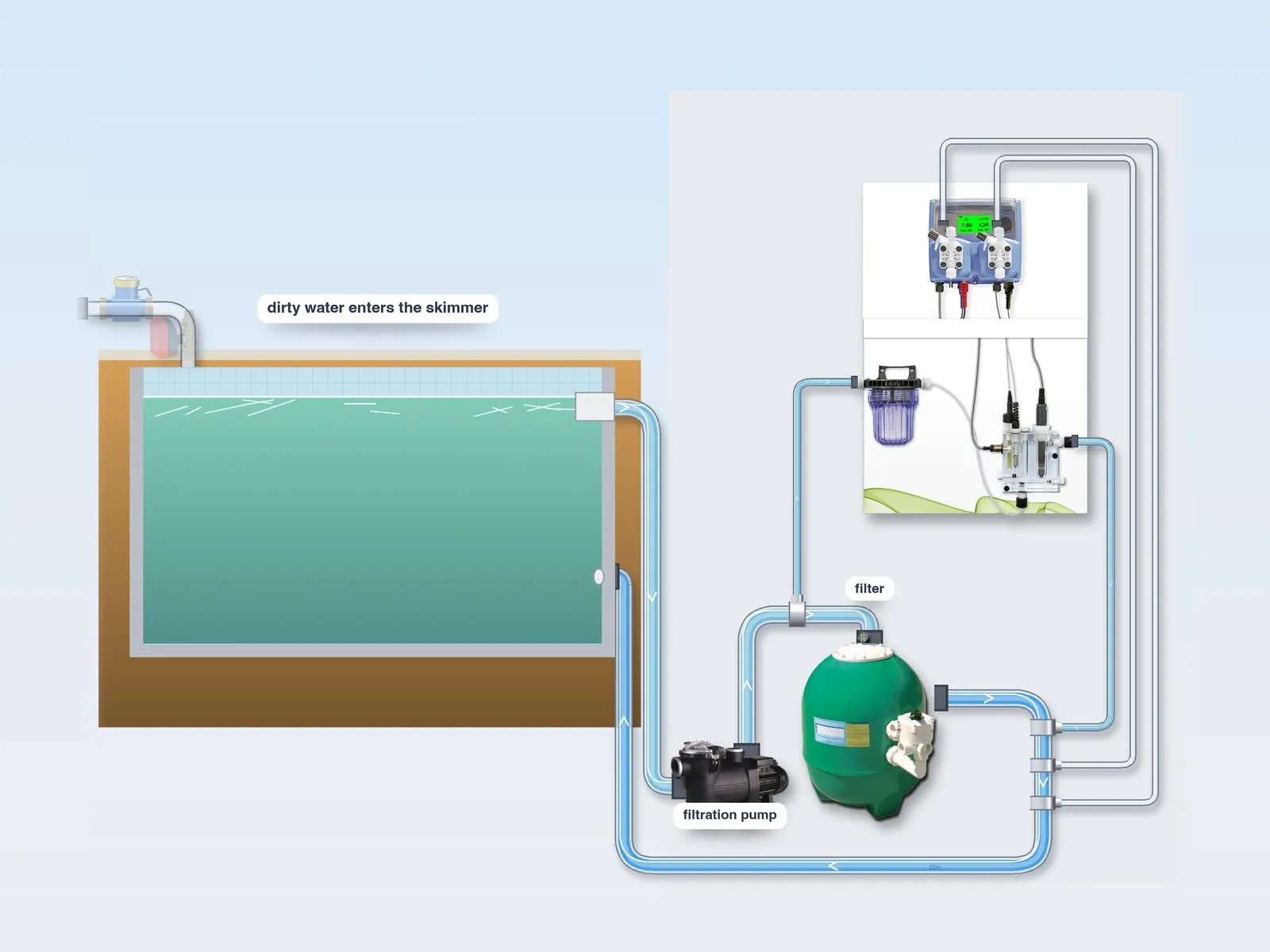
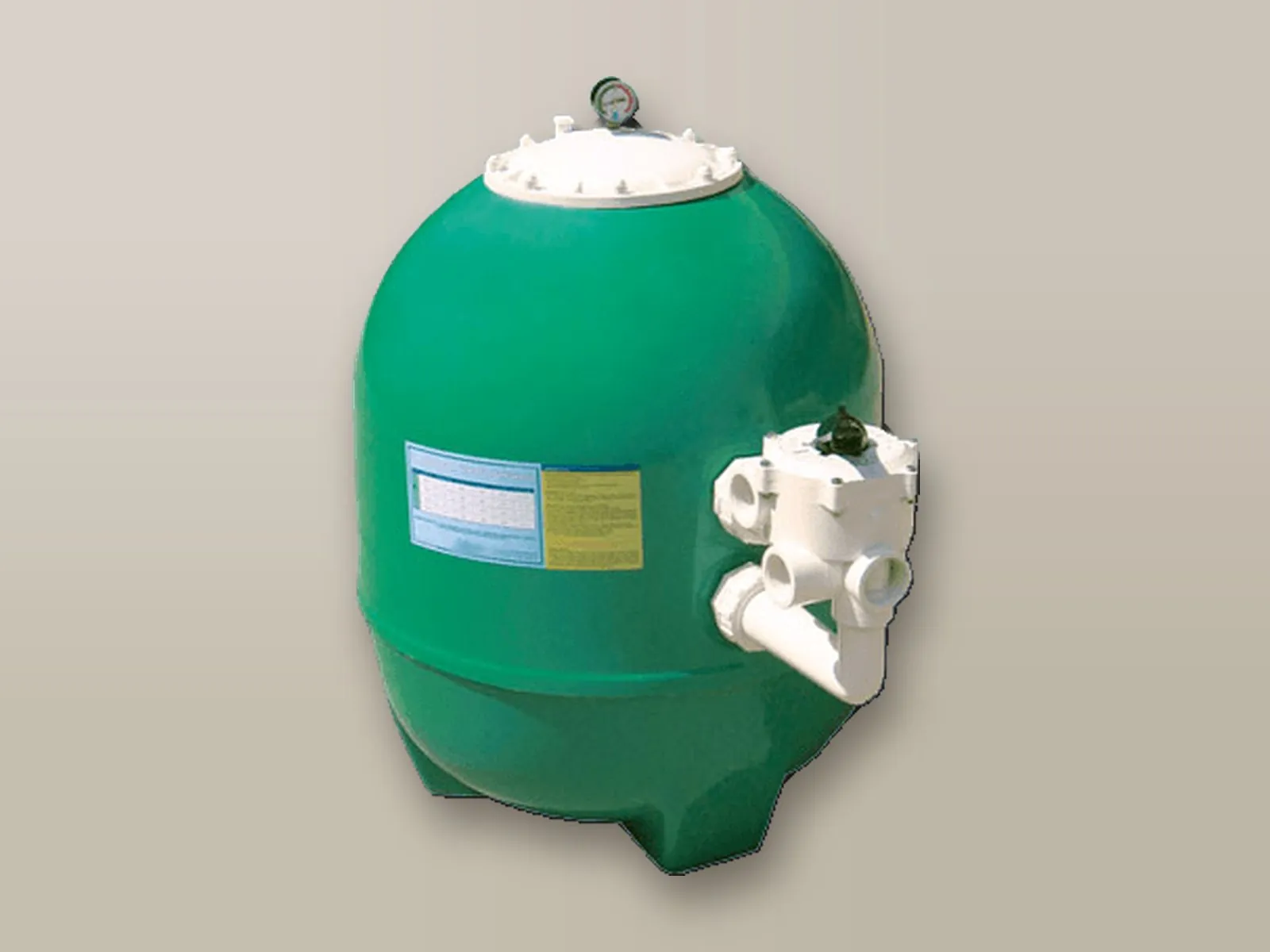
The water passes through a bed of sand or zeolites, which have adsorbent properties and are therefore more effective than sand, retaining colloids and coarse pollutants (skin, saliva, cosmetics, soap, fats), among the main causes of turbidity.
The effectiveness of filtration increases by dosing a flocculant (aluminium sulphate, ferric chloride, ferric chlorosulphate, polyaluminium hydroxychloride and polyaluminium hydroxychlorosulphate, sodium aluminate). Iron and aluminium in the pool must not exceed the values for drinking water: an excess indicates a leak from the filter and the return to the pool of the retained impurities.
UV lamps help to destroy chloramines and reduce the microbial load, but they do not replace the disinfectant: they act only as the water passes under the lamp, with no residual protection, and even a small dust particle can shield microorganisms.
It is the most important parameter: the effectiveness of all the other treatments, the service life of fittings, especially metal ones, and bathing comfort all depend on it. In the 7.2 – 7.4 range, chlorination and flocculation perform best and chlorine achieves its maximum disinfecting effectiveness.
Attack on metal materials and irritation of bathers’ eyes and mucous membranes.
Chlorine is converted into hypochlorite ion, which has little disinfecting power: for the same level of pollution, more chlorine is needed. A high pH also promotes the precipitation of hardness and limescale deposits.
Bathers and alkaline disinfectants (sodium hypochlorite) tend to raise the pH, dichlor and trichloroisocyanurate to lower it. To reduce the pH, sulphuric acid is normally used, which, unlike hydrochloric acid, does not produce chlorides: in excess, chlorides make water discharge difficult.
Swimming pool systems →Suspended solids cloud the water and indicate the presence of organic and colloidal substances (skin, saliva, cosmetics, soap, fats) that hinder disinfectants and provide nutrients and shelter for bacteria. Depending on the cause, it is necessary to:
Increase the filtration running time.
Replace the filter bed or dose a flocculant.
Bring the pH back into the correct range.
Increase the free chlorine value.
Turbidity is measured continuously with turbidity measuring systems.
Chlorine is the most widely used disinfectant in swimming pools: unlike ozone, after disinfection it maintains a safety residual in the pool, approximately 1.5 mg/l, against new contamination: this is active free chlorine, or residual chlorine. Its value depends on organic and inorganic pollution, number of bathers, exposure to the sun, dirt (leaves, soil, insects) and pH: to dose the right quantity, automatic continuous measuring systems are used, while colorimetric tests with DPD reagent provide an approximate indication.
Chlorine-based products (hypochlorite, salt electrochlorination, trichloroisocyanurate) react with the nitrogenous substances introduced by bathers, such as urea, forming monochloramines, dichloramines and trichloramines: together they make up combined chlorine, with negligible oxidising power. Trichloramines, volatile and irritating, cause the typical odour of poorly chlorinated pools.
Monochloramines and dichloramines remain in the water for days: they are eliminated with activated carbon, UV lamps or shock chlorination (break-point), which oxidises the chloramines, converting them into nitrogen gas. It must be limited to what is strictly necessary, because it forms trihalomethanes, volatile compounds that can be absorbed through the skin and by inhalation.
The sum of free chlorine and combined chlorine is total chlorine: by measuring it and subtracting free chlorine, combined chlorine is obtained. Combined chlorine and stabiliser alter the Redox measurement; the closed amperometric cell measures hypochlorous acid only.
Liquid product dosed by automatic systems that continuously measure free chlorine and control the dosing pump to keep it at 1.5 mg/l, also adjusting the pH. Hypochlorite contains sodium hydroxide (caustic soda), which tends to raise the pH. It is the most widely used form of chlorine and the one with the fewest side effects.
pH and chlorine systems →The electrochlorinator produces chlorine by electrolysis of the sodium chloride dissolved in the pool, at a concentration of 4 – 6 g/l, much lower than that of seawater: the disinfectant is generated on site, with no storage. Critical aspects: oxidation of metal parts not made of AISI 316L stainless steel or not connected to an earth electrode, discharge of chloride-rich water, precipitation of hardness in hard water.
Electrochlorinator management →Granular or in tablets placed in the skimmers: a strongly acidic, slow-dissolving compound, it is converted into hypochlorous acid and cyanuric acid, which stabilises chlorine against UV rays. Cyanuric acid accumulates at the bottom: at around 75 ppm it drastically reduces the effectiveness of chlorine and makes pH control difficult. It can only be reduced by replacing water through the main drain.
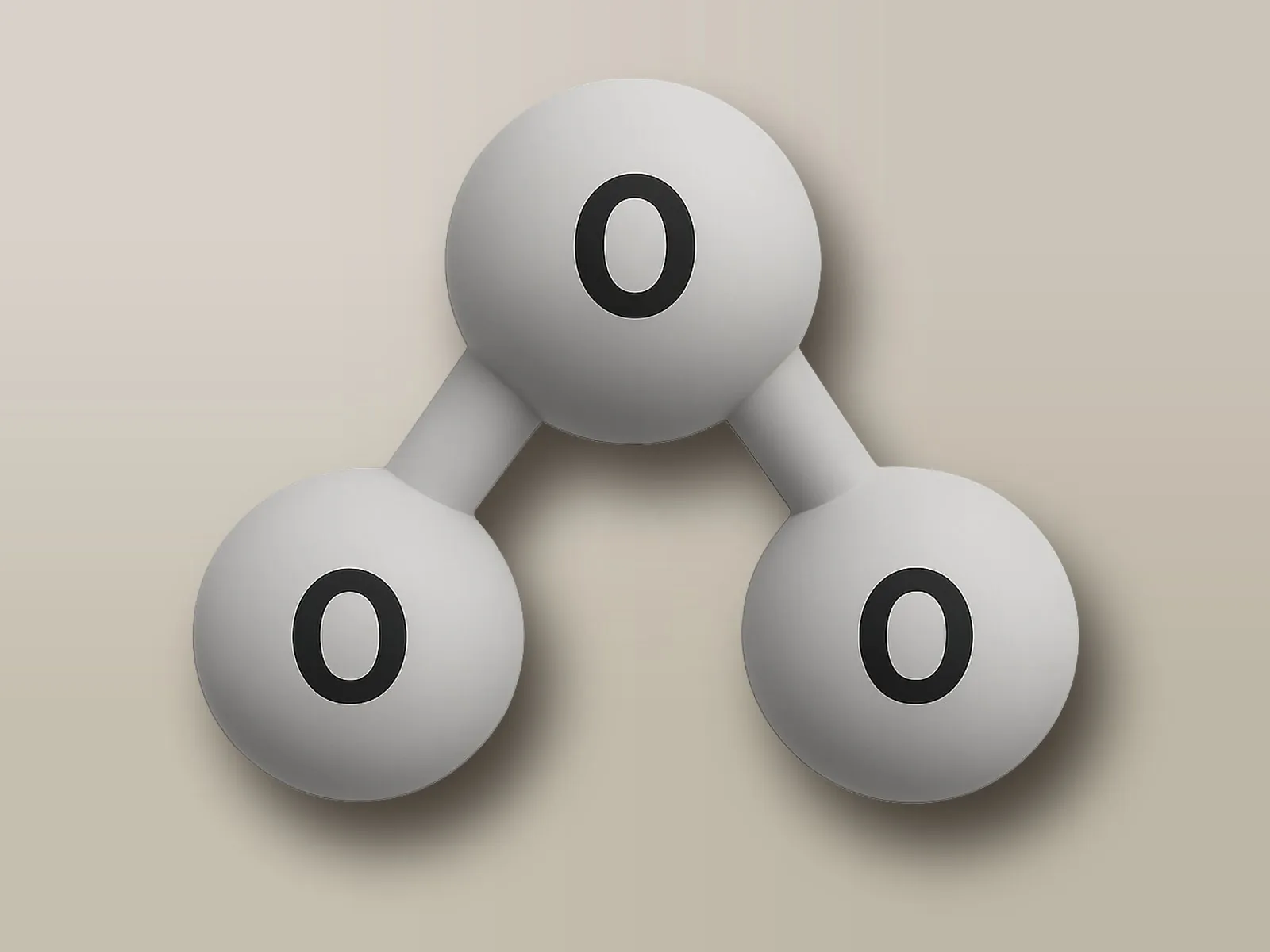
A powerful but very unstable disinfectant, generated on site by generators that pass an electrical discharge through the oxygen in the air. It turns back into oxygen almost immediately and leaves no safety residual; indeed, it must be completely removed before bathing. Chlorine must still be added to protect the pool.
Ozone systems →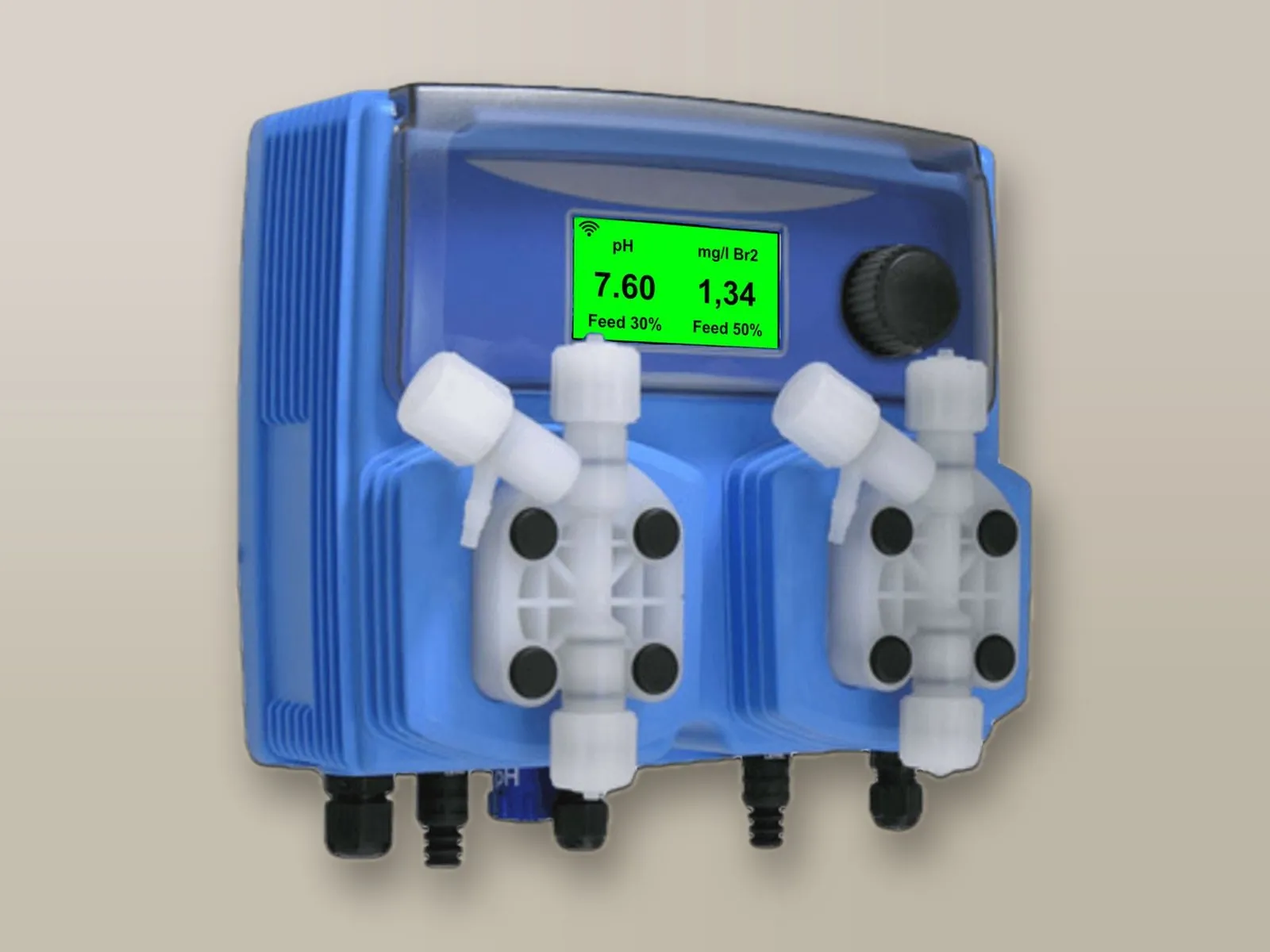
Little used because of its odour; in water it forms hypobromous acid and hydrobromic acid and is less dependent on pH than chlorine. In swimming pools, bromochlorodimethylhydantoin (BCDMH) is used: bromamines, less stable and less irritating than chloramines, recombine into hypobromous acid. A weaker oxidant than chlorine, it requires 2 – 6 mg/l of free bromine; high concentrations of dimethylhydantoin reduce its effectiveness and the Redox potential.
Bromine measurement →Bromine, which is more stable at high temperatures, or hydrogen peroxide (active oxygen), which raises no issues of chlorine by-products or dechlorination of the discharge. The controllers are the same, with the closed cell dedicated to the disinfectant: WD up to 150 m³, LD above. As an alternative to liquid hypochlorite, the salt chlorinator produces chlorine directly from the salt dissolved in the pool.
Free bromine in mg/l with the SBR closed cell (0 – 20 mg/l, 0.01 mg/l resolution): WDpHCl Bromine up to 150 m³, LDpHCl for bromine above.
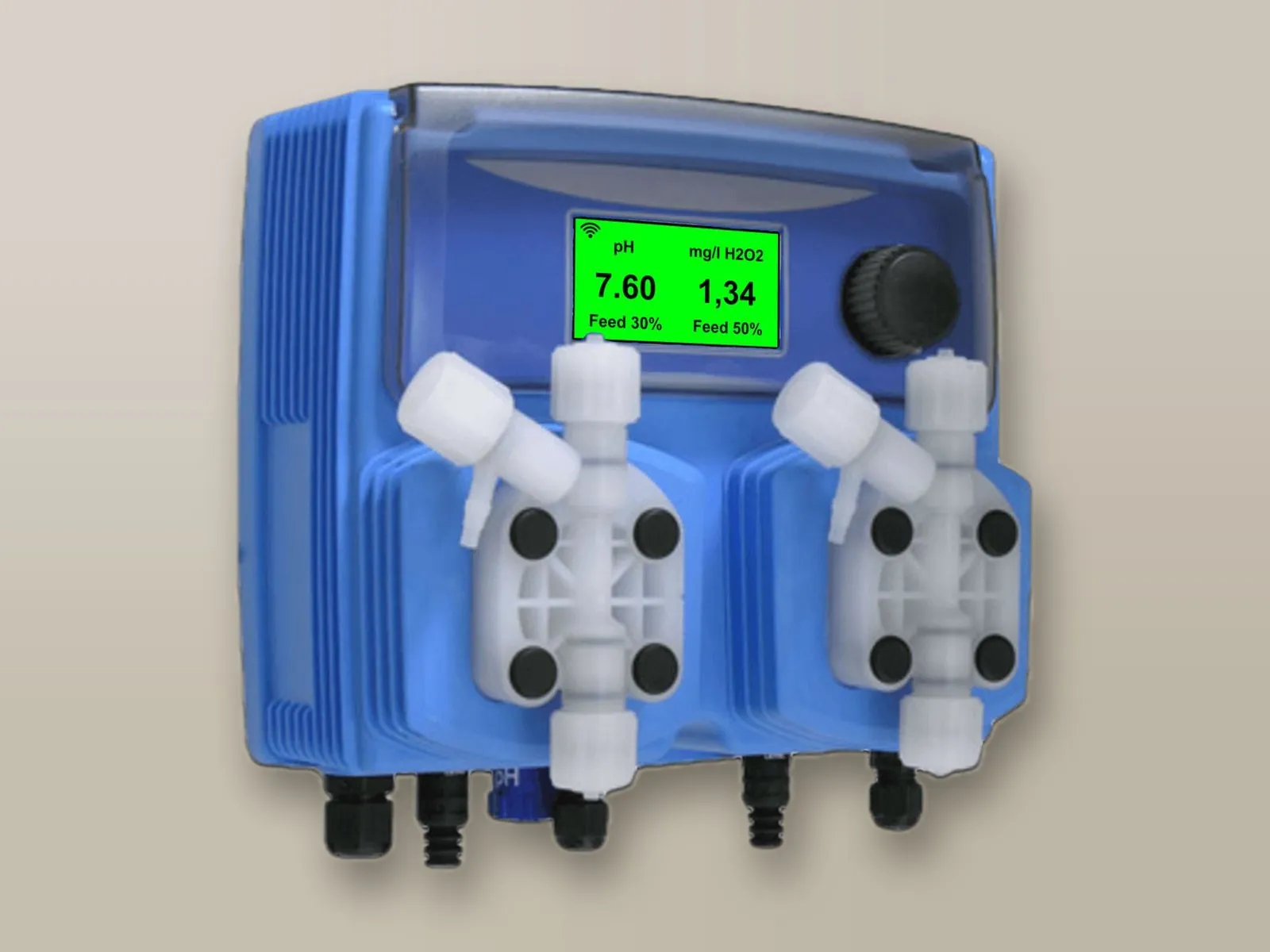
Active oxygen measured by the SCL9 closed cell (0 – 200 mg/l, 0.1 mg/l resolution); typical set points 30 mg/l and pH 7: WDpHCl Peroxide up to 150 m³, LDpHCl for hydrogen peroxide above.
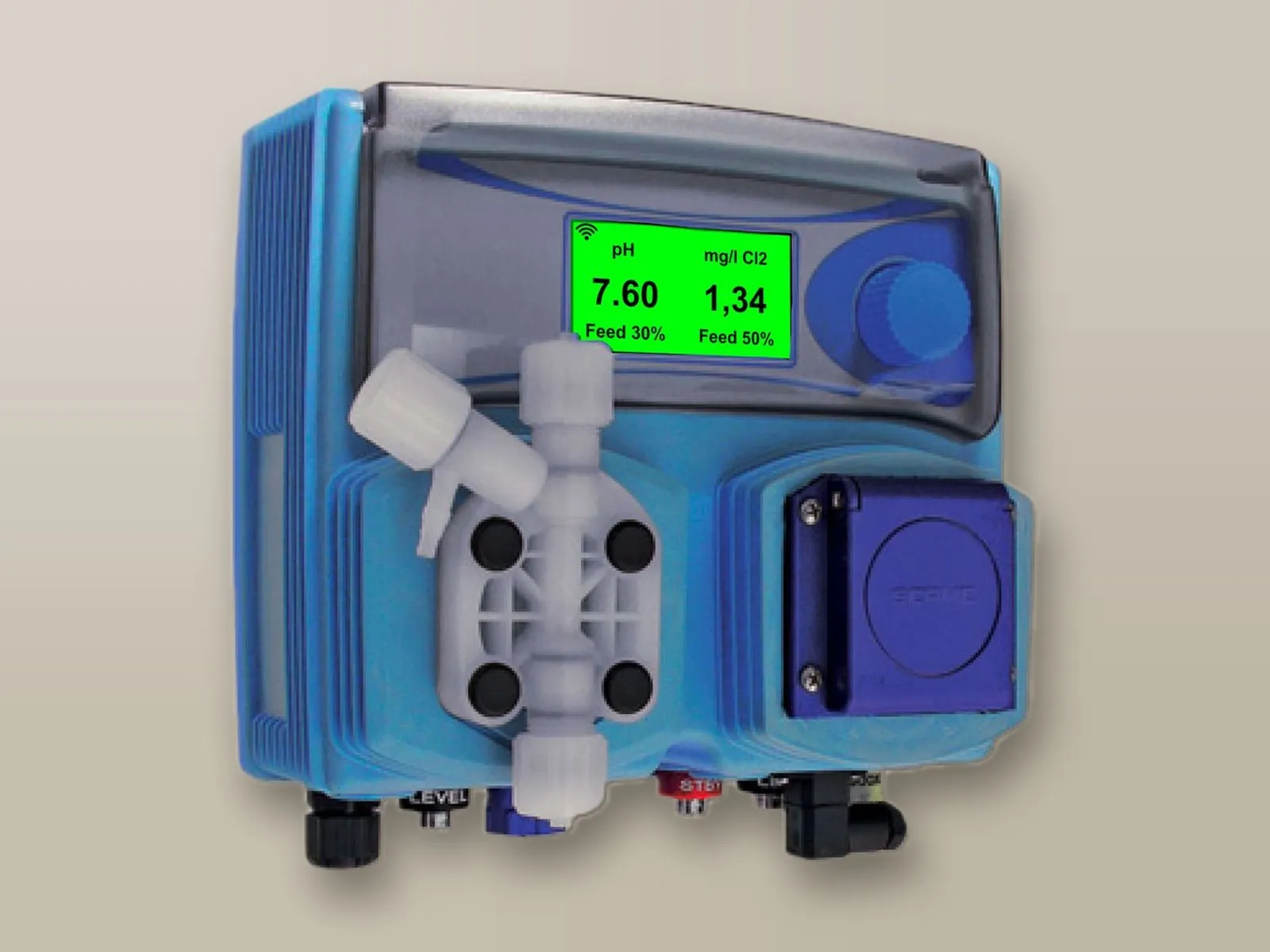
The salt chlorinator produces chlorine from the salt dissolved in the pool, with no storage or dosing of hypochlorite. The S versions (WDpHCls, WDpHRhs) up to 150 m³, and the LDpHCl above, control the control unit on the basis of the measured free chlorine or Redox.
The salt chlorinator produces chlorine from the salt dissolved in the pool. The S models (WDpHCls, WDpHRhs) manage it directly: instead of the hypochlorite pump they have a 230 VAC 10 A Schuko socket, to which the control unit is connected; it is activated according to the measured value.
Example with Redox measurement: the control unit is active below 600 mV, stops at 700 mV and restarts when the value next falls below 600 mV.
Below 600 mV the control unit runs continuously and at 700 mV it stops; in the intermediate range the controller modulates its activation frequency and duration.
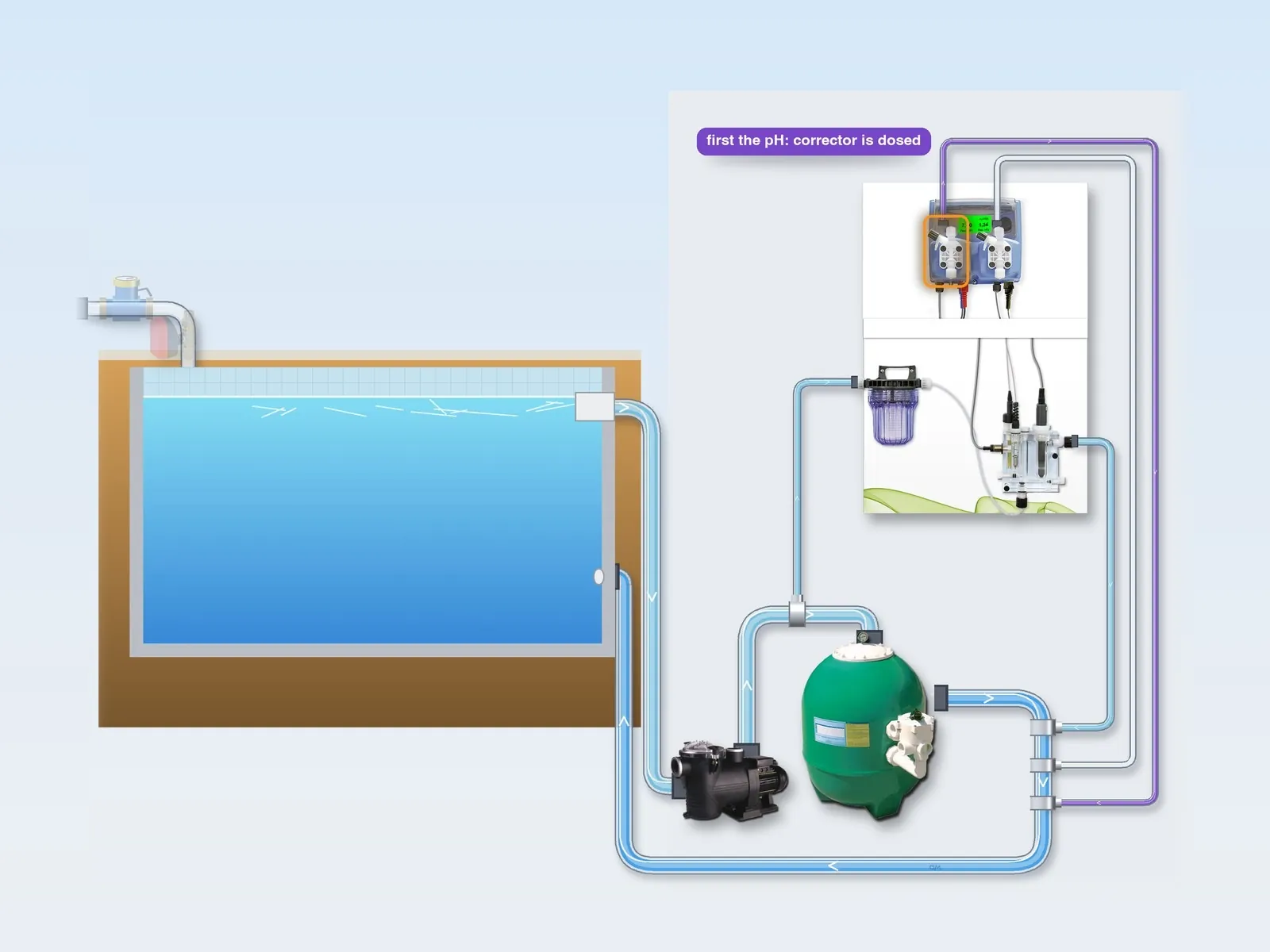
The corrector pump acts first (for example at maximum frequency at pH 8.00 and stopped at 7.00); disinfectant control follows once the set pH has been reached.
Electrochlorinator management →Chlorine added to water, whether sodium hypochlorite or trichloroisocyanurate, dissociates into hypochlorous acid and hypochlorite ion, in proportions that depend on pH. A stable pH close to 7.2 – 7.4 provides, for the same amount of chlorine dosed, a greater quantity of hypochlorous acid.
It is the form of chlorine with the highest and fastest disinfecting power: it prevails the closer the pH is to 7.
It is the form with a considerably lower disinfecting power: it prevails the more the pH tends towards 8.
Chlorine that reacts with the nitrogenous substances introduced by bathers forms chloramines, which cause irritation of the eyes and mucous membranes and the characteristic odour: together they constitute combined chlorine, which must not exceed 0.4 mg/l. The sum of free and combined chlorine is total chlorine.
For this reason, systems that first adjust the pH and only then dose the hypochlorite are preferable.
At the typical pH of a swimming pool the two forms are present in similar quantities, and a few tenths of a pH unit are enough to shift the equilibrium: for the same free chlorine, the share of hypochlorous acid, the only truly disinfecting form, falls rapidly as the pH rises.
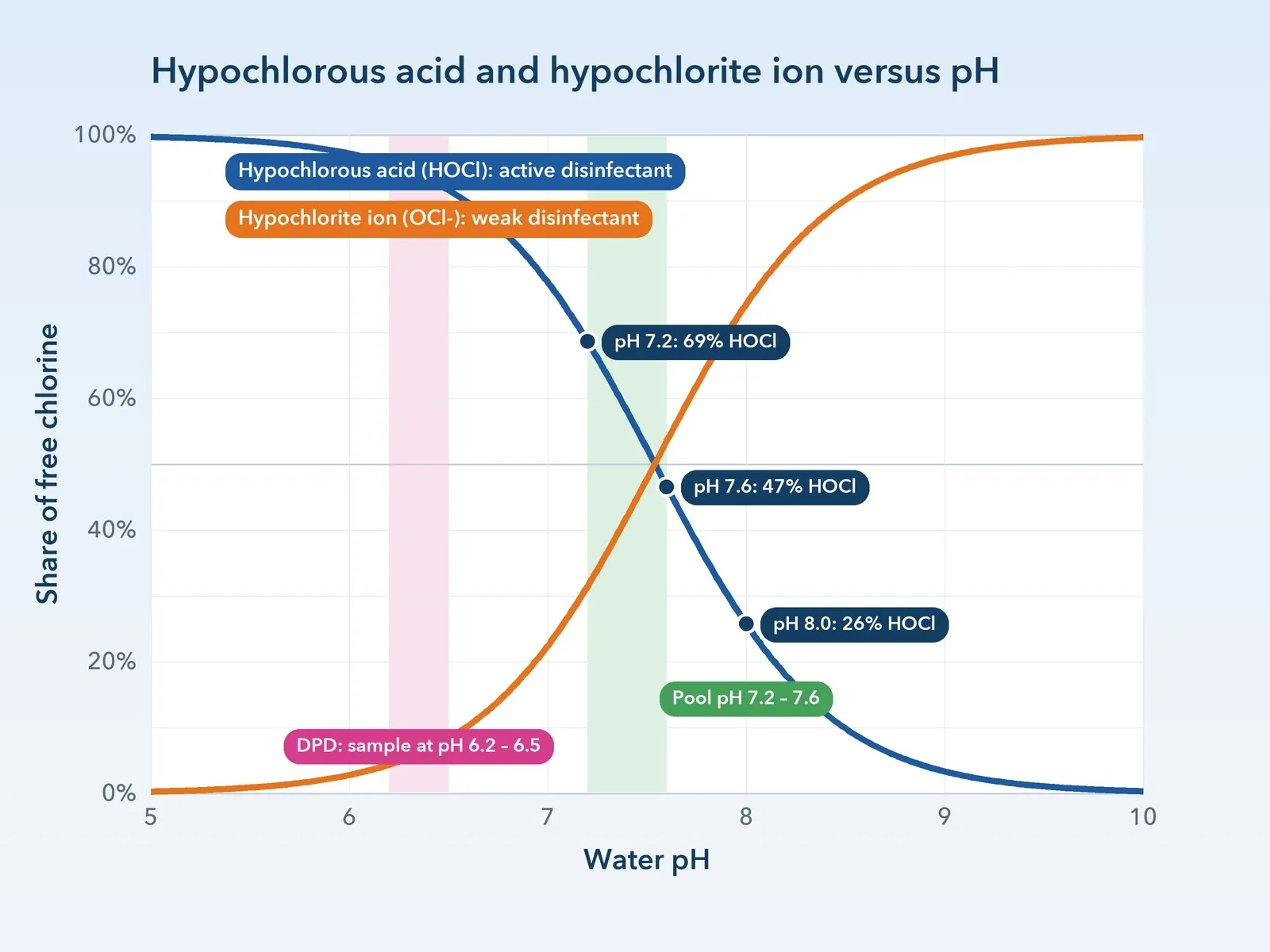
Approximately 69% of the free chlorine is hypochlorous acid.
Hypochlorous acid falls to approximately 47%: the two forms are roughly equal.
Approximately 26% hypochlorous acid remains: three quarters of the chlorine dosed have a reduced disinfecting power.
Values at 25 °C. The DPD method brings the sample to pH 6.2 – 6.5, where almost all the free chlorine is hypochlorous acid: this is why it always reads the overall free chlorine, regardless of the actual pH of the pool.
Trichloroisocyanurate tablets, placed manually in the skimmers, in the balance tank or wherever the water flows over them, are an organic form of chlorine with a molecule of cyanuric acid, which protects the chlorine from UV rays. Each tablet, however, adds further stabiliser, which accumulates: there is no product that removes it while keeping the water suitable for human contact, and above 75 mg/l approximately one third of the water volume must be replaced, drawing it from the main drain, where the acid stratifies.
Cyanuric acid is organic material: chlorine treats it as a pollutant to be oxidised and an increasing share of each tablet is consumed in the attempt. More and more tablets are needed, which in turn add stabiliser.
Excess cyanuric acid keeps the pH very low and makes it difficult to raise, even when a pH increaser is dosed.
Redox systems and open-cell amperometric systems measure the current that chlorine releases in the water: cyanuric acid releases additional current, which the measurement attributes to chlorine; the DPD method also reads the chlorine bound to the stabiliser as free chlorine. Only the closed amperometric cell is unaffected.
Used successfully for many years, hypochlorite is inorganic in nature and does not give rise to the phenomena described. It is added to the pool by dosing pumps controlled by a free chlorine measuring system, up to a maximum concentration of 1.5 mg/l.
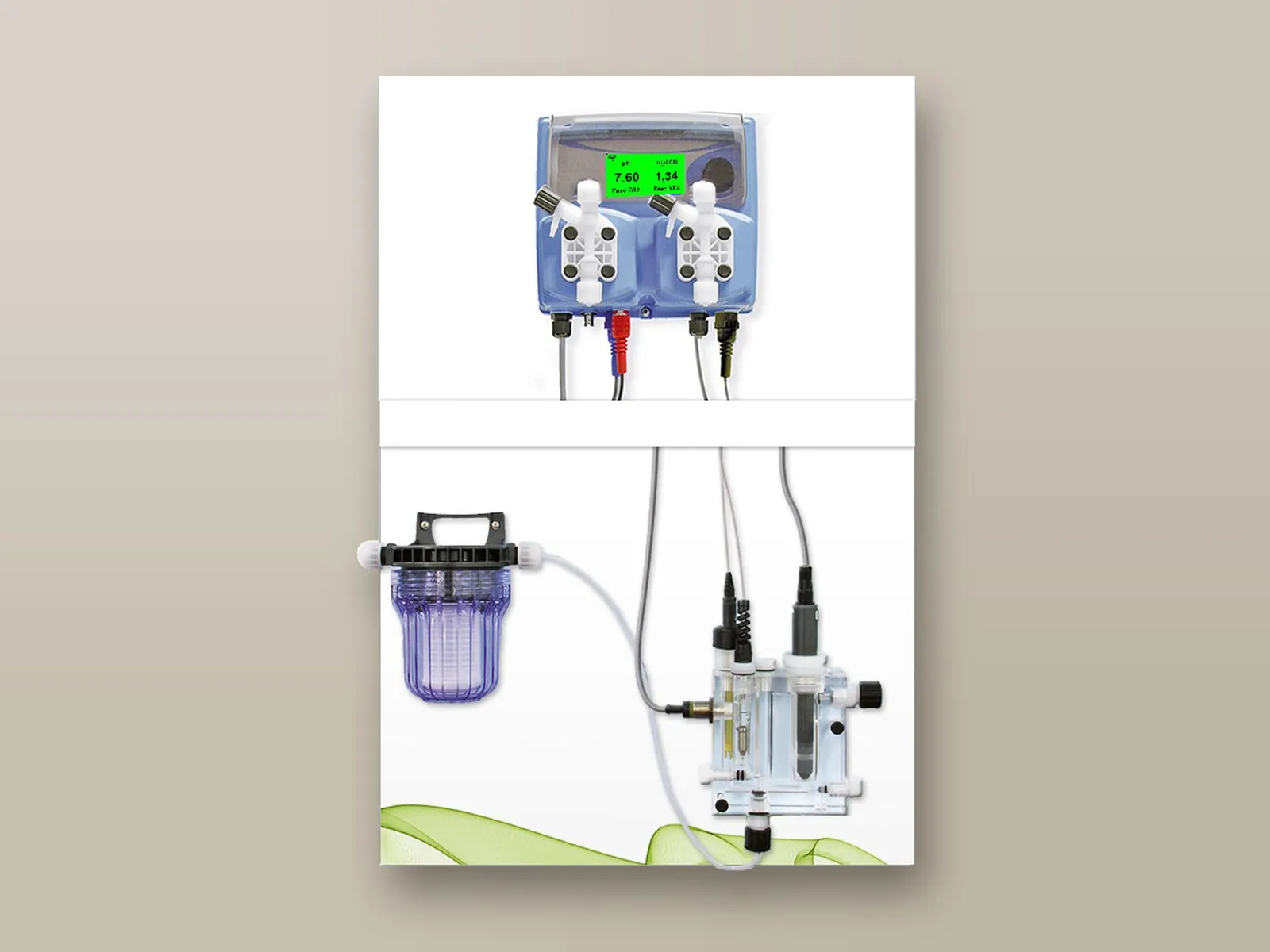
Given the close dependence between chlorine and pH, the pH must also be controlled automatically: systems that first adjust the pH and only then dose the hypochlorite are preferable.
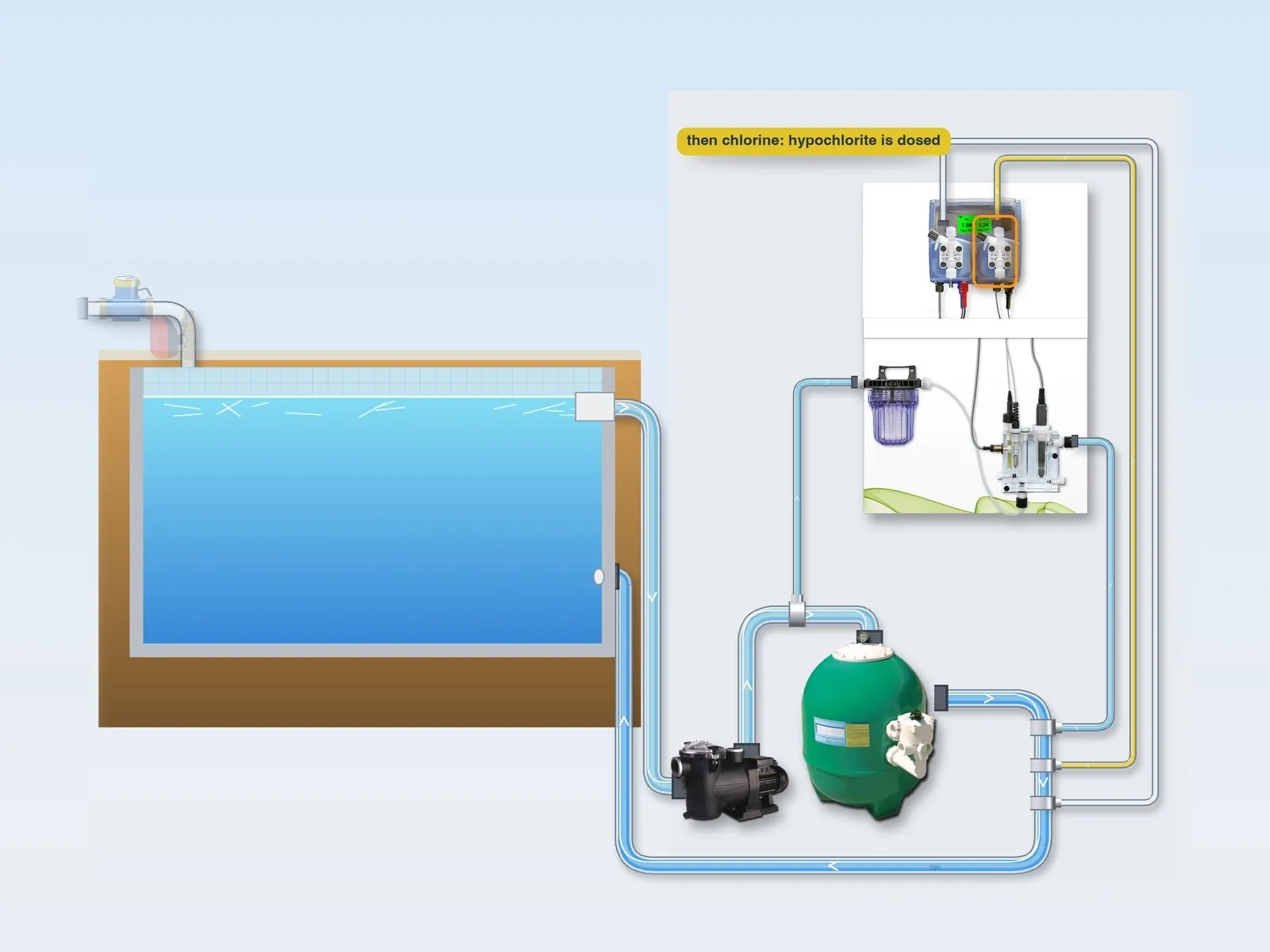
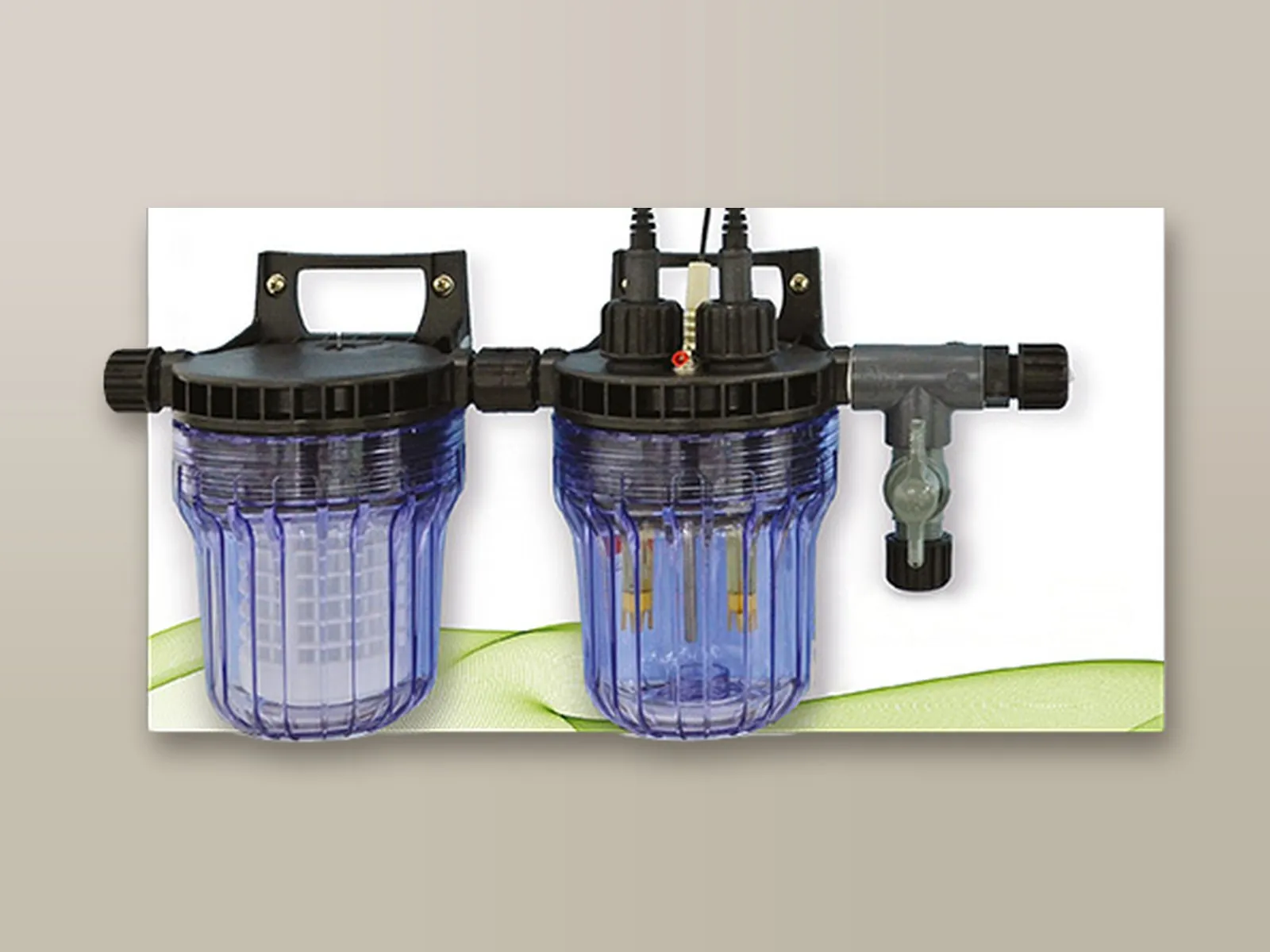
Two probes, mounted in a flow-through probe holder supplied with a water sample taken after filtration, measure pH and free chlorine and tell the pumps how much corrector and how much hypochlorite to dose. There is only one measuring principle for pH; for chlorine the choice is between Redox and amperometry.
The use of liquid sodium hypochlorite is recommended, dosed by a pump controlled by the measurement of free chlorine and pH.
The reading is affected both by the characteristics of the water and by the chlorine dosed: the three continuous probes differ in how many of these variables influence the measurement; the DPD method reads a sample under its own conditions.
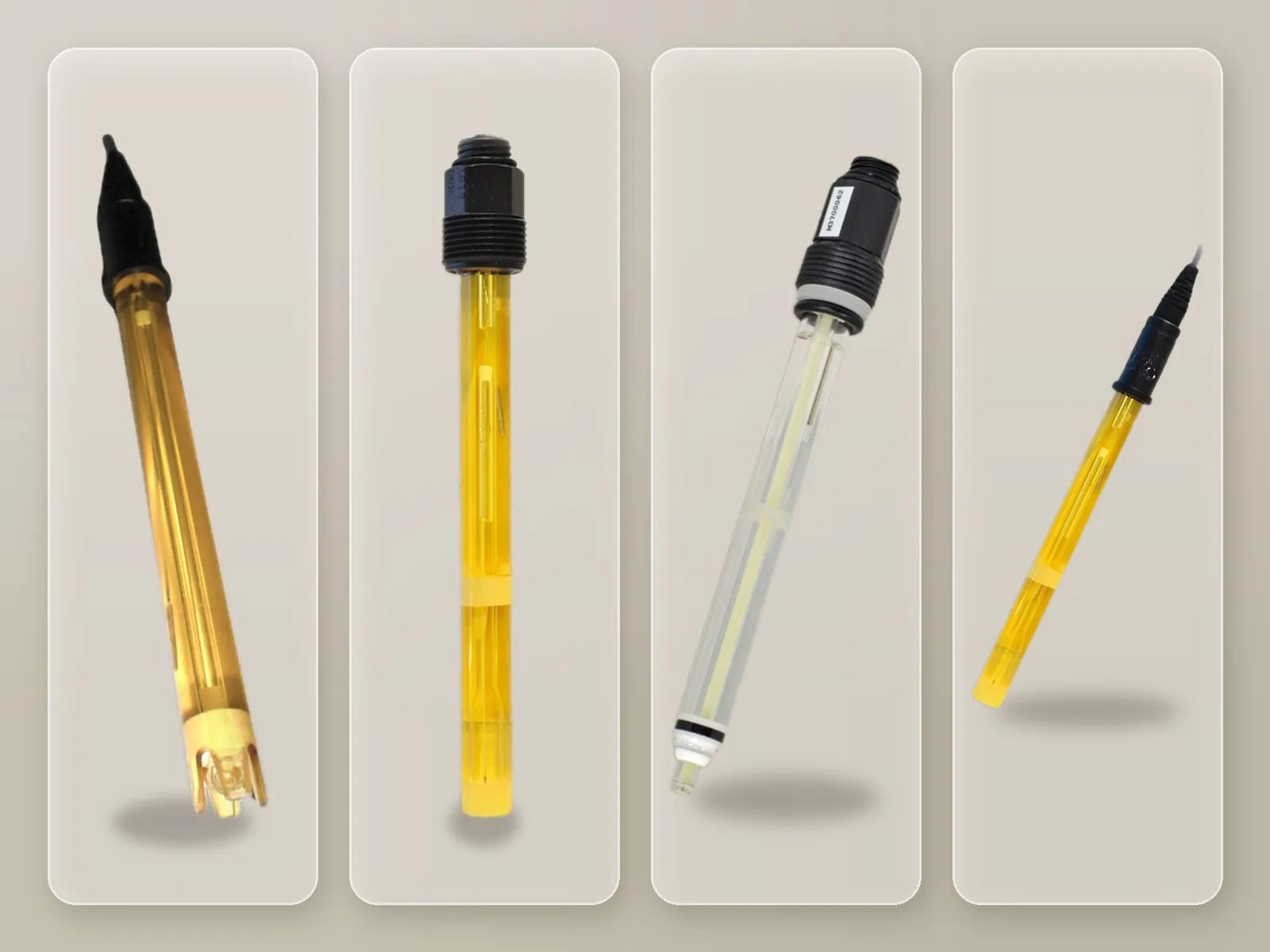
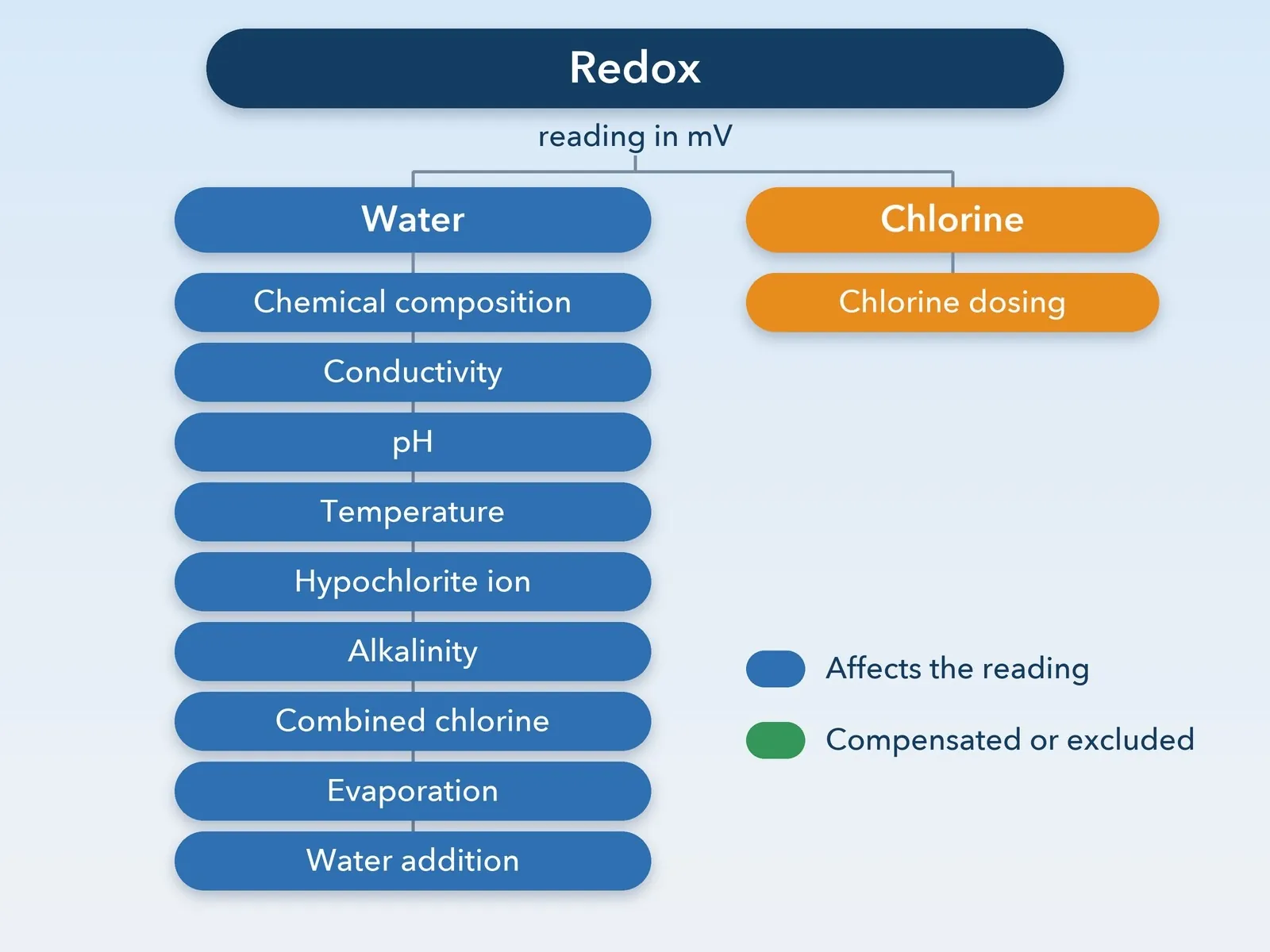
The probe records every variation in potential without distinguishing between that due to the water and that due to chlorine, and attributes it solely to chlorine dosing.
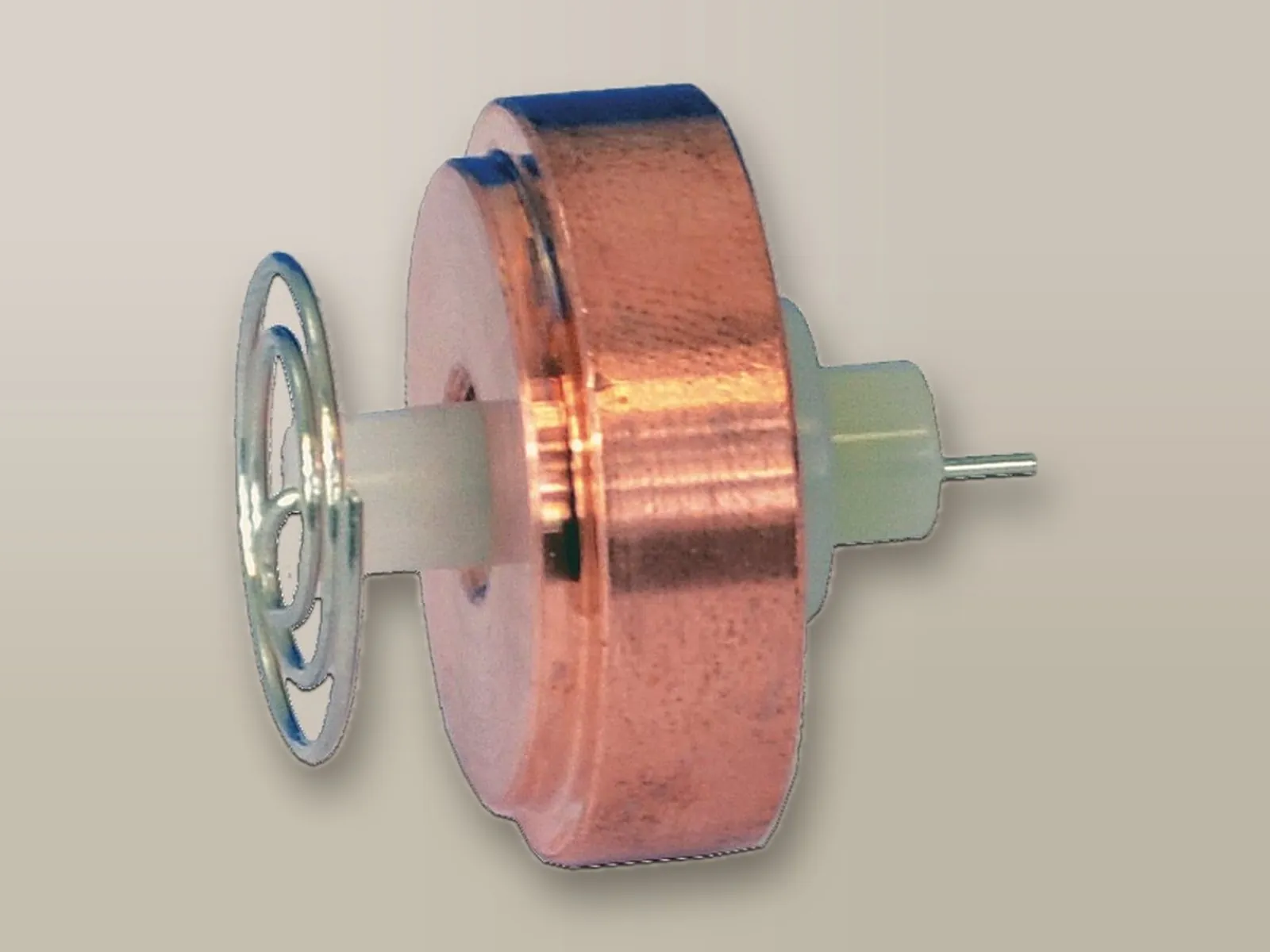
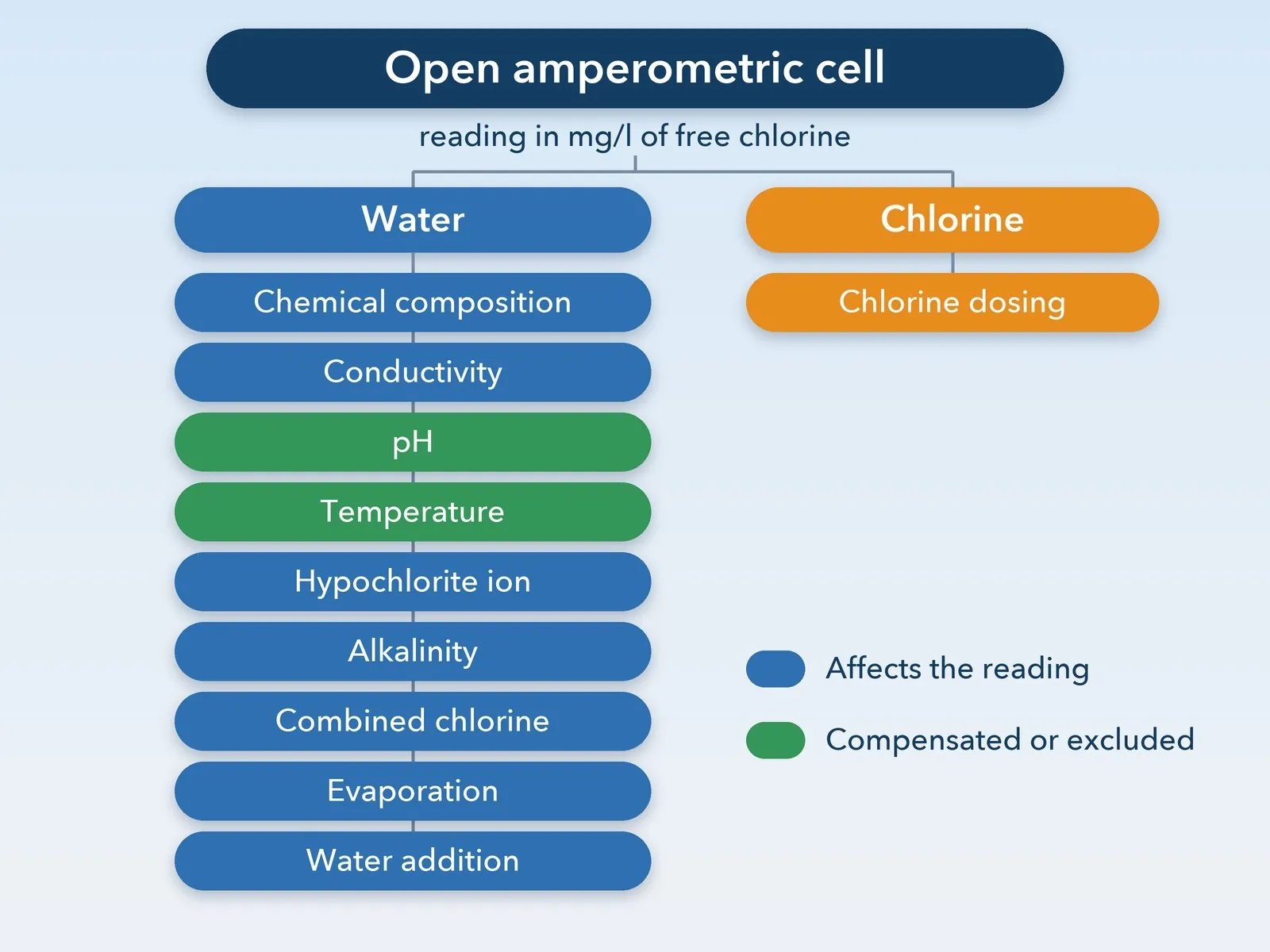
It is only slightly affected by pH and compensates for temperature; the other variables, including combined chlorine, affect the reading.
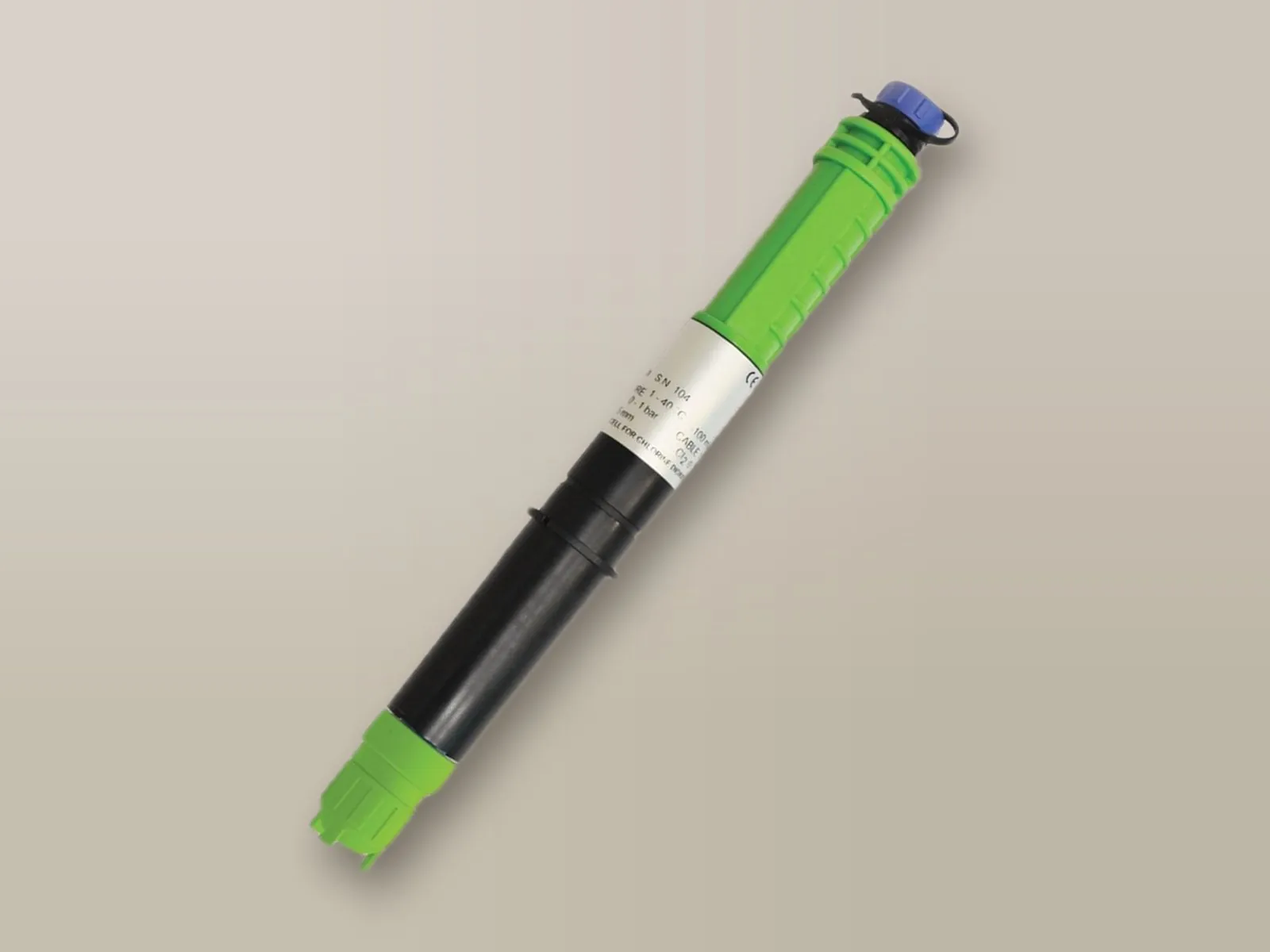
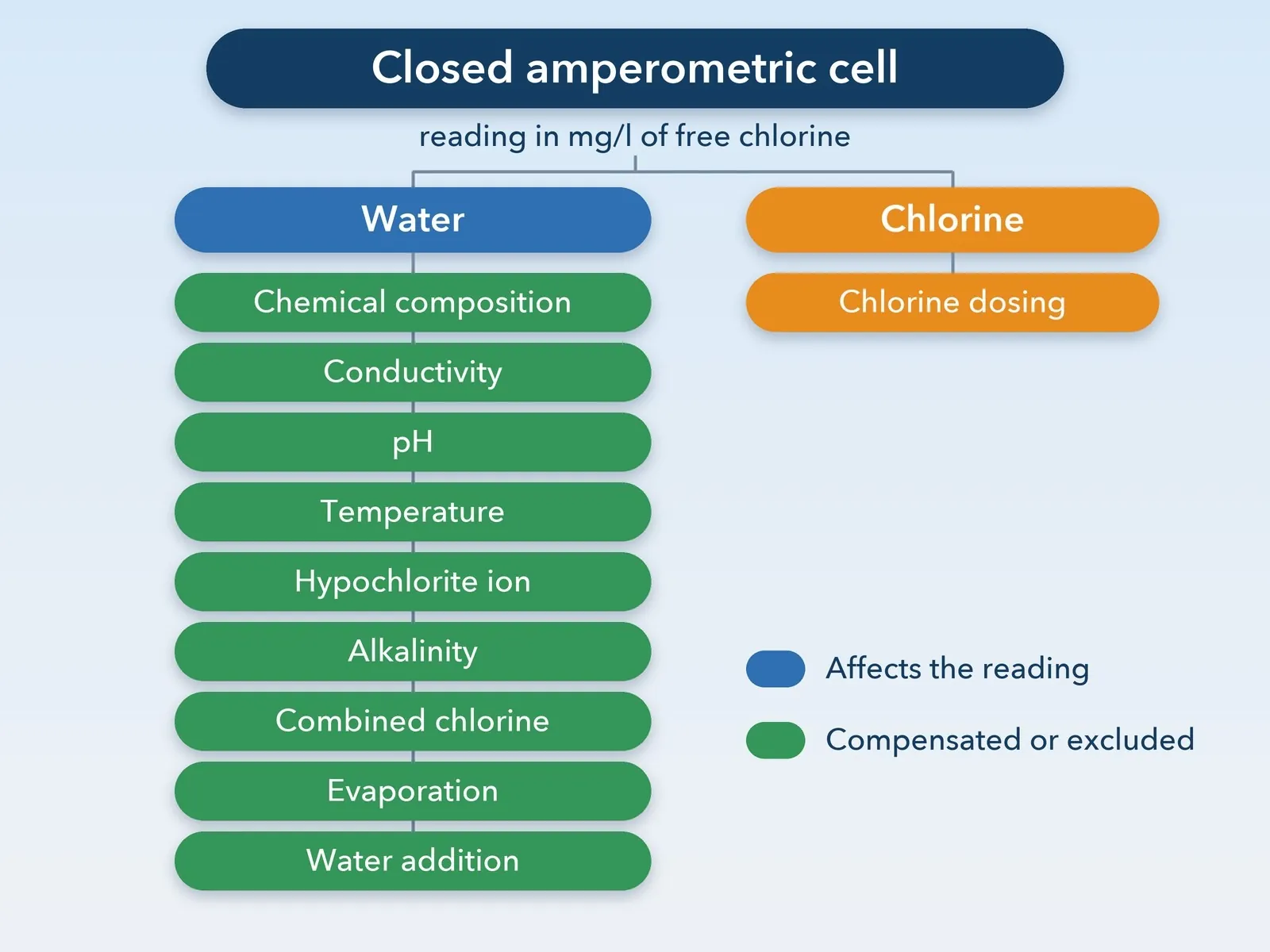
The membrane cap allows only hypochlorous acid to reach the electrodes; pH and temperature are compensated automatically.
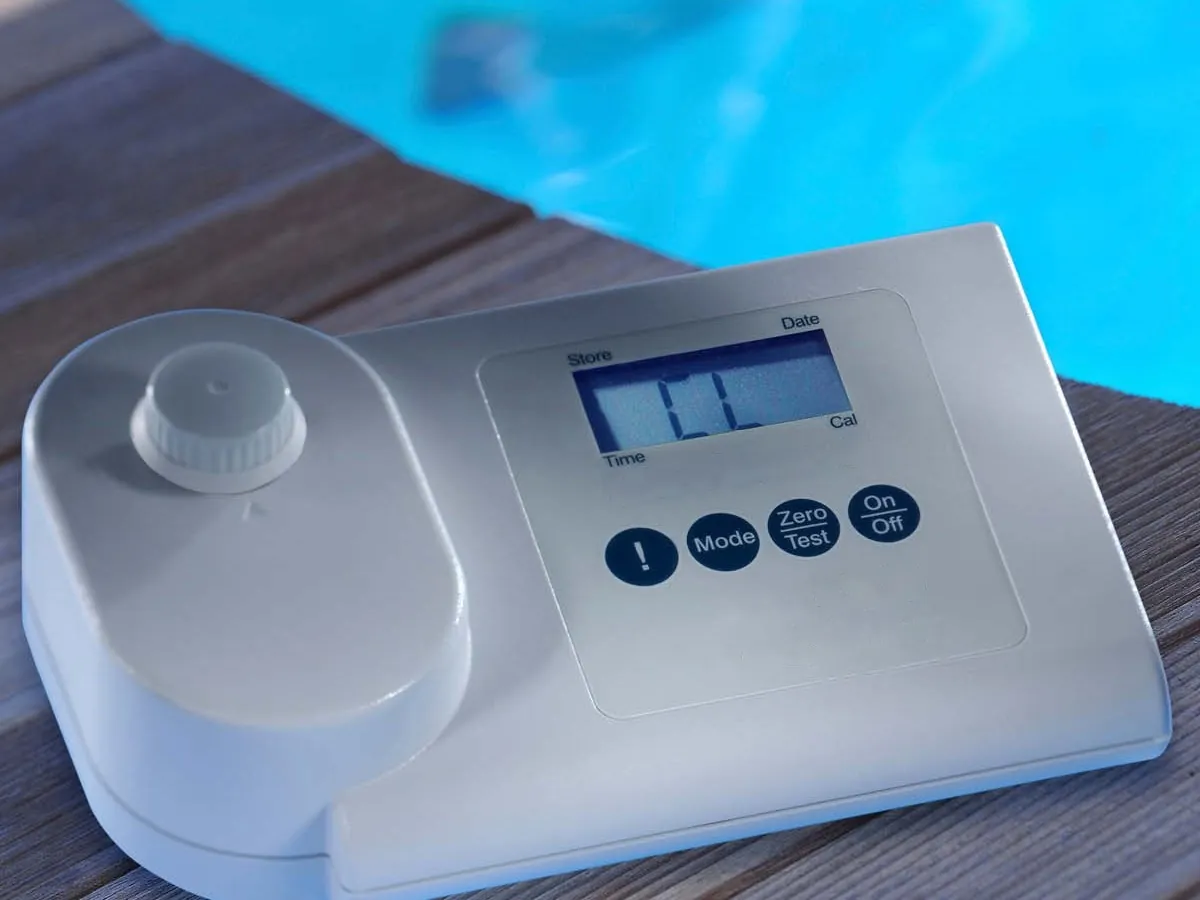
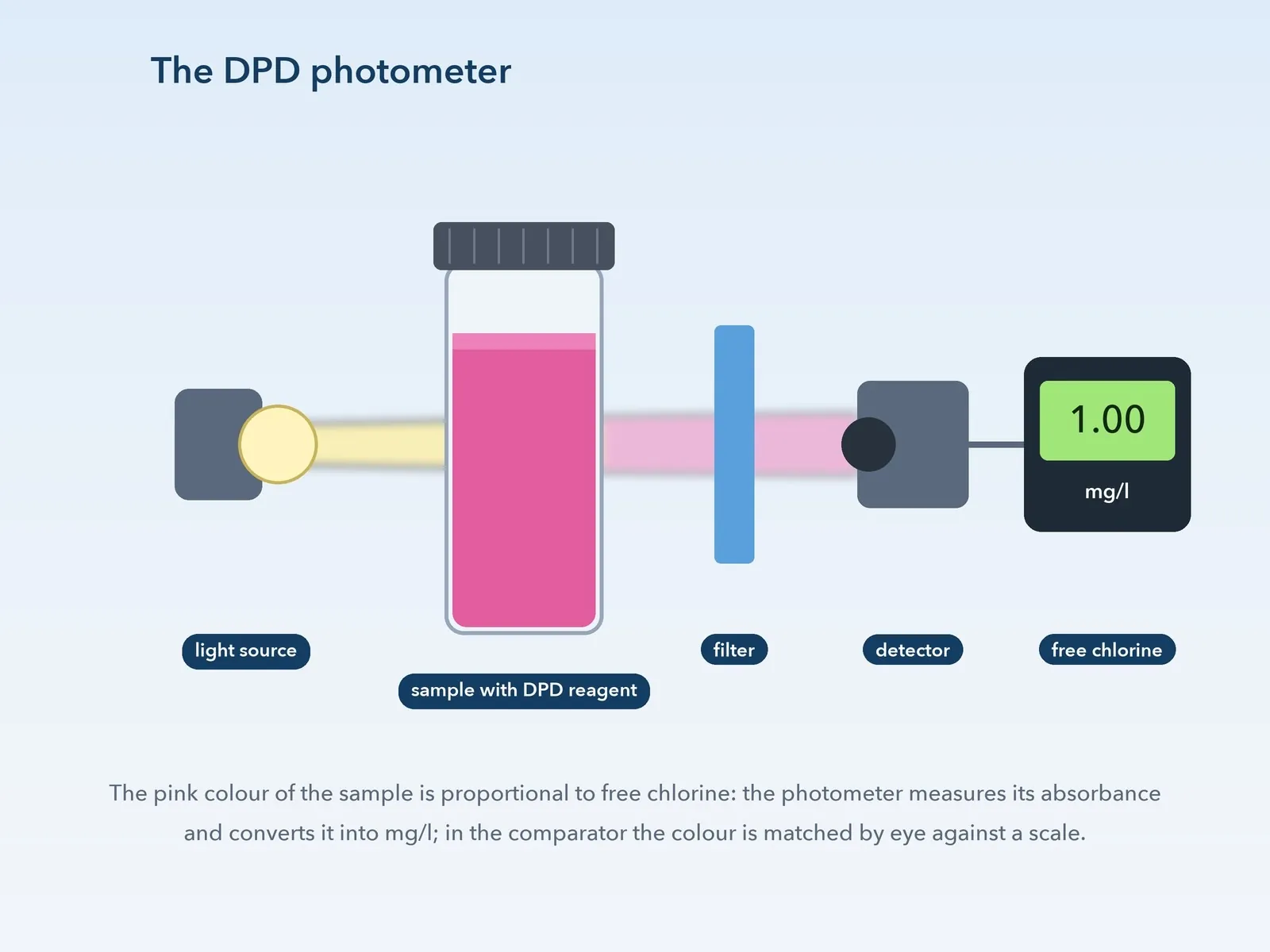
The reagent brings the sample to pH 6.2 – 6.5 and reacts with all the free chlorine, hypochlorous acid and hypochlorite ion: the reading does not depend on the pH of the pool, but is affected by chloramines, other oxidants, turbidity and temperature.
The electrode measures the Redox potential of the water, expressed in mV, and not the free chlorine directly. Every water, even without added chlorine, has its own Redox potential: if even one of its characteristics changes, the electrode must be recalibrated.
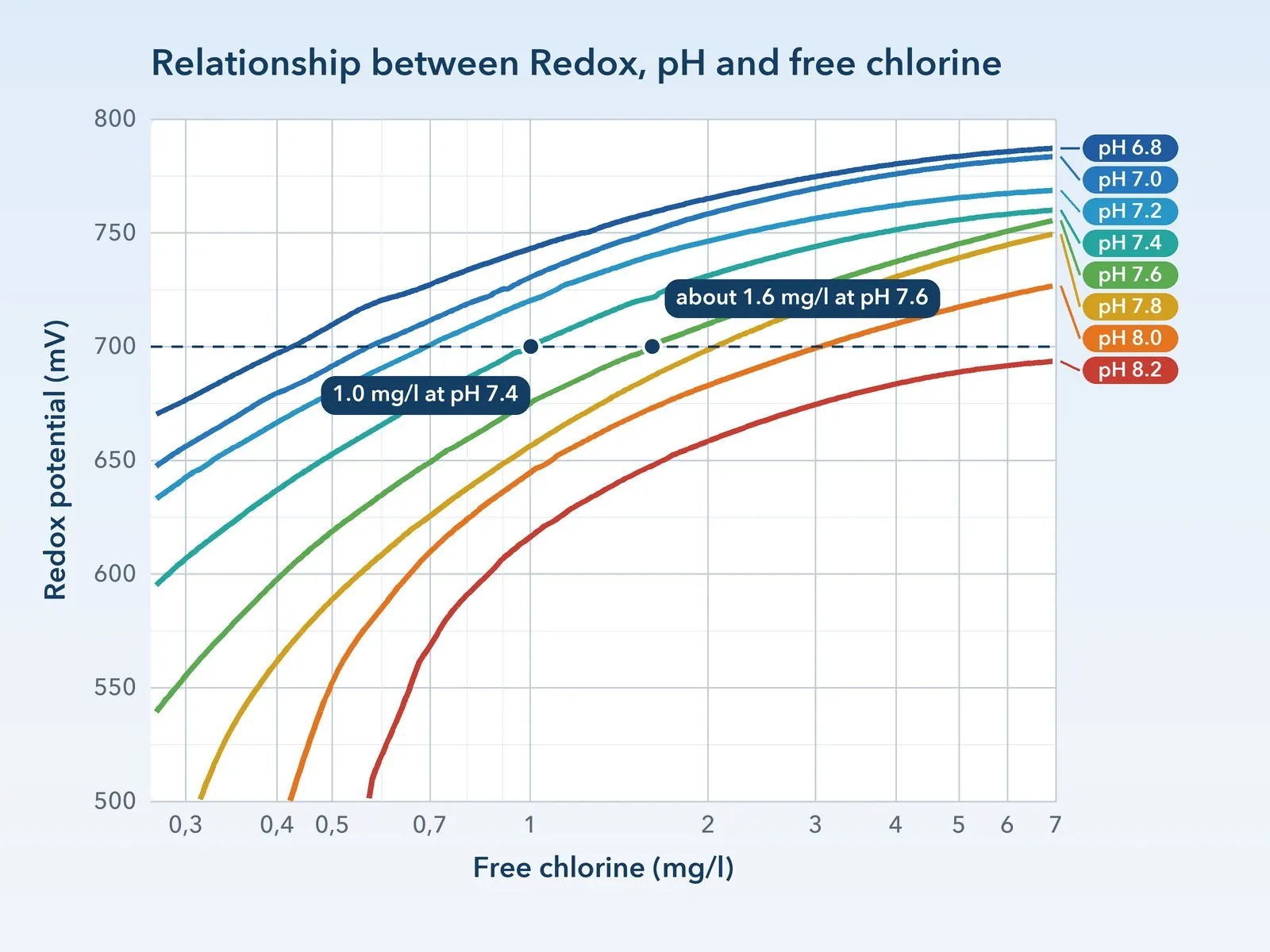
The potential of the free chlorine and of any stabiliser is added to that of the water. In a swimming pool these variables change continuously, pH in particular.
To know the mg/l of free chlorine corresponding to the measured mV, a chart crossing pH and mV is needed. With a set point of 700 mV and pH 7.4, free chlorine is approximately 1.0 mg/l; at pH 7.6 the same 700 mV correspond to approximately 1.6 mg/l. The probe is a single-junction combination probe, with a range of 0 – 1,000 mV.
The set point in mV is determined by bringing the pH to the optimum value, dosing hypochlorite up to 1.5 mg/l of free chlorine measured with the DPD method and recording the corresponding Redox value; the check must be repeated periodically. With Redox measurement it is essential to adjust the pH first. The advantage of the system is its relatively low cost.
The value read by the electrode is the resultant of all the oxidising and reducing substances present in the water and of the conditions in which they are found. Even before chlorine is dosed, the water has a base potential, determined by its chemical composition and dissolved salts (conductivity), pH, temperature and bacterial and organic load. Free chlorine is added to this base potential and the electrode measures the overall value, without being able to distinguish the share due to the disinfectant. Any change in the characteristics of the water therefore changes the reading, even with the same free chlorine.
Rainwater dilutes the concentration of dissolved salts and alters the pH of the pool water, changing its base potential.
Make-up water has its own characteristics: its addition changes the conductivity, salt content, pH and temperature of the pool water.
The water that evaporates leaves the dissolved salts in the pool, where they progressively concentrate; subsequent make-up further changes the composition over the course of the season.
The potential decreases as pH increases. With 1.0 mg/l of free chlorine approximately 700 mV are read at pH 7.4 and approximately 670 mV at pH 7.6: a few tenths of a pH unit shift the reading by tens of mV.
The potential depends on temperature, as described by the Nernst equation: heating of the water and seasonal or day–night variations change the reading even with the same chlorine.
The organic and nitrogenous substances introduced by bathers, the resulting chloramines and any stabiliser (cyanuric acid) change the potential; the stabiliser, in particular, lowers it.
The correspondence between mV and mg/l established by calibration remains valid only as long as the characteristics of the water remain unchanged: this is why the Redox probe requires frequent calibration and checking with the DPD method.
Amperometric cells measure the electric current generated at the electrodes by the oxidant and display the free chlorine directly in mg/l, without resorting to the Redox chart, in real time and without interruption: this is why they are the instruments suited to controlling dosing.
The two electrodes are in direct contact with the water and read all the current generated, including that of combined chlorine. Compared with Redox, it is less affected by pH variations, compensates for temperature and requires periodic calibration, but less frequently. Range 0 – 10 mg/l.
The electrodes are immersed in an electrolyte and separated from the water by a selective membrane cap: hypochlorous acid passes through the membrane, reaches the electrolyte and generates at the electrodes a current proportional to its concentration. The membrane excludes hypochlorite ion, combined chlorine, cyanuric acid and the other components that would alter the measurement; with pH and temperature compensation, the reading shows the mg/l of free chlorine actually present, with a resolution of 0.01 mg/l. Range 0 – 20 mg/l. A dedicated closed cell measures total chlorine: combined chlorine is obtained by difference.
The reading of the closed cell depends on the exchange of water at the membrane: a few precautions during installation and maintenance keep it stable and accurate over time.
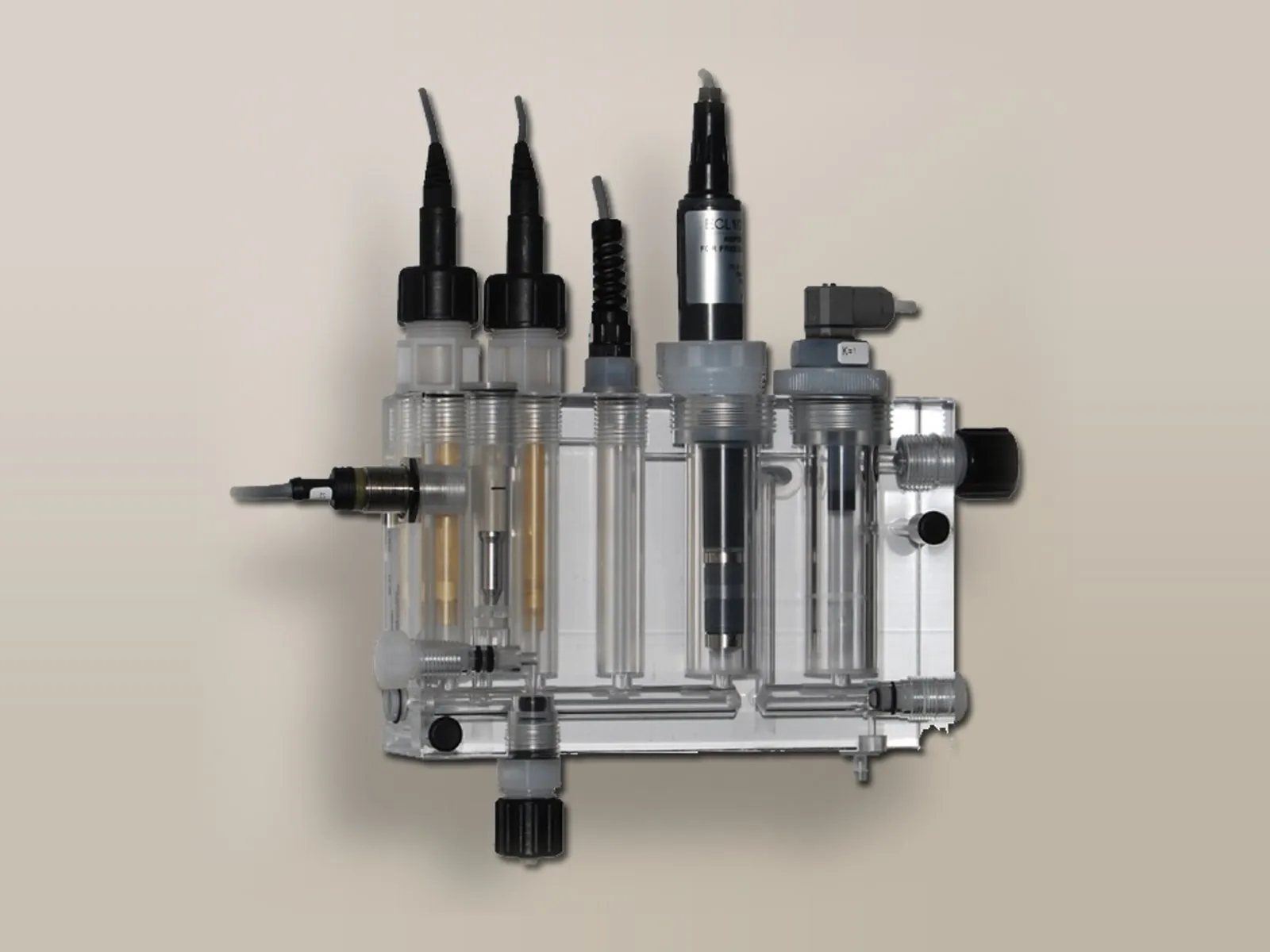
With a low flow rate less hypochlorous acid reaches the membrane and the cell reads less; with an excessive flow rate it reads more. The cell is installed in a flow-through probe holder in by-pass, with adjustment and monitoring of the inlet flow rate and without exceeding the working pressure.
Organic deposits and biofilm on the membrane reduce over time the quantity of hypochlorous acid passing through it and lower the reading: the membrane must be checked and the membrane cap replaced at the specified intervals.
The controller must always remain powered, to maintain the polarisation of the electrodes; when the filtration pump stops it goes into stand-by, continuing to measure without dosing.
The DPD method is based on a chemical reaction that takes place in a cuvette filled with a water sample. It is the method used by manual comparators and photometers, with which automatic systems are checked and periodic checks are carried out.
The DPD1 reagent, in tablet or liquid form, contains a buffer solution that brings the sample to pH 6.2 – 6.5 and reacts with all the free chlorine, hypochlorous acid and hypochlorite ion, developing a pink colour proportional to the concentration.
The photometer measures the absorbance of the sample at the wavelength of the pink colour and converts it into mg/l of free chlorine; in the manual comparator the colour is compared by eye with a scale.
Adding the DPD3 reagent to the same sample measures total chlorine; the difference from free chlorine is combined chlorine.
Each measurement describes the water at the moment of sampling: it is suited to checking and calibration, not to following the process or controlling dosing.
Differences between the reading of the closed cell and that of the DPD photometer are frequent and are not an anomaly: the two methods do not measure the same thing.
The DPD method brings the sample to pH 6.2 – 6.5 and measures the free chlorine as if it were all hypochlorous acid. The closed cell measures the water at its actual pH: at pH 7.6 – 7.8 hypochlorous acid is less than half of the free chlorine and the cell reads considerably less than the photometer.
In these cases the cell must not be recalibrated to the DPD value: it indicates the share of chlorine that actually disinfects, whereas the DPD method indicates the overall free chlorine, including the part that has a reduced disinfecting power at the pH of the pool. To bring the two readings closer, the pH is brought to the optimum value.
In the presence of cyanuric acid, the DPD method also reads as free chlorine the chlorine bound to the stabiliser, which the membrane of the closed cell excludes.
The cell follows every variation in real time; the DPD method captures a single moment, with the margin of error of sampling and of the operator.
The two instruments are complementary: the DPD method for periodic checks and verification, the closed cell for continuously measuring and controlling the truly disinfecting fraction.
The DPD method is reliable, but it is an optical measurement on a sample carried out by an operator: compared with the closed cell it is affected by more factors.
The colour develops at the pH of the buffer solution, not at that of the pool: the measurement does not represent the actual disinfecting power of the chlorine.
The reaction rate depends on temperature: with very cold water or reagents the reaction slows down and the times specified by the method are no longer correct.
A reading taken too early finds incomplete colour development and underestimates the chlorine.
If other oxidants are present in the sample, the reaction is slow or progressive and the value is overestimated.
Air bubbles in the cuvette, turbidity of the sample, cuvettes dirty inside or outside and expired reagents alter the reading.
Chloramines produced by bathers add an unwanted contribution to the free chlorine reading: with monochloramine above 1 mg/l the photometer reads up to 20% more than the closed cell.
| Monochloramine (mg/l) | Additional free chlorine read (mg/l) | Error (%) |
|---|---|---|
| 2.14 | 0.43 | 20 |
| 1.98 | 0.41 | 21 |
| 1.80 | 0.39 | 22 |
| 1.69 | 0.39 | 23 |
| 1.38 | 0.29 | 21 |
| 1.05 | 0.13 | 12 |
| 1.00 | 0.13 | 13 |
| 0.44 | 0.05 | 11 |
| 0.26 | 0.03 | 12 |
If the values are inconsistent, five successive measurements are taken with the DPD1 reagent, the highest and lowest values are discarded and the average of the remaining three is calculated.
| Redox | Open cell | Closed cell | DPD method | |
|---|---|---|---|---|
| Type of measurement | Continuous, in-line | Continuous, in-line | Continuous, in-line | On a sample, spot measurement |
| Reading | mV (estimate of the chlorine) | mg/l of free chlorine | mg/l of free chlorine | mg/l of free chlorine; total chlorine with the DPD3 reagent |
| What it measures | Potential of the water as a whole | Current generated by free and combined chlorine | Hypochlorous acid only, the disinfecting form | Hypochlorous acid and hypochlorite ion, at pH 6.2 – 6.5 |
| Range | 0 – 1,000 mV | 0 – 10 mg/l | 0 – 20 mg/l | Depending on the reagent and the instrument |
| Response time | Continuous | Continuous | Continuous, in real time | A few minutes for each measurement |
| Water composition and conductivity | Affect the reading | Affect the reading to a lesser extent | Do not affect the reading | Turbidity and colour of the sample affect the reading |
| pH | Significant effect | Reduced effect | Compensated | Brought to 6.2 – 6.5: not the actual pH of the pool |
| Temperature | Can be compensated | Compensated | Compensated | Slows the reaction with cold water or reagents |
| Combined chlorine and hypochlorite ion | Affect the reading | Affect the reading | Excluded by the membrane | Hypochlorite ion is read as free chlorine; chloramines increase the reading |
| Stabiliser (cyanuric acid) | Affects the reading | Affects the reading | Excluded by the membrane | Bound chlorine is read as free chlorine |
| Represents the disinfecting power | No | Partly | Yes | Depends on the pH of the pool |
| Repeatability | Depends on calibration | Good | Very good | Depends on the operator |
| Dosing control | Yes | Yes | Yes, the most accurate | No: used for checking and calibration |
| Calibration | Frequent, with a colorimetric test | Periodic | Kept to a minimum | Reagents within their expiry date, clean cuvettes |
In public swimming pools and pools for collective use, UNI 10637:2024 (Italian standard) permits, for free chlorine, comparators and photometers using the DPD method and amperometric meters; the Redox potential is permitted only as a supplementary indication and cannot be used to derive the chlorine value.
The controller measures the pH and the disinfectant and automatically doses corrector and disinfectant: up to 150 m³ with the WD systems, which have the two pumps integrated in the controller, above 150 m³ with the LD controllers and dedicated pumps.
For those who want to keep calibration to a minimum and maintain the pool in optimum condition at all times, with the utmost attention to the interaction between chlorine and bathers: low maintenance, the preferred solution.
Systems with closed cell → Direct reading in mg/l, without charts or conversions: the simplest choice for day-to-day management, without stabiliser and with a limited number of bathers.
Systems with open cell → Suitable when particular accuracy is not required and the aim is to avoid adding chlorine and pH corrector manually: the most economical solution, with frequent calibration.
Systems with Redox control → Always, alongside the automatic system: to calibrate it and to verify it periodically.
Tell us the volume of the pool, the number of bathers, the disinfectant used and whether stabiliser is used: we will recommend the most suitable probe and system.
Call or write to us: a technician will reply with a tailored proposal of controllers, pumps, probes and accessories.