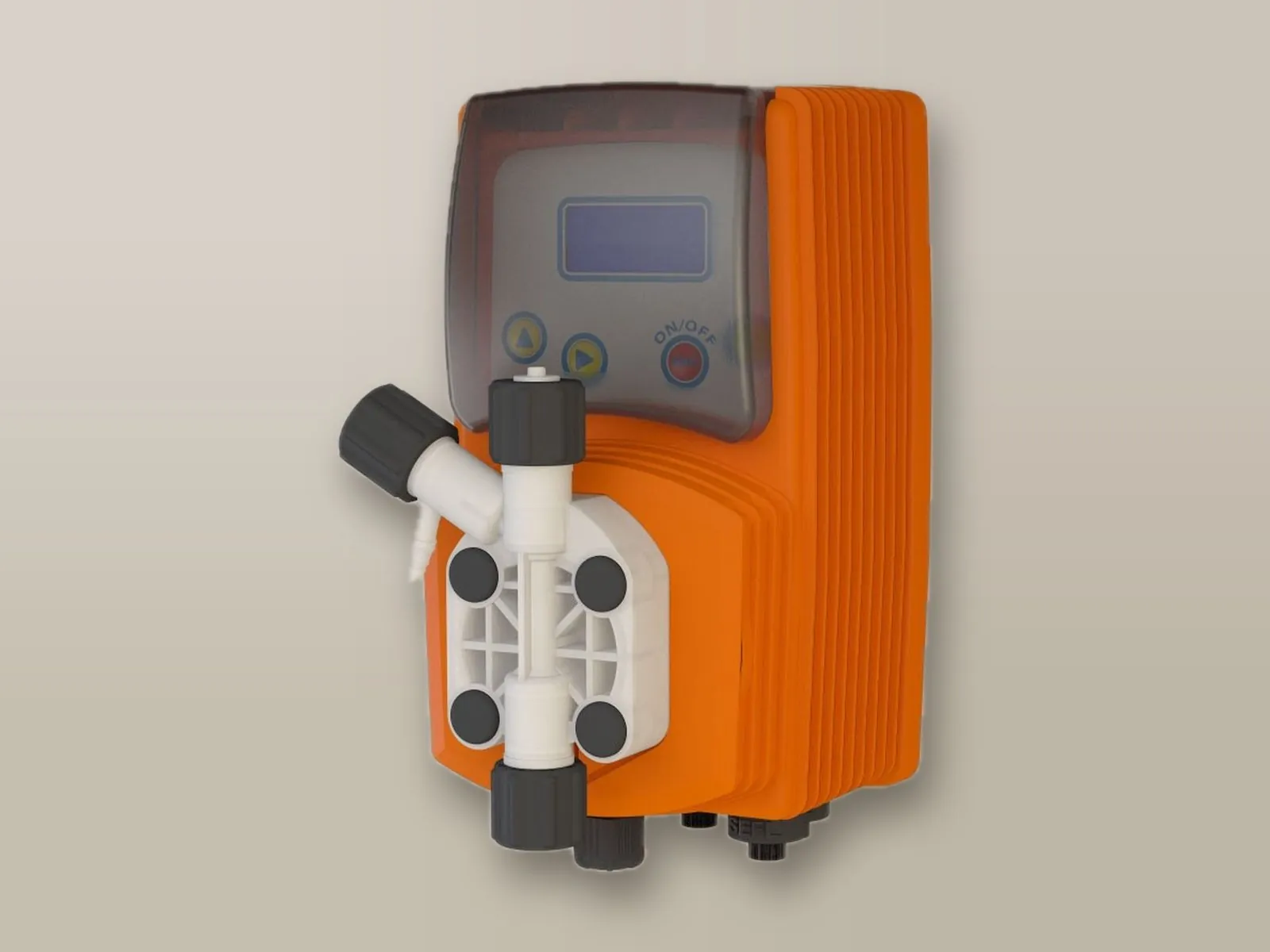
VMS PO
With integrated controller for automatic control of pH or Redox (ORP).
- Proportional to pH
- Proportional to Redox
- Automatic pH dosing
- Automatic Redox dosing
Diaphragm dosing pump with an integrated controller for measuring and automatically regulating pH (0 – 14 pH) or Redox (0 – 1,000 mV), to be combined with the electrode for the chosen parameter. Display, level control and stand-by input are standard.
With integrated controller for automatic control of pH or Redox (ORP).
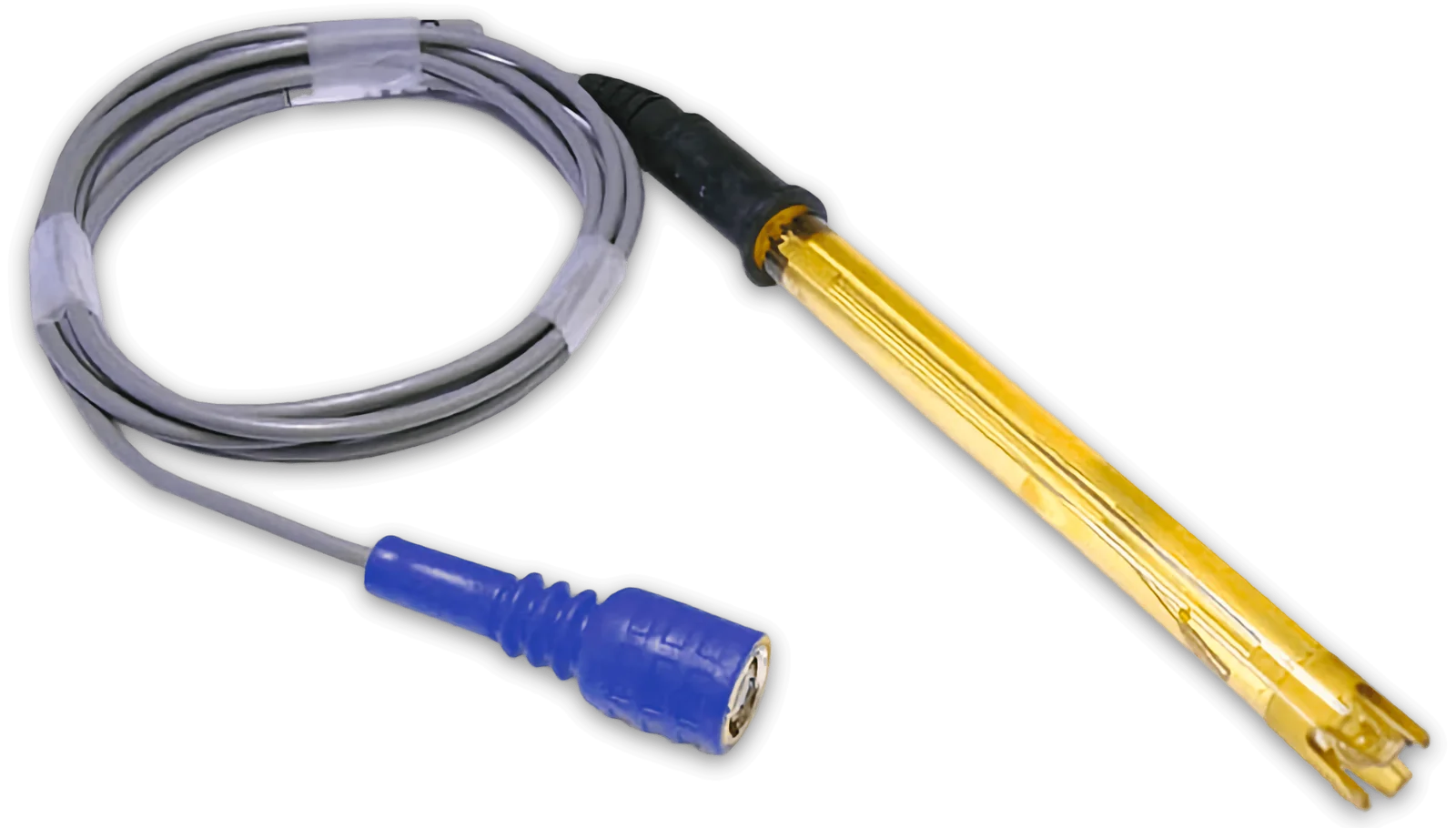 EpHSpH electrode
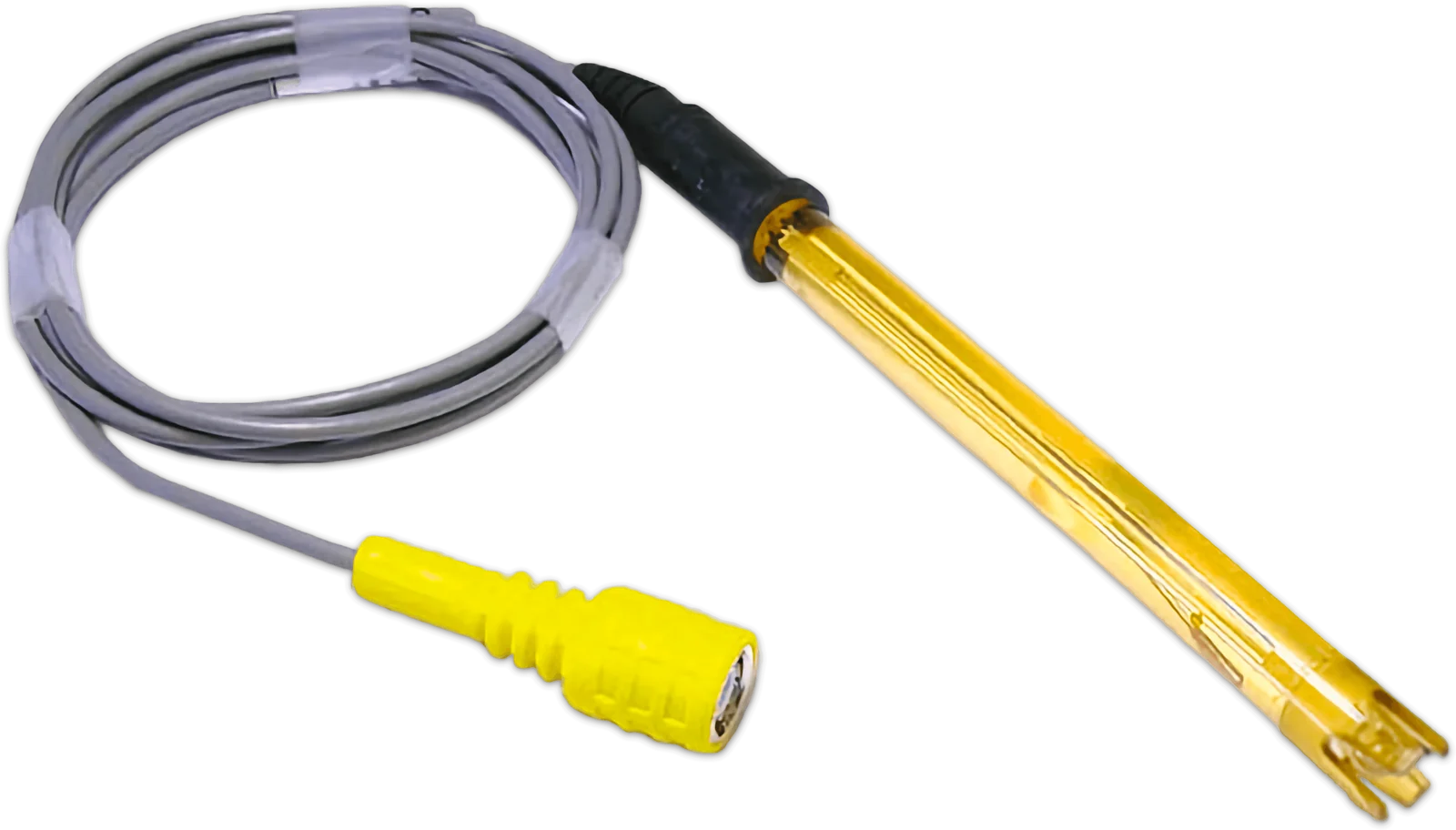 ERhSRedox (ORP) electrode
Pump head: PVDF or PP
The required pH value (SET POINT) is set: the pump measures the pH by means of a pH electrode and progressively reduces the injection frequency as the measured value approaches the set point, stopping when the SET POINT is reached.
The required Redox potential (ORP) (SET POINT) is set: the pump measures it by means of a Redox electrode and progressively reduces the injection frequency as the measured value approaches the set point, stopping when the SET POINT is reached.
Once the pool volume has been set, the pump automatically adjusts dosing according to the required pH (SET POINT), measured by means of a pH electrode: the injection frequency is progressively reduced as the measured value approaches the set point, until the pump stops when the SET POINT is reached.
Once the pool volume has been set, the pump automatically adjusts dosing according to the required Redox potential (ORP) (SET POINT), measured by means of a Redox electrode: the injection frequency is progressively reduced as the measured value approaches the set point, until the pump stops when the SET POINT is reached.
The pump code is made up of the model name and the performance: maximum pressure in bar as two digits followed by the flow rate in l/h (VMS PO 0215 = 2 bar, 15 l/h). It is followed by the pump head code and the power supply code, listed in the tables at the end of this section. Performance varies with the working back pressure and with the characteristics of the chemical.
Suitable for most chemicals: the standard configuration for the most common applications.
| Code | Max pressure (bar) | Max flow rate (l/h) | Tubing (mm) | cc per stroke | Power draw at 230 VAC (W) |
|---|---|---|---|---|---|
| VMS PO 2001 | 20 | 1 | 4 x 8 | 0.09 | 16 |
| VMS PO 1802 | 18 | 2 | 4 x 8 | 0.19 | 16 |
| VMS PO 1804 | 18 | 4 | 4 x 8 | 0.37 | 22 |
| VMS PO 1502 | 15 | 2 | 4 x 6 | 0.19 | 16 |
| VMS PO 1504 | 15 | 4 | 4 x 6 | 0.37 | 16 |
| VMS PO 1505 | 15 | 5 | 4 x 6 | 0.46 | 22 |
| VMS PO 1004 | 10 | 4 | 4 x 6 | 0.37 | 16 |
| VMS PO 1005 | 10 | 5 | 4 x 6 | 0.46 | 16 |
| VMS PO 1010 | 10 | 10 | 4 x 6 | 0.93 | 22 |
| VMS PO 0706 | 7 | 6 | 4 x 6 | 0.56 | 16 |
| VMS PO 0501 | 5 | 1 | 4 x 6 | 0.09 | 16 |
| VMS PO 0510 | 5 | 10 | 4 x 6 | 0.93 | 16 |
| VMS PO 0512 | 5 | 12 | 4 x 6 | 1.11 | 22 |
| VMS PO 0408 | 4 | 8 | 4 x 6 | 0.74 | 16 |
| VMS PO 0310 | 3 | 10 | 4 x 6 | 0.93 | 16 |
| VMS PO 0215 | 2 | 15 | 6 x 8 | 1.39 | 22 |
| VMS PO 0116 | 1 | 16 | 6 x 8 | 1.48 | 16 |
Required with chemicals that release gas (e.g. peroxides), to prevent the pump from becoming air-locked.
| Code | Max pressure (bar) | Max flow rate (l/h) | Tubing (mm) |
|---|---|---|---|
| VMSA PO 1802 | 18 | 2 | 4 x 8 |
| VMSA PO 1501 | 15 | 1 | 4 x 6 |
| VMSA PO 1503 | 15 | 3 | 4 x 6 |
| VMSA PO 100.5 | 10 | 0.5 | 4 x 6 |
| VMSA PO 103.4 | 10 | 3.4 | 4 x 6 |
| VMSA PO 0704 | 7 | 4 | 4 x 6 |
| VMSA PO 057.5 | 5 | 7.5 | 4 x 6 |
| VMSA PO 0509 | 5 | 9 | 4 x 6 |
| VMSA PO 045.5 | 4 | 5.5 | 4 x 6 |
| VMSA PO 0307 | 3 | 7 | 4 x 6 |
| VMSA PO 0212 | 2 | 12 | 6 x 8 |
| VMSA PO 0113 | 1 | 13 | 6 x 8 |
| Specification | Value |
|---|---|
| Strokes per minute | Up to 180 |
| Maximum chemical viscosity | 100 cP |
| Ambient temperature | 10 – 45 °C |
| Chemical temperature | 0 – 50 °C |
| Transport and storage temperature | −10 – 50 °C |
| Protection rating | IP65 |
| Noise level | 70.4 dB(A) |
| Weight | 2.2 kg |
| Housing | PPO |
| Mounting | Vertical, wall or floor |
| Code | Pump head | Seals | Use |
|---|---|---|---|
| 1 | PVDF | FKM B | All flow rates |
| 3 | PVDF | EPDM | All flow rates |
| 4 | PVDF | FKM B | Flow rates up to 1 l/h |
| 5 | PVDF | EPDM | Flow rates up to 1 l/h |
| V | PP | FKM B | All flow rates |
| D | PP | EPDM | All flow rates |
In all versions: PVDF valves with ceramic balls, PTFE diaphragm, PE delivery tube and PVC suction tube.
| Code | Power supply |
|---|---|
| 00 | 230 VAC, Schuko plug |
| 0S | 230 VAC, Australian plug |
| 01 | 230 VAC, no plug |
| 03 | 115 VAC, US plug |
| 04 | 24 VAC, no plug |
| 05 | 12 VDC (some models only) |
| 07 | 24 VDC |
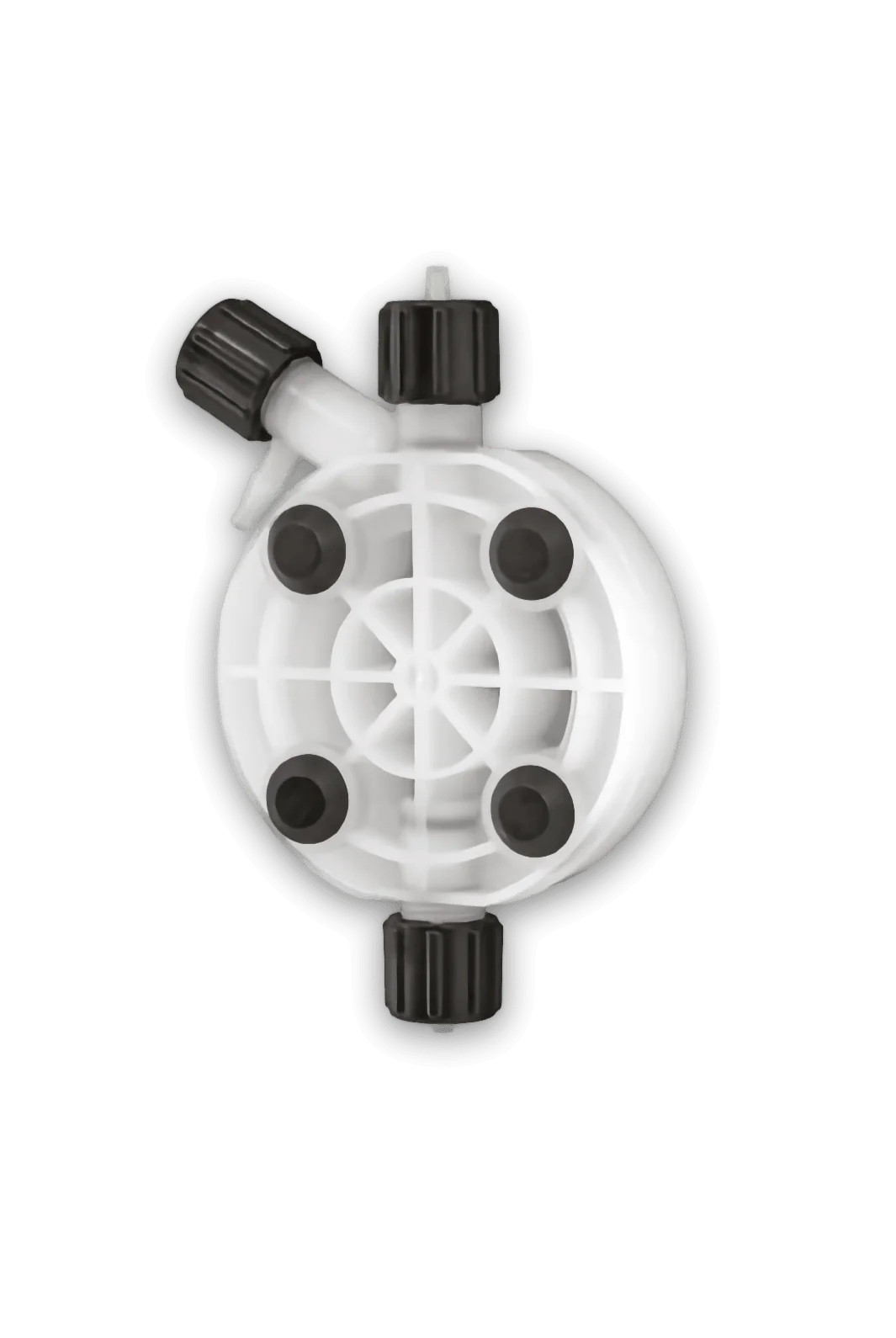
Suitable for most acids, for peroxides and for sodium hypochlorite (chlorine).
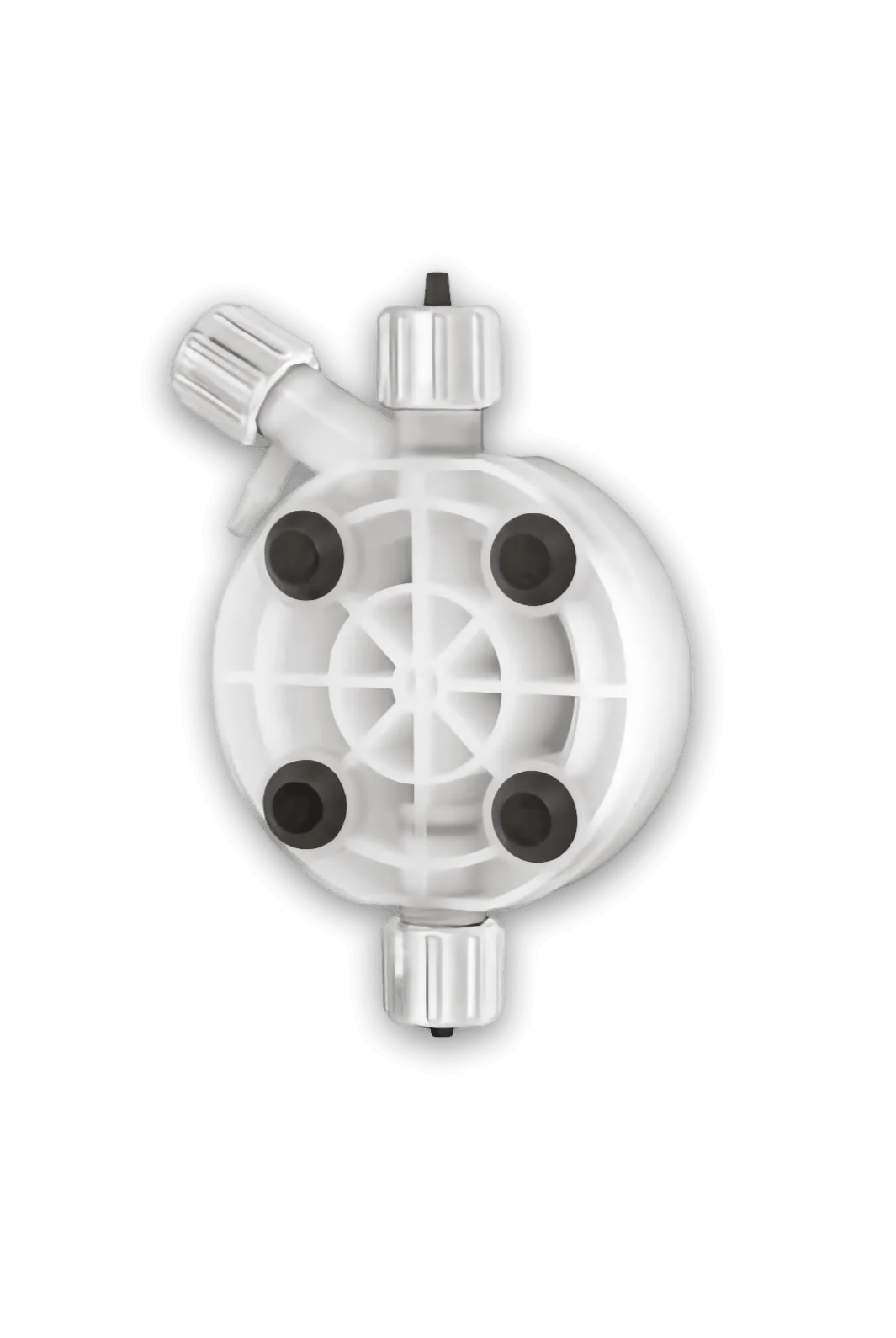
Suitable for sodium hydroxide (caustic soda).
In addition to the standard configuration, versions dedicated to particular applications are available; the performance of each is given in the technical data. The pages by application compare the suitable pumps of all the series.
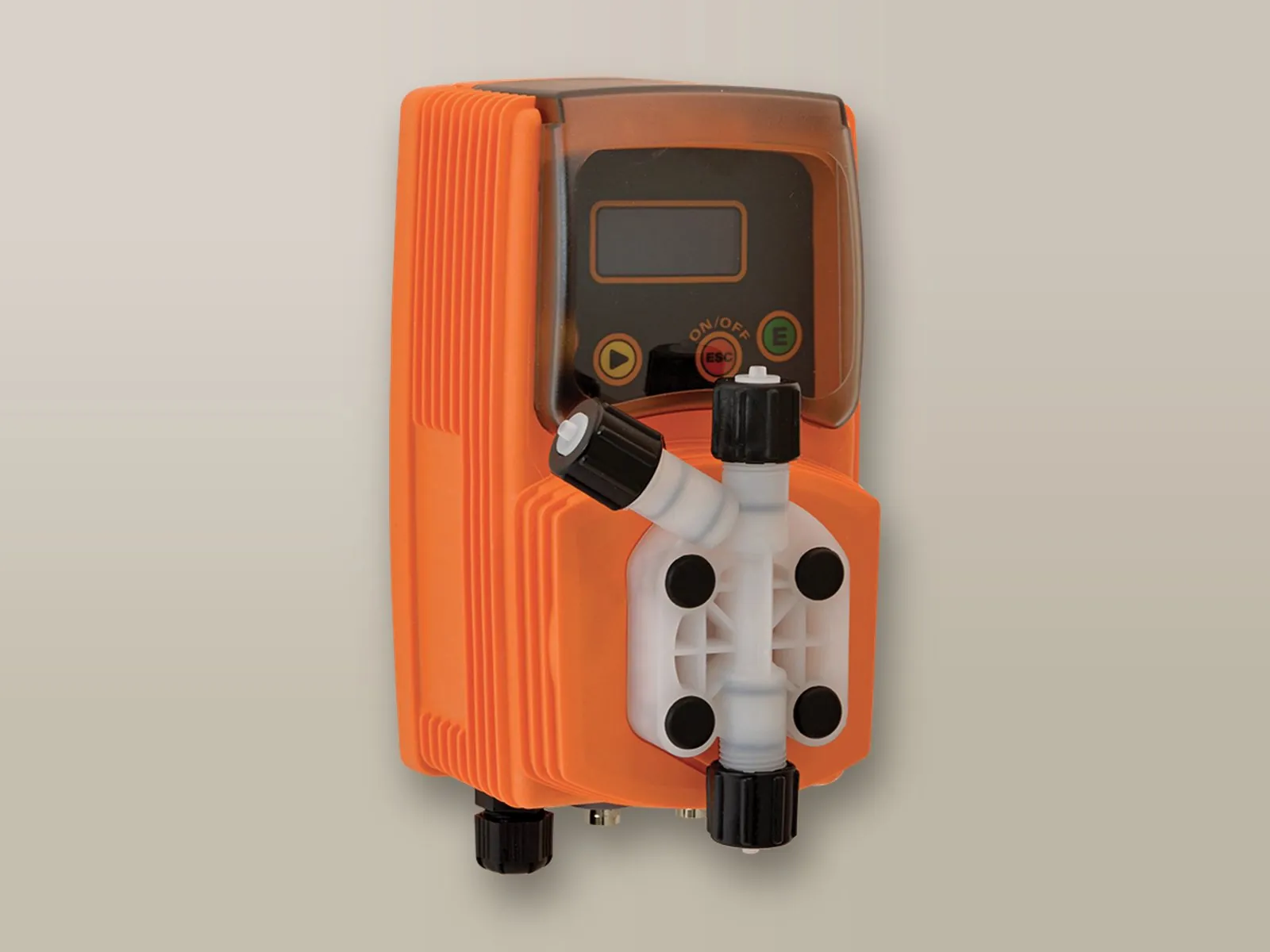
Self-venting pump head, required with chemicals that release gas (e.g. sodium hypochlorite and peroxides): it vents the gas and prevents the pump from locking.
The most frequent causes of malfunction and the corrective actions to check before contacting technical support.
Learn more: the pump does not prime and does not dose →Adjustment is linear between 30 and 100%: below 30% the actual flow rate may differ from the expected one and must therefore be checked.
Connect all the tubing, open the bleed valve and set the adjustment to 100%; start the pump and close the bleed valve as soon as the chemical comes out. With viscous liquids the operation can be assisted with a 20 cc syringe applied to the bleed port.
If the problem persists, contact us. Before sending the pump for servicing, empty the pump head of chemical and dry it.
According to the operating mode and the set parameters, the pump automatically adapts the injection frequency to ensure the required dosing.
The integrated LCD display allows the pump to be programmed and its operating status to be monitored at all times.
The pump is supplied with a low-level probe for the tank: when the chemical runs out, it shows the alarm on the display and activates the corresponding output.
Pump start and stop can be controlled remotely by means of a run/stop contact from a PLC or another source.
On request, in the event of a fault a volt-free contact is activated, configurable as normally open (N.O.) or normally closed (N.C.), to drive a visual or audible signalling device, send an SMS or report the event to a PLC.
A dedicated button allows the lines to be filled with the chemical to be dosed.
Vertical installation, or horizontal installation by means of a dedicated bracket.
Tell us about your application: our technical staff will recommend the most suitable model, configuration and accessories.
Call or write to us: a technician will reply with a tailored proposal of controllers, pumps, probes and accessories.