Skip to content
Swimming pools · Regulations

Swimming pool water discharge

Two types of water leave swimming pools, both public and private: water from emptying and renewing the pool and water from filter backwashing. Before discharge they must comply with the limits of Italian Legislative Decree 152/2006 (D.Lgs. 152/2006): chlorine, kept at around 1.0 mg/l in the pool for disinfection, must be reduced to within 0.2 or 0.3 mg/l depending on the receiving body.

  • D.Lgs. 152/2006, Annex 5
  • DPR 227/2011
  • Emptying and backwashing
  • Dechlorination before discharge
Diagram of discharge dechlorination with water presence sensor
Discharge dechlorination
0.2mg/lFree active chlorine in surface water
0.3mg/lFree active chlorine in sewers
0.2mg/lActive chlorine on soil
1.0mg/lTypical free chlorine in the pool
The water

What water leaves a swimming pool

1

Emptying, renewal and topping up

Water from emptying the pool and from periodic renewal may be treated as domestic wastewater: for small and medium-sized enterprises this is provided for by Italian Presidential Decree 227/2011 (DPR 227/2011, table 2, point 19), in the absence of regional regulations. After dechlorination, it is discharged in accordance with the regulations in force.

2

Filter backwash

Backwash water is excluded from this treatment if it has not been treated beforehand. The Italian Court of Cassation (judgment no. 10373/2020) classified it as industrial wastewater: without treatment, its discharge requires authorisation and must comply with the limits of Table 3.

Limits

Chlorine limits at discharge

The emission limit values are those of Annex 5 to Part Three of Italian Legislative Decree 152/2006 (D.Lgs. 152/2006), unless more restrictive limits are set by the Regions, the competent authorities or the sewer network operators.

Surface water

Table 3: free active chlorine not exceeding 0.2 mg/l.

Sewer

Table 3: free active chlorine not exceeding 0.3 mg/l, in the absence of different limits set by the competent authority or by the operator of the final treatment plant.

Soil

Table 4: active chlorine not exceeding 0.2 mg/l, in addition to the other parameters specified for discharge on soil.

With free chlorine in the pool at 1.0 mg/l, it must therefore be reduced to 0.2 – 0.3 mg/l before discharge. Backwash water also contains the solids retained by the filters and may exceed other parameters of the table, such as chlorides.

Treatments

How it is treated before discharge

Dechlorinating agent dosing pump
1

Dechlorination

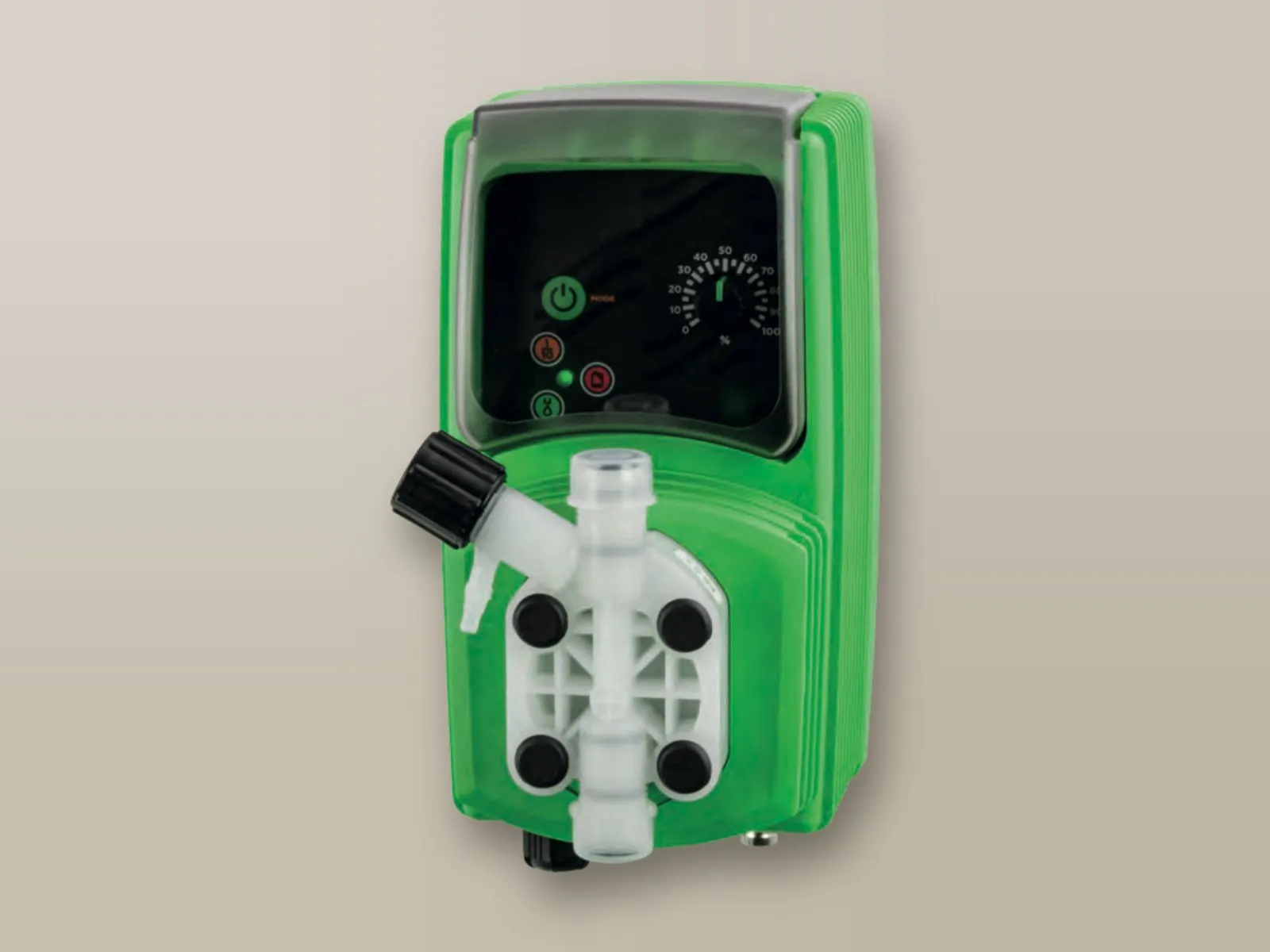
A dosing pump injects a dechlorinating agent, such as sodium metabisulphite or hydrogen peroxide, into the discharge pipe, with constant dosing activated by a water presence sensor or proportional to the volume measured by a water meter.

Dechlorination systems →
2

Waiting period

Some local regulations allow, as an alternative to dechlorination, emptying water to be discharged after a waiting period following the last chlorination (for example 15 days), during which the chlorine is depleted.

3

Settling chamber

For backwash water, a settling chamber is provided to retain the sludge and solids removed from the filters, followed by inspection chambers for checking the discharge.

4

Recovery

Where permitted, dechlorinated water can be collected in a storage tank and reused, for example for irrigation, avoiding waste of water.
Dosing

How the dechlorinating agent is dosed

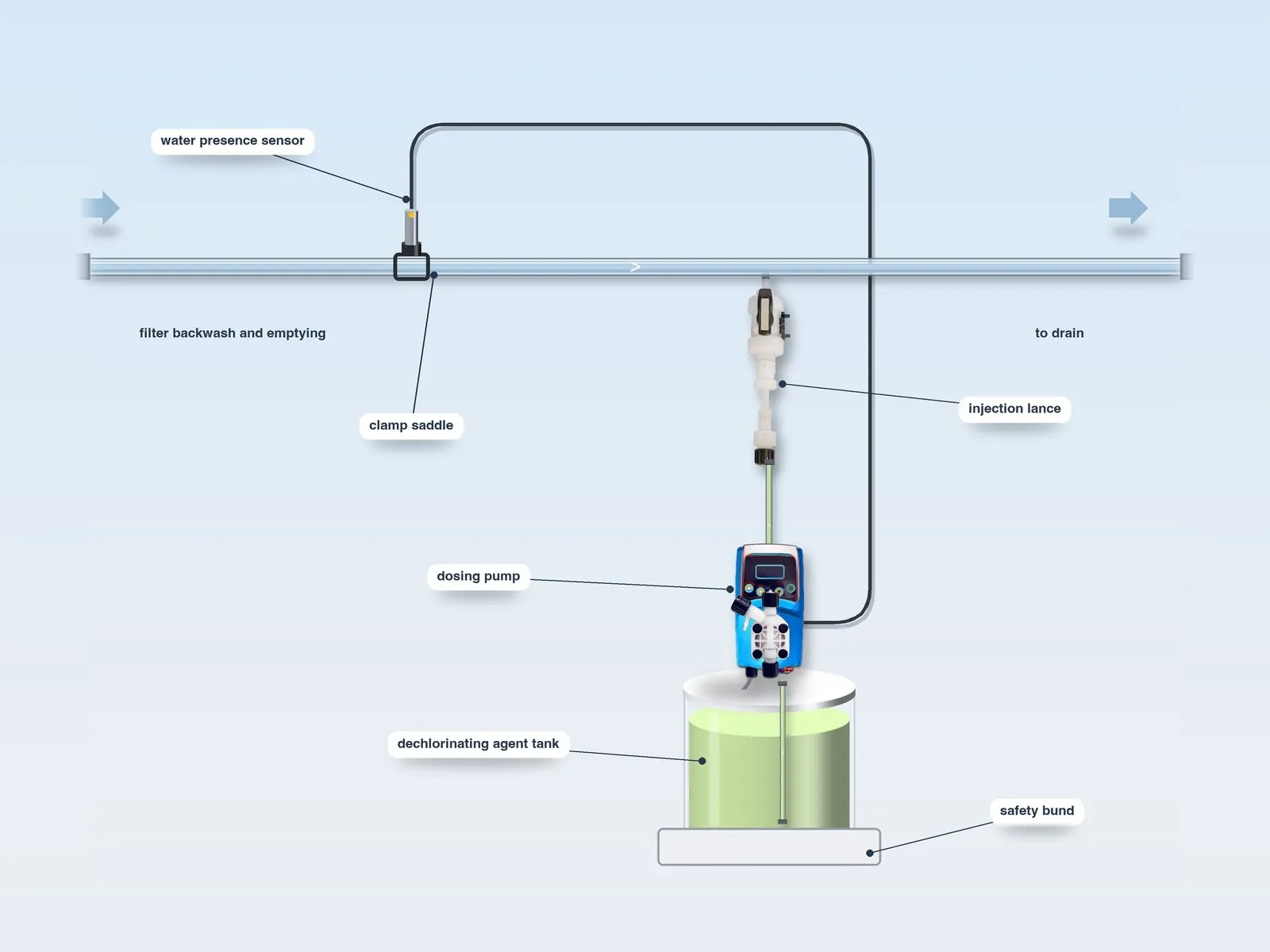
Diagram of discharge dechlorination with water presence sensor

With water presence sensor

A capacitive sensor, installed on the outside of the pipe without contact with the water, detects water during the discharge phases and activates the pump, which doses a constant quantity of dechlorinating agent (0 – 800 or 0 – 8,000 g/h). The quantity is determined on the basis of the total chlorine in the pool, the flow rate of the recirculation pump and the quantity of product required to reduce the chlorine by 1 mg/l, stated on the label.

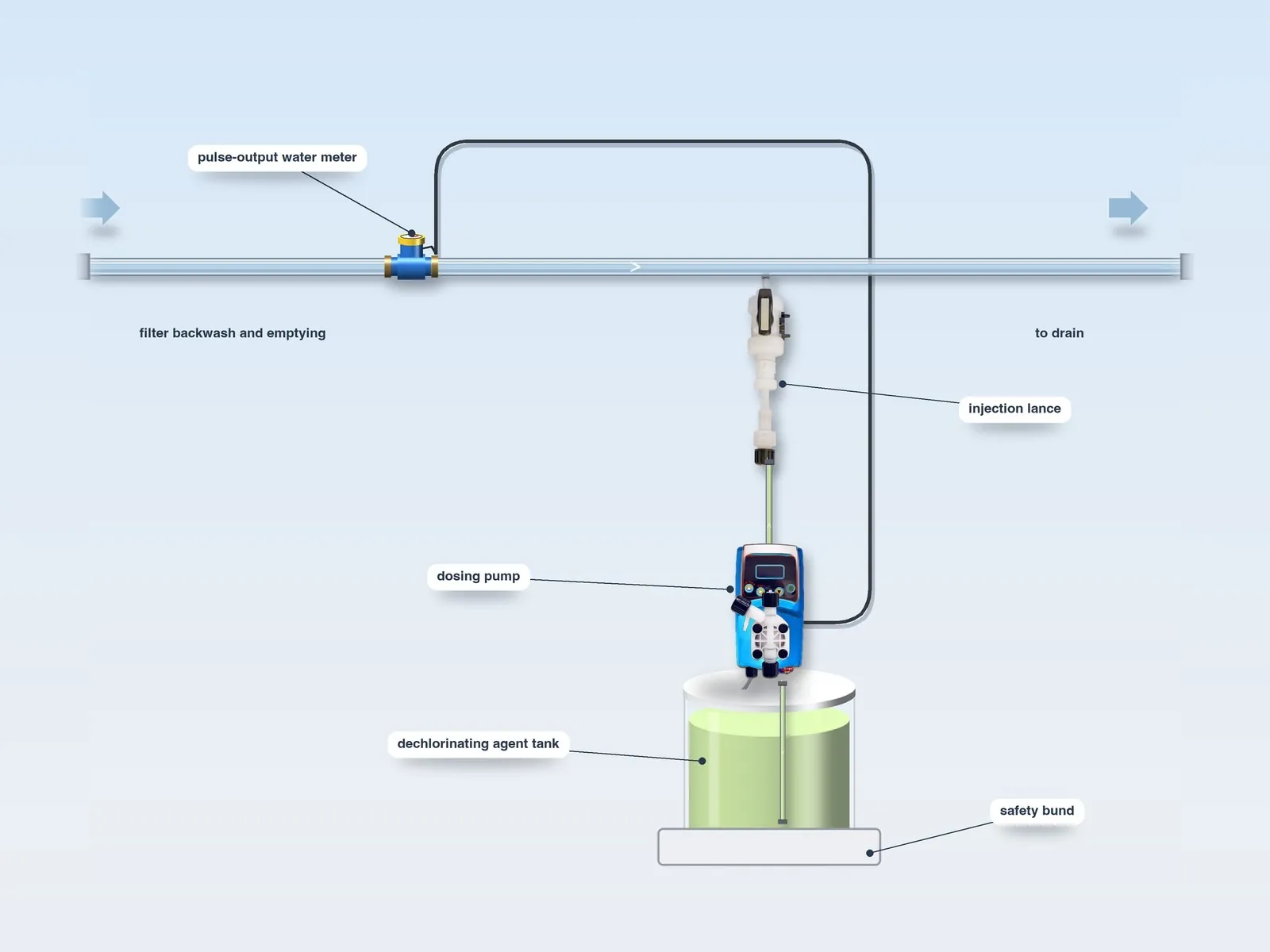
Diagram of discharge dechlorination with pulse-output water meter

With pulse-output water meter

A turbine or Woltmann water meter on the discharge pipe sends a pulse for each set volume of water and the pump doses the dechlorinating agent in proportion to the volume discharged. The settings are the pulses per litre (turbine meters) or the litres per pulse (Woltmann meters), the total chlorine, the concentration of product to be dosed and the strength of the product.

Private swimming pools

Private swimming pools too

Private swimming pool

The same chlorine rules

The discharge of water from a private swimming pool must comply with the same discharge limits: here too, the water must be dechlorinated before emptying and backwashing.

Systems for private swimming pools →

Regional and municipal regulations

Treatment as domestic wastewater and the discharge methods (sewer, soil, water body, recovery) are governed by Regions and Municipalities, which may also prohibit the discharge of emptying water into the wastewater network.

This page is an informative summary and does not replace legal texts and local regulations: before creating a discharge, always check the requirements of the competent authority.

Technical advice

Tell us the volume of the pool, the flow rate of the recirculation pump and the receiving body of the discharge: we will propose the most suitable dechlorination system.

Contact

Tell us about your plant

Call or write to us: a technician will reply with a tailored proposal of controllers, pumps, probes and accessories.

What do you need?
Please enter your name.
Please enter a valid email address.
Please enter your message.

Describe your plant: type, water volume or flow rate, parameters to be controlled.

You must accept the privacy notice to continue.