RACV
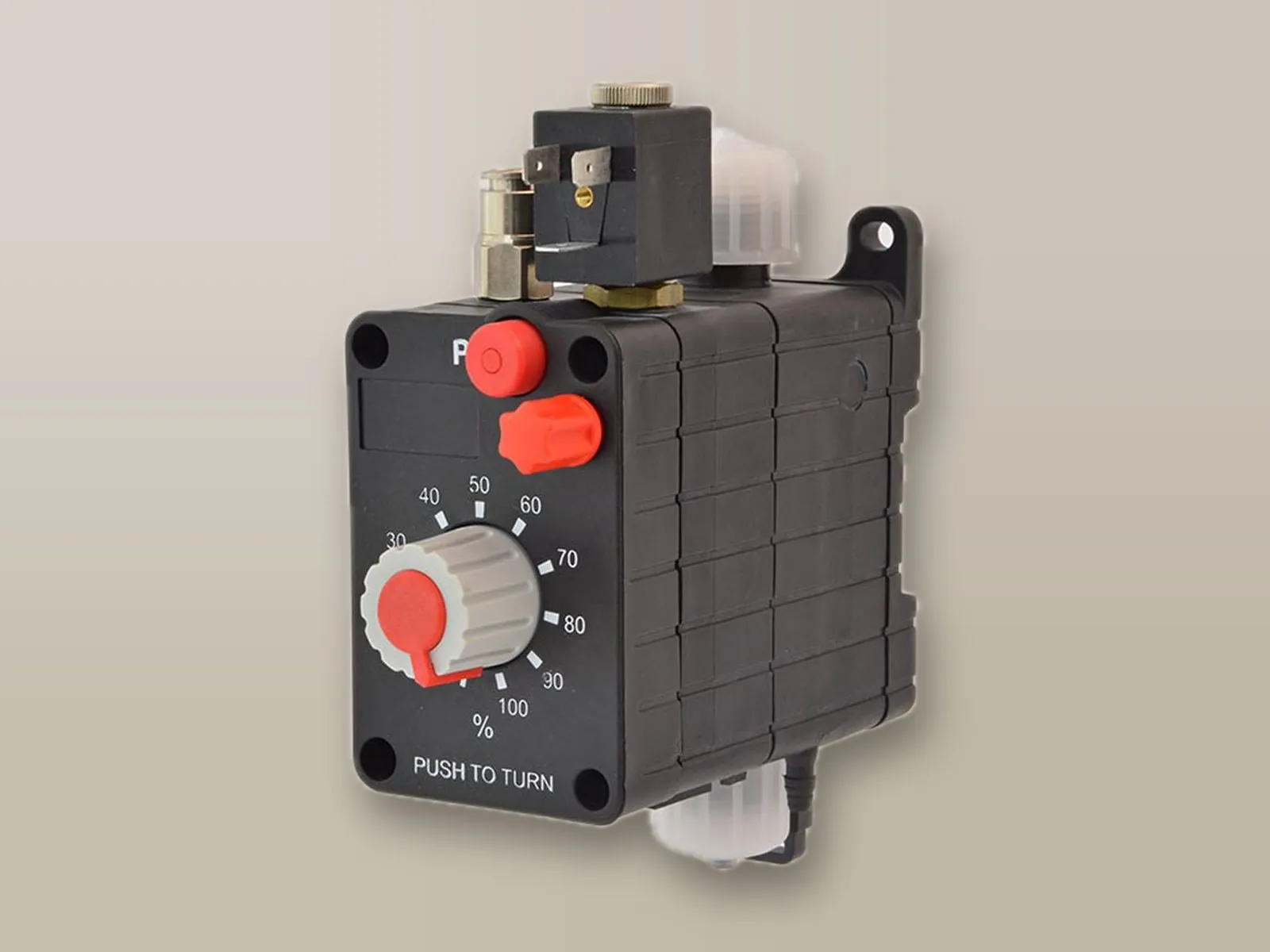
Compressed air dosing pump with control solenoid valve.
- Constant
- Pneumatic adjustment
- Pulses
Compressed-air operated diaphragm dosing pump with a control solenoid valve, suitable for car wash installations: the solenoid valve opens and closes the air that drives the pump and receives voltage pulses from a PLC or another control system. The flow rate is adjusted with the piston stroke knob.
Compressed air dosing pump with control solenoid valve.
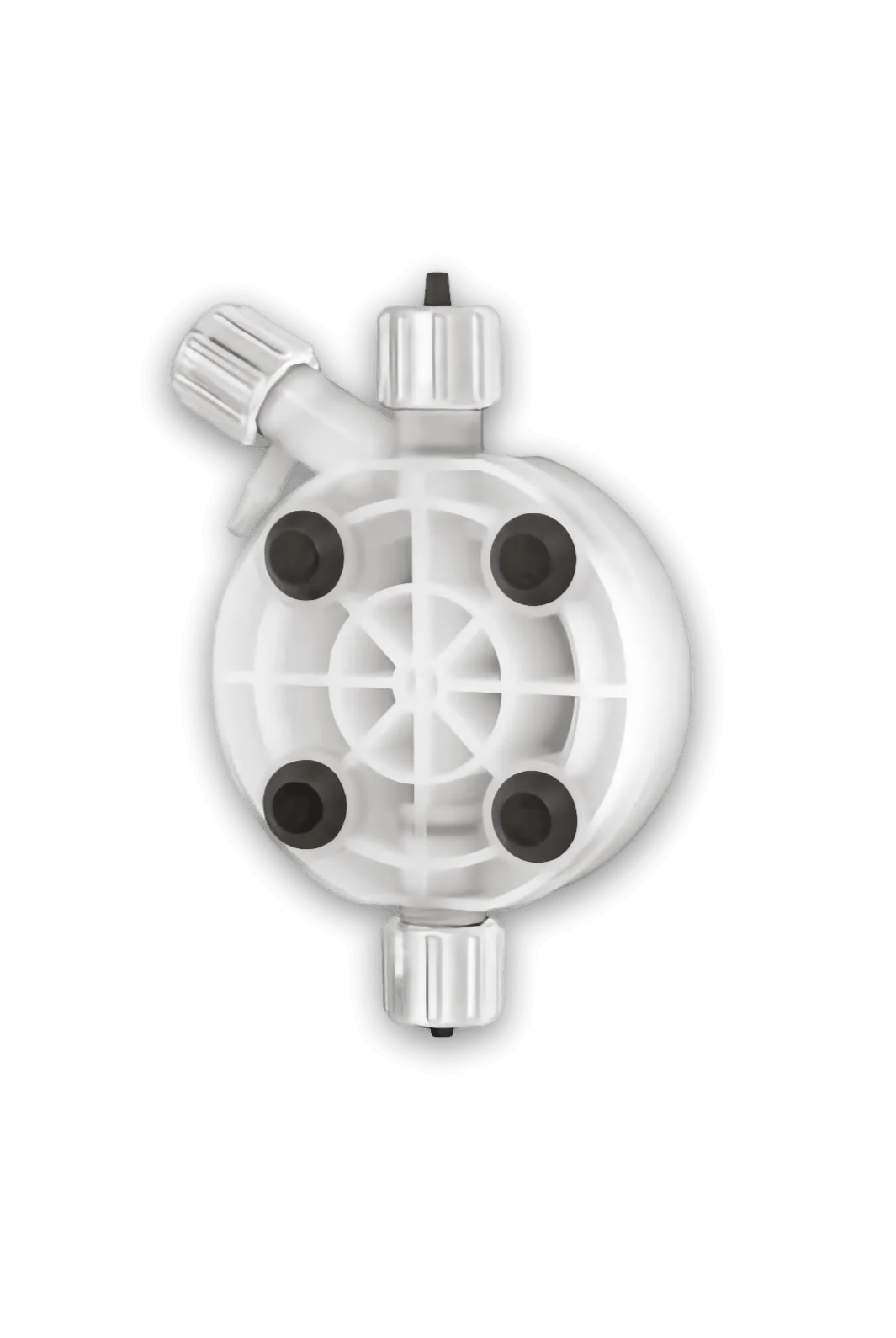
Pump head: PP
Power supply: compressed air from 6 to 8 bar; solenoid valve 230 VAC, 115 VAC, 48 VAC, 24 VAC or 24 VDC
The pump doses at a constant injection frequency, proportional to the flow rate percentage set with the analogue selector (0 – 100%).
The pump doses in proportion to the pulses received from an external controller.
The front knob adjusts the piston stroke, that is the volume of each injection; the frequency, up to 120 injections per minute, is given by the compressed air pulsed by the solenoid valve: each cycle lasts approximately 0.5 seconds, half with the pump supplied with air and half without supply.
The pump code is made up of the model name and the performance: maximum pressure in bar as two digits followed by the flow rate in l/h (RACV 0606 = 6 bar, 6 l/h). It is followed by the pump head code and the solenoid valve code, listed in the tables at the end of this section. Performance varies with the working back pressure and with the characteristics of the chemical.
Suitable for most chemicals: the standard configuration for the most common applications.
| Code | Max pressure (bar) | Max flow rate (l/h) | Tubing (mm) |
|---|---|---|---|
| RACV 0612 | 6 | 12 | 4 x 6 or 6 x 8 |
| RACV 0606 | 6 | 6 | 4 x 6 or 6 x 8 |
| RACV 0603 | 6 | 3 | 4 x 6 or 6 x 8 |
| RACV 0601 | 6 | 1 | 4 x 6 or 6 x 8 |
1/2” valves in all configurations.
| Specification | Value |
|---|---|
| Strokes per minute | 12 – 120 |
| Compressed air supply | 6 – 8 bar, air free of lubricant and condensate |
| Air consumption | 2.4 l/min |
| Air per injection | 0.020 l |
| Air tube connection | 6 x 8 |
| Solenoid valve power draw | 8 W at 230 VAC |
| Maximum chemical viscosity | 100 cP |
| Ambient temperature | −10 – 50 °C |
| Flow rate adjustment | Piston stroke knob |
| Valves | Double ball, 6 mm ceramic or stainless steel balls |
| Diaphragm | PTFE |
| Housing | Glass-filled PP |
| Mounting | Horizontal on a bracket, wall or DIN rail, also side by side |
| Code | Pump head | Seals | Valves | Balls |
|---|---|---|---|---|
| V | PP | FKM | PP | Stainless steel |
| D | PP | EPDM | PP | Stainless steel |
| W | PP | NBR | PP | Stainless steel |
PTFE diaphragm, PE delivery tube and PVC suction tube.
| Code | Power supply |
|---|---|
| 11 | 230 VAC |
| 10 | 24 VAC |
| 18 | 24 VDC |
| 20 | 48 VAC |
The solenoid valve is also available at 115 VAC.
Suitable for sodium hydroxide (caustic soda).
The R Series pumps have no electronics: most faults can be traced back to the compressed air supply or to maintenance.
Learn more: the pump does not prime and does not dose →R pumps require a constant air supply, preferably at 6 bar (± 10%), free of oil and condensate. The maximum frequency is 120 injections per minute (approximately 0.25 s of work and 0.25 s of return): the solenoid valve or PLC must be set accordingly.
Connect discharge, suction and drain, open the drain valve, set the knob to 100% and supply air; close the drain as soon as the chemical comes out. On the RACP the operation can be assisted with the manual priming button; with viscous chemicals use a 20 cc syringe applied to the drain.
At least once a month check the electrical and hydraulic connections, the condition of the diaphragm, the absence of leaks from tubes and fittings and any corroded parts.
If the problem persists, contact us. Before sending the pump for servicing, empty the pump head of chemical and dry it.
The knob reduces the stroke length of the piston, i.e. the volume of each injection and, consequently, the maximum flow rate. This offers two advantages:
Linear dosing: a high number of small-volume injections promotes mixing of the chemical into the water flow and avoids concentration peaks.
Accuracy at low dosing rates: with a 10 l/h pump required to dose 1 l/h, reducing the stroke length to 50% brings the maximum flow rate down to 5 l/h and doubles the injection frequency. Particularly suitable in combination with the pulse-output water meter.
The pump is actuated by a PLC via a solenoid valve.
Horizontal installation, on a DIN rail, or vertical installation by means of a dedicated bracket.
Tell us about your application: our technical staff will recommend the most suitable model, configuration and accessories.
Call or write to us: a technician will reply with a tailored proposal of controllers, pumps, probes and accessories.