Continuous measurement
The probe continuously detects the dissolved oxygen in the tank or in the pipe.
In wastewater tanks the system continuously measures the dissolved oxygen in mg/l and, when it falls below the set value, activates the blowers that introduce air into the tank through the diffusers, until the set point is reached again.
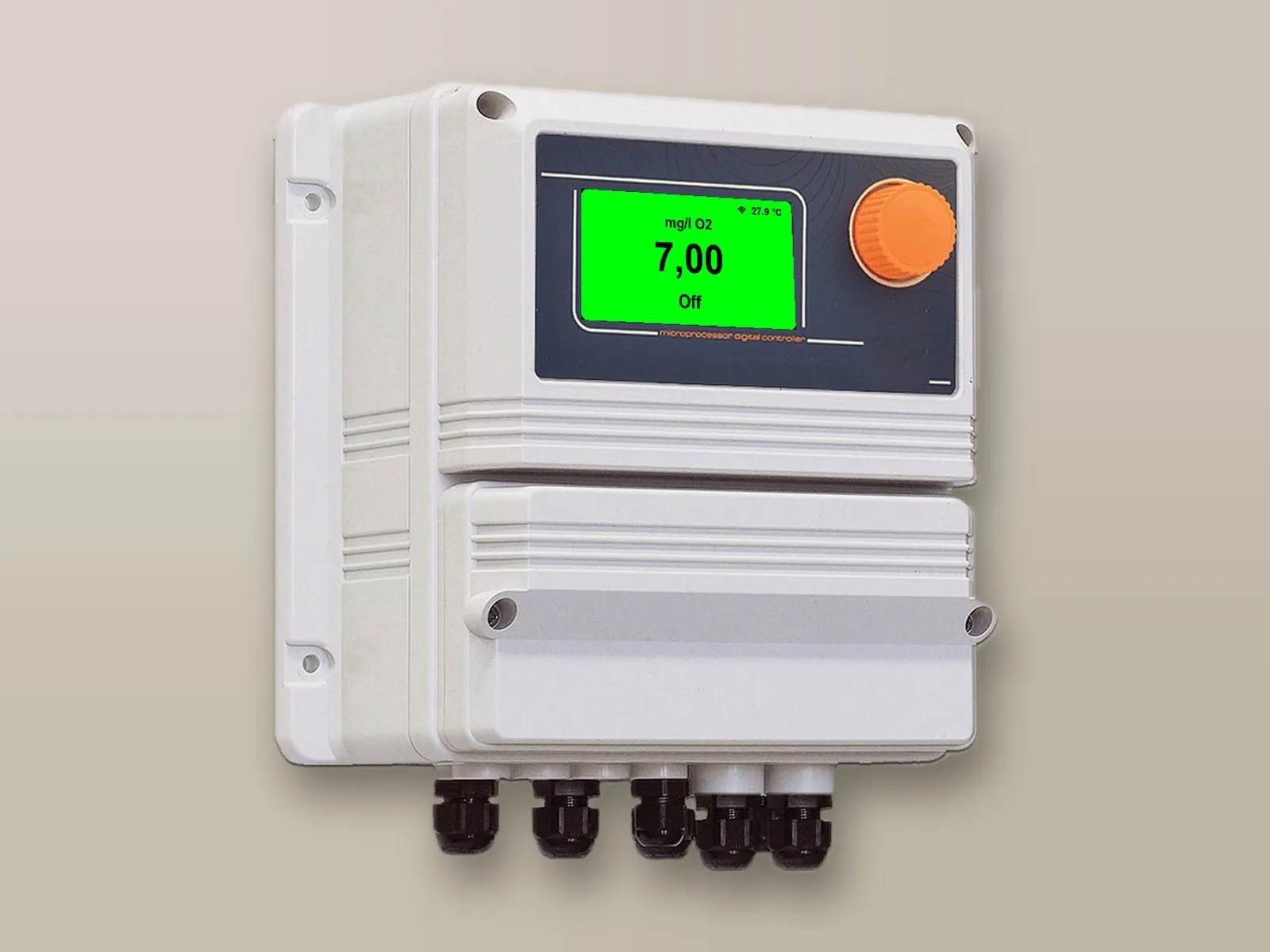
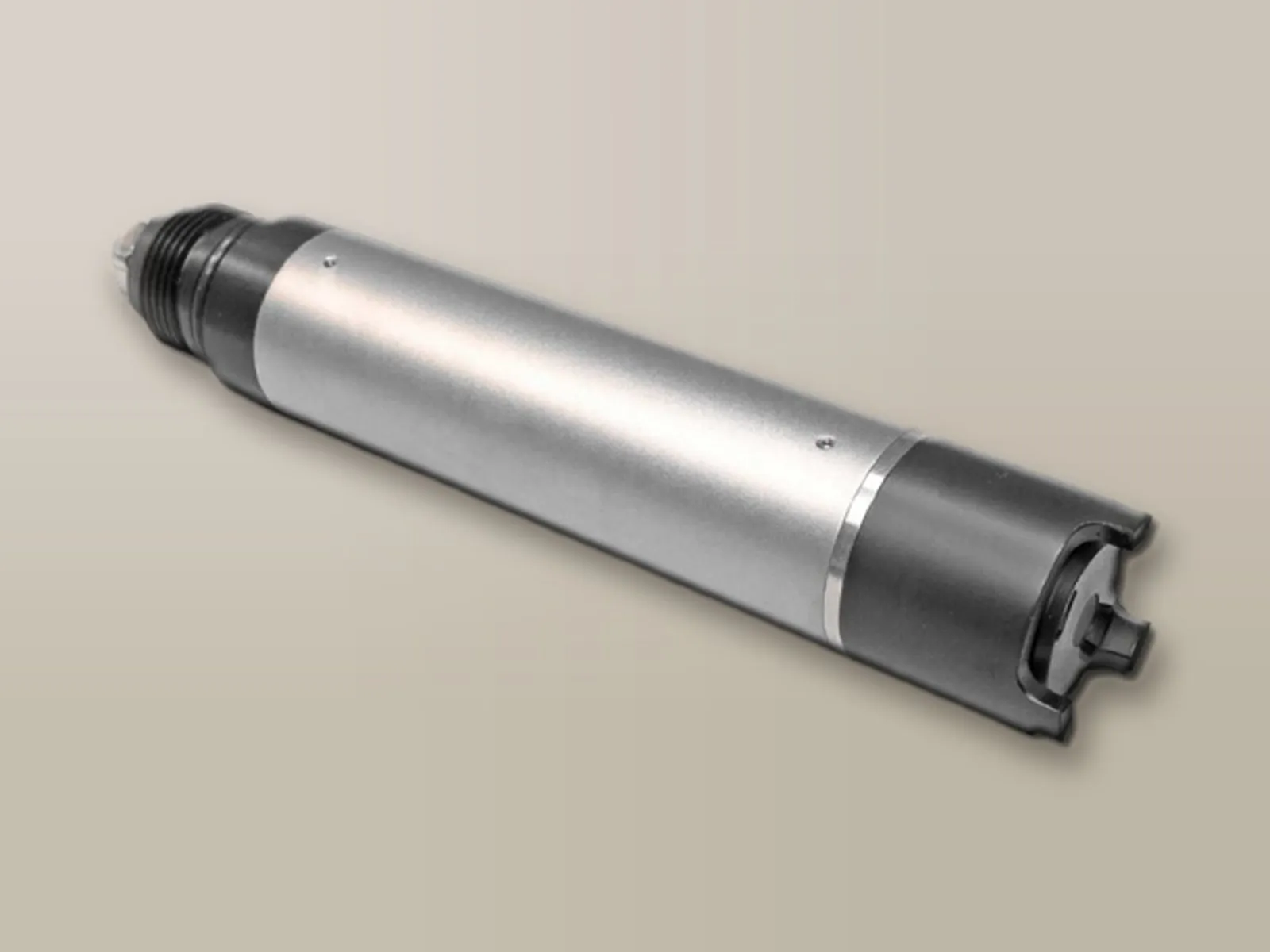
The water from the tank flows through the probe holder in a bypass line, where the probe measures the dissolved oxygen, and returns to the tank; the controller drives the blower, which introduces air into the tank through the diffuser.
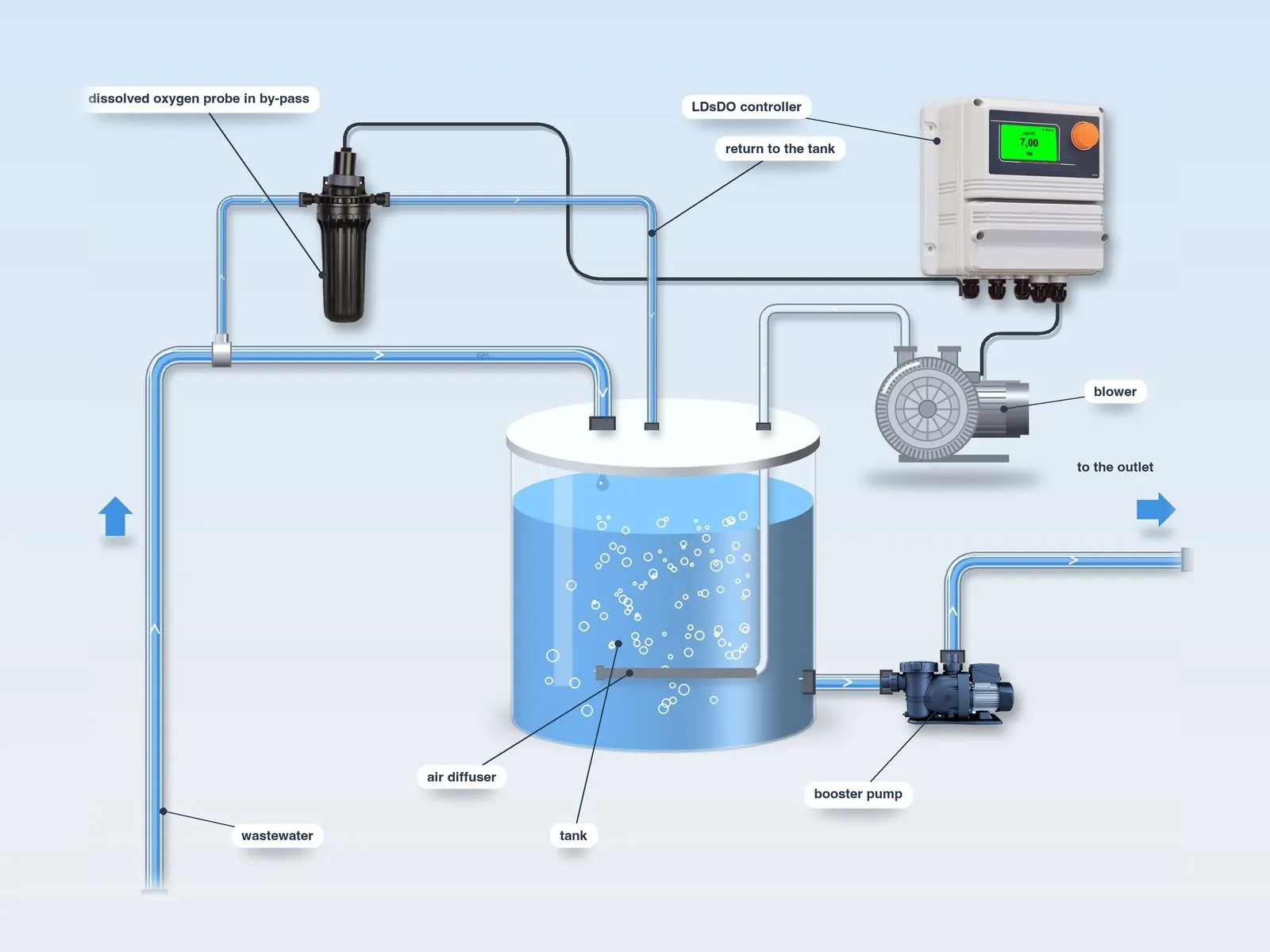
The probe continuously detects the dissolved oxygen in the tank or in the pipe.
When dissolved oxygen falls below the set point, the controller activates the blowers, which introduce air into the tank through the diffusers and increase the oxygen concentration in the water.
Once the set value is reached, the controller stops the blowers; the probe continues to analyse the water and reactivates them when the oxygen falls below the set point again.
The controller and the probe are completed by the blowers and air diffusers of the plant, driven by the outputs of the controller.
It acquires the measurement from the probe and, through its outputs, starts and stops the blowers according to the set point.
LDsDO → The optical measurement does not consume oxygen and is therefore possible even in still water, with automatic temperature compensation.
The probe →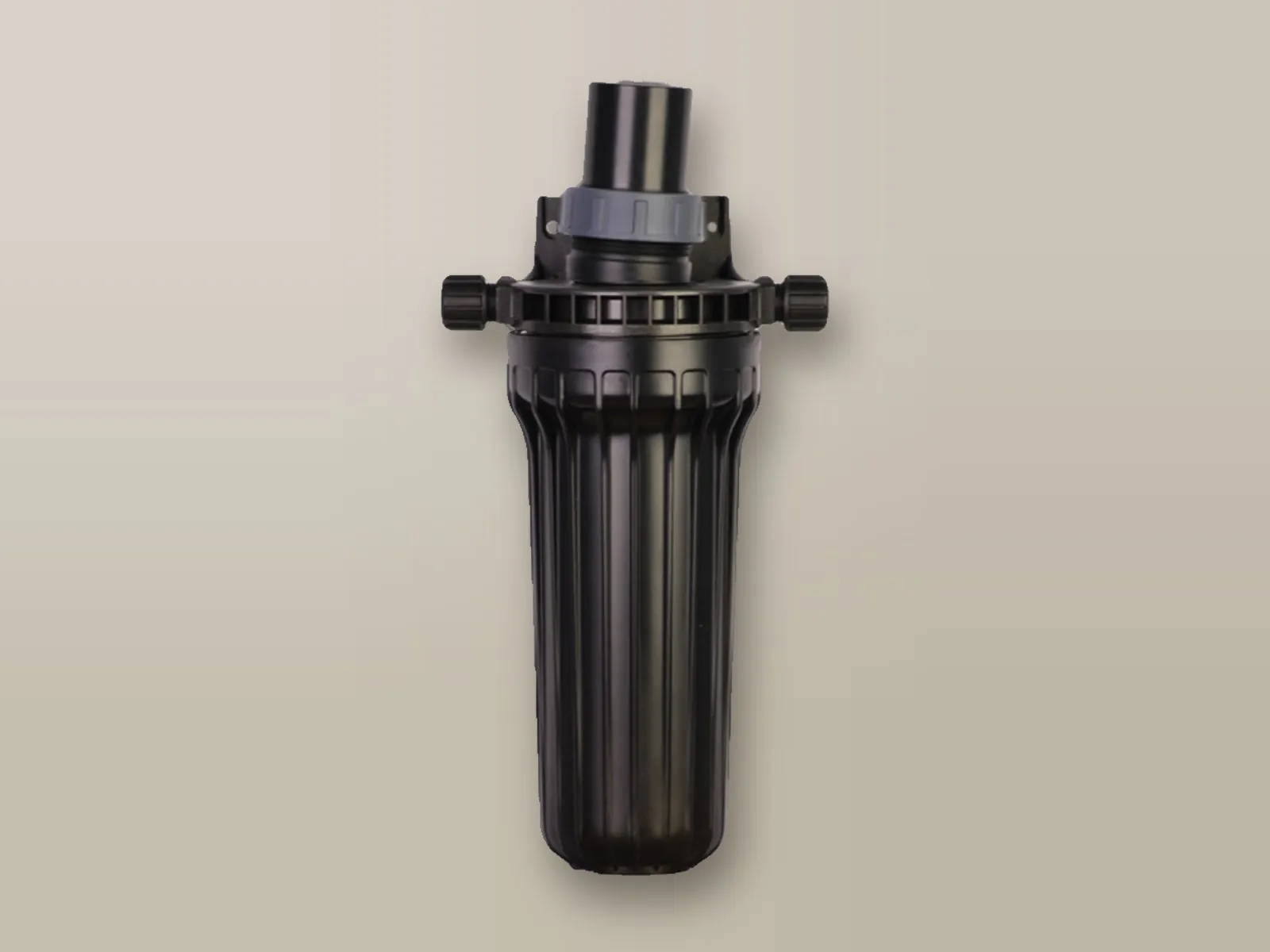
In the bypass installation it holds the probe in the flow of sample water, which then returns to the tank.
Probe holders →The position of the probe is defined according to the characteristics of the plant and of the water to be analysed.
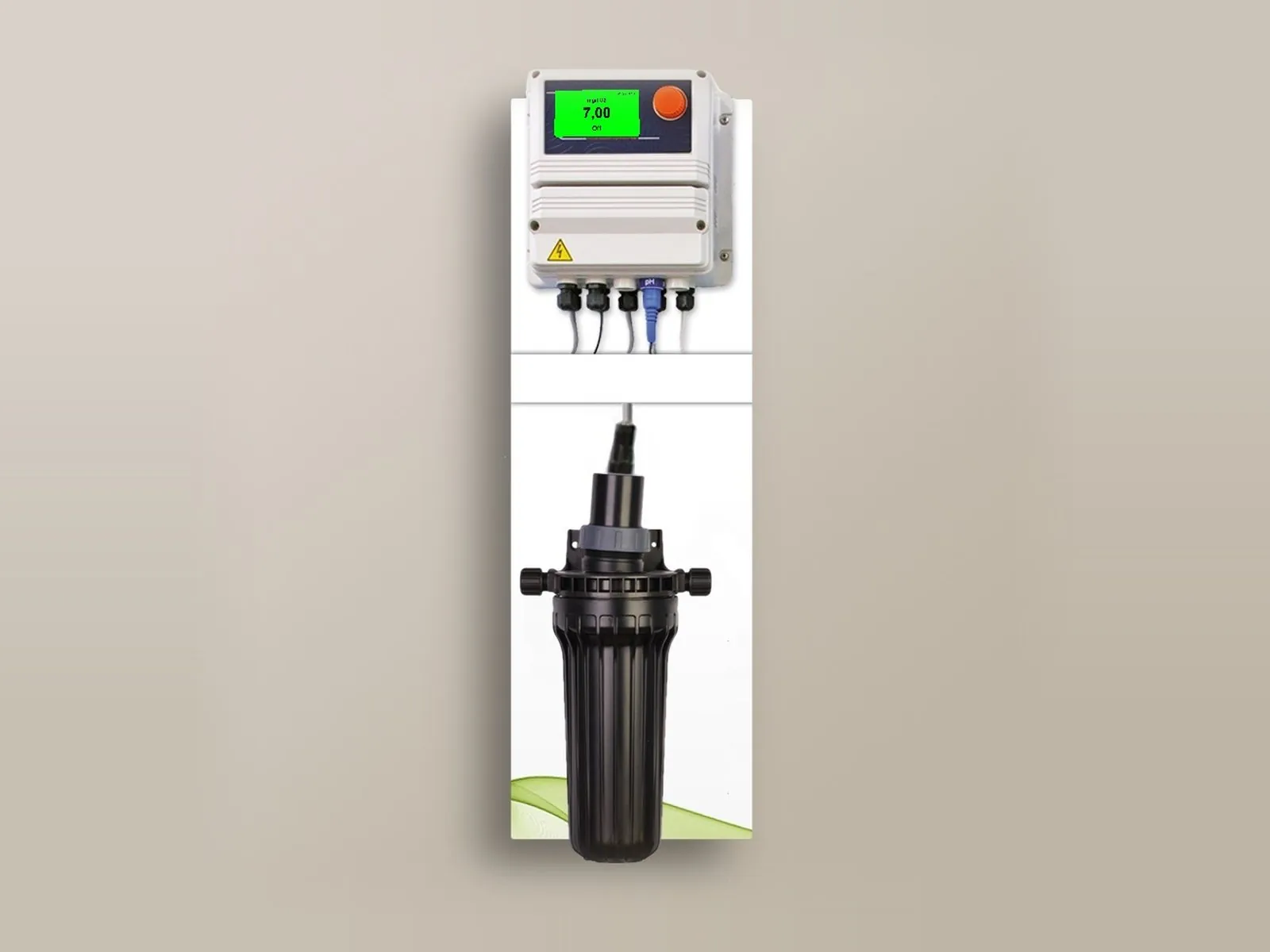
The probe is housed in an NPED probe holder, connected to a sampling point at the tank outlet and fed with about 30 l/h of sample water. A flow sensor can be added, which suspends regulation when there is no flow.
Probe holders →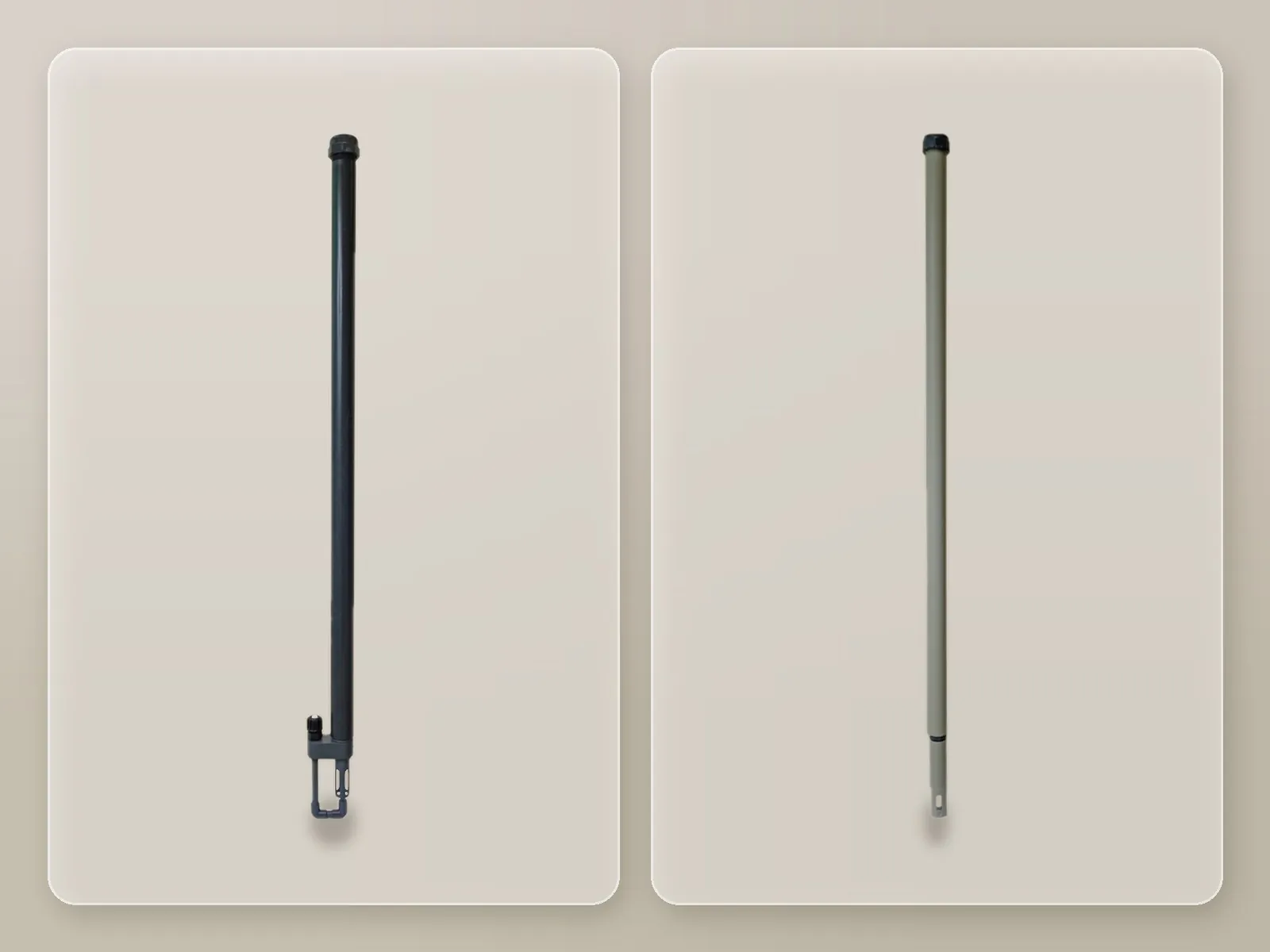
The probe is immersed directly in the tank of the water to be treated, by means of an immersion probe holder.
Probe holders →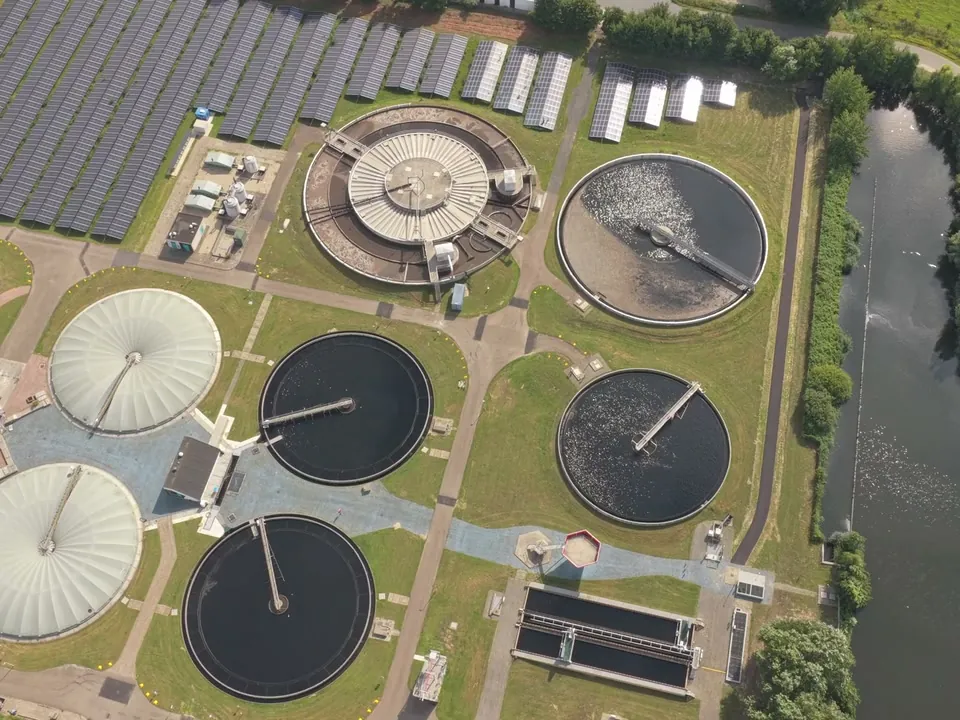
Oxidation tanks for municipal and industrial wastewater, in which dissolved oxygen must be kept at the value required by the treatment process.
Learn more: wastewater →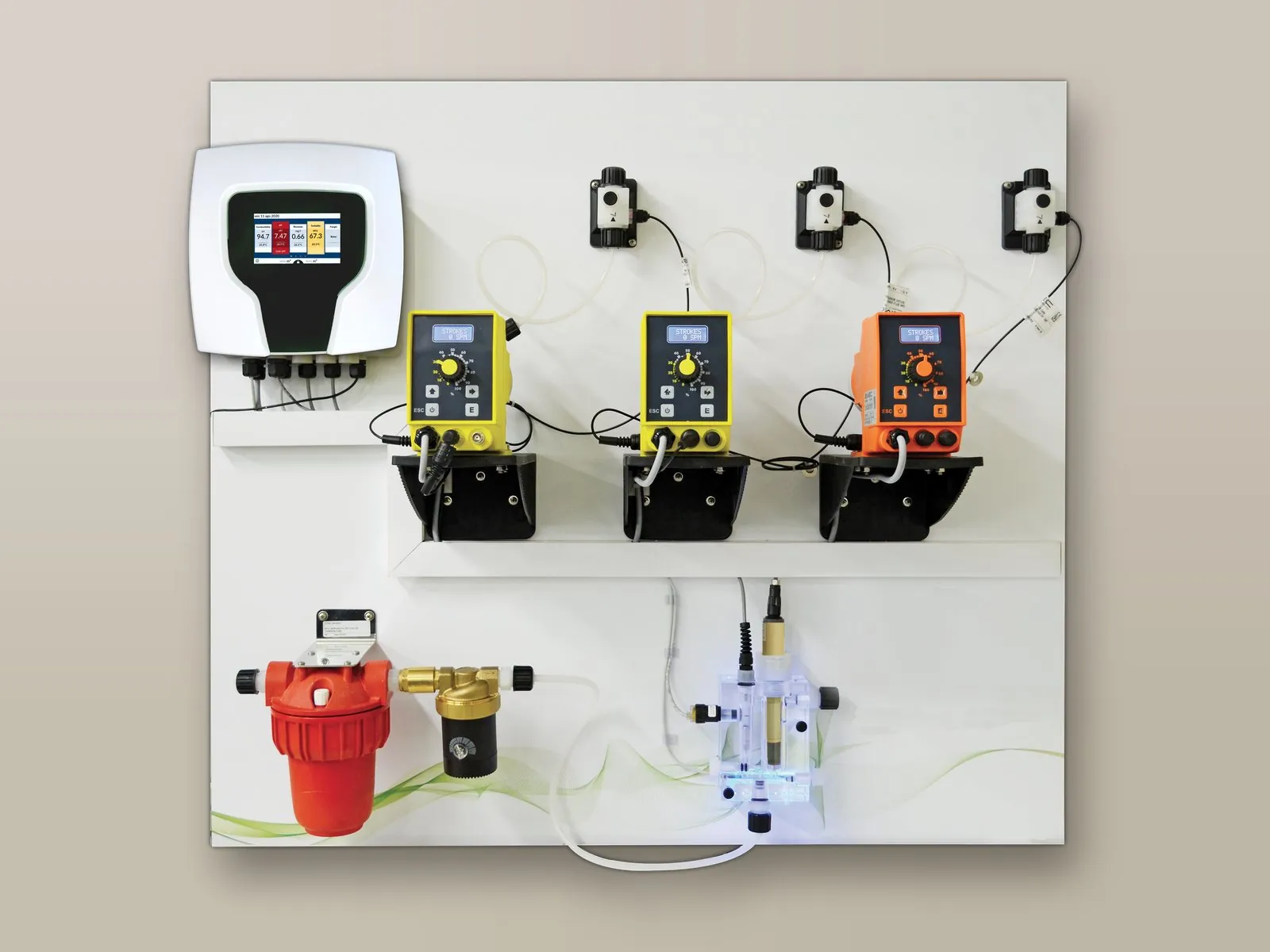
When dissolved oxygen is controlled together with pH, Redox, level, flow rate and turbidity, the Centurio PRO manages all the measurements and dosing of the plant with a single controller.
Wastewater treatment with Centurio PRO →Measuring range, resolution, fluorescence measuring principle, inputs, outputs and connections are given in the controller data sheet.
The controllers support two-way remote access (read and write) through the web portal from a PC, tablet or smartphone: measurements can be viewed, set points, dosing and alarms changed, alarms received and logs downloaded. Alternatively, they can be integrated into your PLC via Modbus.
Connection to the web portal via network cable: measurements, set points, dosing and alarms accessible from a PC, tablet or smartphone.
Wireless connection to the web portal, with the same functions as the cable connection.
Connection via the 4G network for installations without a local network, with alarm notification by SMS or e-mail.
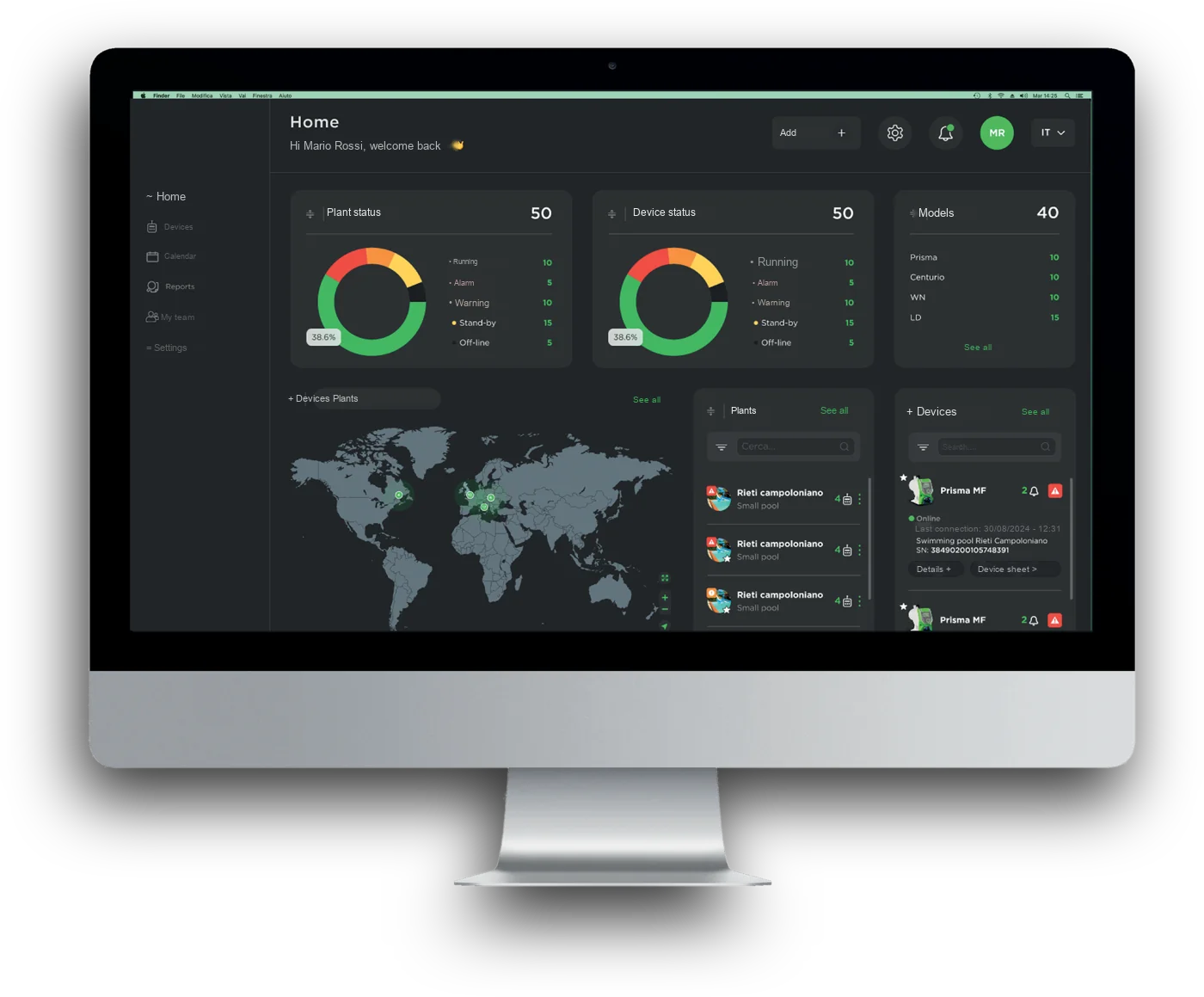 Web portalPC, tablet and smartphone
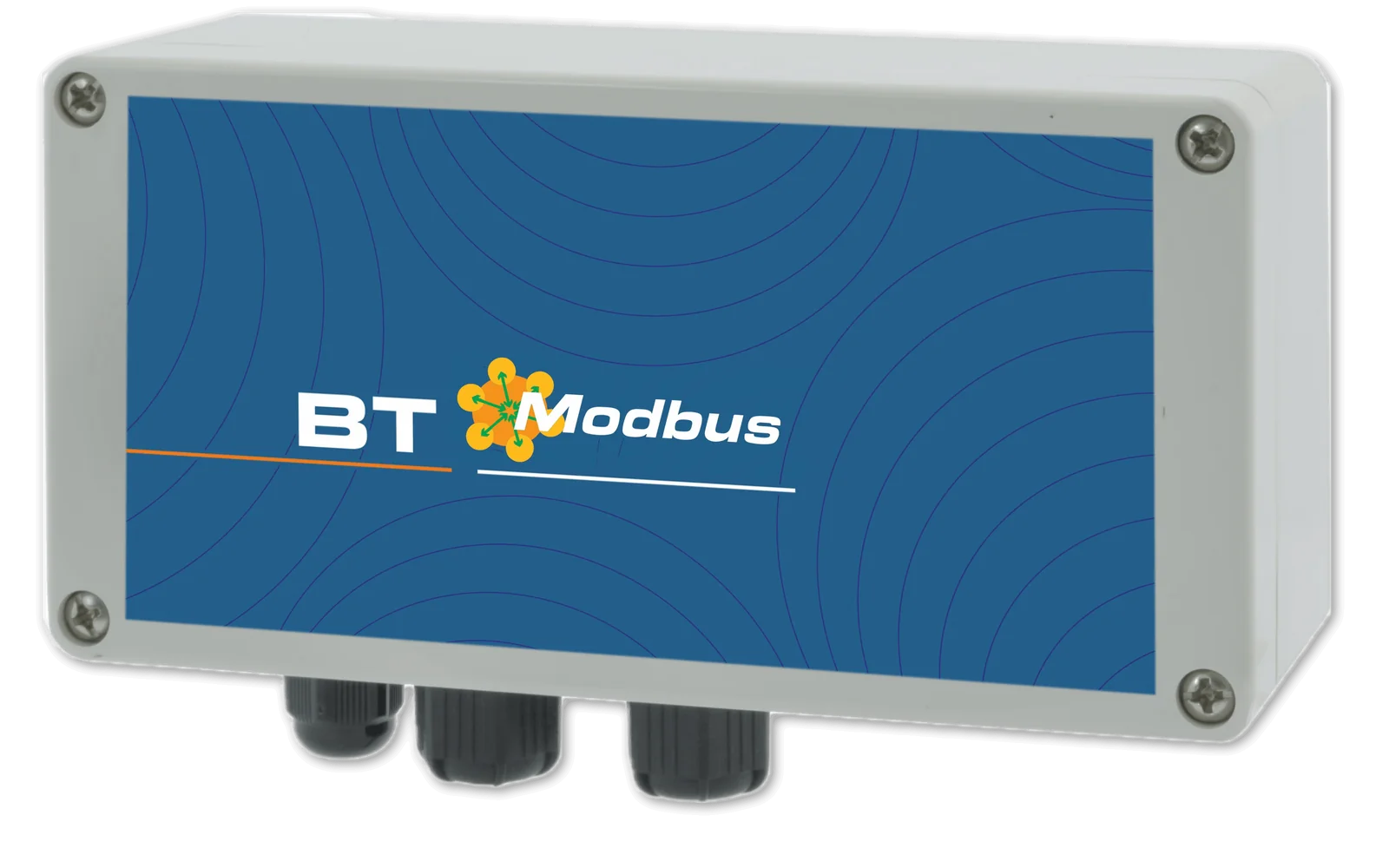
Integration into your PLC via serial port.

Current signal proportional to the measured value, for remote monitoring or for controlling pumps and other instrumentation.

Download of the logged data to a USB memory stick, for archiving and analysis with a spreadsheet.
One communication type at a time: Ethernet, Wi-Fi, 4G or Modbus RTU (built into the BASIC versions, optional on the PLUS versions). 0-4/20 mA current loop outputs standard on the PLUS versions, optional on the BASIC versions; meter input on the PLUS versions only.
A single account brings together all registered installations, each with its own devices: the web portal, free of charge and with no subscription, can be accessed from a PC, Mac, tablet or smartphone and allows every parameter to be both viewed and changed, with an encrypted connection and protected access.
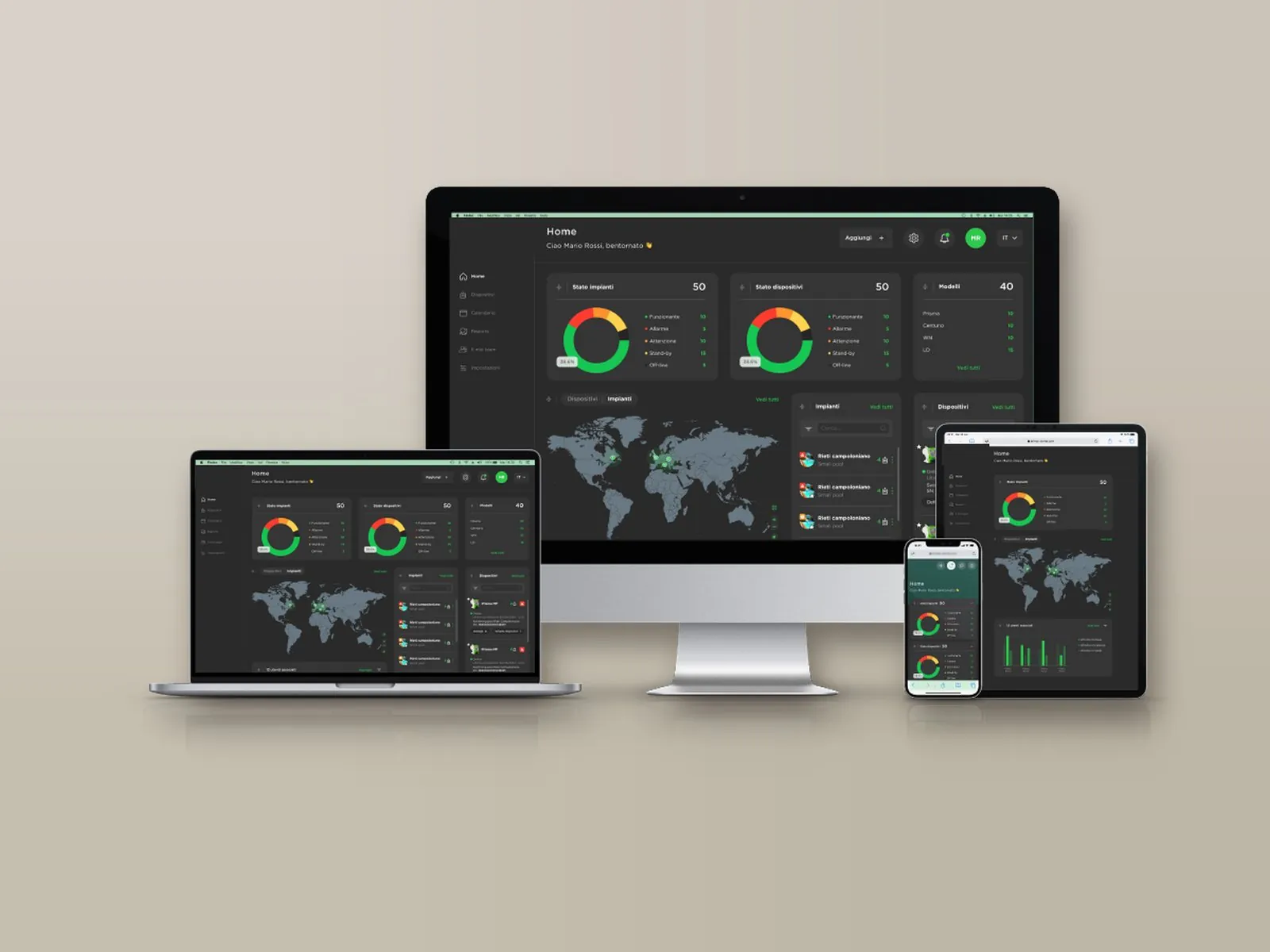
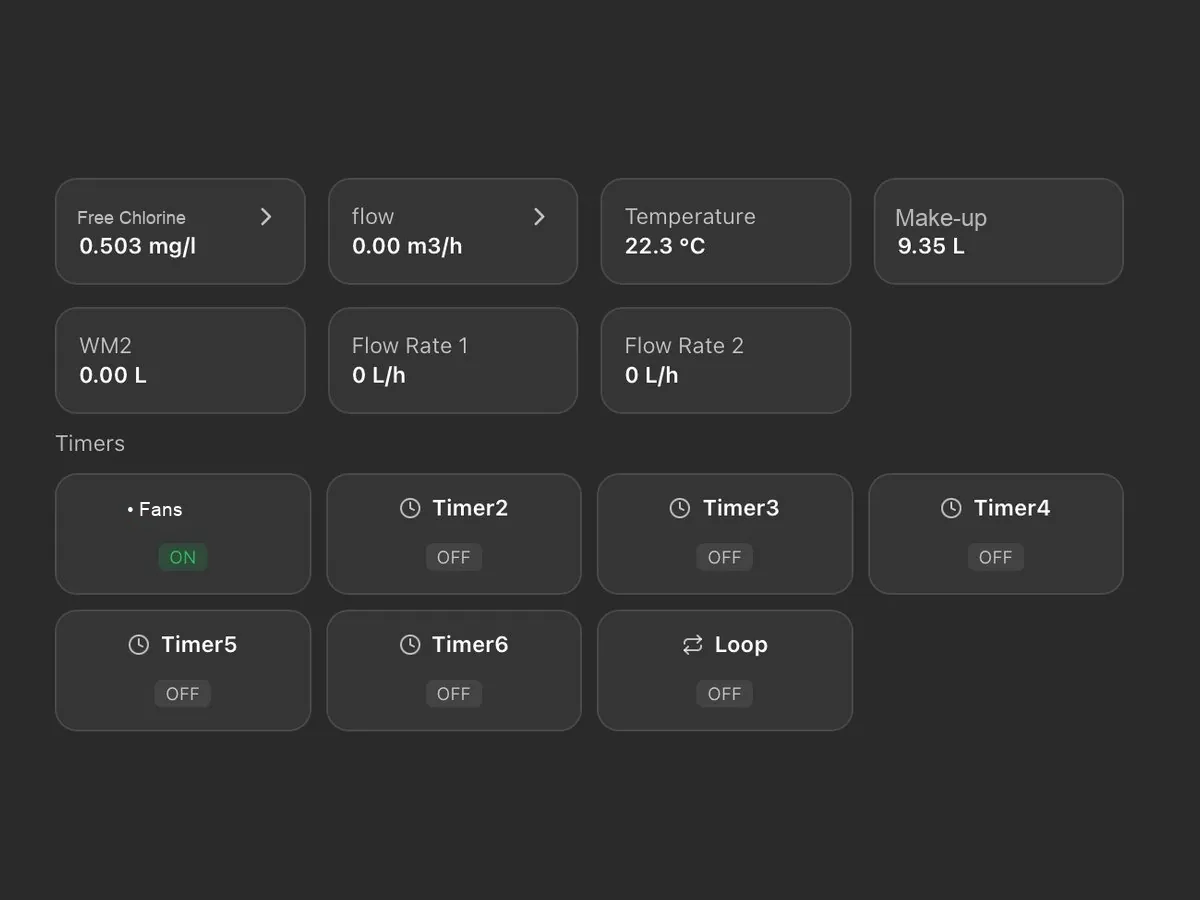
On a single screen: probe readings, chemical levels, pump activation thresholds and active alarms, with the status of installations and devices (normal, warning, alarm, standby, not connected).
Installations appear on an interactive map with their status and open with a click; for each one, the local weather conditions and temperature are also shown.
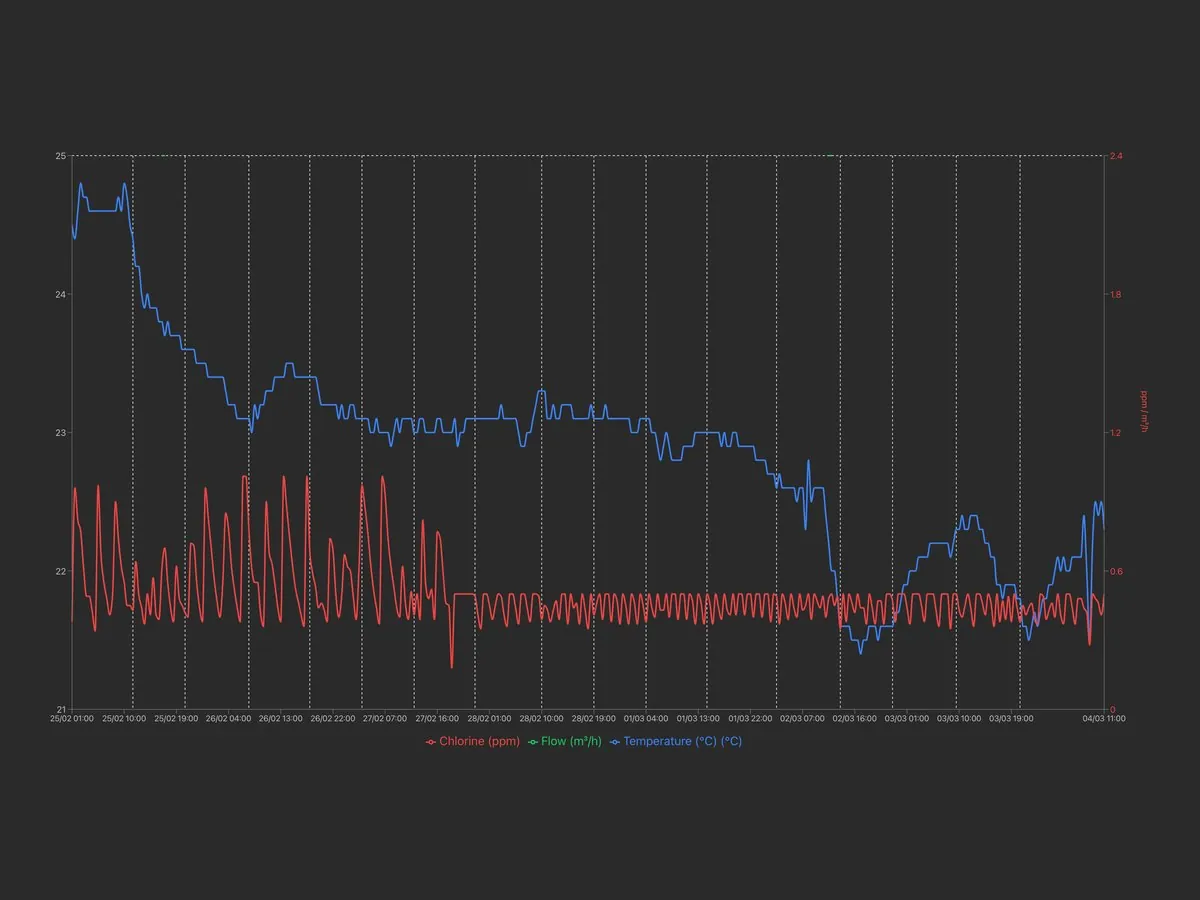
Archive of measurements and alarms, available for consultation at any time with charts and numerical reports exportable in Excel format.
Alarm thresholds for readings, dosing, faulty probe and out-of-range readings, with notification by e-mail or SMS depending on the communication system; a warning is also issued when an installation remains disconnected beyond the set time.
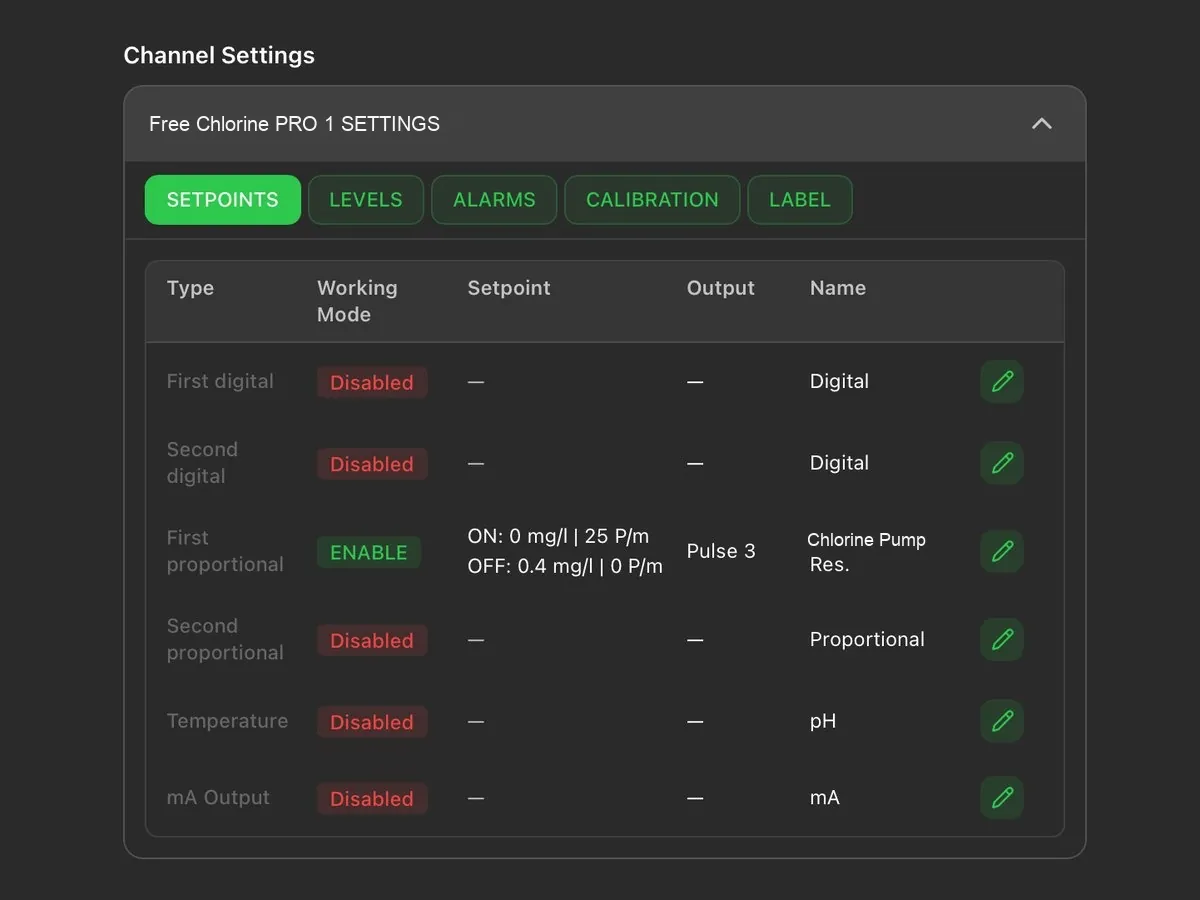
Remote modification of the set points, of the dosing pump activation thresholds and of the corresponding hourly flow rate.
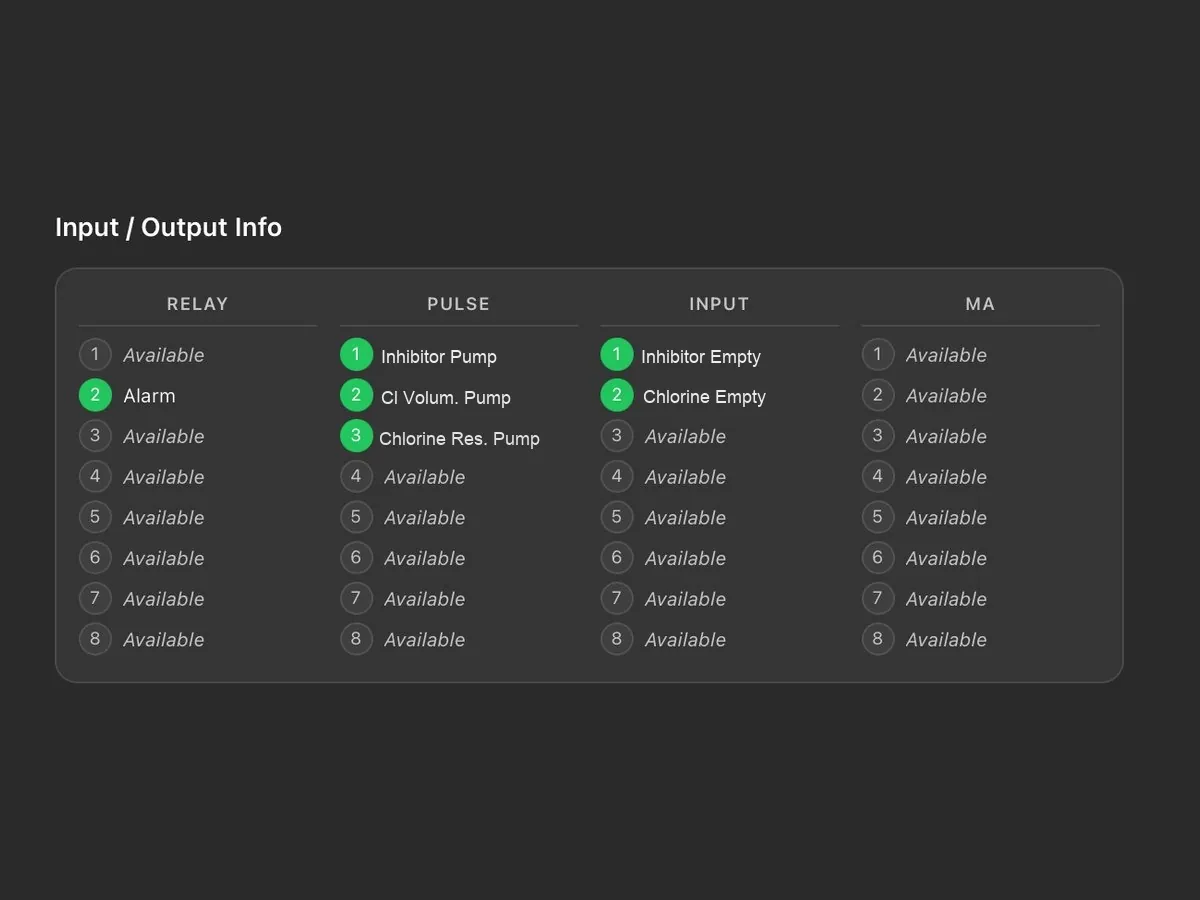
Status of relays, pulse outputs, digital inputs and current outputs, with the name assigned to each connection.
Tasks are scheduled by installation or by device and assigned to technicians; a reminder is sent by e-mail two days before the due date. Each task is shown as scheduled, due, overdue or completed.
The main account has full access and creates the technicians’ accounts, each enabled only for the assigned installations and devices; the last login and activity of each technician are visible.
Reports on devices, tasks and technicians, downloadable in PDF or CSV with the customer’s logo; the log keeps the history of operations and disconnections.
Logo, main colour and light or dark theme; the tiles on the main screen can be rearranged by dragging them. Two installations can be displayed side by side for comparison.
Each device is added through a guided procedure: the model is recognised automatically and associated with the installation, together with the technician to be contacted.
As an alternative to the portal, the Modbus RTU port allows integration into the plant supervision system.
Describe the wastewater treatment plant, the tanks and the blowers installed: we will propose controller, probe and accessories.
Call or write to us: a technician will reply with a tailored proposal of controllers, pumps, probes and accessories.